Sheriff Thomas Blackwood never finished his first sentence. Elijah Dixon drew his pistol and fired in a single fluid motion, the bullet striking the sheriff in the shoulder and spinning him around. The crowd in the public square of Big Stone Gap scattered, screaming, as the other four brothers drew their weapons and fired at anyone wearing a badge. Three deputies fell dead or dying in the chaos.
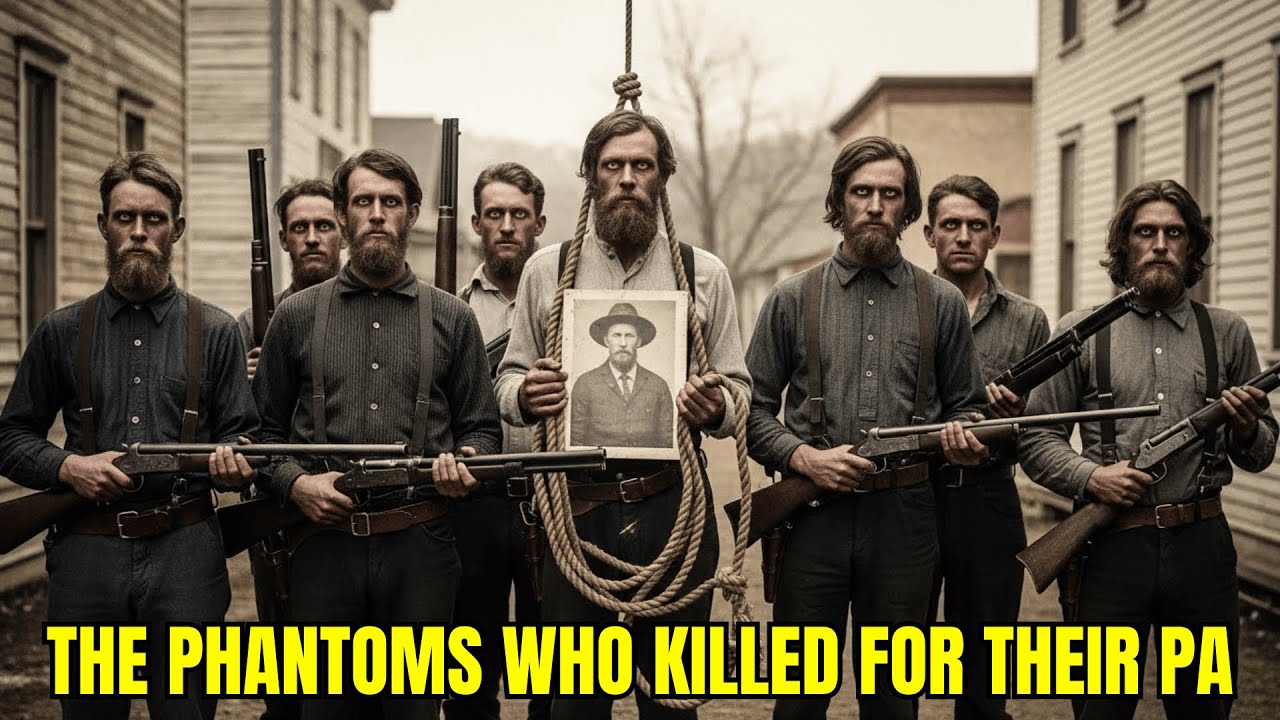
Blackwood was wounded twice more before he managed to crawl to cover behind a water trough. The brothers retreated from the town with their father’s body, fighting their way through a cordon of hastily organized resistance that formed too late and too weakly to stop them. Two more men died in the running battle that followed. By the time the smoke cleared, the Dixon brothers had vanished into the mountains with old Zeke’s corpse, and seven men lay dead or wounded in the streets of Big Stone Gap.
The vendetta had begun before the echoes of the execution had faded. To understand how five brothers came to slaughter twenty men, one must go back to the rugged mountain section of Wise County, Virginia, known simply as the back country. Rarely have these hills been without some sort of warfare or smoldering quarrel that was likely at any moment to burst into rifle fire. Hemmed in by the ancient Appalachian Mountains, the early settlers who lived along the Powell River and its countless tributaries were cut off from the outside world.
For over two hundred years, each succeeding generation remained that way. There were no telephones, roads were few, and travel was slow and tedious. The advance of civilization in the outside world had skirted this mountainous region, which had gained the reputation of being one of the most lawless and unforgiving sections in all of America. From the early period when the hardy mountaineers fought the Indians all the way until the twentieth century, the inhabitants of this area had a tendency to take the law into their own hands.
Most were farmers and hunters who lived a simple existence, surviving in log cabins by working the thin mountain soil and hunting the game that roamed freely through the forests. Schools and churches were few and far between. Most children did not attend school at all, and those who did rarely attended for more than a few months a year. In these mountains, a man’s honor was everything.
It was the currency by which he was measured, the foundation upon which his family standing rested, the legacy he would pass on to his children. A man’s word was his bond, and breaking that bond was a sin worse than murder in the eyes of the community. To be called a liar or a thief was to be cast out from decent society. To be publicly humiliated, stripped of honor before the eyes of one’s neighbors, was a wound that could never heal, and that demanded blood payment from those responsible.
The Dixon family had lived in Wise County since the late 1700s, their ancestors among the first white settlers to push through the Cumberland Gap. For four generations they had carved out a living in a hollow at the head of Guest River, a remote and beautiful place where the mountains rose steep on all sides. By 1895, the Dixon homestead encompassed over a thousand acres of mountainland, making the family one of the most substantial in the county. The patriarch was a man named Ezekiel Dixon, known to everyone simply as Old Zeke.
He was sixty-one years old, a weathered giant who had spent his entire life working the land and raising the seven children his wife Mary had given him before her death in 1882. Zeke had fought in the Civil War on the Confederate side, survived wounds that would have killed lesser men, and returned to the mountains to rebuild a life the war had nearly destroyed. His word was law within his family, and his reputation in the broader community was beyond reproach. The homestead was a testament to what a man could accomplish through honest labor.
The main cabin was a two-story structure built from logs Zeke and his father had cut from the surrounding forest, chinked with clay from the riverbank and roofed with hand-split shingles. Behind it stood a barn large enough to shelter a dozen cattle and twice that many hogs. There was a smokehouse, a springhouse, a blacksmith shop, and half a dozen other outbuildings that made the homestead virtually self-sufficient. The bottomland along the creek produced corn and vegetables; the hillsides provided pasture for cattle prized throughout the region; the forested sections yielded timber and game.
Among Zeke’s seven children were five sons who would become the instruments of a vengeance so complete and so terrible that their names would be spoken with fear for generations. The eldest was Elijah, born in 1862, a man who had inherited his father’s size and strength. Elijah stood six foot four and weighed over 240 pounds, all of it muscle earned through a lifetime of hard labor. He had his father’s dark eyes and his mother’s cold black hair, and he moved with a grace that seemed impossible for a man of his size.
Men who had seen him fight spoke of it with something approaching awe. Then came Isaac in 1864. Quieter than his brother, but equally formidable, a man who preferred to think before he acted. Isaac was the marksman of the family, able to hit targets at distances other men would consider impossible.
He could drop a running deer at three hundred yards or split a playing card edge-on at fifty feet. His patience was legendary, his concentration unbreakable once he had focused on a target. Thomas was born in 1867, the most sociable of the brothers, able to charm strangers and negotiate disputes with a skill his more taciturn siblings lacked. Beneath the charm was a calculating intelligence that missed nothing and forgot nothing.
Thomas gathered information the way other men gathered firewood, constantly and almost unconsciously. He was the eyes and ears of the family. William came in 1870, a steady and reliable man who made up for any lack of exceptional qualities with sheer determination and endurance. He worked from dawn to dusk without complaint, pushed through exhaustion and pain that would stop other men, and could be counted on absolutely to do whatever was asked of him.
His brothers called him the mule, affectionately. And Samuel, born in 1873, the youngest, completed the band of brothers. Samuel was the quickest of them, both in body and in mind. He could outrun any man in the county, climb trees and scramble over rocks with the agility of a squirrel, and squeeze through gaps that seemed too narrow for a child.
He was the best tracker of the five, able to follow a trail through terrain that revealed nothing to other eyes. Where his brothers saw only leaves and stones, Samuel saw stories written in broken twigs and displaced pebbles. The trouble that would destroy the family began with something as simple as a property line. A man named Harrison Crawford purchased land adjoining the Dixon homestead in 1893, and almost immediately disputes arose about where exactly the boundary lay.
Crawford claimed the Dixons were grazing cattle on his property and cutting timber from his land. The Dixons insisted the boundary had been established generations ago. The dispute festered for two years, growing more bitter with each passing month. Crawford was not a native of Wise County.
He was an outsider who had come to the mountains seeking opportunity in the coal industry that was transforming the region. He had made his fortune buying up mineral rights throughout southwestern Virginia, often from families who did not understand what they were selling. By 1893, Crawford controlled more coal than any other individual in the county, and his wealth had purchased political influence that extended all the way to Richmond. His business methods were ruthless and often illegal, though his political connections ensured he was never held accountable.
He had driven competitors out of business through price manipulation and outright sabotage, crushed labor organizing through violence and intimidation, and bribed judges and legislators to ensure the law would always be on his side. The Dixon family represented everything Crawford despised about the mountain communities he was exploiting. They were independent and self-sufficient, owing nothing to anyone. They controlled land Crawford wanted, land that contained coal deposits that could make him even wealthier.
And they refused to be intimidated. Old Zeke Dixon had looked Crawford in the eye and told him the land was not for sale at any price. Crawford never forgave the insult. The county sheriff in 1895 was a man named Thomas Blackwood, a Crawford ally elected with coal money and owing his position to Crawford’s political connections.
Blackwood was not particularly competent, but he was reliably corrupt. When Crawford came to him with a proposal to deal with the Dixon problem, Blackwood listened carefully and agreed to help. The first step was to manufacture a crime that could be attributed to Old Zeke Dixon. Crawford and Blackwood settled on cattle theft, a charge taken seriously in any agricultural community and carrying harsh penalties under Virginia law.
They arranged for several head of cattle bearing Crawford’s brand to be placed on Dixon property by Crawford’s own men in the dead of night. When the cattle were discovered, Blackwood had the pretext he needed to arrest the most respected man in the county. The arrest sent shock waves through Wise County. No one who knew the old man believed for a moment he was capable of stealing cattle.
But the evidence was there, and Blackwood insisted the law had to take its course. Zeke was taken to the county jail in Big Stone Gap to await trial on charges everyone knew were false. The Dixon brothers immediately began working to free their father, hiring the best lawyer in the region and gathering witnesses. They were confident that no jury of their neighbors would convict a man they all knew to be innocent.
What they did not understand was how thoroughly Crawford had corrupted the system. Thomas Blackwood and Harrison Crawford had already decided that Ezekiel Dixon would never see the inside of a courtroom. They understood that even with their influence, a conviction was not guaranteed. The evidence was thin, the community sympathy was with the accused, and the Dixon brothers were working diligently to expose the frame-up.
What Crawford needed was a permanent solution. The solution they settled on was as old as the mountains themselves: a lynching dressed up in the clothes of legal process. Blackwood convened a special session of the county court, stacked with judges who owed their positions to Crawford’s money. The verdict was already determined, and the sentence would be death by hanging, carried out immediately in the public square of Big Stone Gap before the Dixon brothers could organize any response.
The trial of Ezekiel Dixon took place on a cold November morning in 1895, conducted with such haste that the defense attorney only learned of it an hour before it began. The Dixon brothers were not notified at all. Three judges sat on the bench, all of them Crawford men. The courtroom was packed with Crawford employees and supporters brought in to create the appearance of public interest.
The prosecution called witnesses who swore they had seen Zeke near Crawford’s cattle, witnesses who were Crawford employees with obvious motives to lie. They introduced the testimony of the men who had discovered the cattle on Dixon property, men who neglected to mention that they had placed the animals there themselves the night before. The defense attorney, a young man named Jonathan Carter, did his best with an impossible situation. He pointed out the inconsistencies in the witnesses’ testimony, the lack of any motive for a man of Zeke’s means to steal a few head of cattle, the convenient timing of the discovery.
His arguments fell on deaf ears. The guilty verdict was delivered within an hour of the trial’s commencement. The sentence was death by hanging, to be carried out at noon that very day in the public square. Old Zeke received the news with dignity, standing straight and refusing to show fear before his enemies.
He asked only that word be sent to his sons. Blackwood agreed to this request, though he had no intention of honoring it. The sons would learn of their father’s death after it was too late to prevent it. The hanging was designed to be a spectacle.
A gallows had been hastily constructed in the center of the square, a crude wooden platform with a crossbeam and a rope that swayed slightly in the cold wind. They brought Old Zeke out at precisely noon, his hands bound behind his back, a guard on each side. He walked with his head high, refusing the hood that was offered. Blackwood read the sentence in a voice that cracked slightly.
Then the noose was placed around Zeke’s neck, and the trap door was released. The rope was too short, and Ezekiel Dixon did not die quickly. He strangled slowly, his body twisting and jerking for nearly fifteen minutes while the crowd watched in horrified fascination. Some turned away.
Others watched with grim satisfaction. Blackwood stood at the edge of the platform, his face pale, clearly shaken. But he did not stop it. Less than a mile away, the Dixon brothers received word of what was happening from a sympathetic townsman who had risked everything to warn them.
The messenger burst into the main cabin shouting that their father had been convicted and would be hanged within the hour. For a moment the brothers stood frozen. Then Elijah began issuing orders with a cold fury his siblings had never heard from him before. They rode for Big Stone Gap at a gallop, five brothers on five horses, pushing their mounts to the edge of collapse.
But town was over an hour away at the fastest pace, and the hanging was scheduled for noon. They knew they could not possibly arrive in time to save him. This knowledge did not slow them down. They arrived just as Zeke’s body was being cut down from the gallows, too late by perhaps twenty minutes to have made any difference.
Elijah dismounted and pulled the blanket back from the body, looking down at the face of the man who had raised them. Isaac’s face went blank, all emotion draining away as if a door had been closed somewhere inside him. Thomas wept openly, kneeling beside the body and taking his father’s still warm hand. William stood rigid with shock.
Samuel, the youngest, turned away and vomited into the dust. That night, gathered in the main cabin with their father’s body laid out on the kitchen table, the brothers made a solemn vow. Every man who had participated in their father’s murder would pay with his life. Every judge who had sat on the bench, every lawman who had arrested or guarded him, every witness who had testified falsely, every conspirator who had helped plan and execute this travesty of justice.
Before they were done, twenty men would die, and the name Dixon would become synonymous with vengeance throughout the Appalachian Mountains. The brothers did not strike randomly or impulsively. They understood that emotion-driven violence would only get them killed before they could accomplish their purpose. Instead, they spent the weeks following their father’s murder gathering intelligence and compiling a list of everyone who had participated in the conspiracy.
They buried Old Zeke beside his wife on the hill overlooking the homestead, and they transformed their grief into something cold and systematic. The list contained twenty-three names, though three of those men would die of natural causes before the brothers could reach them. At the top was Harrison Crawford himself. Next came the three judges.
Then Sheriff Thomas Blackwood, who had survived the initial attack. The remaining names included deputies, false witnesses, and Crawford employees. Each name was researched, each man’s habits and vulnerabilities documented, each killing planned with care. The brothers divided responsibilities according to their individual skills.
Elijah coordinated the overall strategy. Isaac handled killings that required precision at a distance. Thomas gathered intelligence and identified targets. William and Samuel served as scouts and messengers.
The first killing came three weeks after the hanging, on a moonless December night when Judge Ambrose Carrington was walking home from a Christmas gathering. Carrington had been the presiding judge, the one who had pronounced the death sentence with obvious satisfaction. His body was found the next morning at the edge of the road, shot once through the heart, a note pinned to his chest reading, “Justice for Ezekiel Dixon, one of many. ”
The killing electrified the county and sent the surviving conspirators into a panic.
Crawford hired additional guards. The remaining two judges fled to Richmond. Blackwood barricaded himself in the jail. The second judge died two weeks later, shot through the window of the Richmond Hotel.
The third judge was killed in his own home despite the guards surrounding it, his throat cut while he slept. The notes left with each body continued the count: two of many, then three. The terror spread beyond the immediate targets. Servants quit their positions.
Deputies resigned their commissions. Even Crawford’s mine workers grew restless. Sheriff Blackwood was the fourth victim, killed in his own jail three months after the hanging he had orchestrated. The brothers waited patiently for Blackwood to emerge from his fortifications.
When it became clear he would not, they found another way. A prisoner being held for minor offenses was convinced to create a distraction that drew the guards away. In the confusion, Elijah slipped into the jail through an unsecured window and found Blackwood hiding in a supply closet. When the brief conversation ended, Blackwood was dead with a bullet in his brain.
The spring of 1896 saw the killings continue at an accelerating pace. Deputies who had participated in Old Zeke’s arrest were hunted down. False witnesses were found dead in their homes, in their barns, on the roads they traveled. Crawford’s most trusted employees, the men who had planted the stolen cattle, were eliminated one by one.
By May, twelve men were dead, and the vendetta showed no signs of slowing. The state of Virginia responded by deploying a company of militia to Wise County, over a hundred armed men tasked with restoring order. They established checkpoints, searched every building, offered a reward of five thousand dollars for information leading to the brothers’ arrest. But they found themselves operating in hostile territory.
Information flowed to the brothers while the militia stumbled blind. The terrain was a maze of ridges and hollows that had confounded armies since before the revolution. Every advantage belonged to those who knew the land, and the Dixon brothers knew it better than anyone alive. Most of the soldiers were city boys from Richmond and Norfolk who had never spent a night in the wilderness.
They got lost on trails locals navigated without thinking. They made noise that announced their presence for miles. Within a month, a third of the company was unfit for duty. The local population refused to cooperate with the soldiers, seeing them as representatives of the same distant authority that had murdered an innocent man on fabricated charges.
The conspiracy of silence was virtually complete. The militia’s presence did slow the pace of killings, but it did not stop them. Two more men died in June. The militia commander requested reinforcements and was denied.
Harrison Crawford became increasingly desperate. He had hired the best private guards money could buy, fortified his mansion, and taken to sleeping in a different room each night. In July, he made a decision that would prove catastrophic. He would not wait to be hunted.
He gathered a force of fifty men, including militia soldiers whose commanders had been bribed to look the other way, and led them personally into the mountains toward the Dixon hollow. What Crawford did not understand was that the brothers had anticipated exactly this kind of attack and had prepared for it for months. They had established observation posts throughout the surrounding mountains and prepared fighting positions that exploited every advantage the terrain could offer. The first sign of Crawford’s approach came from a lookout positioned on a ridge three miles from the homestead.
Within an hour, every member of the family who could hold a rifle was in position. Crawford’s force entered the hollow from the south, moving in a column that stretched for nearly a quarter mile. The brothers held their fire, waiting until the maximum number of enemies were within the kill zone. The signal to open fire was given by Elijah, who watched from a position overlooking the center of the kill zone.
When he saw that the majority of Crawford’s force was within the prepared area, he raised his rifle and fired a single shot at the lead horseman. That shot was followed immediately by a volley from every Dixon position. Men fell from their horses, stumbled and collapsed on the trail, scrambled for cover that did not exist. Some tried to charge up the hillsides and were cut down before they had climbed ten feet.
Others tried to retreat and found the trail blocked by Samuel and William, who had circled behind the column during the night. There was nowhere to run. The battle of Dixon Hollow lasted less than two hours and resulted in the complete destruction of Crawford’s force. Of the fifty men who entered the hollow, fewer than fifteen emerged alive.
Crawford himself was among the dead, killed by a bullet that struck him between the eyes as he tried to rally his disintegrating force. His body was found after the battle, stripped of its fine clothes and valuables, a note pinned to his bare chest marking him as the fifteenth victim of the vendetta. The destruction of Crawford’s force created a brief window of opportunity. The militia units were withdrawn in disgrace, their commanders facing courts-martial for involvement in the unauthorized attack.
The remaining men on the list found themselves suddenly without protection. The killings resumed in August and continued through the fall. Some targets were killed from a distance, Isaac demonstrating his legendary marksmanship. Others were approached directly and given a moment to understand why they were about to die.
A few were taken alive and questioned before being executed. The network of support that sustained the brothers extended far beyond Wise County. Mountain families throughout southwestern Virginia and eastern Kentucky had heard the story of Old Zeke, and many had experienced similar injustices at the hands of coal operators. They provided shelter and food, information and warnings.
The sixteenth victim was a man named James Morrison, a jailer present during Old Zeke’s imprisonment. He had fled to Tennessee after the hanging, taking a new name and starting a new life. Thomas Dixon spent weeks tracking him. He died in his bed in a boarding house in Knoxville, his throat cut.
The seventeenth was killed in Kentucky, the eighteenth in North Carolina, the nineteenth back in Virginia. The twentieth and final killing came in February 1897, more than a year after the hanging. The target was a man named Robert Blackwood, the sheriff’s brother, who had helped organize the posse that arrested Zeke and who had been present at the hanging itself. He had believed himself forgotten.
He died in his own barn, shot through the heart from a distance of less than ten feet. The note left with his body completed the count: “Justice for Ezekiel Dixon. 20 of 20. It is finished.
”
The vendetta had been fulfilled. The brothers had spent fourteen months hunting their enemies across five states, had killed twenty men in revenge for one. And when it was over, they simply stopped. The years that followed were surprisingly peaceful.
The state of Virginia, embarrassed by its failure to capture the brothers and reluctant to admit how thoroughly its institutions had been corrupted, quietly dropped all charges in 1899. The official explanation cited lack of evidence. In the mountains, the decision was welcomed as a belated acknowledgement that the Dixons had been in the right all along. The brothers returned to the homestead and began the slow work of rebuilding.
The fields were plowed and planted again. The livestock was rounded up. The community received them back with respect bordering on reverence. Elijah married late at the age of forty-two and fathered three children.
Isaac never married. Thomas was elected to the county board of supervisors in 1910. William and Samuel raised families of their own. The homestead remained in family hands through the twentieth century.
The story of the Dixon brothers passed into legend almost immediately. Songs were written about them, ballads that celebrated their loyalty to their father and mourned the blood that had been spilled. The most famous, known as “The Dixon Boys,” was composed in 1898 by a blind musician named William Stone, who had known the family personally. It has been recorded by dozens of artists over the past century and remains a standard in the Appalachian folk repertoire.
The graves of the Dixon family lie together in a small cemetery overlooking the hollow. Old Zeke rests there beside his wife Mary, and one by one his sons came to join them. Elijah died in 1932, Isaac in 1929, Thomas in 1941, William in 1937, and Samuel, the youngest, in 1945. Their headstones bear only names and dates.
The hollow where the homestead once stood remains in family hands to this day, though the original cabin has long since collapsed into ruin. The foundation stones are still visible if you know where to look, and the spring still flows cold and clear. The site of the battle of Dixon Hollow is overgrown now, but spent cartridge cases still turn up occasionally. Stone walls the Dixons built as fighting positions still stand in places.
The mountains remain ancient and patient and indifferent to human drama. The creeks still flow cold and clear. The trees still change color each autumn. Those who live there still tell stories about the Dixon brothers, about what happens when men push other men too far.
The mountains remember, and through them so do we all.
