In the winter of 1891, the Ozark Mountains endured a cold more brutal than any in living memory. The frost seeped through the walls of the isolated homesteads scattered across Taney County, Missouri, forcing families to huddle by their hearths. But for those who lived near the Langley cabin on Cutters Ridge, the silence was not born of cold alone. The property belonged to Josiah Langley, a 72-year-old widower and descendant of one of the region’s earliest settler families.
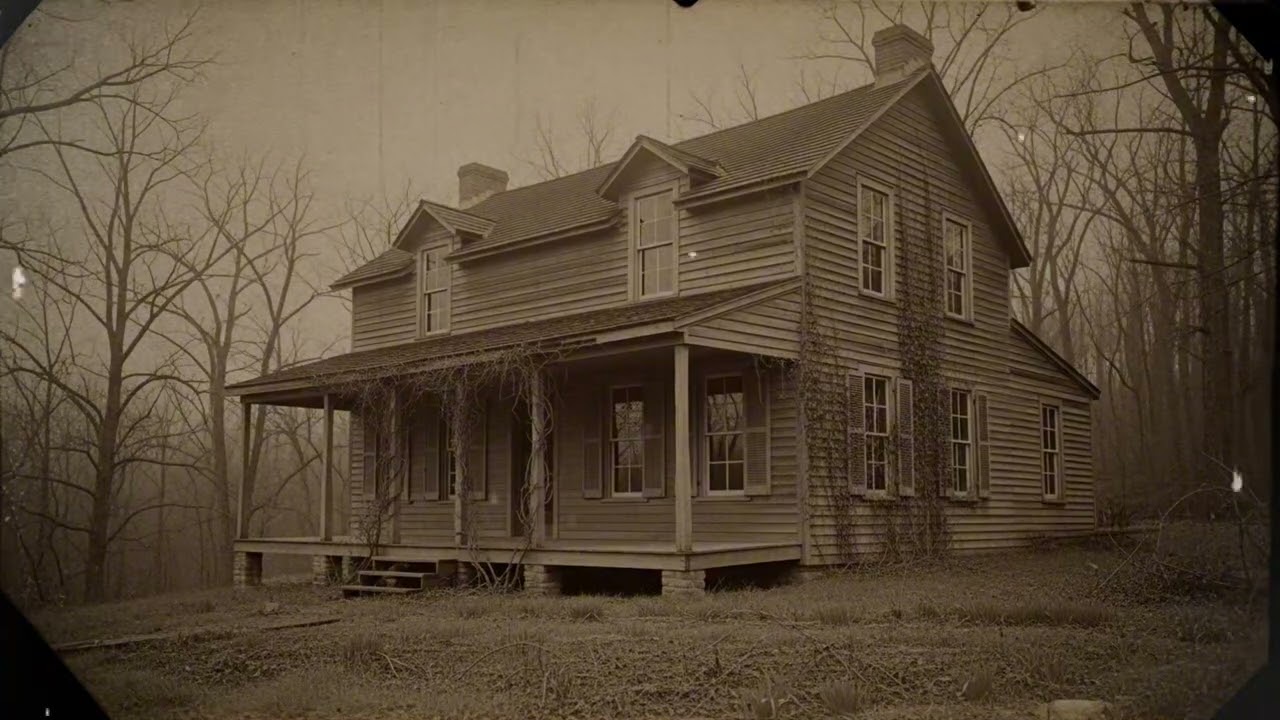
The cabin itself was an imposing structure for the area, built in 1857 by Josiah’s father, Montgomery Langley, during the prosperous years before the war. It featured a wide front porch supported by hand-carved oak columns, high windows shuttered with heavy wood, and a rear yard that had once been a lush garden. By the winter of 1891, however, the land lay overgrown with briers, and wild vines climbed the weathered walls, casting shadows that seemed to move at dusk. County records and interviews conducted decades later by historian Jeremiah Porter revealed that the cabin had acquired a strange reputation even before Josiah’s disappearance.
Winifred Haskell, a midwife who worked for families throughout the county, recalled that something always felt wrong about the place. Even when Josiah’s wife, Constance, was alive, the linens Haskell handled smelled not of common soil but of damp earth and dried herbs, even after washing. Langley always paid her at the door and never allowed her past the threshold. The official record was straightforward.
Josiah had lived alone since Constance’s death in 1877. Without heirs, he devoted himself to managing the property his father left him, rarely appearing in town except for Sunday services at the Cutters Ridge church. He always wore black, always sat in the same pew, always alone. The details of Constance’s death, though superficially well documented, contained troubling inconsistencies.
The official death certificate signed by Dr. Abraham Finch on January 12, 1877, listed heart failure from a winter fever. But a more detailed medical report found in the old archives of the Springfield Medical Society described symptoms that did not match a simple fever. The patient suffered violent agitation alternating with deep lethargy.
She reported disturbing visions and insisted something inside the walls was watching her. Her pupils remained dilated even in strong light, her skin unusually pale. Most alarming, she sometimes spoke during her delirium in a language unknown to the doctor. On February 14, 1891, Josiah Langley did not appear at Sunday service.
At first, no one paid much attention. But when his absence stretched to three consecutive Sundays, the pastor, Reverend Silas Holloway, sent his attendant, Ephraim Ketch, to check on the old widower. According to the sheriff’s report filed on March 4, 1891, and deposited in the Taney County courthouse, Ketch knocked on the cabin door for several minutes without receiving an answer. Finding the door unlatched, he entered, calling Josiah’s name.
The interior was clean and orderly, as if prepared for visitors. On a side table in the sitting room stood a half-empty cup of tea, long since cold. There was no sign of violence, no sign of Josiah. One detail in the report stood out as peculiar.
Upon entering, Ketch noticed that all the clocks in the house had stopped at exactly 3:17, including the mantle clock in the sitting room, the pocket watch on the study desk, and even the small bedside clock in the master bedroom. Ketch told the sheriff that this detail caused him considerable unease, though he could not explain why. Ketch searched every room without finding the owner. In the cellar, however, he noticed something unusual.
There was an old, dark wooden chest, of the type used for storing clothing or keepsakes, standing open. This was odd, given that Josiah was known for carefully closing and securing all his belongings. Inside the chest, Ketch found only a black-bound book that appeared to be a diary. As he flipped through its pages, he noted the neat, precise handwriting that was unmistakably Josiah’s.
But in the final written pages, the script had become increasingly shaky, almost illegible, as if written by someone under severe strain or fear. The cellar itself deserved closer description, as its unusual design later became a point of interest for researchers. Unlike the simple earthen-floored storage spaces typical of frontier homes, the Langley cabin’s cellar was built with great care. The floor was of cut stone, and the walls were lined with a type of mortar containing unusual components that made it exceptionally resistant to moisture.
Light came through small barred windows arranged to provide adequate illumination even on cloudy days. More striking was the division of space. Though the cabin occupied a large footprint, the usable cellar took up only about half of that area. The other half was packed earth.
The wall dividing the two sections did not align with any wall of the upper house, creating an asymmetrical design that puzzled architects who studied it later. Most curious of all was a small door of dark wood, nearly invisible, set into the dividing wall. Josiah had always kept it closed. The sheriff, Zachariah McIntosh, was not known for his enthusiasm for investigation.
At age 61, he held his position more through political connections than professional competence. He had been appointed sheriff in 1882 after supporting the winning faction in a local electoral dispute. His record in solving cases was mediocre. The official inquiry into Josiah’s disappearance was superficial and brief.
After three days of searching the property and surrounding area without finding any trace of the old man, Sheriff McIntosh concluded that Josiah had probably traveled to visit relatives in Springfield without telling anyone. The case was closed, and the cabin on Cutters Ridge was shut up pending the owner’s return. The investigation reports, though brief, noted a telling detail. All of Josiah’s clothing and personal effects were found intact in the closets.
His strongbox contained every item on the inventory of his personal possessions, including a silver pocket watch and a set of ivory cufflinks, gifts from his late wife that he was known to treasure greatly. His wallet, containing a considerable sum of money, remained untouched in his desk drawer. If the widower had traveled of his own accord, he had left without taking any of his belongings or resources. The diary that Ephraim Ketch found was never included in the official proceedings.
Sheriff McIntosh claimed he returned it to the pastor’s attendant, who in turn insisted he had never received it. For decades, the document’s whereabouts remained unknown until 1964, when a carpenter named Wesley Gaines, during renovations to an old parish house in Cutters Ridge, discovered a wooden box built into a false wall. Inside the box, wrapped in a piece of black silk, was Josiah’s diary. Gaines initially kept the discovery secret, being superstitious and fearing the object was connected to some unfamiliar religious practice.
Three months later, when he overheard a passing conversation about the old mystery of the widower’s disappearance, he revealed his discovery to his employer, the architect Harlan Morris, who notified church authorities. The diary eventually reached Reverend Thaddeus Crawford, who, after reading its contents, decided to transfer it to the history department of the University of Missouri. For reasons never officially explained, however, the diary was filed in the library’s restricted documents section, where it remained out of public reach for another five years. In 1969, Professor Montgomery Wells, researching the social history of the Ozarks in the late nineteenth century, obtained permission to examine the document.
What he found in the yellowed pages disturbed him deeply, leading him to abandon his original research and devote himself exclusively to studying the case. Wells was not merely a competent historian but also a meticulous researcher with secondary training in psychology. Born in 1921 in Joplin, he had served briefly in the army during World War II before dedicating himself to academic life. He specialized in oral history and the analysis of personal documents such as letters and diaries to reconstruct the social and psychological dimensions of historical periods.
The diary’s first entries dated from January 1877, shortly after Constance’s death. They were ordinary notes about a widower’s daily life, lists of household tasks, expense records, and scattered reflections on loneliness and loss. The handwriting was clear and organized. One entry from March 1877 offered a glimpse into Josiah’s routine and state of mind.
He recorded a visit from his lawyer regarding estate matters, noted that the cabin, lands in Shannon County, and shares in the lumber company provided enough to live comfortably, but confessed that he would trade all that material security for a few more years with his wife. The nights were very difficult, he wrote. The house seemed larger and emptier. Sometimes he woke thinking he heard her voice calling him from the study, as she had done when she worked late into the night.
Over the following months, the entries followed a similar pattern, documenting Josiah’s gradual adaptation to his new reality as a widower. One recurring theme was his reluctance to alter any aspect of the house or dispose of his wife’s possessions, as if maintaining the physical environment kept her presence alive. An odd entry from August 1877 mentioned the cellar for the first time. Josiah wrote that he had needed to go down to the cellar to fetch some jam for a dinner with Judge Preston.
He had not entered it since Constance’s death. She had always insisted on being the only one responsible for managing that storage space. Strangely, he found the small door at the back slightly ajar, though he was certain it should have been closed. The key, which Constance had always carried with her, was in the lock.
He did not dare look beyond it. He had never entered that place. Constance said it was just storage for old family things, worthless items she could not bring herself to discard. He closed the door, took the key, and kept it with him.
By November 1890, the writing style began to change. Josiah started recording strange sensations, nighttime sounds he could not identify, a persistent feeling of being watched, and objects that seemed to move when he was not looking. One entry from November 16 described a sound like nails scraping wood coming from the walls. He had asked his hired man, Jeremy Talbot, to check for possible rats, but Talbot found no trace of them.
Perhaps it was just the old house settling, as he had suggested. But why always at midnight? Jeremy Talbot had worked for Josiah three days a week. According to county employment records, he left the Langley cabin in December 1890, claiming he had found a better job on a farm at the edge of the county.
When Professor Wells located a relative of Talbot’s, Augusta Talbot, in 1969, she told a different story. Jeremy never spoke about that cabin or the old man. When asked why he left a steady job in the county to work so far away, he would only answer that there were things money could not compensate for. On the night before his departure, she heard him tell his wife that the walls of that cabin had eyes and ears.
She never understood what he meant. Augusta also revealed a disturbing detail not found in any official record. Her father, who had been healthy and physically strong, began to wither shortly after leaving Josiah’s employment. She described it as if something was consuming him from within.
He lost weight, lost his appetite, and suffered at night from nightmares so severe he screamed until his voice gave out. Before his death, only six months after leaving the cabin, he raved about something dwelling between the walls, repeating: I should not have looked. I should not have opened that door. Josiah’s diary entries grew more alarming through December.
He mentioned seeing a dark figure standing at the foot of his bed at night, vanishing when he lit the oil lamp. He heard whispering voices that seemed to come from inside the walls, speaking words he did not understand but which seemed directed at him. On January 2, 1891, he wrote that he had found that photograph again at the bottom of the wardrobe drawer, though he was certain he had burned it three days earlier. How could this be?
The photograph looked different now. Her eyes seemed to follow him around the room. Tomorrow he would burn it again, and this time scatter the ashes in the garden. The photograph was never recovered, and the diary did not identify its subject.
Because Josiah referred to the person in the photograph using feminine capitalization, Professor Wells initially assumed it was his late wife. Later entries cast doubt on this interpretation. On January 5, Josiah wrote that he had not slept. The voices in the walls continued, louder and more insistent now.
They no longer sounded like scratches but rhythmic knocks, as if someone or something was trying to communicate in code. He decided to inspect the cellar the next day, that small door at the back which had remained closed all these years. The key was still with him, kept in the jewelry box since that day in 1877. Constance had made him promise never to open it, but she was no longer there to protect him from whatever might be on the other side.
On January 6, the entry was short and troubling. He had gone down to the cellar. The key was not in the jewelry box, though he was certain he had left it there the night before. He found it in the lock of the small door, as if someone had placed it there.
The door was slightly ajar. The smell from inside, he could not describe it precisely. A mixture of damp earth, mold, and something else. Something metallic, like the smell of old blood or oxidized iron.
He lacked the courage to open the door fully or enter. He closed it again and took the key with him. He would sleep with it under his pillow. On January 15, Josiah described a recurring dream.
For the third night in a row, he stood before that door in the cellar, the door he always kept closed. In the dream, he knew he should not open it, but his hands moved against his will. When the door opened, he saw only darkness and felt an icy cold emanating from within. Then, from the depths of that darkness, he heard that voice.
Not Constance. The other one, the one who had promised to return. The voice said: I am keeping my promise. Then he woke, always at 3:17 in the morning, with a feeling that someone was sitting on the edge of his bed.
The reference to the other voice and the promise of return was particularly interesting because there was no earlier mention in the diary of such a promise or to whom it might have been made. Professor Wells devoted considerable time to trying to discover whether there was a secret door or hidden chamber in the Langley cabin’s cellar. But when he finally obtained permission to inspect the property in May 1969, he discovered the cellar had been completely filled with concrete during a renovation in 1926, when a family of merchants from St. Louis briefly occupied the cabin.
That family, the Petersons, remained on the property for only seven months, a remarkably short period given the significant investment they made in renovating the cabin. Albert Peterson, the head of the family, was a successful dry goods trader. In 1926, at age 54, he decided to acquire a residence that reflected his social standing. The old Langley cabin, which had sat closed for years, presented an opportunity.
Records show Peterson contracted the architect William Harden to oversee a comprehensive renovation, including electrical fixtures and indoor plumbing. An interesting detail appeared in the architect’s notes preserved in the county archives. The client insisted on filling in the entire cellar after an incident with the workers. Harden suggested keeping at least part of it for storage given the favorable climate, but Peterson was adamant.
I want that place sealed forever. Those were his exact words. The incident was not detailed in the official notes, but Professor Wells obtained some information from Harden’s assistant. According to this assistant, two workers clearing debris from the cellar discovered a small door set into the back wall.
Out of curiosity, they broke the lock and found a narrow chamber no larger than a wardrobe. What exactly they saw inside was never fully clarified, but both men left the job that same day and refused to return even when offered double wages. One of them reportedly moved out of the county the following week. As January neared its end, the diary entries became more sporadic and fragmented.
On January 27, there was a particularly troubling entry. Josiah could no longer sleep. When he closed his eyes, he felt her presence in the room. The walls were damp now, though it had not rained.
The moisture formed patterns resembling faces watching him. The smell, the same smell of damp earth and something else, something he knew but could not name. He should have burned all those things while he had the chance. Now it was too late.
Constance had known. She had tried to warn him. On January 29, Josiah described someone or something moving through the house at night. He heard footsteps above his room, in the attic that had remained closed for years.
The creaking of floorboards was unmistakable. The previous night, he had gathered his courage to go up and check. The attic door was closed as usual, the key kept in his desk drawer. But when he put his ear to the wood, he clearly heard breathing from the other side, heavy and irregular.
Most alarming, when he moved away, the breathing stopped suddenly, as if whatever was there knew he was listening. He returned to his room and closed the door. In the early hours, he woke to the sound of scratching at his door. Not like an animal trying to get in, but something deliberate.
Three slow scratches followed by three faster ones, then silence. The pattern repeated. He remained motionless in bed, unable to check. The scratching lasted about an hour, then stopped.
In the morning, he examined the door. There were no visible marks on the wood. On January 31, Josiah alluded vaguely to a past event. He had thought much about that night, the last night Constance seemed fully lucid before the disease consumed her entirely.
She had called him to the study late at night, handed him the key to that door in the cellar, and made him swear never to open it. She said: What we did was wrong, Josiah. I should never have brought that into our home. I should never have made that agreement.
He had never known what agreement she meant. Constance always managed her own affairs independently. But he remembered that she changed in 1874, after returning from a trip to Kentucky. She became more withdrawn, spending long hours alone in the cellar.
He sometimes heard her talking down there, though he never saw anyone enter or leave. After that trip, the storage room at the back of the cellar was built, officially for keeping important documents. Now he wondered what was really kept there. The last regular entry was dated February 9, 1891.
Josiah had found tracks on the cellar floor as if something heavy had been dragged toward that door. He had not gone in there. He could not. But he knew he would eventually have to face it.
The voices were louder now, almost clear enough to understand what they were saying. He thought they were calling his name, or perhaps it was just the sound of the wind. He would go to church tomorrow to speak with Pastor Holloway. Maybe he could help.
There is no record that Josiah actually sought out Reverend Holloway. According to the parish visitor register, his last confession was on January 26, 1891. However, an interesting document exists in the pastor’s personal archives: a handwritten letter on fine paper, signed by Josiah and dated February 10, 1891. In the letter, Josiah apologized for missing their scheduled meeting.
Urgent circumstances required his presence at home. The matter he had intended to consult about had become more pressing than he imagined. He asked for prayers, for he feared he was facing something beyond his understanding, perhaps even beyond the church’s doctrine itself. If they did not meet again in this world, he wanted the pastor to know he departed with peace in his conscience, if not necessarily at peace with what dwelled between those walls.
The pastor never mentioned this letter publicly. It was discovered only after his death in 1925 among his personal papers. After February 9, nearly a month passed without entries. Then, on March 10, four days before his absence was first noticed, a final entry appeared.
The handwriting was nearly indistinguishable, trembling and rushed, as if written by someone on the verge of collapse. She is here, in the house, with me. She is not Constance. She never was.
The cellar door is open now. I did not open it. The sounds she makes moving between the walls. I can no longer stay, but where can I go when she is everywhere?
The photographs, all of them, even the ones I burned, have returned. The faces in the photographs have changed. They all have her eyes now. I must end this.
There is only one way. This was the last clearly readable entry. In the final pages, there were only incoherent scribbles and what appeared to be frustrated attempts to draw something, perhaps a face or a symbol. On the last page, one sentence was written with striking clarity and steadiness.
The handwriting was so different from the preceding text that it raised questions about whether it was written by the same hand. Finally, I understand what she wanted from the beginning. Professor Montgomery Wells spent the following years trying to establish a clearer chronology of events and determine what actually happened to Josiah Langley. In his research notebooks, found after his death in 1975, he proposed several hypotheses, ranging from supernatural explanations, which he himself rejected as products of a lonely old man’s imagination, to more realistic possibilities: an intruder who tormented the widower, a distant relative interested in his inheritance, or even a case of gradual mental deterioration culminating in flight or suicide.
One aspect that particularly interested Wells was the synchronization between the repeated time in Josiah’s dreams, 3:17, and the fact that all the clocks in the house were found stopped at the same time. This suggested that something significant had happened at that exact moment, perhaps on the night before his disappearance. Another troubling element Wells highlighted was the final sentence of the diary. The way that last entry was written, so different from the rest, raised questions about its authenticity.
Was it possible someone else had written that line? And if so, who? What did that understanding mean? One of the most interesting aspects Wells uncovered during his investigation was Constance Langley’s death records.
According to the official document, she died of natural causes on January 12, 1877. However, examining the archives of the old Springfield Medical Society, Wells found a medical report providing additional details. Constance suffered from a mysterious illness causing severe hallucinations in the weeks before her death. The attending physician, Dr.
Abraham Finch, noted that the patient spoke often about something living inside the walls and insisted she had made an agreement that could not be fulfilled. The medical report, dated January 10, 1877, contained additional observations Wells considered particularly relevant. The patient alternated between periods of mental clarity and fits of severe agitation. During her lucid moments, she expressed a logical and persistent fear regarding an agreement she had made during her trip to Kentucky in 1874.
Though reluctant to provide specific details, she mentioned acquiring an artifact from a merchant in Louisville, which she now kept in a special chamber in her home. More troubling was her insistence that this object was not inanimate. Mrs. Langley, an educated woman of respected social standing, did not appear superstitious.
Yet she described with disturbing conviction that the object had changed after being brought into her home and was now communicating with her through the walls. When questioned about the nature of these communications, the patient became severely agitated and refused to provide details. In the last 48 hours, her condition had deteriorated markedly. She suffered from permanently dilated pupils even in strong light, an abnormally low body temperature, and a strange odor emanating from her skin that did not correspond to any condition known to the physician.
There were also unexplained marks on her forearms and neck, resembling bruises but with a regular pattern suggesting deliberate friction rather than accidental injury. The doctor wrote that as a physician, he was obliged to record only observed facts, but he confessed the case defied his scientific understanding. Had he been less educated, he might have suggested Mrs. Langley was under some malignant influence.
Because he was not, he limited himself to documenting her condition and administering prescribed sedatives to ease her suffering, though he feared the outcome was inevitably fatal. Constance died two days after this report was written. The death certificate signed by the same Dr. Finch listed cardiac arrest as the cause, ignoring all the disturbing details documented in the hospital report.
During his research, Professor Wells also interviewed several elderly residents of the county, including Millicent Haskell, who in 1891 was a young woman of 20 living near the Langley cabin. According to Millicent’s testimony recorded in 1969, no one spoke openly about the old man’s cabin at that time, but everyone knew something strange was there. Her mother forbade her from passing that house alone. On nights of the full moon, they sometimes heard sounds coming from there.
Not screams, not voices in the literal sense, but a kind of faint moaning, as if someone was humming a sorrowful tune. On the morning they discovered his disappearance, Millicent had been returning from the general store and saw something she had never told the authorities. She saw a woman leaving the house very early, before sunrise. The woman wore a hat covering her face and carried something wrapped in dark cloth.
Millicent assumed at the time it might be a doctor who had been called during the night. But now, thinking about it, why would a doctor leave carrying something like that instead of simply finishing his work and going? In a note following his interview with Millicent, Professor Wells wrote that her description of the woman matched reports of a stranger who had sometimes been seen visiting Constance in the months before her death. According to Ephraim Ketch, this visitor never revealed their identity, always arrived after sunset, and Constance insisted on receiving them alone in the study or the cellar.
The attendant described the visitor as a thin woman, extremely pale, tall, always dressed in dark clothing with a wide-brimmed hat that shaded her face. The Langley cabin sat closed for many years after Josiah’s disappearance. In 1926, the merchant Albert Peterson bought it and undertook extensive renovations before moving in with his family. The Petersons occupied the property for only seven months before suddenly relocating, selling the cabin at far below its market value.
When asked about the reasons for the move, Peterson reportedly said only that the cabin was not suitable for a family seeking peace of mind. During his interview with Professor Wells in 1969, the 97-year-old Peterson, then living in Chicago, showed extreme reluctance to discuss his brief residence in the Langley cabin. After intense pressure, he agreed to provide some details on the explicit condition that the conversation not be recorded. According to Wells’s notes, Peterson said the family was excited about the new home in the first weeks after moving in.
The renovation had been thorough, modernizing the cabin without compromising its historic character. But after about a month, strange events began. At first they were simple things, Peterson said. Objects disappearing and appearing in different places.
Strange sounds in the walls, like scratches or regular knocks. His wife complained of a persistent unpleasant odor in the master bedroom, a smell of damp earth and metal that cleaning would not remove. They replaced the flooring, checked the plumbing, even removed part of the wall covering, but the smell always returned. According to Peterson, the incident that prompted the move occurred on a July night in 1926.
His wife woke screaming, claiming she had seen a dark figure standing at the foot of the bed. When Peterson lit the lamp, no one was there. But on the dresser they found something that did not belong to them: a small carved wooden box containing a single photograph. It was a picture of an old man sitting in a chair.
Behind him, there was what looked like a shadow, but with a vague human form. What disturbed Peterson most were the man’s eyes, which were completely black, like holes in the photograph. He recognized the man immediately as the previous owner, Josiah Langley, whose picture he had seen in the county clerk’s office when they signed the purchase papers. On the back of the photograph was written: She dwells in the walls and wants company.
The next morning, Peterson contracted workers to fill the entire cellar with concrete, especially the hidden chamber discovered during the renovation. A week later, the family left the cabin, never returning even to retrieve many of their personal belongings. In subsequent years, the property changed hands several times, with no owner remaining for more than two years. In 1952, after sitting abandoned for nearly a decade, the cabin was finally demolished to make way for a small commercial building, initially a general store and later a fabric shop.
During the demolition, as reported in the Taney County Times on July 17, 1952, workers discovered something unsettling. When the concrete cellar floor was removed, they found a small wooden door sealed with what appeared to be black wax. The foreman, Josiah Dawkins, decided to open the door, revealing a small chamber no larger than a wardrobe. Inside were only three objects: an old matchbox, a broken perfume bottle, and a faded photograph.
The report provided no details about the photograph’s content, noting only that it was handed over to the authorities. No record of this photograph exists in the police archives of that time. The only evidence of its possible content comes from an interview Dawkins himself gave to Professor Wells in 1968. Dawkins said he would never forget that photograph as long as he lived.
It was a picture of an old man, presumably Josiah Langley, sitting in a chair. Behind him was a vague shape, like a shadow with a human form. Most disturbing were the man’s eyes in the photograph, completely black as if someone had covered them with ink. There was a message written on the back, but it was so faded that Dawkins could only make out a few words: A promise fulfilled within the walls.
Dawkins also revealed a detail he had omitted from the press at the time. Beside the photograph was what appeared to be a small box of carved bone, resembling an ancient artifact. The box was empty except for a thin layer of dark dust at its bottom. When asked what happened to this object, Dawkins admitted he was disturbed by the discovery and decided to burn it that very night along with the matchbox.
The photograph, potentially relevant to the old disappearance case, was the only thing he handed over to the authorities. Professor Montgomery Wells died in September 1975 before completing his research on the Josiah Langley case. He had bequeathed his notes and collected materials to the university library. But for reasons never explained, a large portion of this collection disappeared during an archival reorganization, leaving only some field notebooks and correspondence.
The unexplained loss, ironically mirroring the disappearance of Josiah’s original diary from police records, was attributed to administrative error by the library administration. However, Edith Montgomery, the professor’s assistant who helped him catalog the materials before the donation, expressed doubt about this explanation. She said they had organized the entire collection related to the case with extreme precision. There were more than a dozen notebooks, photographs of the cabin before its demolition, copies of official documents, and interview transcripts, all indexed in three clearly labeled file boxes.
The professor was extremely meticulous in his work. It was simply impossible for all that material to have been lost due to ordinary administrative error. In one of the remaining notebooks, dated August 1969, Wells recorded a disturbing personal experience. Months into investigating the case, he began suffering from insomnia and hearing strange sounds in his home.
Scratches on the walls, footsteps in the hallway when he was alone, the creaking of a rocking chair in his study, though he did not own such a chair. In his last known note on the case, he wrote that he had dreamed of Josiah standing in the cellar of the cabin on Cutters Ridge before that door. Josiah looked directly at him and said: You have made a promise too, Professor. When Wells woke, he found a matchbox identical to the one described in the demolition report on his desk.
He did not know how it got there. His house was locked. Tomorrow, he would end this research. There were questions that should not be answered, mysteries that must remain buried.
Josiah had realized this too late. He still had time. Professor Wells formally abandoned his research on the Josiah Langley case shortly after this incident, returning to his earlier studies of Missouri social history. He rarely mentioned the subject, and when asked, would only say he had lost interest in the story.
His assistant Edith documented a peculiar detail: the professor insisted on burning all his remaining notebooks related to the case. She also reported a change in his behavior after abandoning the research. He began avoiding work after dark, installed additional lighting in his home, and developed an almost pathological aversion to enclosed spaces such as basements and attics. The truth of what happened to Josiah Langley in February 1891 remains a mystery.
His body was never found, and no conclusive evidence of a crime was ever established. The official records still classify his case as a disappearance. In 1960, a journalist from the Springfield Register named Howard Bennett attempted to reopen the investigation. He was intrigued by the folk legend that had grown around the widow’s cabin, as it was known locally.
Bennett managed to locate Ephraim Ketch, the pastor’s attendant who had found the house empty in 1891, and interview him. The 89-year-old Ketch showed signs of dementia, but in his lucid moments, he told Bennett something he had never officially mentioned before. When he entered that cabin, Ketch said, he immediately felt something was wrong. It was not just the silence or the man’s absence, but as if the house itself was breathing.
The walls seemed to pulse faintly, like a heart beating very slowly. And there was a smell, not of decay or illness, but of freshly dug earth and wax. But the strangest thing he found was in Josiah’s bedroom. The bed was neatly made, as if no one had slept in it.
On the pillow was a single object: a large old key, probably to the cellar, and beside the key, barely visible on the white of the sheet, small stains of a dark liquid that Ketch preferred to believe was ink. Ketch also revealed a detail he had omitted from the sheriff in 1891 for fear of being considered pessimistic or mentally unstable. When he went down to the cellar to check whether Josiah was there, he noticed that the small door at the back, which Josiah always kept closed, was slightly ajar. A smell of damp earth emanated from there.
He approached in fear, but something compelled him to look. The chamber behind the door was small, like a closet built into the wall, but it seemed deeper than the house’s structure would allow. The interior walls were of packed earth, not stone like the rest of the cellar. In the center was something he could not immediately identify.
It appeared to be a small carved box made of a material that was neither wood nor metal. Beside it, a photograph turned face down. He touched nothing. Something about that place inspired in him a primal dread he could not explain.
He closed the door, ran up the stairs, and never returned to that cabin. Howard Bennett’s article about the case was published in the Sunday edition of the Springfield Register in July 1960, but it did not generate the interest he had hoped. The story became just another urban legend among the many that filled the county’s imagination. Bennett himself soon moved on to other topics, and the mystery of Josiah Langley’s return faded into obscurity.
An unsettling coincidence, never publicly recorded, was Howard Bennett’s sudden death barely three months after his article was published. According to the death certificate, he died in his sleep, a heart attack, at age 42. But one of his newsroom colleagues confided to Professor Wells that Bennett had become increasingly paranoid in the weeks before his death, claiming to hear strange sounds in his apartment and feeling constantly watched. He also mentioned finding, without explanation, an old matchbox on his desk similar to the one described in the demolition report of the cabin.
Today, the site where the Langley cabin once stood is occupied by a small department store. The longest-serving employees occasionally comment on strange nighttime events, such as merchandise changing position, footsteps heard upstairs when the store is empty, and sometimes the smell of old perfume lingering from the walls. The current manager, Margaret Reynolds, who has worked there since 1998, reports that these phenomena intensify during certain periods of the year, especially in February, the month of Josiah’s disappearance. It is something everyone who works here for a while notices.
It is not frightening, she says, more a feeling of unease. As if you are never alone in the building, even when you are. Some employees refuse to close the store by themselves, especially on Mondays. She does not know why specifically Monday, but strange things seem to happen more often then.
The air becomes heavier, like before a storm, and the smell of old perfume appears. Sweet, but with a faint hint of damp earth. Sometimes, for a fleeting moment, you feel like you see someone out of the corner of your eye, usually near the stairs that led to the cellar. When you turn, no one is there.
Recently, in 2023, during a renovation of the store’s floor, workers found embedded in the concrete a small silver medal engraved with the initials JL from 1891. The artifact was donated to the county historical museum, where it remains on display, a silent witness that some secrets resist the passage of time. Interestingly, Harrison Wells, the museum employee responsible for cataloging the piece, reported a strange incident concerning the medal. According to him, on the first night after the piece was displayed, the museum’s surveillance cameras recorded a mysterious malfunction at exactly 3:17 in the morning, lasting precisely seven minutes.
When the system came back online, the medal had moved within the display case, rotated 180 degrees. Technicians examined the system and found no explanation for the malfunction. What actually happened to Josiah Langley in that cabin on Cutters Ridge? Was he the victim of an ordinary crime committed by someone interested in his wealth?
Did he succumb to madness and isolation, fleeing or taking his own life? Or is there something darker in this story, something the official records and logical explanations cannot fully accommodate? Perhaps the answer lies in the last readable words of his diary. Finally, I understand what she wanted from the beginning.
What did this late understanding mean? And who or what was she? Professor Wells, in his closing notes on the case, offered an interesting perspective. After months of investigation, he found himself contemplating possibilities his academic training was reluctant to accept.
The patterns were undeniable. The black eyes in the photographs, the persistent smell of damp earth and metal, the sounds in the walls, the specific time of 3:17 that appeared repeatedly, the feeling of being watched, the gradual mental deterioration of people who delved into the mystery. And most troubling, the mysterious figure described consistently by witnesses decades apart. There was an element in this case that resisted traditional explanations, something that seemed to persist after the cabin’s demolition, after the deaths of the original witnesses, and even after time itself.
Wells did not dare express fully what he suspected, but the final sentence of Josiah’s diary still echoed. What had he understood? And why did this understanding coincide with his disappearance? There is an old concept in Ozark folklore, rarely discussed openly, called the Bargainer.
A creature not entirely human that makes agreements and grants wishes, but eventually returns to collect a price far exceeding what the beneficiary initially imagined. Could Constance, during her mysterious trip to Kentucky, have encountered something of this sort? Something she brought home and confined in that sealed chamber in the cellar, discovering too late that some entities cannot truly be contained? These are merely speculations, of course.
The most likely explanation remains an ordinary crime or a tragic case of mental instability. Yet Wells could not ignore the chill he felt when rereading the accounts, nor the persistent sense that by investigating this mystery, he had attracted a kind of unwanted attention. Some stories have no definitive ending, only echoes that reverberate across the decades, reminding us that not all mysteries were meant to be solved. The case of Josiah Langley is one such echo, a whisper from the past that, even after more than a century, still makes us wary of old walls and strangers, wondering what might be hidden behind appearances.
And if you should find yourself walking the historic roads of Taney County at dusk and feel a sudden chill as if being watched, or catch a faint whiff of old perfume in the air, perhaps it is just coincidence. Or perhaps it is a reminder that some presences never truly leave, and some promises once made cannot be broken. There is an old saying in the Ozarks that not all stories end with their teller’s death.
In the case of Josiah Langley, the story began with his disappearance, and perhaps it continues to this day in ways we do not fully understand.
