The SS bodyguard reacted first. He had been keeping his eye on the Finnish engineer from the other side of the carriage, and now he made a sharp gesture, his gaze locked on the table where the man was seated. Thor Damen had been engaged to record the conversation for Finnish state radio — an ordinary assignment that had turned far more perilous the instant Adolf Hitler came aboard. The bodyguard covered the distance across the compartment in a few long strides and jabbed a finger at the microphone, hidden within the paneling close to the table.
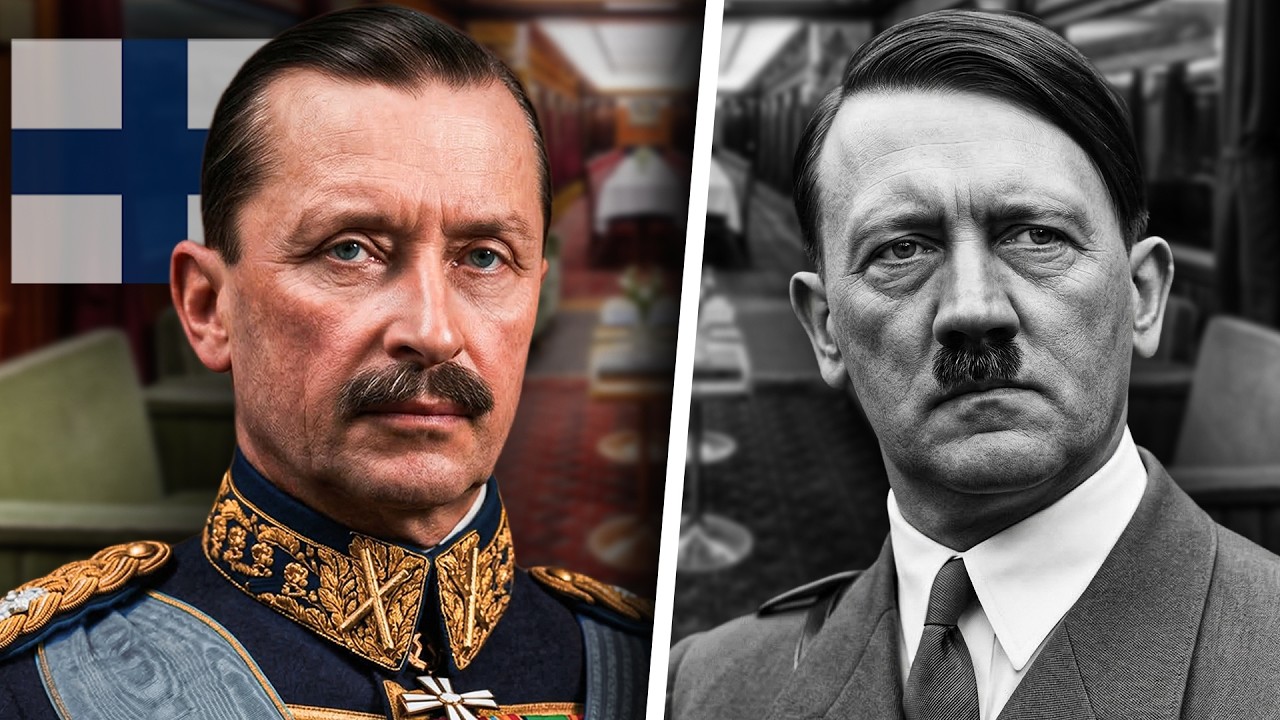
The recording ceased. Eleven minutes had elapsed. During that span, Hitler had talked the way he almost never did in public: unscripted, off his guard, with no idea that anyone was catching his words. It would stand as the only audio document of Hitler in private conversation, speaking as he truly was when he thought no one was listening.
Yet for the people inside that carriage, the more telling detail lay not in what Hitler said. It lay in what the man seated opposite him left unsaid. The 75-year-old Finnish general at the heart of the exchange had hardly spoken a word. His silences, his cautious evasions, carried a story of their own.
They were the fruit of a lifetime spent mastering precisely when to keep his mouth shut. Carl Gustaf Emil Mannerheim had not always been this restrained. In the summer of 1886, he was a 19-year-old cadet at the military academy in Hamina, thrown out for breaking curfew. Instead of accepting the defeat, he devoted the following year in Ukraine to polishing his Russian, then applied to the Nikolaev Cavalry School in St.
Petersburg. He graduated in 1889 and joined the Imperial Russian Army as a cavalry officer, launching a career that would stretch nearly three decades in the Tsar’s service. Mannerheim was Finnish by birth, Swedish in language and culture, and Russian by profession. He moved easily within the Imperial world without ever quite belonging to it.
Through the 1890s he climbed steadily, at last securing a place in the elite Chevalier Guards Regiment and gaining entry to the Imperial Court. At the coronation of Tsar Nicholas II in 1896, Mannerheim stood without moving in full dress uniform in Moscow for four and a half hours. He would later describe the ceremony as magnificently beyond words. It was the nearest he would ever get to the heart of the empire he served.
The Russo-Japanese War of 1904–1905 gave him his first genuine taste of combat command, and he came back with his reputation unblemished. Then came the expedition. Two years after his return from Manchuria, in 1906, the Russian General Staff dispatched Mannerheim on a mission across Central Asia to Beijing. His official cover was that of an ethnographer.
His real task was military intelligence: charting routes, evaluating Chinese forces, and submitting detailed reports for Russian planners. Over the following two years, he covered roughly 14,000 kilometers on horseback from Russian Turkestan through Xinjiang and across northern China. He took photographs, gathered artifacts, filed the reports his superiors wanted, and kept everything else to himself. By late 1908 he was back in St.
Petersburg and formally presented the expedition’s findings to Nicholas II. The First World War carried him to the Eastern Front, where he attained the rank of lieutenant general by 1917. When the October Revolution tore apart the empire he had served for thirty years, Mannerheim read the situation swiftly and departed. Finland was his destination in December 1917, only weeks after the country declared independence from Russia.
That independence carried a cost. Within weeks, civil war erupted between the country’s socialist Red Guards and the conservative White forces. Mannerheim led the Whites, secured victory by May 1918, and entered Helsinki as a national hero. Within a year he had served as regent, lost the country’s first presidential election, and withdrawn without public complaint.
He passed the next decade largely out of public view, watching from afar until May 19, 1933, when he was granted the title of Field Marshal. Throughout those years he quietly pushed for the fortification of the Karelian Isthmus, often against government reluctance and tight budgets. The defensive line that would eventually carry his name was built in pieces across the 1930s. By the time the Soviets arrived, it was ready.
In October 1939, the Soviet Union handed Finland a set of territorial demands. It sought border adjustments on the Karelian Isthmus, several islands in the Gulf of Finland, and a 30-year lease on the Hanko Peninsula for a naval base. In return, it offered Finnish territory elsewhere. The Finnish government said no.
On November 30, 1939, more than 450,000 Soviet troops crossed the border on multiple fronts. Stalin’s planners expected the campaign to be over in two weeks. Mannerheim set up his headquarters in Mikkeli, a small city in central Finland, and set about doing what he had spent the previous decade preparing for. His forces numbered roughly 300,000, had virtually no tanks, and were outgunned at every level.
What they did have was terrain, weather, and a commander who understood both. Mannerheim built his defense around Finland’s lakes, forests, and roads, funneling Soviet columns into narrow corridors where numbers mattered less. His troops moved on skis. The Red Army, unprepared for temperatures that fell below minus 40 degrees Celsius, did not.
In December 1939, Soviet forces driving toward the Gulf of Bothnia committed two divisions, the 163rd and 44th Rifle Divisions, to an advance through the wilderness around Suomussalmi. Colonel Hjalmar Siilasvuo’s 9th Division, outnumbered and lightly armored, encircled both columns and destroyed them methodically. Soviet casualties across the Suomussalmi engagement reached between 22,500 and 27,000. Finnish losses were fewer than 900.
The battle became a textbook example of how a smaller force, properly led in familiar terrain, could take a larger one apart piece by piece. Moscow formed its own conclusions. In January 1940, Stalin replaced his front commanders with Marshal Semyon Timoshenko, reorganized his forces, and massed 600,000 troops against the Karelian Isthmus. On February 1, 1940, they opened with a massive artillery bombardment.
The Mannerheim Line held for weeks, then broke. By early March, Soviet forces were entering the suburbs of Viipuri, Finland’s second city, and Mannerheim’s army was spent. The Moscow Peace Treaty was signed on March 12, 1940. Finland ceded approximately 11 percent of its territory, including Viipuri, and evacuated around 422,000 civilians from the lost regions.
It kept its government, its army, and its independence. In Berlin, Adolf Hitler followed the war closely and drew a conclusion that fit his purposes. The Red Army was slow, badly led, and brittle under pressure. It was the most consequential misreading of the war.
Eighteen months later, that misreading brought German forces to Finland’s border and handed Mannerheim the hardest decision of his career. On June 5, 1941, three days after Germany invaded the Soviet Union, Soviet aircraft bombed Finnish cities. Finland declared itself at war. What followed was not, in Mannerheim’s careful framing, an alliance with Nazi Germany.
For him it was a continuation of the conflict the Soviet Union had ignited in 1939, an opportunity to reclaim what the Moscow Peace Treaty had stripped away. That distinction carried enormous weight for him, and he upheld it through a string of refusals that would shape Finland’s stance for the remainder of the war. When German commanders suggested unified control over Finnish forces, Mannerheim said no. When they pressed him to sever the railway from Leningrad to Murmansk, the supply corridor linking the city to the outside world, he refused once more.
When pressure mounted to advance on Leningrad itself and complete the encirclement from the north, he turned them down a third time. Finnish troops stopped at the old pre-Winter War boundary and dug in. Mannerheim had won back the lost territory. He had no interest in fighting Germany’s war past that line.
By September 1941, the front had settled into something resembling a stalemate. Finland held its recovered lands and waited. From Berlin, the requests kept arriving. In Mikkeli, they kept being turned aside.
Then came June 4, 1942, Mannerheim’s 75th birthday. Hitler flew to Immola airfield that morning, ostensibly to extend his congratulations. It was an odd gesture. Mannerheim had made plain he did not want the meeting held in Helsinki, where it would look like a state visit, and not at a headquarters either.
A railway siding near the airfield was settled on. When Hitler stepped off the plane and spotted Mannerheim waiting, he ran toward him across the tarmac. Those who knew Mannerheim recorded his reaction. “An officer does not run,” he is said to have remarked quietly to those beside him.
“Only corporals do that.”
What neither man knew was that Thor Damen had hidden a microphone inside the railway car. For 11 minutes, Hitler spoke without reserve. He told Mannerheim he had never suspected the scale of Soviet armament: 35,000 tanks, industrial plants employing tens of thousands of workers, a capacity he had believed impossible.
Had he known, he said, the decision would have weighed on him even more heavily. He would have made it regardless. Mannerheim said very little in reply. He lit a large cigar during the meal that followed, fully aware that his guest could not abide the smoke.
Hitler left Finland five hours after gaining nothing he had come for. That same day, the Finnish government created a new title specifically for Mannerheim: Marshal of Finland. He remains the only person ever to hold it. In the early hours of June 9, 1944, Mannerheim sat at his headquarters and read the reports arriving from the Karelian Isthmus.
The Soviet offensive he had quietly expected for two years had finally come. It was bigger than anticipated. The Finnish front collapsed within 24 hours. By June 20, Soviet forces had seized Viipuri, the city Finland had already lost once in 1940 and spent three years winning back.
The situation was grave enough that German support suddenly became indispensable. For a brief moment in late June 1944, it was unclear whether Finland would survive as an independent state. The front had given way, the second city had fallen, and the country now depended on an ally it had spent three years carefully keeping at arm’s length. Mannerheim had prepared for this moment as well.
On June 26, 1944, German Foreign Minister Joachim von Ribbentrop arrived in Helsinki and demanded a formal pledge that Finland would not pursue a separate peace. It was the price for continued German arms supplies. President Risto Ryti agreed and gave his personal commitment. The document became known as the Ryti–Ribbentrop Agreement.
Mannerheim did not sign it. That detail would prove decisive. At Tali-Ihantala, between June 25 and July 9, 1944, Finnish forces fought the largest battle in Nordic history across 100 square kilometers of the Karelian Isthmus. The Soviet 21st Army, backed by hundreds of tanks and aircraft, hammered a Finnish line that would not break.
By July 9, with the 21st Army having suffered between 18,000 and 22,000 casualties and the offensive bogged down, Soviet commanders began moving forces south toward Estonia. The front held. Germany had supplied the arms, and Finland had halted the offensive. The debt was noted and then quietly set aside.
On August 1, 1944, Ryti resigned as president. Four days later, the Finnish Parliament unanimously elected Mannerheim to succeed him. On August 17, Mannerheim annulled the Ryti–Ribbentrop Agreement. His reasoning was simple.
The pledge had been Ryti’s personal commitment, not Finland’s. Mannerheim had never signed it. It was therefore not binding on him. Germany protested, but Finland paid the protest no heed.
The ceasefire with the Soviet Union took effect on September 4, 1944. The Moscow Armistice, signed on September 19, required Finland to cede Petsamo, restore the 1940 Karelian border, lease the Porkkala Peninsula for 50 years, and pay $300 million in reparations. It also demanded the expulsion of all German forces. The Lapland War that followed drove roughly 200,000 German troops north into Norway.
The last German soldier departed Finnish soil on April 27, 1945. Finland came out of the war as the only German co-belligerent that kept its democracy, its sovereignty, and its freedom from occupation. Mannerheim resigned the presidency on March 4, 1946, and died in Lausanne, Switzerland, on January 27, 1951. The recording Thor Damen made was withheld by Finnish state censors for years.
Yle, the national broadcaster, recovered the tape in 1957. When it was finally made public, listeners heard 11 minutes of history’s most guarded man speaking as though no one were listening. What they also heard, in the silences and the careful non-answers from the other side of the conversation, was Mannerheim.
