The day Robert Todd Lincoln decided to commit his mother, he had to believe he was saving her. Mary Todd Lincoln had been behaving strangely for years, but by 1875 the strange had curdled into something Robert could no longer dismiss. She was convinced that someone was trying to poison her. She saw enemies everywhere.
She spent money in ways that made no sense, even to a family that had once occupied the White House. On the other side of that decision stood the woman who had been First Lady of the United States, widowed by an assassin’s bullet, a woman who had already buried three of her four sons. Robert took her to court anyway. The doctors testified.
The jury agreed. Mary Todd Lincoln was declared insane, and her own child had her committed to a private asylum in Illinois. It was a long fall from where she had stood on the evening of April 14, 1865. When Abraham Lincoln was assassinated at Ford’s Theatre, the whole nation mourned, but the grief that landed on Mary Todd Lincoln was of a different order.
She had been sitting beside him when the bullet struck. In an instant she lost her husband, her position, and the shape of her entire future. She left the White House and returned to Illinois with her surviving sons, hoping to find some stability in the place where her life had begun. Her husband’s estate, valued at roughly $80,000, should have been enough to secure her for the rest of her days.
But grief does not respect arithmetic. Mary feared poverty with a constant, gnawing terror, even though the money was still there. She had always been a woman who found comfort in beautiful things, but after the assassination the shopping became something else, a frantic effort to fill a void that could not be filled. She bought dresses, jewelry, furniture, objects she barely used.
Every dollar she spent made headlines. Every choice she made was dissected in the papers. The woman who had once been among the most admired figures in America was becoming an object of public scrutiny, and the scrutiny was rarely kind. In 1868, her desperation became impossible to hide.
Mary decided to sell her personal belongings, including items that carried deep personal meaning, and she went so far as to ask the American public for financial help. The reaction was swift and harsh. The former First Lady was suddenly a figure of ridicule. Newspapers mocked her.
The public shook its head. She who had lived at the highest level of American society was now being portrayed as a greedy, unstable woman who could not manage her own affairs. Shamed and wounded, Mary made a decision that must have felt like an escape. She fled the country with her youngest son, Tad, the only child she had left.
They settled in Frankfurt, Germany, where they found an unexpected source of support. The Seligman family, a prominent banking clan with connections across Europe, quietly helped her. They paid for travel expenses and assisted her privately, out of view of the American press. Mary could breathe again, far from the headlines and the judgment.
She had Tad with her, and Tad was the one bright spot in her life. It did not last. In 1871, Tad fell ill. The illness was sudden and severe, and at just eighteen years old, the boy died.
Mary had now buried her husband and three of her four children. Robert, her eldest, was the only one left, and he was a grown man building his own life. Mary returned to the United States a broken woman, and this time the breaking was permanent. She dressed only in black.
She lived in constant fear. Though she still possessed $56,000 in government bonds, a considerable sum, she reportedly sewed the bonds into her petticoats, convinced that someone might steal them. She became certain that she was being targeted by enemies, that people were trying to poison her. She began to look for reassurance beyond the world of the living.
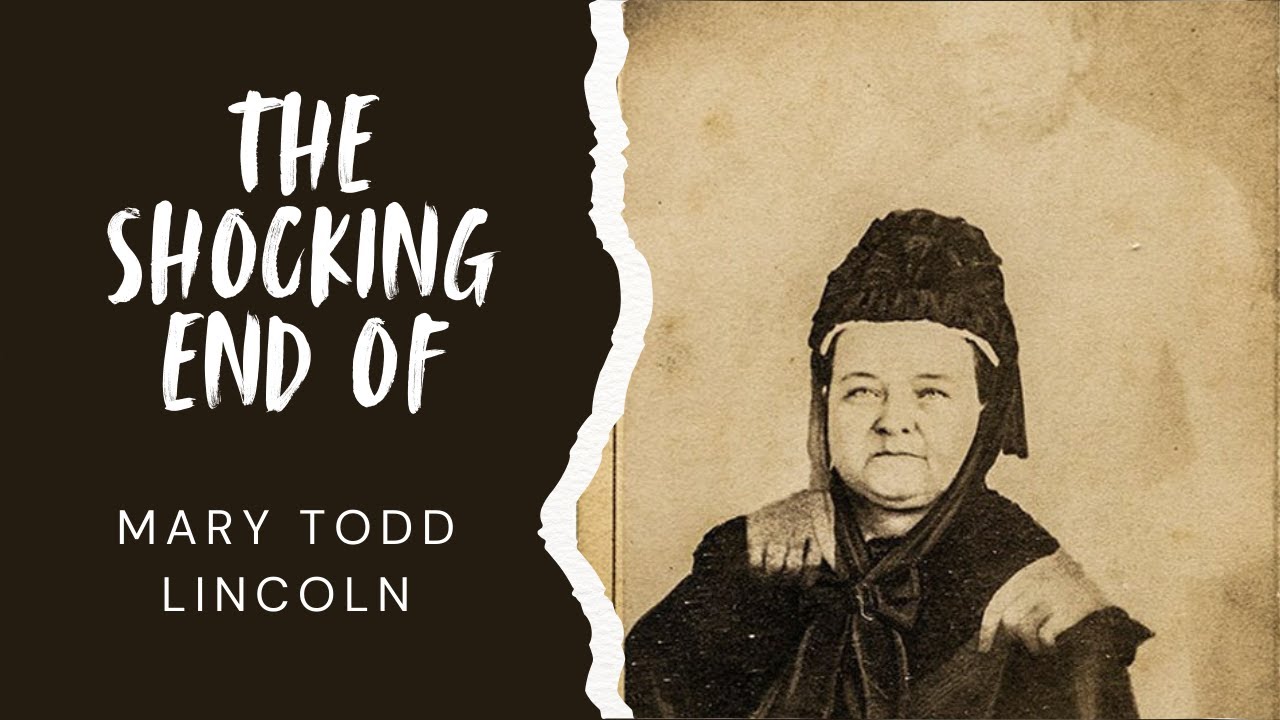
She visited a photographer named William H. Mumler, who was known for producing “spirit photographs. ” Mumler produced an image of Abraham Lincoln standing behind Mary, a ghostly figure looming over the grieving widow. It was later proven to be a photographic trick, a double exposure, but at the moment it may have brought her some fleeting comfort.
Robert Todd Lincoln watched his mother’s decline with mounting worry. He was a successful man, a lawyer, a rising political figure, but he could do nothing for the woman who had raised him. She was convinced that he, too, was part of the conspiracy against her. She wrote letters full of suspicion and accusation.
She refused to accept help. By 1875, Robert had reached the end of what he could manage privately. He made the decision that would define both of their lives. He petitioned the court, arguing that his mother could no longer care for herself.
The case was heard before a jury. Doctors testified about her behavior, her delusions, her erratic conduct. The jury did not take long. Mary Todd Lincoln was declared insane.
She was committed to Bellevue Place, a private asylum in Batavia, Illinois. The woman who had once stood at the pinnacle of American society was now locked away against her will, and the order had come from her own son. Inside the asylum, Mary’s despair turned into something darker. She tried to buy enough laudanum, the opium-based tincture widely used as a sedative, to end her own life.
Alert pharmacists refused to sell it to her, and the attempt failed. But even in her confinement, she did not surrender her voice. She wrote letters to friends, pleading for help, and those friends took her story to the newspapers. The narrative began to shift.
The public, which had mocked her spending and her erratic behavior, started to ask a different question. Had Mary Todd Lincoln been treated fairly? Or had she simply been a woman crushed by unbearable loss, judged by people who had never carried such weight themselves? The scrutiny grew.
Bellevue Place came under pressure. After only three months, the asylum allowed Mary to leave. She went to live with her sister, Elizabeth Edwards, in Springfield, in the same house where she had once been a young woman before her marriage. In 1876, a court restored her legal rights.
She was declared competent once again. The official record said she was sane. But the damage was done. The relationship between Mary and Robert had been torn open in a way that neither of them could repair.
They remained emotionally distant for years, two people bound by blood and history, unable to bridge the chasm that the insanity trial had carved between them. Mary never fully forgave him. Robert, for his part, carried the weight of the decision for the rest of his life. Mary spent more of her time abroad.
She lived for a while in Pau, France, a town popular with wealthy invalids who came for the mild climate. But her health was deteriorating steadily. Cataracts clouded her vision until she was nearly blind. Falls left her with injuries that never fully healed.
The money, which she had guarded so fiercely, was running out. When she returned to the United States, she faced one more battle. She asked Congress for an increased pension. Many in Washington still viewed her spending with suspicion, and the fight was difficult.
She had to argue her case in public, defending her need against a skeptical institution. Eventually, the pension was granted. It was not a victory that brought her joy, only a measure of security. Her final years were quiet.
She stayed in Springfield, in her sister’s care, living out her days in the house of the woman who had taken her in. On July 15, 1882, exactly eleven years to the day after Tad’s death, Mary collapsed at home. She never regained consciousness. She died the next morning at the age of sixty-three.
She was laid to rest beside Abraham Lincoln and their three sons who had gone before her, in the tomb where the family would finally be together again. The woman who had worn black for the better part of two decades, who had sewn bonds into her petticoats, who had tried to buy the means of her own end, was at peace. The story of Mary Todd Lincoln does not end with a tidy lesson. It ends with a question that her contemporaries never fully answered: was she insane, or was she simply a woman whose grief had outgrown the capacity of the world to hold it?
The jury in 1875 said she was insane. The court in 1876 said she was competent. The public, which had ridiculed her, eventually came to pity her. Robert Todd Lincoln, who made the decision to commit her, lived the rest of his life defending it.
What remains is the record of the facts. A woman lost her husband to an assassin’s bullet. She lost three sons to illness. She tried to sell her possessions to survive, and the nation laughed at her.
She fled to Germany and found kindness from strangers. She buried her youngest child. She wore black. She feared poverty.
She believed she was being poisoned. She consulted a photographer who showed her a ghost that was only a trick of the light. Her son had her committed. She tried to buy laudanum.
She wrote letters. She was released. She was declared sane. She grew old and blind in her sister’s house, and on the eleventh anniversary of her son’s death, she fell and never woke again.
She is buried beside her husband and her sons. Whatever she was in the eyes of the law, whatever the doctors said, whatever the papers printed, she is remembered now as the woman who loved Abraham Lincoln and lost him, and who spent the rest of her life trying to find her way back to him.
