For a decade, a single figure silently controlled an astonishing five percent of the world’s copper supply. He was not a mining magnate, a government official, or a celebrated financier. He was Yasuo Hamanaka, a mid-level trader at Japan’s Sumitomo Corporation, whose quiet manner concealed an empire built on deception. When his scheme finally collapsed in 1996, it produced the largest trading loss in corporate history—$2.
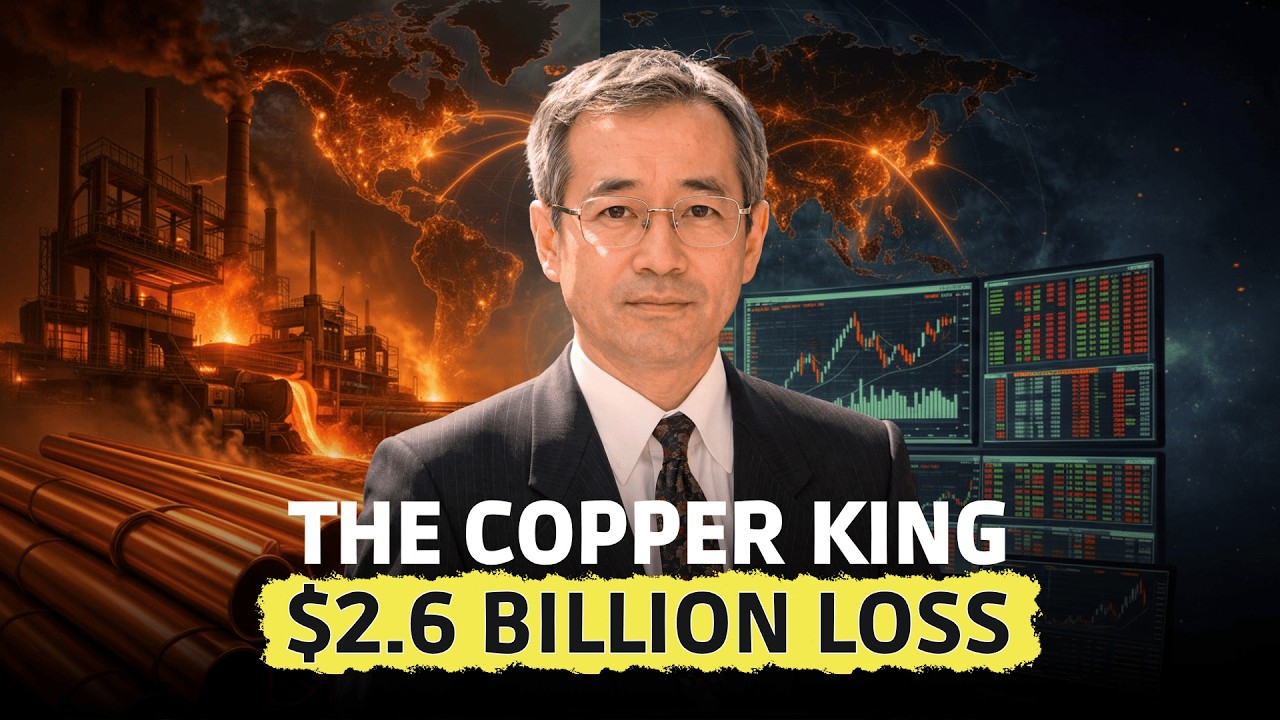
6 billion—and sent shockwaves through global commodity markets. World leaders debated copper prices, and mining executives calibrated production based on what they believed were market signals. In truth, Hamanaka was the market. Hamanaka joined Sumitomo in 1970 after graduating from Seikei University with a law degree.
Copper trading was then a quiet corner of international finance, far less scrutinized than oil or gold. But the metal was essential: every electrical conductor, water pipe, and circuit board depended on it. Sumitomo had deep roots in copper, tracing its heritage back to the seventeenth century, and the corporation treated the metal as its cornerstone. Hamanaka spent years absorbing the trade’s complexities, mastering supply chains, seasonal patterns, and the psychology of market participants.
His colleagues described him as methodical, intense, and obsessively focused. The turning point came in 1985. Hamanaka and his superior, Saburo Shimizu, suffered significant losses from physical copper trading in the Philippines. Trying to recover, they began unauthorized speculation on the London Metal Exchange.
The deficit ballooned to roughly $60 million. Rather than confess, they hid the losses with off-the-books deals. When Shimizu resigned, Hamanaka took over as head copper trader and created secret trading books to conceal the mounting debt. The deception was not born of greed alone, but of a desperate need to erase a mistake and save face in a corporate culture that punished failure harshly.
Each subsequent loss convinced him that an even larger gamble was the only way out. Hamanaka’s manipulation relied on a sophisticated understanding of both the financial and physical copper markets. The London Metal Exchange, founded in 1877, was the world’s premier venue for metals trading, blending open-outcry sessions with private negotiations. Crucially, it allowed extensive use of derivatives—futures, options, and swaps—that did not require immediate delivery of metal.
Hamanaka realized he could build enormous positions through these instruments without affecting physical supply, making his control nearly invisible. He spread his purchases across dozens of accounts, trading entities, and contract periods, interleaving them with legitimate activity to avoid suspicion. He also exploited the physical side of the market. Copper had to be stored, transported, and delivered, and the LME maintained a global network of approved warehouses.
By systematically accumulating vast quantities of metal and controlling warehouse stocks, Hamanaka created artificial scarcity. Industrial consumers needing immediate delivery found supplies mysteriously constrained and had no choice but to pay his premium prices. His control extended across Europe and Asia, deliberately dispersed to prevent any single facility from revealing his true reach. He used a shadow network of complicit brokers, including David Campbell, whose firm Global Minerals and Mining Corp.
helped execute wash trades that created a false veneer of legitimate commerce. Winchester Commodities Group, founded by Charles Vincent and Ashley Levitt, served as his primary broker for the most aggressive plays. Regulators failed to stop him. In 1991, London broker David Threlfall received a brazen fax from Hamanaka requesting backdated invoices for non-existent trades worth up to $500 million to satisfy Sumitomo’s internal audits.
Threlfall refused and reported the evidence to the LME and the Securities and Investments Board. Both concluded they lacked jurisdiction because Sumitomo was not a direct member of the exchange. No significant action was taken, and Hamanaka continued unhindered. Around the same time, Paul Scully, an employee at Threlfall’s firm who had warned about irregularities, died in a suspicious house fire.
Investigations ruled it an accident, but the timing cast a dark shadow over the affair. By 1991, Hamanaka had become the secret architect of global copper prices. He coordinated trading across Tokyo, London, and New York around the clock, using Sumitomo’s international offices to execute trades in multiple jurisdictions. This geographic spread made it nearly impossible for any single regulator to see the full picture.
His influence distorted industrial planning on a global scale. Mining companies adjusted production schedules based on price signals he created, and manufacturers designed products around copper costs inflated by his manipulation. The profits flowed into Sumitomo’s accounts, disguised as routine trading returns. During peak years, they exceeded $500 million annually.
Sumitomo’s leadership chose not to look too closely. When JP Morgan executives approached them in 1994 with concerns about Hamanaka’s massive transactions, Akio Imamura, his superior, boasted: “You are not seeing the whole deal. There are a couple of legs to this. ” The company’s internal controls were designed for conventional operations and were inadequate for detecting sophisticated manipulation spread across multiple markets.
Hamanaka’s quiet demeanor and technical competence made him appear trustworthy, and his extraordinary profits were attributed to skill rather than fraud. The fragility of his empire became visible in 1995. Global economic conditions shifted: Asian growth slowed, reducing demand, while new mining operations in Chile and Indonesia increased supply. These genuine market forces clashed with Hamanaka’s artificial price support.
Rather than reducing his positions, he doubled down. By November 1995, he controlled an astonishing 93 percent of all LME copper warrants. His true weapon was not the physical metal but the paper claims needed by short sellers to close their positions. He had cornered the exchange itself.
The fatal crack appeared in the United States. In 1994, the LME opened a new approved warehouse in Long Beach, California. As Hamanaka’s manipulations drove LME contracts to a massive premium over US-based COMEX contracts, physical copper began draining out of COMEX facilities and flowing into Long Beach. Regulators watched in bewilderment as COMEX stocks plunged while LME stocks surged despite a discount on forward prices.
This irregular behavior finally provoked the US Commodity Futures Trading Commission to launch an aggressive investigation. The walls of Sumitomo could no longer contain the international crackdown. When the full extent of the manipulation was revealed, the world was shocked by the man behind it. Hamanaka was not a flamboyant criminal but a typical Japanese salaryman known for plain gray suits and steel-rimmed glasses.
His unassuming appearance had been his greatest camouflage. The national disillusionment was so severe that Japan’s chief cabinet secretary publicly lamented that the moral fiber of all Japanese had deteriorated and they had become desensitized toward money. The collapse produced one improbable victor. Herby Black, a Montreal-based scrap metal merchant, had bet heavily against Hamanaka, taking massive short positions.
When copper prices plummeted, Black walked away with a fortune while the rest of the financial world burned. Sumitomo launched lawsuits against the banks that had facilitated Hamanaka’s trades. Merrill Lynch paid $275 million in 2000, JP Morgan settled for $125 million in 2002, and UBS paid $86 million. Credit Lyonnais Rouse settled a colossal $1.
1 billion lawsuit in 2004. Industrial consumers also fought back: companies like Southwire and Asarco filed antitrust lawsuits alleging that JP Morgan had actively aided Hamanaka’s squeeze. The scandal forced fundamental changes at the London Metal Exchange. New lending rules required any participant holding fifty percent or more of available warrants to lend copper back to the market at capped rates, dismantling the short-squeeze mechanism Hamanaka had weaponized.
The exchange also introduced mandatory daily position reporting that traced all the way to the ultimate end client, and the SWORD system, a secure electronic network that identified the true controller of every warrant. These reforms eventually drove the LME’s demutualization, transforming it from a centuries-old members club into a modern, strictly regulated corporate entity. Hamanaka was sentenced in 1998 to eight years in prison on charges of fraud and forgery. Sumitomo paid $150 million to the US Commodity Futures Trading Commission and $8 million to the UK’s Securities and Investments Board.
Hamanaka was released in July 2005, one year early for good behavior, and retreated entirely from public life. Sumitomo shareholders sued the former directors for gross mismanagement, forcing senior executives to resign and pay $3. 55 million to settle claims. Shimizu, the former boss whose initial loss had sparked the decade-long deception, answered every question at Hamanaka’s trial with a single response: “No comment.
”
For ten years, the world’s most essential metal moved not by supply and demand but by the secret whims of one man in a gray suit. His empire broke Sumitomo, rewrote the rules of global trade, and left a permanent warning in the trading rings of London: no one is larger than the market itself.
