The door shut behind him, and for an instant the silence inside Kensington Palace was total. Dr. James Colthurst placed his medical bag on the polished table, unzipped it, and drew out not a stethoscope but an ordinary cassette recorder. He hit record.
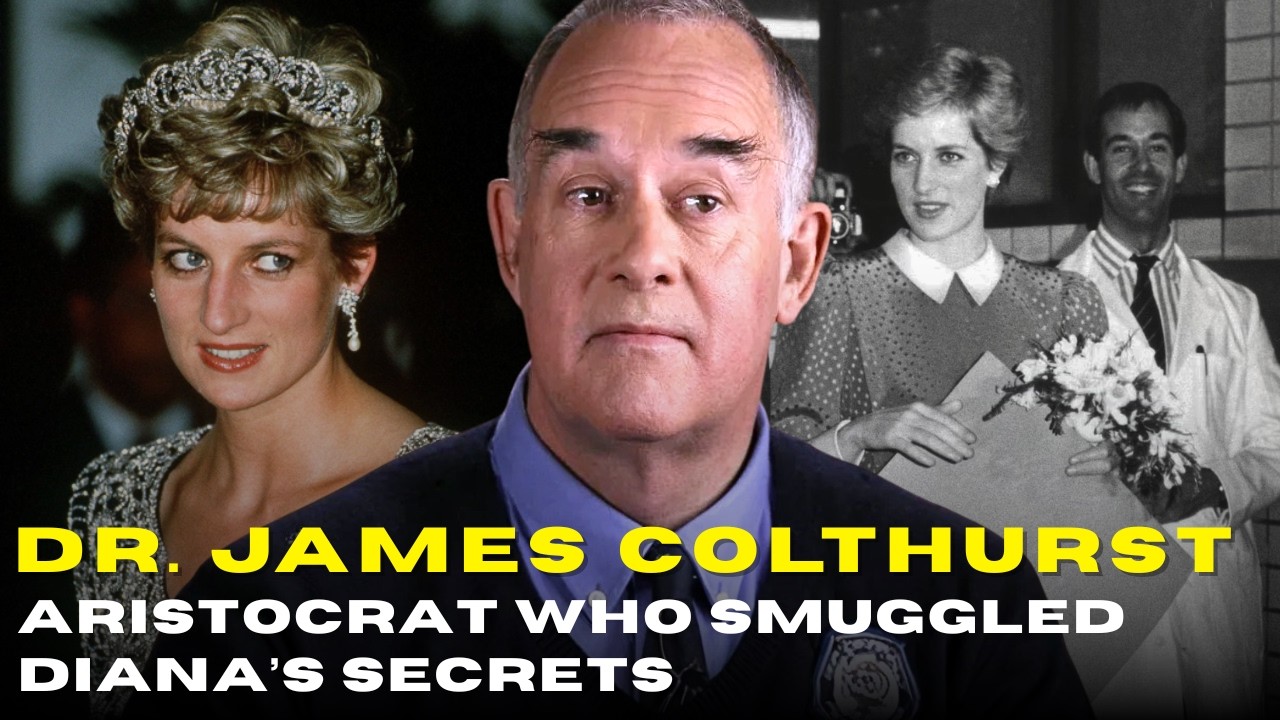
Opposite him sat the Princess of Wales, her eyes worn down by ten years inside a gilded cage. He started reading from the typed pages in his hand—blunt, clinical questions drafted by a journalist who had never been permitted past those gates. And Diana started to talk. The man the royal elite once reviled as a traitor who drove a knife into the throne is today remembered by history as the only knight who dared stake his life to rescue a princess.
From a reserved nobleman with an unblemished career, he turned himself into a quarry of Britain’s most infamous security apparatus. Why would a man with every advantage choose to take on the Windsor empire merely to shield the tearful confessions of Princess Diana? Born in 1957, James Colthurst was no commoner peering in through the palace railings. He came from the very same elite social layer as the royal family—the son of Sir Richard Colthurst, the ninth baronet, whose ancestral home was the famed Blarney Castle in Ireland.
Schooled at Eton College, the foremost breeding ground of the British ruling class, he grasped the aristocracy because he was one of its products. He knew their codes, their arrogance, and their essential ruthlessness. Yet Colthurst made one decisive departure from the usual aristocratic script. Rather than running a country estate or sliding into a comfortable inherited post in finance or politics, he opted to work.
He entered St. Thomas’s Hospital in London to endure the punishing training that becoming a medical surgeon demands. That choice became the master key to his character and, in the end, to his role in Diana’s life. Medical training has no interest in your father’s title.
It peels away social pretense. It compels a person to confront blood, pain, fear, and human frailty every single day. By choosing medicine, Colthurst rooted himself in the real world—and guaranteed his own complete financial and professional independence. He had no need of a grace-and-favor residence from the Queen.
He had no need of an invitation to a royal garden party to prove his worth. He was a baronet’s son with a scalpel and a paycheck of his own. That made him structurally immune to the leverage the palace traditionally wielded to control people. Diana Spencer, by contrast, was born into a wholly different form of aristocratic trauma.
The Spencer family ranked among the oldest and most prominent in England, but behind closed doors Diana’s childhood was shaped by a deep, aching abandonment. Her mother, Frances Shand Kydd, walked out when Diana was only seven, after a bitter and heavily publicized divorce from John Spencer, the 8th Earl Spencer. In the 1960s aristocratic divorces were scandalous, and the children were frequently treated as collateral damage. John Spencer won custody, but he was a remote, emotionally walled-off patriarch.
Diana grew up in vast, echoing houses feeling deeply unwanted—a child who absorbed the belief that love was conditional, fragile, and easily taken away. The Spencer family, like most of the high aristocracy, ran on transactional terms. Children were raised by nannies, packed off to boarding schools, and expected eventually to marry well and secure the family’s proximity to power. Diana was not nurtured.
She was stored away. That was the psychological starting point of the seventeen-year-old girl who arrived on a snowy ski slope in Val Claret, France, in the winter of 1978. She was a teenager carrying the invisible scars of parental abandonment, with no university prospects and no clear direction in life—just trying to find her footing. During the ski trip she had a minor mishap, twisting her ankle.
James Colthurst, at the time a twenty-one-year-old medical student, happened to be on that same trip. He came over to examine the injury. What grew on that freezing mountain was not a sweeping, dramatic romance. It was something much rarer and, in the end, far more dangerous to the British monarchy: an easy, purely platonic, and deeply equal friendship.
Colthurst did not look at Diana and see an earl’s daughter. He did not see a strategic social alliance. He simply saw a slightly clumsy, wonderfully funny teenager with a quick wit and a fondness for practical jokes. They connected instantly over a shared sense of mischief, laughing at the absurdities of the upper class.
Colthurst, steadied by his medical training, gave her a plain, unpretentious warmth that Diana had been starved of all her life. The timing mattered enormously. Colthurst knew Diana before the machine took hold of her—before the cameras, before the title, before she was turned into a globally traded commodity. He laid down a foundation of trust entirely free of hidden agendas.
He liked her for who she was. In the circles they moved in, a relationship without transactional value was an oddity. For Diana, James Colthurst became a human anchor. As the 1970s gave way to the 1980s, the dark machinery of the British establishment began turning its attention toward the Spencer family.
The royal family had a serious problem. Prince Charles, heir to the throne, was approaching thirty. He was deeply and hopelessly in love with Camilla Shand, later Parker Bowles. But the palace had judged her unacceptable.
She had a history. She was not aristocratic enough, and she was not a virgin. The monarchy, run on an archaic and deeply misogynistic set of rules, demanded a very particular kind of bride to secure the succession. They did not want a modern woman with her own opinions, her own past, and her own agency.
They wanted a blank slate—a girl with a spotless aristocratic pedigree, no scandalous history, and a pliable personality. They needed a vessel to carry the next generation of Windsors. A quiet girl who would smile for the cameras, cut the ribbons, and look the other way when her husband inevitably went back to his mistress. They looked at nineteen-year-old Diana Spencer—shy, inexperienced, starved for affection, thoroughly conditioned to obey authority—and concluded she was the ideal candidate.
The courtship was not a romance. It was a corporate takeover. Diana, bearing the deep trauma of her parents’ divorce, desperately wanted a family. She wanted to belong.
When the Prince of Wales offered her the ultimate fairy tale, she seized it, never realizing she was stepping into a psychological meat grinder. Through 1980, as the press began to hound her and the immense, terrifying gravity of the royal family started pulling her in, Diana’s social circle was methodically dismantled. The palace courtiers—the men in gray suits—set about isolating her. They preferred her to have no independent support system, to depend entirely on the crown.
Yet James Colthurst was not someone they could remove. He stayed resolutely on the outside, watching his clever, vibrant friend disappear into an institution that had no plans whatsoever to shield her. He noticed the danger signals that everyone else overlooked in their eagerness for a royal wedding. He saw the fear in her eyes as the snare tightened.
He held back because he honored her independence, but he made a quiet, unwavering vow. He ensured Diana understood that whatever unfolded behind the iron gates of Buckingham Palace, his phone would never be off the hook for her. He stayed the one incorruptible sanctuary in her fast-shrinking world—the aristocrat standing beyond the castle walls with his medical bag in hand, awaiting the inescapable day when the fairy tale would break apart and the bleeding would start. When the heavy doors of Buckingham Palace shut behind Diana Spencer on July 29th, 1981, the public fairy tale was over and the psychological post-mortem began.
The world had just watched the wedding of the century. Millions cheered for a glowing twenty-year-old princess. But within the walls of the royal residences, the mood shifted in an instant from festivity to a stifling clinical reality. Diana had fulfilled her primary function.
She had delivered the visual spectacle the monarchy needed to lift its popularity. Now she was meant to slide smoothly into her secondary role: a quiet, obedient incubator for the next generation of the Windsor bloodline. The sheer brutality of the environment Diana entered was built into the fundamental architecture of the British royal system. The monarchy is not a family.
It is a constitutional utility—an ancient, sprawling corporation built solely to preserve itself. The people who run this corporation—the private secretaries, the equerries, the senior courtiers known as the men in gray suits—are bureaucrats of bloodline. They do not traffic in human emotion. They traffic in public relations, operational efficiency and risk management.
Their system rests on stoicism. The Windsor operating manual demands that trauma be buried, marital infidelity be ignored, and public duty always override personal suffering. Into this icy, inflexible machinery stepped Diana. She was young, emotionally broken by her parents’ divorce, and desperate for validation and affection.
She did not need a schedule; she needed a husband. But Prince Charles was emotionally unavailable and fundamentally unable to give her the reassurance she required. Worse still, he remained deeply entangled in his relationship with Camilla Parker Bowles. Diana grasped the truth almost at once.
She discovered the customized bracelets, intercepted the phone calls, and spotted the cufflinks Charles wore on their honeymoon—gifts from his mistress. She was trapped in a crowded marriage, geographically isolated in royal palaces, and surrounded by staff who answered directly to the establishment that was actively gaslighting her. When Diana responded to this trauma with tears, anger and despair, the palace machinery offered no empathy. It offered contempt.
The courtiers treated her emotional distress as a systemic failure. To them, she was not a suffering twenty-year-old girl. She was a malfunctioning asset. They branded her unstable.
They whispered that she was hysterical. The royal family’s answer to her pain was simply to pull back further, creating a vacuum of isolation around her. They expected her to eventually exhaust herself and accept the bleak transactional reality of her position. This environment of utter powerlessness set off a severe psychological collapse.
Diana developed bulimia nervosa. In this context, bulimia must not be dismissed as a trivial vanity issue. It was a desperate, violent coping mechanism. At Kensington Palace, Diana had no control over her life.
The courtiers dictated her schedule, her wardrobe, her public appearances, her housing. Her husband controlled her social standing while openly carrying on an affair. The media owned her image. The state owned her future children.
The only thing in the entire world Diana could control absolutely was her own physical body. The binging was a physical reaction to profound emotional starvation. The purging was a literal and psychological rejection of the poison the royal system was feeding her. It was a silent scream for help carried out behind the locked doors of her private bathrooms.
As the illness ravaged her body, her paranoia deepened—and her paranoia was entirely justified. Kensington Palace was a gilded fortress, but it was also a panopticon. The walls had ears. The switchboards were monitored.
The police officers posted outside her door were elite members of the royal protection squad, but their ultimate loyalty was sworn to the crown, not to the Princess of Wales. If Diana made a phone call, she had to assume it was recorded. If she confided in a lady-in-waiting, she had to assume the conversation would be briefed to the Queen’s private secretary by the end of the day. She was drowning.
The men in gray suits watched her drown, actively calculating how to manage the public relations fallout if she went completely under. She needed a lifeline the palace could not tap, intercept or manipulate. She picked up the phone and called Dr. James Colthurst.
A chance reunion in the late 1980s brought Colthurst back into her inner circle. By then, he was a highly respected medical professional. When they reconnected, he did not see the Princess of Wales. He saw the terrified, isolated girl from the ski slopes.
And Colthurst held a singular, devastating advantage that let him bypass the entire Windsor security apparatus: his medical degree. The royal establishment was deeply class conscious and highly deferential to professional titles. When James Colthurst pulled up to the gates of Kensington Palace, the guards did not see a threat. They saw an aristocratic doctor carrying a medical bag.
They assumed he was there to treat a physical ailment—perhaps to prescribe medication for a headache or check a minor injury. They waved him straight through. The security machine built to detect journalists, spies and unauthorized guests had a massive blind spot for a physician making a house call. Colthurst used his medical credentials as an impenetrable alibi.
He walked straight past the royal protection officers, navigated the silent, thickly carpeted hallways of apartments eight and nine, and entered Diana’s private drawing room. Inside that room, he shifted from a surgeon into a reluctant emergency trauma therapist. The scenes that unfolded in those private quarters were stark. Diana would pace the room frantically, swinging between severe depression and sheer panic.
She would detail the coldness of her husband, the calculated cruelty of the courtiers, and the physical toll of her eating disorder. She recounted throwing herself down a flight of stairs while pregnant with Prince William—a desperate, theatrical attempt to force her husband to simply look at her. She described the agonizing reality of knowing exactly where Charles was when he was not with her. Colthurst offered no empty platitudes.
He did not tell her to keep a stiff upper lip, the standard royal response to tragedy. He applied clinical logic to institutional madness. He listened. He let her vent the toxic build-up of secrets the palace demanded she swallow.
When she began to hyperventilate, his clinical instincts kicked in. He steadied her, brought her heart rate down, and spoke in a low, even voice. Yet his greatest gift was psychological affirmation. The royal family’s most damaging weapon against Diana was gaslighting.
They repeated that her fears about Camilla were pure fantasy. They insisted her misery was something she had brought on herself. They worked to make her believe she was losing her mind. James Colthurst sat in her drawing room, met her gaze, and assured her she was completely sane.
He gave her an outside, objective reality check, confirming that the world she inhabited was profoundly unnatural and deeply abusive. He affirmed her pain. Simply by acknowledging what she was truly living through, he stopped the Windsor machine from completely shattering her hold on reality. Yet as the years wore on, Colthurst arrived at a chilling clinical conclusion.
He could come to see her every week. He could soothe her panic attacks. He could track the physical deterioration caused by the bulimia. But he could not cure her.
In medicine, you cannot cure a patient of a respiratory disease while they remain locked in a room thick with toxic smoke. The pathogen destroying Diana was not a virus. It was the institution itself. It was the marriage.
It was the crushing weight of the crown. Colthurst came to see that his house calls amounted to palliative care—putting bandages on a woman bleeding out from systemic institutional trauma. By the close of the 1980s, the dynamic inside Kensington Palace hit a critical threshold. Diana was nearing thirty.
The bulimia had worn her down, but she had outlasted the worst of the psychological assault. The frightened, naive twenty-year-old was gone. In her place stood a deeply wounded, sharply observant, and increasingly furious woman. She understood that the royal family would never protect her.
They would never end the affair. They were merely waiting for her to break so they could quietly have her institutionalized or shove her out of public view entirely while keeping hold of her children. If she stayed silent, she would die in that palace—by her own hand or from the physical devastation of her illness. The strategy of endurance had failed.
Survival was no longer enough. Diana understood she had to go on the offensive. She had to strike at the one thing the men in gray suits truly cared about: the public image of the British monarchy. She had to tell the world the truth.
But she was sealed inside a fortress, watched by guards, cut off from the press. She needed a smuggler. She needed a man who could walk past the police, take the explosive truth from her hands, and carry it safely into the outside world. She looked at the doctor sitting across from her.
By the start of the 1990s, the Cold War inside the House of Windsor had escalated into a desperate hostage situation. Diana was no longer merely suffering; she was actively suffocating beneath a carefully managed campaign of institutional erasure. The palace machinery had realized she was too popular to discard publicly, so it chose a strategy of slow psychological containment. Prince Charles had withdrawn entirely into his parallel life with Camilla Parker Bowles.
The courtiers tightened their hold on Diana’s schedule, tracking her movements, intercepting her communications, and methodically isolating her from anyone who might give her an independent platform. Diana saw that the traditional channels for complaint were completely sealed off. She could not appeal to the Queen, who fundamentally detested emotional confrontation and viewed Diana’s distress as an unseemly lack of discipline. She could not speak to the established royal correspondents, as they were deeply embedded in the palace’s patronage system, relying on the courtiers for access and feeding the public a sanitized narrative.
If she stayed within the rules of the system, she would be quietly neutralized—branded as mentally unstable, eventually locked away in a country estate while the monarchy retained absolute control over her children. To survive, she had to detonate the entire narrative. She had to bypass the establishment and speak directly to the public. She needed to weaponize the truth.
Enter Andrew Morton. Morton was a freelance royal journalist operating outside the strict control of the Buckingham Palace press office. He was sharp, ambitious, and had already begun to piece together the terrifying discrepancies between the public fairy tale and the private nightmare. Through a network of peripheral contacts, Morton knew that the marriage was a sham and that Diana was deeply unwell.
But knowing the truth and proving the truth are two entirely different legal realities in the United Kingdom. To publish a book exposing the future king of England as a callous adulterer and the royal institution as a psychological meat grinder, Morton needed irrefutable proof—straight from the princess herself. The logistical hurdle was absolute. Kensington Palace was a fortress.
Andrew Morton could not simply walk through the front gates. The Royal Protection Squad logged every visitor. The perimeter was heavily guarded. Surveillance cameras covered the entrances.
If Morton was spotted meeting with the Princess of Wales, the men in gray suits would instantly shut the operation down. Morton’s career would be destroyed by the royal legal apparatus, and Diana would face severe permanent lockdown. They needed a ghost—a middleman who could move freely between the gritty reality of Fleet Street journalism and the hyper-secure inner sanctum of the royal apartments without triggering a single alarm. Diana looked to the only man who possessed the access, the intellect, and the absolute unshakeable loyalty required to execute a high-stakes espionage operation: Dr.
James Colthurst. When Diana approached Colthurst with the plan, she was not asking him for a medical favor. She was asking him to commit an act of institutional treason. Colthurst understood the stakes immediately.
If he was caught smuggling information out of the palace to a tabloid journalist, the blowback would be catastrophic. The British establishment is merciless to class traitors. He would be excommunicated from high society. His medical career could be sabotaged.
He could face severe legal repercussions, intense police harassment, and public ruin. Yet Colthurst agreed. He did not agree because he harbored a political vendetta against the monarchy. He did not agree for financial compensation—he refused to take a single penny for his role.
He agreed because his clinical assessment of Diana’s situation had reached a terrifying conclusion. As a doctor, he recognized that his patient was standing on the absolute edge of the abyss. The bulimia, the depression, and the despair were reaching critical mass. He believed, quite literally, that if Diana did not get this poison out of her system and take back control of her life, she was going to die.
Smuggling the tapes was no longer a PR strategy. It was an emergency medical intervention. The mechanics of the operation were brilliantly primitive. In an era before encrypted digital communication, they relied on analog hardware and human nerve.
Andrew Morton would sit at his desk and hammer out questions that were extremely sensitive and unsparingly direct. These were no gentle, PR-safe queries. They were investigative probings into the bleakest recesses of the Windsor marriage—questions about suicide attempts, about Camilla Parker Bowles, about how the royal family had reacted to her eating disorder, and about the sheer, isolating terror of existence behind palace walls. Morton passed these sheets to Colthurst.
Colthurst would fold them, tuck them into the bottom of his medical briefcase, and drive over to Kensington Palace. James Colthurst’s brilliance lay in his capacity to turn his own ordinariness into a weapon. At the security checkpoints, he gave off none of a smuggler’s jittery energy. Instead he radiated the weary, courteous authority of an aristocratic physician paying a routine house call.
The officers knew him. They respected his title. They never searched his medical bag. Kensington Palace’s security grid had been built to stop physical threats and uninvited journalists.
It was wholly unprepared to defend against an insider armed with a stethoscope and a tape recorder. Once inside Diana’s private sitting room, with the doors shut, the true weight of the operation settled in. Colthurst would pull an ordinary, cheap cassette recorder from his bag and set it on the table between them. He pressed record.
Then, reading aloud from Morton’s typed pages, the aristocratic doctor turned interrogator. The mood in that room was extraordinarily tense. Both of them understood that if a courtier or an unsympathetic staff member came through the door, everything was lost. Against the pressure of that ticking clock, Diana began to speak.
Colthurst sat utterly motionless, holding the microphone, taking in the full, raw, unfiltered horror of her life. He listened as she recounted the pure desperation of throwing herself down a staircase while pregnant, hoping her husband would at last show some flicker of empathy. He listened as she described the exact humiliating moment she confronted Camilla at a party, only to meet cold arrogance. He heard the weariness in her voice as she laid out the grueling cycle of binging and purging—a physical expression of the rot at the heart of her life.
These recording sessions were no tidy, polished interviews. They were the traumatic release of ten years of bottled-up agony. Diana wept. She faltered.
She raged. And James Colthurst simply sat there, flipping the tapes over, offering the safe, non-judgmental space she needed to finally drain out the truth. When a session ended, the most dangerous stage of the operation began: getting the tapes out. Recording the confessions was only half the fight.
Colthurst now held physical cassette tapes carrying the most explosive, highly classified personal secrets of the British Crown. He had to get them out of the palace and into Andrew Morton’s hands. If Colthurst drove his car through the gates, there was always a slight chance of a random security search, an accident, or being tailed by the paparazzi who camped permanently outside the palace. If he walked, he was a sitting target.
He needed a means of transport that was utterly invisible, completely unremarkable, and nimble enough to slide through London’s dense traffic. He picked a battered, unremarkable bicycle. This detail is not just a quirky historical footnote. It is a striking illustration of how rigid, arrogant power structures can be beaten by simple, pragmatic nerve.
The Royal Protection Squad was trained to watch for sophisticated threats—surveillance vans, hidden cameras. They were entirely blind to a man in a tweed jacket pedaling a rusty bicycle. Colthurst took the explosive cassette tapes, wrapped them casually, and dropped them into the wire basket on the front of his bike. He walked out of the royal apartments, smiled at the police officers, unlocked his bicycle, and rode straight through the heavy iron gates of Kensington Palace.
He pedaled down the affluent streets of West London, weaving through traffic, carrying the detonation codes for the British monarchy in a wire basket. The contrast was staggering. Inside the palace, the men in gray suits were meticulously plotting the next decade of royal tours and public relations strategies, utterly confident in their total control over the princess. Outside the palace, an aristocratic doctor on a push bike was calmly carrying the weapon that would reduce their whole carefully built empire to ash.
Colthurst would ride to a prearranged neutral spot—often a quiet café or a busy London street corner. There he would meet Andrew Morton. The handover was quick, silent, and deeply consequential. A plastic cassette tape would pass from the doctor’s hands into the journalist’s bag.
This clandestine cycle—the typed questions, the smuggled papers, the tearful recordings, the bicycle transport—was repeated across several tense months in 1991. Six full cassette tapes were successfully smuggled out of Kensington Palace. Colthurst had carried out the operation flawlessly. He had slipped past the cameras, outwitted the guards, and secured the raw data of Diana’s survival.
He had done his job. Now the burden of the truth passed to the printing presses. The bomb had been successfully built, armed, and planted directly beneath the throne. All that remained was to wait for the blast.
The Windsor establishment had spent millions of pounds and decades of structural engineering to make sure no one could breach their walls or expose their internal rot. They relied on fear, class deference, and an elite security apparatus to preserve the silence. But they fundamentally misread the nature of the threat. The system was defeated because it could not comprehend a man who operated entirely outside the currency of power.
Colthurst wanted no knighthood. He wanted no money. He did not fear their wrath. He simply saw a patient bleeding to death, and he applied the tourniquet.
As the final tapes were handed to Andrew Morton in the winter of 1991, the silent phase of the war ended. The princess’s words had escaped the fortress. The men in gray suits were still sleeping soundly in Buckingham Palace, wholly unaware that the aristocratic doctor on the rusty bicycle had just signed the death warrant of their public illusion. The bomb detonated on a Sunday.
On June 7th, 1992, The Sunday Times published the first serialized extracts of Andrew Morton’s book, Diana: Her True Story. The impact was not merely a scandal. It was a constitutional earthquake. The British public woke up, opened their newspapers, and watched the central myth of their national identity fall apart over breakfast.
The carefully curated billion-dollar illusion of the happy royal family was torn to shreds. The text was undeniable because the voice was undeniable. Although Morton was the author, the phrasing, the emotional depth, and the specific granular details of the misery were unmistakably Diana’s. The world learned about the suicide attempts.
They learned about the bulimia. They learned the name Camilla Parker Bowles, definitively moving her from the realm of high society gossip into the glaring light of historical fact. The public realized that they had not been watching a fairy tale for the past eleven years. They had been watching a psychological hostage situation.
Within Buckingham Palace, the response was one of sheer, unmatched alarm. The Windsor establishment runs on the currency of image. The British monarchy endures because it insists on deference, casting an aura of divine right and untarnished virtue. Morton’s book tore away the velvet and laid bare the corroded, brutal machinery beneath.
The men in gray suits were wholly unprepared for this scale of public exposure. Their first reflex was not to look inward, nor to feel any sympathy for the Princess of Wales. Their reflex was eradication. They had to demolish the book’s credibility—and to accomplish that, they had to locate and destroy the source of the leak.
The royal security machine instantly turned from guarding the family to pursuing the traitor. They understood that Andrew Morton could not have obtained this material on his own. They understood a mole existed. The system launched a merciless forensic manhunt.
They pored over the visitor logs at Kensington Palace. They questioned the staff. They studied the phone records. The net was thrown wide, but the process of elimination is ruthlessly precise.
They searched for the outlier—the individual who had regular unmonitored access to the princess, who did not answer directly to the royal household, and who had the intelligence to carry off an espionage operation. The spotlight swung, inevitably, toward Dr. James Colthurst. What came next was not a public arrest or a formal legal action.
The British establishment prefers to deal with class traitors in the shadows. Colthurst found himself the target of a silent, invisible, and profoundly frightening covert campaign. He was a civilian surgeon—a man trained to save lives in operating theaters—suddenly thrust into the sights of the state security apparatus. The intimidation methods were textbook psychological warfare.
The aim was not to kill him. The aim was to freeze him with paranoia. The establishment wanted Colthurst to panic, to rush to the press with complaints, or to collapse and confess, giving the palace the leverage it needed to discredit the entire Morton book. It began with the telephones.
When Colthurst lifted the receiver at home or in his office, he started to hear the unmistakable hollow clicks and echoes that betray a tapped line. He was under surveillance. The men protecting the crown were listening to his conversations, logging his contacts, and waiting for him to slip. Then came the physical intrusion.
Colthurst came back to his private residence to discover that the sanctuary of his home had been breached. The property had been entered. Drawers stood open. Personal files had been searched through.
Furniture was slightly out of place. But the most unsettling detail was what had been left behind. His valuables—the silver, the electronics, the money—none of it had been taken. This was no burglary.
This was a message. In the vocabulary of intelligence agencies, a black bag job in which nothing of financial worth is removed is meant to instill sheer terror. It is the state announcing its reach. The message was plain: We can get past your locks.
We can read your private papers. We are inside your life. Keep silent, or the next consequence will not be a warning. For an ordinary citizen, this kind of state-sponsored intimidation is psychologically devastating.
The natural human instinct is to yield. The royal establishment fully anticipated that Colthurst would crack. Historically, men of his social class surrendered at once when confronted with the crown’s wrath. They prized their club memberships, their social position, and their quiet, comfortable lives far above the truth.
But the men in gray suits had fatally misjudged the psychological toughness of Dr. James Colthurst. They tried to frighten a trauma surgeon with shifted furniture. Colthurst faced life-and-death crises every single day.
He possessed a clinical, objective detachment that made their psychological warfare completely useless. He regarded the tapped phones and the ransacked apartment not with fear, but with cold diagnostic clarity. He saw these tactics as the desperate, flailing symptoms of a sick institution trying to save itself. Colthurst’s answer to the intimidation was total, unyielding silence.
He did not call the police, knowing they belonged to the same system. He did not call the tabloid newspapers to complain about harassment. He did not confront the palace. He simply absorbed the pressure like a brick wall.
By refusing to react, he denied the royal security apparatus the leverage it so badly needed. He gave them nothing. He kept going to work. He kept treating his patients.
He behaved as though the most powerful institution in the country were nothing more than a minor nuisance. That silent resilience gave Diana the ultimate protective shield. Because Colthurst refused to crack, the palace could not definitively prove his role in smuggling the tapes. Because they could not prove it, they could not publicly destroy him.
And because they could not destroy him, they could not halt the momentum of the truth. The book’s publication forced the British government’s hand. In December 1992, Prime Minister John Major rose in the House of Commons and formally announced the separation of the Prince and Princess of Wales. Diana had won her immediate physical freedom.
She was no longer obliged to pretend. The establishment had been forced to admit defeat on the public stage. But the separation did not end the war. It merely shifted the battlefield.
Diana was now a rogue operator living beyond the crown’s protection, yet still highly visible, highly vulnerable, and regarded by the royal family as an enormous, unpredictable threat. Through these turbulent mid-1990s, the dynamic between Diana and Colthurst changed. The smuggling operation was finished. The tapes had served their purpose.
But Diana’s need for an uncompromised ally was stronger than ever. The palace stripped her of her royal titles, cut back her security detail, and kept briefing the press against her. She was navigating a minefield of treacherous advisers, opportunistic journalists, and former friends who were actively selling her secrets for cash. Through all of it, James Colthurst stayed firmly anchored in her life.
He shifted from the role of the bicycle smuggler back to the part he had played on the ski slopes in 1978: the true friend. He was the man who had seen the very worst of the royal machinery, who had looked the security state in the eye, and who had not blinked. He remained the single constant in a life defined by betrayal. The shadow war waged against Dr.
James Colthurst reveals the brutal authoritarian reflex of the British establishment when its core illusions are threatened. The system deployed surveillance, psychological intimidation, and the threat of total ruin to crush a civilian doctor. They failed because they met a man who operated on an entirely different moral axis. Colthurst understood that true power is not the ability to inflict fear.
It is the ability to withstand it. By refusing to break, refusing to speak, and refusing to betray his patient, Colthurst effectively neutralized the wrath of the crown. He held the line while Diana secured her freedom. But the victory of the separation was a fragile one.
The princess had broken free of the palace’s immediate walls, but she was now moving through a world fixated on her every step, with no safety net beneath her. The aristocratic doctor had helped her pry open the cage, yet neither of them could have predicted the horrifying speed of the tragedy rushing toward them through the darkness of a Parisian tunnel. The fight for Diana’s survival did not conclude in a courtroom or a royal residence, but against a concrete pillar in a Paris tunnel. On August 31st, 1997, the physical life of Diana, Princess of Wales, came to a violent end.
For the British monarchy, her death set off an unparalleled constitutional crisis and a vast surge of public anger. For audiences around the world, it was the jarring finale of an unrelenting media drama. But for Dr. James Colthurst, seated in his peaceful home in England, the news was neither a political emergency nor a cultural turning point.
It was the sudden, irreversible loss of the funny, deeply scarred teenager he had first encountered on a ski slope two decades before. The cruel irony of Diana’s death was that it came just as she had at last won her operational freedom. The tapes had done their work. The divorce was finalized in 1996.
She had surrendered the HRH title, but she had gained control over her own movements and her own voice. She was no longer a royal captive. Yet the apparatus of surveillance and fixation that the palace and the press had constructed around her had gathered too much force. It followed her into the Pont de l’Alma tunnel, and it killed her.
In the first days after her death, the world watched a vast display of public mourning. But behind the scenes, in the cynical, deal-driven corridors of Fleet Street and the British upper class, a very different reaction took shape. Diana’s death opened a multi-million pound void. The tabloids could no longer photograph her, so they needed to take her memory apart.
To accomplish that, they required entry into her private world. This is where the essential cruelty of the royal system stood fully revealed. The Buckingham Palace employment model rests on a particular socio-economic trap. The royal household hires staff—butlers, bodyguards, private secretaries—and pays them strikingly low wages.
The recompense is not monetary. It is the prestige of being near the crown. The system expects total, submissive loyalty, yet offers no genuine security in exchange. When Diana died, this underpaid, deeply resentful web of former employees grasped that they were sitting on a goldmine.
The prestige had vanished, but the secrets were highly liquid assets. A grotesque cottage industry of betrayal emerged overnight. The men once sworn to protect her hurried to cash in. Her former butler, Paul Burrell, who famously called himself her rock, released a highly profitable, deeply intrusive tell-all book exposing her private letters and moments of vulnerability.
Her former riding instructor and lover, James Hewitt, tried to sell her most intimate, desperate love letters to the highest bidder on the international market. Former bodyguards and aides queued at the doors of television networks, trading their closeness to the late princess for enormous publishing advances. The people who had been inside her inner circle treated her memory as a commodity to be liquidated. The system had taught them that human relationships were transactional, and they applied that lesson with ruthless efficiency.
Amid this feeding frenzy, the global media understood there was one man who held the most valuable secrets of all. Dr. James Colthurst was the architect of the Morton tapes. He was the man who had sat across from her through her darkest psychological crises.
He held the unedited, raw memories of her confessions. He knew precisely what she had said about Prince Charles, about the Queen, and about the sheer terror of living inside Kensington Palace—details too explosive even for the published book. The British tabloids and international television networks pursued him aggressively. They offered him blank checks.
They offered him the kind of wealth that could buy estates and secure fortunes for generations. He could have written a definitive multi-volume memoir. He could have positioned himself as the ultimate authority on Diana’s psychological state. The market was ravenous, and Colthurst controlled the prime supply.
His response to this unprecedented financial temptation defines his historical legacy. He shut his door. James Colthurst turned down the money. He turned down the interviews.
He turned down the television specials. He did not hire a literary agent, and he made no attempt to monetize his proximity to the tragedy. He simply stepped back out of the spotlight and returned to his surgical practice. Against the backdrop of corrosive human greed, Colthurst’s silence is profound.
It takes an immense, almost superhuman level of psychological discipline to reject massive, life-altering wealth, especially when everyone around you is taking the money and justifying it. But Colthurst understood something the opportunistic butlers and former lovers did not. He understood the power of refusal. By refusing to take a single penny for his role in Diana’s life or in the aftermath of her death, Colthurst achieved two monumental victories.
First, he permanently shielded himself against the revenge of the Buckingham Palace machine. The royal establishment’s primary method of destroying its critics is character assassination. Had Colthurst taken the money, the men in gray suits would have sent their media proxies to brand him a grifter. They would have painted him as an opportunistic fraud who exploited a vulnerable princess for his own financial gain.
They would have used his greed to discredit the truth of the Morton tapes. Because he took nothing, they could say nothing. His financial independence and his absolute refusal to profit stripped the establishment of its most effective weapon. They could not question his motives because his motives were demonstrably pure.
He acted out of clinical necessity and human empathy, and his post-1997 silence was the irrefutable proof. Second, and more importantly, he honored the sacred medical and personal trust that Diana had placed in him. Diana had spent her entire adult life surrounded by people who viewed her as a stepping stone. Colthurst was the one man who had entered her life without an agenda and left it without a payout.
He proved that her faith in him was entirely justified. He took the darkest, most terrifying secrets of her institutional abuse, locked them away in his mind, and carried them into the quiet anonymity of his private life. When we evaluate the life and actions of Dr. James Colthurst through the cold, unforgiving lens of historical power dynamics, he emerges as a terrifying anomaly to the British establishment.
The House of Windsor’s empire of leverage, built on titles, access, and financial patronage, failed completely when it encountered James Colthurst. They could not buy him, outrank him, or intimidate him. And they could not control him with fear, because he possessed the clinical detachment of a trauma surgeon who refused to be intimidated by displaced furniture and tapped phone lines. The story of James Colthurst is not a romantic fairy tale.
It is a cold, clinical examination of institutional cruelty and the machinery of resistance. It lays out how a vast billion-dollar security apparatus, buttressed by the authority of the British state, was in the end brought down by a doctor on a worn-out bicycle. Colthurst understood that Kensington Palace was no home. It was a psychological danger zone.
He saw Diana not as a royal icon but as a patient enduring systemic institutional abuse. When he carried those cassette tapes out through the palace gates, he was performing a radical emergency extraction. History is full of powerful institutions that crush the people trapped within them. The story of Princess Diana nearly ended that way.
Had James Colthurst not intervened, the agonizing truths of her life would have been buried for good beneath the monarchy’s heavy velvet curtains. The public would have been handed a sanitized tale of a fragile woman who simply could not cope with the pressure. And the men who pushed her to the edge would have kept their spotless reputations. Instead, the truth endured.
James Colthurst slipped past the guards, set off the explosion of truth, and then quietly faded back into the shadows, asking for absolutely nothing in return. He stands as a stark, unyielding reminder to the architects of power: however high the walls, however tight the security, a corrupt system can always be taken apart by the quiet courage of one friend who cannot be compromised.
