Evelyn Chase magnified the bride’s hands on her screen, and her breath caught. The high-resolution scan exposed what a century and a half of separation and the shortcomings of the original print had kept hidden. Those hands, which she had at first taken for graceful, delicate, arranged with the studied decorum of Victorian wedding portraiture, were in fact covered in scars. Deep, textured scars that spread a whole terrain of damaged tissue over the palms, the fingers, the wrists.
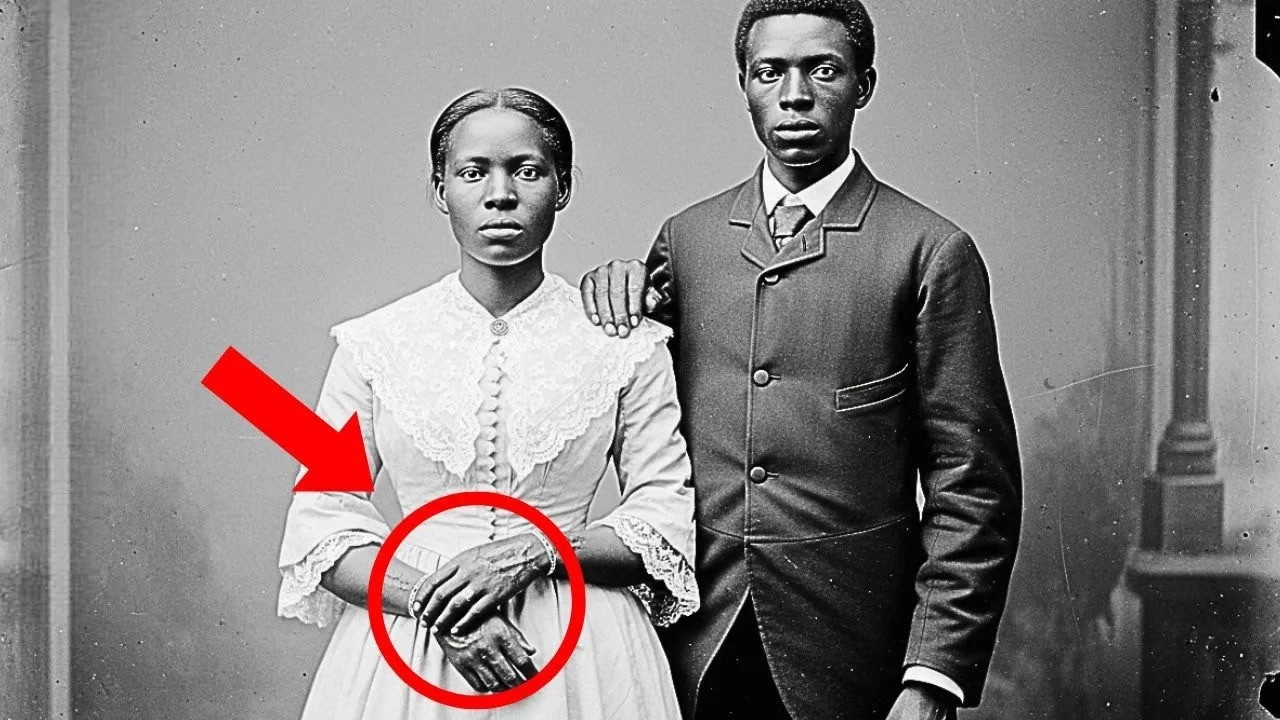
These were not the faint creases of age, nor the little nicks that come from kitchen mishaps. These belonged to the category of scars left by serious burns, repeated injury, and healing that had never been treated. The bride had placed her hands with great intention, Evelyn now realized, presenting only the backs and edges where the scarring showed least, hiding her palms and the worst of the harm. But the scan laid all of it bare.
The puckered skin, the drawn-in fingers, the proof of pain that no amount of careful posing could entirely conceal. It was February 2024, a cold morning in Washington, D.C., and Evelyn, a medical historian at the Smithsonian’s National Museum of African-American History and Culture, had studied more wedding photographs from the post-Civil War years than she could count.
Yet this one image had stopped her cold the instant she first laid eyes on it. The photograph had come to the museum as part of a donated collection from a church in Charleston, South Carolina. It pictured a young Black couple on their wedding day, dated on the reverse in faded ink: June 14th, 1868. For its age the image was extraordinarily well preserved, printed on heavy card stock that had rested carefully inside a family Bible for more than a hundred and fifty years.
The bride stood at the left, in a plain but elegant dress of pale fabric, most likely her best dress, adapted for the day with lace added at the collar and cuffs. Her hair was drawn back tightly from her face, bringing out high cheekbones and eyes that looked straight into the camera with a force that reached across the decades. Beside her stood the groom, one hand resting formally on her shoulder, in a dark suit that looked a little too big, probably borrowed for the occasion. His face was solemn and dignified, bearing the weight of a moment he plainly recognized as historically important.
This was 1868. Only three years after slavery ended. Only months after the Fourteenth Amendment was ratified, granting citizenship to people who had once been enslaved. Evelyn leaned back in her chair, her thoughts racing.
This was no ordinary wedding photograph. It was evidence. A record of violence, of labor, of survival. And the bride had understood precisely what she was doing when she arranged her hands for this portrait, composing an image of grace and dignity while bearing the permanent marks of all she had endured.
She devoted the next hour to scrutinizing every detail of the enlarged image. The scarring was widespread and plainly old. The tissue had the settled, healed look of injuries suffered years before the photograph was taken. The scars clustered on her palms and fingertips, with further marks visible at her wrists where the high-resolution scan could see under the lace cuffs of her dress.
The pattern told its own story. These were not random burns. Their concentration on the palms and fingers pointed to repeated contact with hot surfaces. The sort of injuries a person would suffer from handling hot metal, working beside open flames, or being made to touch heated objects as a punishment.
The scarring at the wrists showed a different pattern. Linear marks suggesting restraints, rope burns, or shackles that had bitten into the skin during a struggle. Over her years as a medical historian, Evelyn had pored over the documentation of slavery at length. She had read eyewitness accounts of the punishments inflicted on enslaved people: branding, whipping, burning, mutilation.
She had studied photographs of formerly enslaved people taken by photographers in the 1860s and 1870s, images that recorded the physical proof of their suffering, scarred backs, missing fingers, branded skin. But those photographs had been made expressly to document abuse, to gather evidence for abolitionist advocacy, to shock northern audiences into grasping the reality of slavery. This wedding photograph was something else. Here was a woman choosing to be photographed on what should have been the happiest day of her life, bearing scars she could never fully conceal, yet arranging herself to project dignity rather than damage.
Evelyn reached for the phone and called Dr. Marcus Webb at the Atlanta Historical Society. Marcus had grown into her closest colleague through years of joint research, and his knowledge of post-Civil War African-American history had no equal. “Marcus,” she said when he picked up, “I need you to take a look at something.
I have a wedding photograph from Charleston, 1868. A Black couple only three years after emancipation. And the bride, Marcus, her hands are covered in burn scars. Severe, extensive scarring that she’s trying to hide in the photograph.
“
“Send me the image,” Marcus said at once, his voice tight with interest. Evelyn emailed the high-resolution scan, then waited while Marcus opened it on his end. She heard his sharp intake of breath as he zoomed in on the bride’s hands. “Jesus Christ,” he whispered.
“What did they do to her?”
“That’s what we need to find out. The photograph came from a church in Charleston, Mount Zion. It was kept in a family Bible donated to the church’s historical collection.
There’s a date on the back, June 14th, 1868, but no names.”
“Charleston in 1868,” Marcus said slowly. “Three years after the war ended. The city was under Union occupation.
The Freedmen’s Bureau was active. Black people were voting, marrying legally for the first time, registering their families.”
“This couple, they would have been enslaved just three years before this photograph was taken.”
“And those scars,” Evelyn said, “they’re old.
Healed for at least several years. Whatever happened to her hands, it happened during slavery.”
For a moment neither of them spoke, both looking at the image of the young bride, her scarred hands carefully arranged, her eyes gazing across more than a century and a half with an expression that now seemed less like simple dignity and more like defiance. “We need to find out who she was,” Marcus said at last.
“We need to tell her story.”
Marcus arrived in Washington two days later, bringing boxes of documents from Charleston archives: marriage registers, Freedmen’s Bureau records, church membership rolls, and newspaper clippings from the turbulent years after the Civil War. He spread them across Evelyn’s office table, assembling a timeline of Black life in Charleston in the late 1860s. Charleston in 1868 was a city in transition.
The war had wrecked the economy. The planter class had lost everything. And all at once, four years after emancipation, Black people were citizens. They were voting, holding office, starting businesses, and above all, getting married.
Marcus slid a Freedmen’s Bureau document across the table: Register of Marriages of Freed People, Charleston District, 1865–1869. Inside the ledger were hundreds of entries, couples once enslaved making official unions that had never carried any legal weight under slavery. “Getting married was among the first things folks did once they were free,” Marcus said. “Under slavery, a marriage between enslaved people counted for nothing in the eyes of the law.
A family could be torn apart without warning. But from 1865 onward, marriage carried real meaning. Legal protection, the right to inherit, the chance to claim your children as your own. It was a way of declaring that you were human.
“
Evelyn went through the register searching for entries dated June 14th, 1868. On that single day she counted seventeen marriages. Likely a popular date because it landed on a Sunday. Most of the entries gave only first names, or names that had plainly been taken up after freedom.
Enslaved people had frequently been refused surnames, or had been made to carry their owners’ names. One entry stopped her: Thomas Freeman and Patience, both formerly enslaved, married June 14th, 1868, Mount Zion Church, Charleston. Witnesses: Reverend Samuel Green, Mary Freeman. “Freeman,” Evelyn said out loud.
“That was a surname a lot of formerly enslaved people chose to take.”
“It was a statement,” Marcus agreed. “Choosing the name Freeman told the world you belonged to nobody anymore. And notice, they married at Mount Zion, the very church that donated the photograph.”
“
Hope rose in Evelyn. Thomas Freeman and Patience. It could be them. “But we still need more proof.”
“
Marcus drew out another document. “The 1870 federal census for Charleston. I’ve already gone through it. There’s a Thomas Freeman, Black, age 28, working as a carpenter and living on Society Street, and in the same household, Patience Freeman, Black, age 24, listed as keeping house.
“
“That’s them,” Evelyn said under her breath. “It has to be.”
But Marcus looked uneasy. “There’s something more in the census record.
A note written beside Patience’s name.” He indicated faint handwriting in the margin: “Hands damaged, unable to perform fine work.”
Nobody spoke. That one note, jotted down by a census taker in 1870, verified what the photograph had already shown.
Patience Freeman’s hands had been hurt so badly that a stranger could see it, serious enough to set down in an official government record. “What sort of work does that to a person’s hands?” Evelyn asked, though she had a feeling she already knew. Marcus produced a thick folder of documents he had gathered on Charleston’s antebellum economy.
Charleston’s wealth flowed from several places: rice plantations along the low country, cotton plantations further inland, and within the city itself, iron works, foundries, and turpentine distilleries. Enslaved people labored in every one of them. “But the work that would leave burns like the ones in that photograph—” He opened the folder to an 1850s business directory. “Before the war there were three big iron works in Charleston.
The Charleston Iron Works, the Palmetto Iron Works, and Bennett’s Foundry. All three ran on enslaved labor.”
Evelyn grasped it at once. Iron works meant dealing with red-hot metal, toiling beside blast furnaces, pouring molten iron into molds.
The labor was savage and hazardous, inflicting terrible burns and injuries that frequently went untreated. “We have to establish whether Patience worked at one of those iron works,” she said. “We need to learn what happened to her hands.”
The Charleston Iron Works had ranked among the biggest industrial operations in the antebellum South, with more than two hundred workers, the majority of them enslaved, turning out tools, machinery, and munitions.
The site had been partly wrecked during the Civil War, yet its business records endured, kept among the collections of the South Carolina Historical Society. Marcus devoted three days in Charleston to reviewing those records while Evelyn carried on her research in Washington. The iron works had maintained painstaking records: production logs, inventory sheets, and, troublingly, a ledger of enslaved workers hired from their owners to labor at the facility. He phoned Evelyn on a Thursday evening, his voice unsteady.
“I found her. Patience. She appears in the Charleston Iron Works hiring records from 1859 to 1864.”
“What do the records say?
“
“Her owner, a man called Robert Middleton, hired her out. He had a rice plantation outside Charleston, and he also hired out his enslaved workers to the city’s industrial operations for extra income. Patience is listed as working in the mold pouring section. That’s where molten iron got poured into casts to make finished products. It was among the most dangerous jobs in the whole iron works.
“
Evelyn shut her eyes, picturing a young girl. In 1859 Patience would have been just thirteen, made to work near furnaces reaching temperatures above two thousand degrees, handling tools and materials that could inflict devastating burns with one wrong move. “There’s more,” Marcus went on, his voice strained. “The iron works kept injury records.
I came across several entries for Patience between 1860 and 1863. February 1860: Patience burned hands from splashed iron, treated with lard, three days recovery. August 1860: Patience burned right palm from hot tongs, no treatment, return to work. November 1861: Patience, severe burns both hands from spilled molten metal, treated by Dr.
Simons, two weeks recovery before return to work.”
“They kept burning her,” Evelyn said, horror and fury tangled in her voice. “And they kept sending her back.”
“The final entry is from March 1863.
It reads, ‘Patience, extensive burns to hands and wrists from accident at furnace. Hands permanently damaged, reassigned to cleaning and sorting work.’ After that, she vanishes from the hiring records. Middleton most likely quit hiring her out because her hands were too damaged for industrial work.
“
Evelyn thought about the wedding photograph taken only five years after that last injury. Patience had been twenty-one when she married Thomas Freeman, her hands bearing the lasting proof of four years of brutal labor that had begun when she was barely a teenager. “We need to learn more about her life,” Evelyn said. “Not just what was done to her, but who she became afterward.
She came through those injuries. She lived through slavery and emancipation. She married and built a life. That’s the story we need to tell.
“
Uncovering Patience Freeman’s own voice turned out to be surprisingly possible through a source Evelyn hadn’t expected: the testimonies the Freedmen’s Bureau gathered in the years after emancipation. The bureau had recorded thousands of cases of formerly enslaved people seeking payment for unpaid wages, help reuniting families, or legal recognition of their marriages and children. At the National Archives, Evelyn came across a testimony Patience Freeman had given in November 1868, only five months after her wedding. She had submitted a claim asking for compensation for her years of labor at the Charleston Iron Works.
A bureau agent named Jonathan Webster had taken down the testimony, and it survived in striking detail. “Testimony of Patience Freeman, colored, formerly enslaved by Robert Middleton of Charleston District, given November 18th, 1868. I am 22 years old. I was born on Mr.
Middleton’s plantation, but when I turned 13, he hired me out to the Charleston Iron Works. I worked there from 1859 until 1863. My job was helping pour the melted iron into molds. It was hot work and dangerous.
A lot of people got burned. I was burned many times. The first time was just a splash on my hand. It hurt something awful, but they put grease on it and made me go back to work the next day.
After that, well, I got burned more times. Small burns and then bigger ones. The masters didn’t care much about burns unless you couldn’t work. In 1863, there was an accident.
A crucible of melted iron tipped over and splashed on my hands and arms. I screamed and fell down. They took me to the doctor who said my hands were ruined. The skin came off in sheets, and when it grew back, it was hard and tight.
I couldn’t open my fingers all the way anymore. I couldn’t hold small things. My hands hurt all the time for two years. Mr.
Middleton was angry because I couldn’t work at the iron works anymore. He put me to cleaning rice and sorting bowls, but I wasn’t worth as much money to him with damaged hands. When freedom came, I was glad because I thought I wouldn’t have to work at hot iron anymore. I am married now to Thomas Freeman, who is a carpenter.
I keep house for him, but my hands make it hard to do fine cooking or sewing. I am filing this claim because I worked for four years at the Charleston Iron Works and never got paid one cent. All the money went to Mr. Middleton.
I think I should get something for my labor and for my hands that got ruined in his service. ”
Signed with her mark, as Patience cannot write due to hand injuries. Evelyn read the testimony three times, tears streaming down her face. Patience’s voice came through across 156 years with heartbreaking clarity, matter-of-fact about the horror she had endured, seeking not sympathy but compensation, describing her damaged hands with the practical acceptance of someone who had learned to live with permanent injury.
The phrase “signed with her mark” particularly struck her. Patience couldn’t write, whether because she had never been taught or because her scarred hands couldn’t hold a pen. The testimony didn’t specify. But she had made sure her story was recorded.
She had pursued a legal claim for justice, even though she must have known the chances of receiving compensation were slim. Marcus found the outcome of the claim in the bureau’s resolution records. Claim denied. No legal obligation to compensate for labor performed during slavery.
Petitioner advised to seek redress through civil courts if desired. Patience had received nothing. The hands that had been ruined in Robert Middleton’s service, the years of brutal labor, the permanent disability, none of it entitled her to compensation under the legal framework of 1868 America. But she had tried.
She had stood before a Freedmen’s Bureau agent and told her story, had it recorded in official documents, made herself visible in the historical record as more than just a nameless victim. And six months before that testimony, she had stood before a photographer with Thomas Freeman and created another kind of record: a wedding photograph that showed her not as a damaged worker seeking compensation, but as a bride, a woman building a new life, someone who had survived and was claiming her right to dignity, love, and legal recognition of her marriage. While Evelyn focused on Patience’s testimony, Marcus traced Thomas Freeman’s story through carpentry records and city directories. What he found added crucial context to the wedding photograph and helped explain how Patience had found not just a husband but a partner who understood the weight of what she carried.
Thomas appeared in Freedmen’s Bureau records from 1865, immediately after Charleston’s liberation. He had filed for a certificate of freedom and registered his name: Thomas Freeman, age 25, formerly enslaved by the estate of Charles Morrison. The records noted his occupation as skilled carpenter, trained in furniture making and construction. But it was Thomas’s own testimony, given in 1867 when he petitioned to establish a carpentry workshop, that revealed his connection to Patience’s experience.
“I learned carpentry working at Morrison’s furniture workshop in Charleston. I was trained from age 12 to make fine furniture for white families. Morrison hired me out to other carpenters and kept all my wages. In 1861, when the war started, Morrison contracted my labor to the Confederate government.
I was sent to build fortifications and gun carriages. For three years, I worked building war machines. I saw terrible things. Many men died building those fortifications.
Shot by Union guns, killed in accidents, worked to death. I survived because I had a skill they needed. In 1864, I was assigned to work at the Charleston Iron Works, making wooden molds and patterns for the foundry. That is where I met Patience.
She worked pouring the melted iron into the molds I built. I saw what that work did to people’s hands and bodies. I saw Patience get burned badly. I saw them make her keep working even when her hands were wrapped in bandages.
When freedom came in 1865, I promised myself I would use my carpentry skill to build a good life. I also promised that if Patience survived the war, I would find her and ask her to marry me, because I saw her courage every day at that iron works. I saw her keep working even with damaged hands. I saw her help other workers, teaching them how to avoid burns, how to handle the hot metal safely.
She was the bravest person I ever knew. ”
Marcus called Evelyn as soon as he found this testimony. “They knew each other during slavery,” he said, his voice thick with emotion. “Thomas watched Patience suffer those injuries.
He witnessed what the iron works did to her. And he spent three years after emancipation searching for her so he could marry her. ”
Evelyn understood immediately what this meant for the wedding photograph. Thomas’s hand on Patience’s shoulder wasn’t just a formal pose.
It was a gesture of protection and support from someone who understood exactly what her scarred hands represented. He had seen her burned. He had watched her suffer. And he had chosen to build a life with her anyway.
Not despite her damaged hands, but in full knowledge of the courage it had taken to survive. “The photograph takes on completely new meaning,” Evelyn said. “This isn’t just a wedding portrait. It’s a reunion.
Two people who survived slavery together, found each other in freedom, and chose to create a legal, recognized marriage. Thomas knew about her hands. He testified about seeing her burned. And he married her and built a life with her.
”
“There’s more,” Marcus said. “I found Thomas’s business records from his carpentry workshop. Between 1868 and 1890, he employed over thirty people, all formerly enslaved, many of them disabled or injured. There are notes in his account books.
James, who was missing his right hand, learned to plane wood using only one hand. Samuel, whose arms bore burns, was put to sanding and finishing. Thomas built a workshop expressly meant to hire people whose injuries had made them, in the eyes of others, unemployable.”
“He was constructing the world he wished Patience could have had,” Evelyn said quietly.
“Precisely. And Patience worked alongside him. I came across mentions of her in his business letters. Her damaged hands kept her from fine carpentry, but she oversaw the workshop’s finances, negotiated contracts, and dealt with customers.
They were partners in every way.”
The 1870 census that had first established Thomas and Patience Freeman’s identities also turned up another key detail Marcus had missed at first. Thomas Freeman, head, age 28, carpenter. Patience Freeman, wife, age 24, keeping house.
Clara Freeman, daughter, age 1. They had a daughter. She was born in 1869, only a year after their wedding. Clara Freeman was the first in her family to be born into legal freedom.
She was born to parents whose marriage the law recognized. She was born into a home led by a skilled craftsman and run by a woman who had endured the worst of slavery’s brutality. Evelyn followed Clara Freeman through later censuses and city directories. In 1880, at eleven, Clara was listed as attending school—a plain notation that carried tremendous meaning.
Patience, who at thirteen had been forced into labor at an iron works, had made certain her daughter got an education instead. By 1900, Clara Freeman had married a teacher named James Stevens and was living in Philadelphia, part of the Great Migration of Black southerners seeking better opportunities in northern cities. The census recorded her occupation as seamstress, fine work—a job that demanded the precise hand coordination her mother’s scarred hands could no longer manage. Marcus found Clara’s name in another unexpected place: the records of the Philadelphia chapter of the National Association of Colored Women, an organization founded in 1896 to advocate for Black women’s rights and social welfare.
Clara joined in 1901 and served on the committee for industrial education, advocating for job training programs for young Black women. In 1908, Clara spoke at the organization’s annual convention. The speech was preserved in the organization’s archives, and one passage made both researchers stop breathing. “My mother’s hands were destroyed by slavery.
She worked at an iron works in Charleston, pouring molten metal, and the work burned her hands so badly that she carries the scars to this day. She cannot sew fine seams or write letters or do many tasks that require delicate finger work. But she raised me to value education and skill. She made sure I learned to do the work her damaged hands prevented her from doing.
And she taught me that survival is not enough. We must build lives of dignity and purpose. We must create opportunities for the next generation that were denied to us. My mother’s scarred hands built my future.
I carry your courage with me every day.”
Evelyn and Marcus sat in silence after reading that passage. The wedding photograph from 1868, taken before Clara was born, had captured the moment when Patience and Thomas chose to create that future: to build a family, to establish a legal marriage, to claim their right to raise children in freedom. “We need to keep tracing the family line,” Evelyn said.
“We need to find out if any descendants are still alive. They deserve to know this story. They deserve to see that photograph and understand what it represents.”
Marcus nodded and began the painstaking work of genealogical research, following the Freeman-Stevens family through the twentieth century.
Clara had four children, all of whom attended college: an extraordinary achievement for the grandchildren of enslaved people. Her youngest daughter, Dorothy, became a social worker in Philadelphia and was active in the civil rights movement during the 1950s and 1960s. Dorothy’s daughter, Patricia Morrison, was still alive at age seventy-eight, living in Silver Spring, Maryland, just fifteen miles from where Evelyn sat in her Washington office. Marcus found her through modern genealogy databases and public records.
“We found Patience Freeman’s great-great-granddaughter,” he told Evelyn. “And she lives right here in the DC area. I think it’s time to make a call.”
Evelyn spent an hour preparing what she would say before calling Patricia Morrison.
How do you tell someone that you’ve discovered their great-great-grandmother’s wedding photograph, and that it reveals evidence of trauma and survival that has never been fully documented? How do you explain that a simple image of a bride and groom from 1868 carries a story of suffering, resilience, and triumph that deserves to be told? Patricia answered on the second ring, her voice warm and curious. Evelyn introduced herself, explained her work with the Smithsonian, and asked if Patricia had time to discuss her family history.
“I’ve been researching my family tree for twenty years,” Patricia said immediately. “I’ve traced back to my great-great-grandparents, Thomas and Patience Freeman, in Charleston, but I keep hitting walls trying to find out about their lives during slavery. I know they were enslaved, and I know they married in 1868, but I don’t know much beyond that.”
Evelyn took a breath.
“I found their wedding photograph. June 14th, 1868. Mount Zion Church in Charleston. And Patricia, the photograph reveals something about your great-great-grandmother that I don’t think the family knew.
”
She heard Patricia’s sharp intake of breath. “You found a photograph of their wedding?”
“I’m sending it to you now,” Evelyn said, emailing the high-resolution scan. “Look at the image first, then I’ll tell you what we discovered.
”
She waited while Patricia opened the file. She heard a soft gasp, then silence that stretched for nearly a minute. “That’s them,” Patricia finally whispered. “That’s really them.
I’ve never seen a picture of either of them. The family lost almost everything in a fire in the 1920s. We have stories passed down, but no photographs from that generation. This is—this is extraordinary.
”
“Now, I need you to look closely at Patience’s hands,” Evelyn said gently. “We used high-resolution scanning technology that can reveal details not visible in the original print. Zoom in on her hands, Patricia. Tell me what you see.
”
Another long silence, then Patricia’s voice, tight with emotion. “Scars. Her hands are covered in scars. Oh my god.
What happened to her?”
Over the next hour, Evelyn told Patricia everything they had discovered. The Charleston Iron Works hiring records, the injury logs, Patience’s testimony to the Freedmen’s Bureau, Thomas’s witnessing of her suffering, Clara’s speech about her mother’s damaged hands. She explained how Patience had positioned her hands in the wedding photograph to conceal the worst of the scarring, how she had built a life despite permanent disability, how she had raised a daughter who became an advocate for industrial education.
Patricia cried through much of the conversation, but they weren’t tears of simple sadness. “I knew there was trauma in our family history,” she said. “We all knew our ancestors had been enslaved, but we didn’t know the details. We didn’t know what specifically had been done to them.
My grandmother Dorothy, who was Patience’s great-granddaughter, would often remark, ‘Our people survived the unsurvivable.’ I never truly grasped what she meant until this moment.”
“There’s more,” Evelyn continued. “Your great-great-grandmother’s hands were injured, yet consider everything she accomplished regardless.
She brought up Clara. She assisted Thomas in operating his carpentry business. She handled the finances and negotiated agreements even though she couldn’t write. She endured, Patricia.
And she ensured her daughter and granddaughter received chances she herself never had.”
“The wedding photograph,” Patricia said, speaking slowly. “She isn’t concealing herself in that image. She’s standing beside Thomas, gazing directly into the lens.
She was aware her hands bore scars. She knew the photographer would notice. Yet she still posed for that photograph, because she wanted a lasting record of her marriage, her freedom, her new life.”
“Precisely,” Evelyn agreed.
“That photograph is a brave act. Your great-great-grandmother was asserting her right to be seen, to be documented, to be remembered as a bride, a wife, and a free woman—not merely as someone slavery had damaged.”
Patricia fell silent for a moment.
“When can I view the photograph myself? And what will happen to it now?”
“That’s exactly what I want to talk with you about,” Evelyn replied. Four months afterward, Evelyn stood in the exhibition hall of the Smithsonian’s National Museum of African-American History and Culture, observing visitors as they clustered around a newly installed exhibit titled “Hands That Built Freedom: The Story of Patience Freeman.
”
The 1868 wedding photograph held the center of the display, greatly enlarged to reveal both the formal elegance of the image and the painful detail of Patience’s scarred hands. Yet the photograph was not shown by itself. Evelyn and Marcus had gathered the full documentary record of Patience and Thomas Freeman’s lives: the Charleston Iron Works injury logs, Patience’s testimony to the Freedmen’s Bureau, Thomas’s petition to establish his carpentry workshop, census records documenting their growing family, Clara’s speech about her mother’s courage, and photographs of the Freeman-Stevens descendants across five generations. The focal point of the expanded display was a second photograph that Evelyn had taken just two months before.
It depicted Patricia Morrison alongside fifteen members of the Freeman family—descendants spanning four generations—assembled at Mount Zion Church in Charleston, standing on the very spot where Patience and Thomas had wed 156 years earlier. In the image, Patricia held a framed copy of the 1868 wedding portrait, closing the circle across more than a century and a half. The exhibition text recounted Patience’s story without softening the brutality she had endured, yet also without reducing her to nothing more than a victim. Patience Freeman was thirteen years old when she was compelled to labor at the Charleston Iron Works, one of the most perilous industrial operations in the antebellum South.
For four years, she worked with molten iron near furnaces reaching over two thousand degrees. She was burned again and again. In 1863, a catastrophic accident left her hands permanently scarred and disabled. Three years later, she was free.
In 1868, she wed Thomas Freeman, a skilled carpenter who had seen her suffering at the iron works and had vowed to find her after emancipation. This wedding photograph, taken on June 14th, 1868, shows Patience deliberately arranging her scarred hands to convey dignity rather than injury. But high-resolution technology exposes what she could not fully conceal: the lasting proof of slavery’s cruelty. Patience Freeman lived until 1891.
She raised a daughter who went to school and became a seamstress. She helped Thomas operate a carpentry workshop that hired formerly enslaved people whose disabilities made them unemployable elsewhere. She managed finances, negotiated contracts, and built a purposeful life despite hands that could no longer do fine work. This photograph is many things at once: evidence of trauma, a record of survival, a celebration of love and legal marriage, and a declaration that damaged hands could not destroy human dignity.
Patience Freeman stood before that camera knowing her scars would show. And she posed regardless, because she had earned the right to be photographed as a bride, a wife, a free woman building a future. Her hands built that future. Five generations of her descendants carry her courage forward.
Patricia came to the exhibition opening with twelve family members, among them her own granddaughter, seven-year-old Patience Morrison, named for her great-great-great-grandmother. The child stood motionless before the enlarged photograph, examining the face of the woman whose name she bore. “Why are her hands like that?” young Patience asked her great-grandmother.
Patricia knelt beside her namesake. “Bad people hurt her when she was young. They forced her to do dangerous work and she got burned. But she survived.
And she married and had a family. And because she was so brave and strong, you’re here today.”
The little girl reached out and touched the glass over the photograph, her small, unmarked hand resting atop the image of Patience Freeman’s scarred palm. “I’m glad she didn’t give up,” she said simply.
In the months after the exhibition opened, the story of Patience Freeman’s wedding photograph spread beyond the museum’s walls. Journalists reported on the hidden scars uncovered by technology. Medical historians examined the injury patterns to better grasp the physical cost of industrial slavery. Genealogists used the Freeman family records as a model for tracing other formerly enslaved families through scattered archives.
Yet the deepest impact came from other families who recognized themselves in Patience’s story. The museum received dozens of letters and emails from descendants of enslaved people who held their own fragments of family history: a name in a ledger, a notation in a census, a story handed down through generations but never fully documented. One letter arrived from a woman in Atlanta whose great-great-grandfather had worked at the same Charleston Iron Works as Patience. She sent a photograph of him from the 1870s, and when Evelyn scanned it with high-resolution technology, it revealed similar scarring on his hands.
Another letter came from a family in Baltimore whose ancestor had been hired out to a turpentine distillery and had lost three fingers in an accident. They possessed the employment records but had never grasped the full context until they saw Patience’s story. Evelyn launched a new project, the Scarred Hands Archive: a collection of photographs, documents, and testimonies recording the physical evidence of slavery’s violence. She partnered with Patricia Morrison, who contributed the perspective of a descendant navigating the emotional complexity of this history.
“People ask whether I’m traumatized by learning what happened to my great-great-grandmother,” Patricia said during a public panel discussion six months after the exhibition opened. “But I’m not traumatized. I’m empowered. Yes, it’s painful to see evidence of what she suffered.
But it’s also powerful to see that she survived, that she built a family, that she ensured her daughter had opportunities she never had. That isn’t a story of victimhood. That’s a story of triumph.”
She gestured toward the wedding photograph projected on the screen behind her.
“Notice how she holds herself in that photograph. There’s no cowering, no shrinking away. Her gaze meets the camera directly, her husband’s hand resting on her shoulder, her own scarred hands folded at her waist.
She’s declaring, ‘This is who I am. This is what I lived through. And I’m here to build a future.’ That’s the story I want my grandchildren to carry.
”
Evelyn came back to her office late that night, once the panel had wrapped up and the museum had shut its doors. The wedding photograph was still sitting on her desk. She kept a high-quality print there as a reminder of why this work mattered. Patience Freeman’s eyes looked out across 156 years.
And now Evelyn grasped what that stare stood for. Defiance. Survival. A refusal to be erased or whittled down to the scars on her hands.
Patience had faced that photographer in 1868, aware that the image would outlast her, aware that it would serve as proof of her existence, her marriage, her insistence on dignity and legal standing as a free woman. And she had been right. The photograph endured. It had lasted more than a century and a half, kept safe in a family Bible and given to a church, until it eventually reached a museum where technology could uncover what the first viewers never saw.
The scars Patience had tried to hide had become, thanks to historians and the power of high-resolution imaging, not a record of her victimization but a record of her remarkable courage. Evelyn opened her file of unexamined post-Civil War photographs. Dozens of images awaiting scanning, analysis, and understanding. Somewhere among them, other Patiences were waiting to be discovered.
Other hands bore other scars. Other faces looked out across the decades with stories that deserve to be told. She started scanning the next photograph, watching the high-resolution image emerge on her screen, hunting for the hidden details, the concealed evidence, the stories that had waited more than a century to be recognized and honored. Patience Freeman’s wedding photograph stayed on her desk.
Those scarred hands, visible in astonishing detail. Hands burned by molten iron. Hands denied compensation for years of labor. Hands that had raised a daughter, run a business, and built a life of dignity despite permanent disability.
Hands that had built freedom, one scarred finger at a time, one day at a time, one generation at a time. Until five generations later, a little girl named Patience Morrison could stand before a museum display and say, “I’m glad she didn’t give up.”
She never gave up.
And her hands, those scarred, damaged, resilient hands, proved it.
