The shovel hit earth a few feet down, and the men standing in the cemetery in November 2019 knew they were doing something almost unheard of in American criminal investigation. They were there with a court order to open the grave of a man who had been dead for thirty-eight years, to pull his remains into the light, and to force his body to answer a question that had haunted a family for more than four decades. The man in that grave was Bruce Lindahl, and the investigators believed—needed to prove—that he had killed sixteen-year-old Pamela Maurer in January 1976. The only way to be certain was to take a DNA sample from the dead man’s bones and compare it to the genetic fingerprint he had left on her body all those years ago.
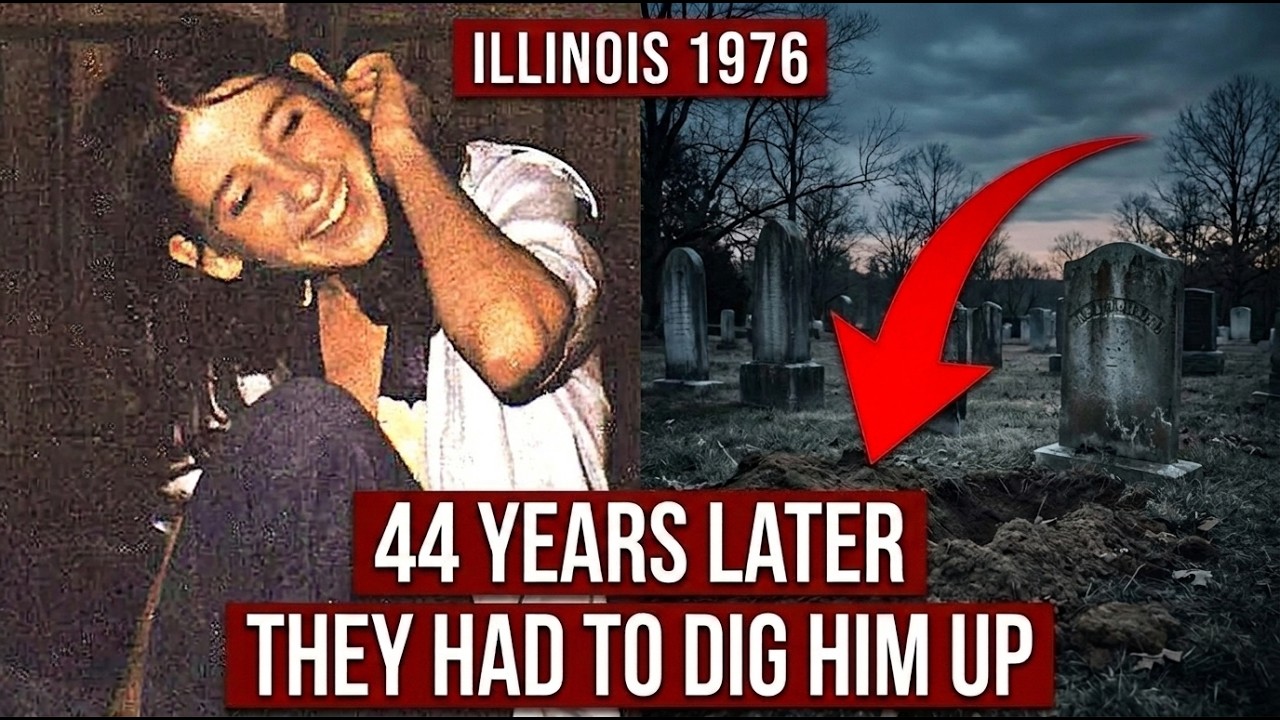
There was no other path left. Lindahl could not be arrested, questioned, or tried. He had been dead since 1981. But his body could still speak, and the science had finally caught up to the silence.
It had all begun on an ordinary winter night, the kind of night that no one in the western suburbs of Chicago had any reason to fear. On January 12, 1976, Pamela Maurer was sixteen years old, a sophomore at Downers Grove South High School, living in Woodridge, Illinois, one of those sprawling bedroom communities west of the city. By every account she was a normal, beloved teenager, spending her evenings with friends the way teenagers did in those years, living in a world where she felt completely safe. One of her old friends put it plainly decades later: in those days, there were no such fears.
Kids walked at night alone. Nobody thought twice about it. You went to a friend’s house. You walked down the street to get a soda.
Then you came home. That was life in that town in those years. That was the world Pam walked into on the night of January 12, 1976. She was at a friend’s house, and at some point in the evening she decided to walk to a nearby McDonald’s to buy a soda.
That was the whole errand. A Coca-Cola from a place a short walk away, on a cold January night. She told her friends where she was going, and she left. They watched her go.
She stepped out into the darkness, heading toward the McDonald’s a short distance away. She never came back. When she didn’t return home, her parents called the police that same night. By the next morning, the worst had happened.
A passing driver spotted a purse on the side of College Road near Maple Street in Lisle. It was Pam’s purse. Nearby, just behind a guardrail, was Pam herself. For her family, the details of those hours were unforgettable.
You call the police because your teenage daughter hasn’t come home. You convince yourself she lost track of time, that she’s still at her friends’ house, that there’s an ordinary explanation waiting for you once the night is over. You wait in the dark, and then a stranger finds a purse on the roadside, and by dawn the ordinary explanation has evaporated forever. The scene had been staged.
Her body had been arranged to look as though she had been struck by a car and left there. But the medical examiner’s finding told a different and darker story. Pam had been assaulted and killed. A sixteen-year-old girl, on a five-minute errand to buy a soda, had been abducted, attacked, and placed on the roadside to buy time for her killer.
Then he vanished. No witnesses. No name. Just a murdered teenager, a staged scene, and a suburb about to discover that its safe, open world had never been as safe as it believed.
The investigation hit the wall that every case hit in that era. DNA testing did not exist; it would not become an available tool for another decade. There were no cameras, no databases. What the police had was a staged roadside scene, a grieving family, and a town flooded with new fears.
And Pam was not alone. Her murder came in the middle of a wave, a series of young women killed in those western suburbs in the mid-1970s. Each one young, each one struck down alone. To understand how such a murder could go unsolved, you have to imagine those years.
In that cluster of towns—Woodridge, Lisle, Downers Grove, Aurora—girls were being found dead one after another, and the residents felt it. At one point, a Chicago newspaper ran a headline that said, in plain and terrifying words, that people were getting away with murder in the suburbs. That was the world Pam’s family lived in on the night she didn’t come home—a place where the usual safety everyone had quietly assumed was gone, and no one could say who was behind it. Her case was worked exhaustively, and then, like so many others in that wave, it went cold.
Investigators kept the file open and followed every available lead, but the years piled up, the leads dried out, and the original detectives retired. Pam’s family was left with only one thing that made grief bearable. They left. They moved to Texas, a thousand miles from the road where their daughter was found, and tried to build a new life away from an unanswerable question.
Her father made his peace with it in a painful way. He assumed, as so many families do, that he would die without ever knowing who killed his little girl. But the police had done something crucial in 1976: they had preserved the evidence taken from Pam’s body. And here was the thing her killer never knew he had left behind.
On Pam’s body was his DNA, decades before anyone alive could read it. A perfect, silent fingerprint kept in an evidence locker, waiting for a science that hadn’t been invented yet. The answer to the question of who killed Pamela Maurer was already there. All it took was forty-four years, a revolution in forensic science, and eventually a shovel to read it.
The first thread appeared in 2001. By then, DNA testing was a reality, and it was precise. Investigators pulled the preserved evidence and created a full DNA profile of Pam’s killer. His genetic code had been recovered a quarter century after he thought he had disappeared.
They ran it through CODIS, the national database that matches crime-scene DNA against known criminals. Nothing. No match. The killer was not in the system, which meant either he had never been arrested for an offense requiring his DNA to be taken, or he was already dead and outside the database’s reach.
They had his genetic fingerprint, but there was no one on earth to connect it to. For nearly twenty more years, it sat there. A perfect answer to a question no tool of that time could ask. Pam’s father kept waiting in Texas.
The evidence kept waiting in Illinois. Imagine what that was like for the investigators who inherited this case. To hold, in a sealed envelope, the exact genetic identity of the man who killed a sixteen-year-old girl. To be able to read his code letter by letter, and yet be no closer to his name than the officers who stood at that guardrail in 1976.
The answer was right in front of them. But they didn’t yet live in a world that had the key. Then, in 2019, everything changed, because two new sciences finally unlocked what that evidence had been hiding all along. Investigators sent a DNA sample to a specialized laboratory called Parabon Nanolabs, and to genetic genealogist CeCe Moore, one of the people whose work had helped catch the Golden State Killer.
Parabon did something that still sounds like science fiction. Using only the killer’s DNA—no photo, no name, no witness—they predicted what he looked like: his probable eye color, skin color, hair, even the shape of his face. They built an image of a killer from nothing but his genetic code, and that image produced a face. Think about how strange this is.
It wasn’t a sketch from a witness. There was no witness. The code itself, the one that determines whether a person has blue or brown eyes, a wide jaw or a narrow one, is written into every cell he left behind. By reading enough of it, you can reverse-engineer the human being it came from and draw the face of a stranger you have never seen.
That is what they did with the traces on Pam’s body. They asked her killer’s DNA what he looked like, and it answered. Then came the second science: investigative genetic genealogy. Your DNA isn’t only yours.
You share pieces of it with cousins you have never met. So even if the killer himself was in no database, his relatives could be traced through public genealogy sites. The genealogists built a family tree branch by branch, narrowing it down until it pointed to one man. His name was Bruce Lindahl.
This is the part people underestimate about how these cases get solved. DNA doesn’t come with a name. What the genealogists found in those databases were distant relatives—second and third cousins, people who spit into a tube to learn about their ancestry and had no idea they were about to help catch a killer. From those scattered matches, the team built a sprawling family tree, then worked their way down its branches, asking at every junction: who in this family was the right age, in the right place, in 1976?
The tree kept narrowing, generation by generation, until only one man remained at the bottom. When investigators pulled an old photo of Bruce Lindahl from his high school yearbook and put it next to the face the DNA analysis had drawn, the resemblance was striking. Imagine what that meant. A machine had read a killer’s genetic code and drawn his portrait, and it matched a real photograph of a real man taken decades earlier.
They had found not just a name, but a face that the DNA itself had predicted. But there was a hard problem. Bruce Lindahl could not be arrested. He could not be interrogated.
He could not be held accountable for anything, because Bruce Lindahl had been dead since 1981. He had died young and violently, in a way that tells you almost everything about him. In 1981, Lindahl was attacking and killing someone else—an eighteen-year-old young man—when he was fatally wounded by his own hand during the struggle. He died there, at the end of his crime, nearly forty years before anyone linked him to Pamela Maurer.
Genealogy had given investigators a name, and phenotyping had given them a face, but a name and a face are not proof. To establish scientifically, beyond any doubt, that Bruce Lindahl killed Pamela Maurer, they needed to compare his DNA directly to the DNA he had left on her body in 1976. And Lindahl’s DNA existed in only one place on earth: his grave. So, in November 2019, investigators obtained a court order and took the rare and staggering step this whole story had been quietly moving toward from the start.
They exhumed Bruce Lindahl’s body. They took a direct DNA sample from the remains of a man who had been buried for thirty-eight years, and compared it to the genetic fingerprint he had left on Pamela. Consider how extraordinary that step was. Police solve cases by interrogating suspects, searching homes, matching fingerprints and fibers and DNA against living people.
They do not, as a rule, get a judge’s permission to open a grave and dig up a corpse to interrogate it. It is one of the rarest procedures in criminal investigation, a last resort—and it was the only remaining option in this case, because the only man who could answer for Pamela had made himself unreachable in the only way a person truly can. He had been dead and buried for nearly forty years. The evidence matched.
The odds that this evidence belonged to anyone else on earth were one in 1. 8 quadrillion. In the end, the buried man testified against himself. And with that match, the full picture of Bruce Lindahl emerged—and it was far worse than a single murder.
When Lindahl died in 1981, police found something disturbing in his home: photographs, dozens of them. Pictures of young women. In the years that followed, as investigators reopened his file with fresh eyes, they came to believe Pamela Maurer was not his only victim. Bruce Lindahl was likely a serial killer who had moved through those same western suburbs during the 1970s, targeting young women who were alone.
On the surface, Lindahl had looked like no one in particular. He was from Aurora, attended a local high school, and held ordinary jobs, including teaching at a vocational school for a period. He had a criminal record, but he had never served real prison time. He kept slipping through the cracks, and he was obsessed with cameras.
The photographs, more than anything else, showed the police who they were dealing with after his death—a wall of young women’s faces that no one could fully explain. His name began to surface alongside other cases. A young woman accused him of assaulting her violently, then disappeared just two weeks before she was due to testify against him; her body was later found in a shallow grave. Another teenage girl vanished in 1979, and her photograph was found among his belongings.
Investigators publicly appealed for anyone who had known Bruce Lindahl to come forward, because they no longer believed they knew the full scope of his crimes. He had escaped all punishment, having died young, before the science that exposed him ever existed. For forty years, Bruce Lindahl had been a faceless monster. Until Pam’s DNA revealed the truth.
On January 13, 2020—exactly forty-four years after Pam’s body was found—the DuPage County State’s Attorney stood at a press conference and announced that her murder had been solved. It was the first murder in the history of Illinois to be solved using this kind of genetic genealogy, a genuine historic achievement. It is hard to overstate what that meant. Just two years earlier, the world’s first case of its kind had unmasked the Golden State Killer, and within a short time the same technique had begun quietly cracking dozens of cold cases across the country.
One hundred names had finally been linked to killers who had counted on decades to protect them. Pam’s case was the moment that revolution reached Illinois. A teenager on her way to buy a simple soda in 1976 had become, in a strange and unexpected way, a landmark in American forensic history—her state’s first murder finally solved through a family tree and a grave. But the most important moment did not happen at that podium.
It happened quietly a few weeks earlier, during the holidays, off-camera. Before the announcement, investigators from Lisle boarded a plane and flew to Texas, to the family who had moved a thousand miles away to survive this. They sat down with Pam’s father and brother and told them, in person, that after forty-four years, they finally knew who killed Pam. Her father had long given up waiting for this day.
What he felt, as the investigator put it, was mostly gratitude—not because the killer would be punished, because he never would be now, but because someone had not forgotten his daughter. That she had not died in vain. That after all these decades, there were still people who cared enough about her to bring them the truth. There would be no trial.
Bruce Lindahl had been dead for thirty-nine years. But Pam finally had her answer, and her family finally had a place to put the question. One of Pam’s old friends, who knew her in those early days, said something unforgettable. She said what mattered to her was simply that Pam was not killed in vain, and that the man responsible had finally been exposed, even if he was never held accountable.
That is the quiet truth at the heart of so many of these cases. For those who loved Pam, revenge was not what they needed in the end—revenge was no longer possible. What they needed was human dignity: to know the truth, to say his name and her name out loud, and to close a file that had been open for their entire lives. So the story returns to where it began: a sixteen-year-old girl on an ordinary January night, walking down the road to buy a soda.
Everything in this story is a collision between something very small and something very large—a trivial errand and a monster, a teenager’s five-minute walk and forty-four years of silence. And in the end, what closed that distance forever was something no one standing on that roadside in 1976 could have imagined: that a killer’s corpse, buried and forgotten for decades, could be pulled into the light and forced to confess in the one language a person cannot lie in. There is something like justice in that. Bruce Lindahl spent his whole life certain he had gotten away with it, and he died still certain.
He outlasted every investigator, every courtroom, every ordinary path to capture. None of it saved him, because the truth was written on Pam all along, simply waiting for him. It outlasted his escape. It outlasted his death.
It outlasted the grave itself. Pamela Maurer was sixteen years old. She had friends and family who loved her, and a perfectly ordinary errand that was supposed to end with her walking back through the door, a glass of soda in her hand. She should have come home.
It took forty-four years and an exhumed grave, but the world finally knows who took her, and it finally knows her name. For the other families—those whose daughters may have crossed his path too—that same truth is still working for them. Pam was sixteen years old, and for forty-four years the world did not know who stole her from her family.
Now it does.
