It had taken a full week to cut the channels, and now the block stood free of the mountain on three sides, undercut along the bottom, a solid slab of white stone eighteen feet long, eight feet wide, and six feet thick. One hundred seventeen thousand pounds of Vermont marble, nearly fifty-nine tons, resting on a bench carved into the slope twelve hundred feet above the valley floor. The finishing mill waited three miles down the mountain at six hundred feet, and between them lay a dirt road with grades that reached eighteen percent in places, stretches so steep that a man walking downhill had to lean backward to keep from pitching forward. The stone carried delicate gray veining that would make it worth a fortune once it reached a market, but the stone did not care whether it ever got there.
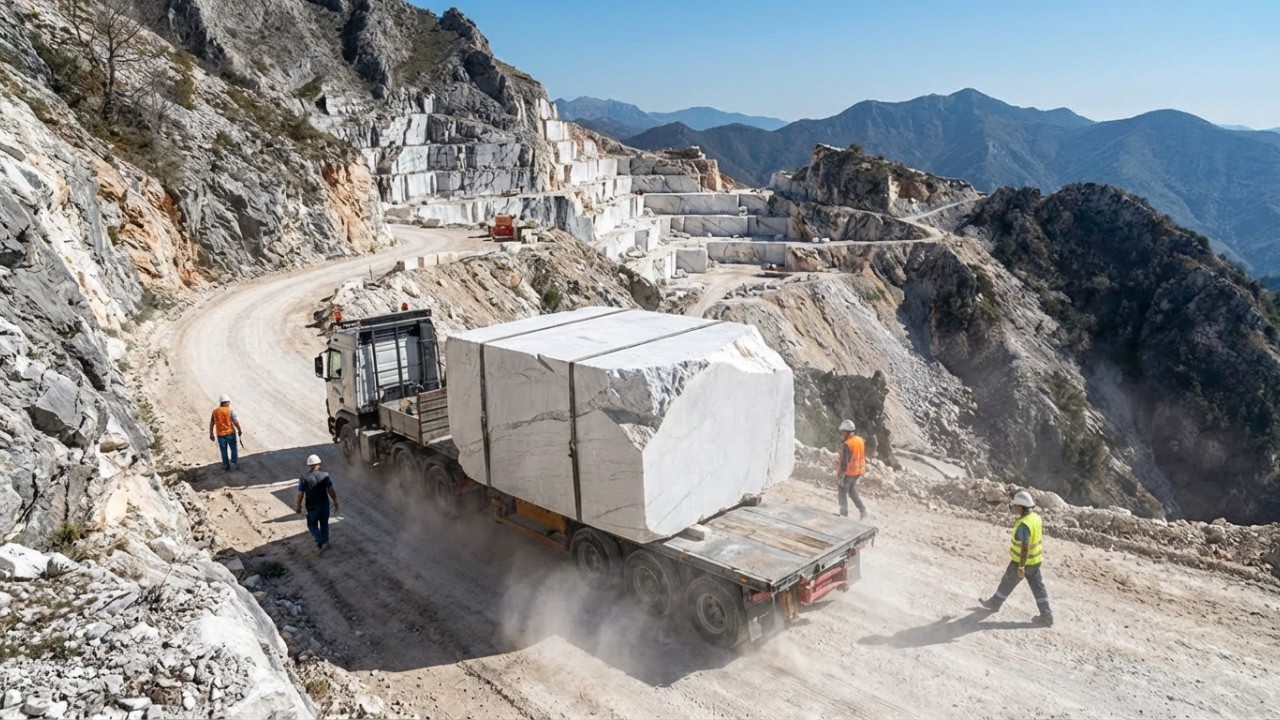
It had killed men before and it would kill men again. This was the problem that confronted every quarry crew in the marble beds above Rutland and Proctor, Vermont, in the winter of 1893. There were no engines and no trucks. There were derricks, rail, cable, horse teams, and arithmetic so unforgiving that a single mistake meant a block reduced to rubble, a team crushed, or a man buried.
The men who worked the quarries understood the equation completely. The stone did not threaten them. It simply did not care. Marble is metamorphic limestone, sedimentary rock compressed and heated over millions of years until the calcium carbonate recrystallized into tight, interlocking grains.
The result is dense and hard, and in its best deposits it is white, a pure white capable of taking a polish so fine it looks wet even when dry. In the late nineteenth century, a nation building monuments, government buildings, banks, and mansions prized marble above all other stone. Granite and sandstone could be cut, but they could not match marble’s capacity for precise carving and that deep, reflective finish. The best marble in North America lay in Vermont, beds of stone hundreds of feet thick that outcropped on the mountainsides in vertical white faces, exposed and ready to be quarried without the heavy stripping that buried most other deposits.
It looked almost generous. Almost. The quarries were open pits carved into the mountainside. Crews stripped away the overburden with shovels, pickaxes, and wheelbarrows, removing soil and broken rock until the marble bed lay exposed.
Then the real work began. The stone was too hard and too valuable to blast from the mountain with powder; a shattered block was a destroyed product. The goal was to remove intact blocks, massive pieces that could be cut and finished into slabs and carved elements. To do that, quarrymen used a method older than the United States itself.
They cut channels. A channel was a narrow cut, three or four inches wide, carved vertically into the marble face. The work was done by hand with a gad, a steel bar with a chisel tip, hammered into the stone again and again. Two men worked a channel, one holding the bar steady, the other swinging an eight-pound sledgehammer.
Strike. Turn the bar a fraction. Strike again. The ringing of steel on steel echoed off the quarry walls hour after hour.
A single channel ten feet deep and twenty feet long could take a crew a week to carve, and a block required multiple channels: one on each side, a horizontal channel along the bottom to undercut the block, sometimes channels on the back to separate it from the bedrock. Once the channels were complete, the block was separated with wedges and feathers, a technique borrowed from ancient stonemasons. Workers drilled holes along the line where the stone was meant to split. Into each hole they inserted a pair of curved steel shims, the feathers, and between them a wedge.
The wedges were driven in with sledgehammers, slowly and carefully, with even pressure spread across all the holes. As the wedges sank deeper, pressure built inside the stone. First came a creaking, then a crack, sharp and loud, and the block split cleanly along the line of holes. Done correctly, the fracture surface was so flat a straight edge could be laid across it.
Done wrong, the block shattered into useless fragments and weeks of work were lost. The block now rested on the quarry floor, still weighing fifty or sixty tons. Moving it required a derrick. Quarry derricks were massive wooden A-frame towers built from timbers twelve inches square, standing thirty or forty feet tall with a boom extending out over the stone.
A steel cable ran through a pulley block at the top of the boom, powered by a steam winch, or in smaller operations a horse-powered capstan. The crew attached slings, heavy chains or cables looped under the stone, and this part was delicate. A sling positioned incorrectly could let the block shift during the lift, and a fifty-ton block swinging on a cable was a pendulum that would crush anything it touched. When the slings were set, the hoist operator began to lift slowly.
The cable tightened. The block creaked. Inch by inch it rose off the quarry floor while the derrick timbers groaned and the boom flexed. The men stood clear, because if the cable snapped or the derrick collapsed, there was no surviving it.
Once airborne, the block was swung over to a stone boat, a massive wooden sled with iron-shod runners sitting on a prepared roadway or a set of rails. The block was lowered, the slings removed, and the stone chained down. Now it had to move, and moving fifty tons down a mountain was not a matter of hitching a horse and walking away. The quarries connected to the finishing mills and rail yards through inclined railways, wagon roads, and temporary tramways.
The incline railways were engineering marvels and death traps in equal measure. An incline was a set of rails running straight down the slope, sometimes at grades exceeding twenty percent. A reinforced flat car with a cradle held the marble block, loaded at the top. A cable connected the car to a stationary engine at the top or bottom of the incline.
When a loaded car descended, it pulled an empty car back up on a parallel track, using gravity and counterweight to do most of the work. The engine only controlled the speed, and control was the problem. A loaded car with a sixty-ton block on a twenty percent grade wanted to accelerate. The cable under enormous tension was always on the edge of failure.
The brakes were simple friction systems, blocks of wood pressed against the wheels. If the brake failed or the cable snapped, the car would accelerate, jump the tracks, and cartwheel down the mountain, shedding the block like a missile. It happened. In 1887, a cable failed on the incline at the Sutherland Falls Quarry.
A loaded car shot down the slope out of control, derailed halfway down, and the fifty-two-ton block tumbled off the track and rolled four hundred feet down the mountain before smashing into a stand of trees. The impact shattered the block and splintered a dozen trees. Two workers on the incline were killed trying to stop the runaway. The company rebuilt the incline and resumed operations within a month.
For quarries without inclines, or where terrain was too complex for rail, the blocks moved on stone boats pulled by horse teams, and these were not small teams. The teams assembled for marble hauling in Vermont were among the largest working animal teams in American industry: twenty horses, thirty horses, and in documented cases forty horses hitched to a single block. These were draft animals, Percherons and Belgians, each weighing over a ton. The horses were hitched in pairs side by side, forming a line that could stretch a hundred and fifty feet in front of the sled.
The teamster worked from alongside the team or from the sled itself, using voice commands and a long whip to signal which pairs needed to pull and which needed to ease off. The lead pair was the most critical. They set the direction on the narrow mountain roads, and a wrong turn could put the entire team over the edge. The teamster had to trust the leaders completely, and training a good lead pair took years.
The rest of the team just had to pull in unison, leaning into the harnesses, hooves churning the dirt. On flat ground, the team moved the sled at a walking pace, maybe two miles an hour. On an incline, the pace dropped to a crawl. On steep descents, the challenge reversed.
The sled wanted to slide forward and push the team. The horses could not hold it back, so the sled was equipped with drag brakes, heavy iron shoes dropped under the runners to increase friction. On very steep sections, the crew used snub lines, cables anchored to trees and slowly released as the sled descended, acting as a controlled brake. One miscalculation and the sled would accelerate.
The horses, unable to get out of the way, would be overrun and crushed. The sled would careen off the road, the block would tumble, and men would die. The toll was constant. In the winter of 1891, a team hauling a forty-eight-ton block down the road from the West Rutland Quarry lost control on an icy descent.
The sled accelerated and the drag brakes could not grip the ice. The horses panicked. Some broke free of their harnesses, others were trampled as the sled slid past. The sled went off the road, tipped, and the marble block rolled into a creek bed where it broke in half.
Three horses were killed and one teamster was injured. The company records listed the loss as $4,200 for the block and $600 for the horses. The man recovered and went back to work. His line in the ledger read $0.
The roads themselves were built and maintained by the quarry companies. They were private haul roads, graded and surfaced for the specific traffic of marble transport. In dry weather, crews watered the roads to keep the dust down and the surface firm. In wet weather, they spread gravel or cinders to prevent the road from turning into a mud pit that could swallow a sled.
The grades were kept as gentle as possible, but in mountain terrain that often meant switchbacks, tight turns where the road reversed direction to gain or lose elevation gradually. Navigating a switchback with a hundred-foot-long horse team and a fifty-ton sled was a test of skill and patience. The lead horses made the turn while the back of the team was still on the straight section. The sled had a wide turning radius, and the teamster had to time the turn so the sled followed the road and did not cut the corner and go over the edge.
At the bottom of the mountain, the blocks arrived at the finishing mills, industrial buildings sometimes several stories tall and filled with machinery designed to cut, shape, and polish stone. Overhead cranes or derricks unloaded the blocks and moved them into the mill on rail carts. Inside, gang saws cut the blocks into slabs. The saws were large frames holding multiple blades that cut through the marble in parallel passes, but the blades had no teeth.
Marble was too hard for steel teeth. Instead, they were flat strips of soft steel, and the cutting was done by an abrasive slurry, a mixture of water and sand or silicon carbide fed onto the stone as the blades reciprocated back and forth. The process was slow. Cutting a six-foot-thick block into two-inch slabs could take days.
The saws ran continuously, the blades moving a few inches per stroke, the abrasive grinding through the stone with a sound like distant thunder. The slabs moved to the polishing shed, where they were ground flat with progressively finer abrasives: coarse grit to remove the saw marks, medium grit to smooth the surface, fine grit to bring up the polish. The final polish used tin oxide or rouge applied with felt pads on rotating machines. The result was a surface so smooth and reflective you could see your face in it.
The polished slabs were cut to final dimensions, the edges shaped, and the marble was ready for rail shipment to Boston, New York, and Washington. Vermont marble went into the floors of the Library of Congress, the walls of Grand Central Terminal, the columns of the Supreme Court building. It was not just building material. It was a symbol.
Marble meant permanence. It meant wealth. It meant the republic was here to stay. But the human cost of producing it was brutal.
Quarry work was one of the most dangerous occupations in America. The stone gave no warnings. A crack in a derrick timber could propagate silently until the moment the timber snapped. A cable under tension could part and whip back with enough force to cut a man in half.
Blocks could shift during lifting and crush riggers standing too close. Channeling crews inhaled stone dust for years, and the dust accumulated in their lungs, causing silicosis, a progressive and incurable disease that slowly suffocated them. By their forties, many quarrymen could not walk up a flight of stairs without gasping for air. By their fifties, many were dead.
There was no workers’ compensation and no safety regulations. If you were hurt, you were done. If you died, the company might pay for the funeral. One ledger from the Proctor Quarry dated 1889 lists, under miscellaneous, a single entry: fatal accident P.
Donnelly, $75. That was the cost of burying a man crushed when a derrick collapsed. His wages had been two dollars a day. He left a widow and three children.
The company gave them nothing beyond the burial cost. Yet men kept coming to the quarries, because the pay was better than farming and more reliable than logging. A skilled quarryman could make three or four dollars a day. A derrick operator made five.
These were wages that could support a family, buy a house, save a little. The workers were mostly immigrants. Italians who had experience with marble from Carrara. Scots and Welsh who knew stone from the quarries back home.
Irish laborers who took the heavy work of channeling and hauling. They lived in company housing, rough wooden barracks or small cottages clustered near the quarries. The towns of Proctor and West Rutland were company towns. The quarry company owned the land, the houses, the store.
You worked for the company, bought from the company, and if you were fired, you were evicted. There was no union in the 1890s. Attempts to organize were met with blacklisting. A man identified as a union agitator would find himself unemployed and unemployable, his name circulated to other quarries until no one would hire him.
The scale of the industry at its peak was staggering. In the 1890s, the quarries around Rutland produced over one hundred thousand tons of finished marble per year. To produce that, the quarries had to extract and move several times that weight in raw blocks, because not all the stone was usable. Fractures, impurities, veining in the wrong place all reduced the yield.
A sixty-ton block might produce only thirty tons of saleable slabs. The waste was left in piles near the quarries or used as fill for roads. The mountains were being carved away one block at a time, leaving scars still visible today. By the early 1900s, technology began to change the industry.
Wire saws, loops of steel cable embedded with abrasive, cut channels faster than hand drilling. Steam-powered derricks replaced horse-powered capstans. Compressed-air drills made hole drilling for wedge and feather work faster and less labor-intensive. But the basic method, cutting large blocks and moving them down the mountain, remained the same.
The blocks were still massive. The risks were still high. The men still died. The introduction of trucks in the 1920s changed transportation.
A truck could haul a block faster and with less manpower than a horse team. The inclined railways were gradually abandoned, replaced by graded roads trucks could navigate. The finishing mills mechanized, installing electric-powered saws and polishers that increased output and reduced the need for skilled labor. By the 1930s, the marble industry was more efficient, more productive, and employed fewer men than it had in 1890.
The workers who remained operated machines rather than swinging sledgehammers. The skills that had defined quarry work, the ability to read stone, to set a charge, to control a horse team, were becoming obsolete. But the quarries kept producing. World War II created demand for building stone, and the postwar building boom sustained it.
Vermont marble went into countless buildings, monuments, and memorials. The scale was smaller than the peak years, but the industry survived. Some quarries still operate today using modern methods: diamond wire saws, hydraulic drills, excavators, and loaders. The blocks are still massive, but they are moved with machinery that would have seemed like science fiction to the men of 1890.
What remains from that era are traces. Abandoned quarries filled with water, white stone walls rising from emerald-green pools. Old incline railways, the rails rusted and overgrown, disappearing into the forest. Derrick foundations, massive stone blocks with iron anchor bolts still embedded.
Photographs in historical societies showing men dwarfed by blocks of marble, horse teams stretching into the distance, derricks towering over the quarry floor. And the marble itself, cut a hundred and thirty years ago, is still in place. Walk through Washington, D. C.
, and you are walking on Vermont marble. The columns, the floors, the walls. The stone has outlasted the men who cut it, the horses that hauled it, the companies that sold it. Marble geologically lasts forever.
It weathers, yes, but slowly. A century is nothing to stone. The men are gone. The last of the old-time quarrymen, the ones who worked with hand tools and horse teams, died decades ago, and the knowledge went with them.
How to read a marble bed and know where to cut. How to place a wedge so the stone splits clean. How to control a thirty-horse team on a mountain road. These skills existed for a few generations and then vanished, made obsolete by technology and economic change.
The industry adapted and survived. The craft did not. The environmental cost was localized but severe. The quarries carved into the mountains left permanent scars.
Waste piles, some hundreds of feet high, altered drainage and buried streams. Abandoned quarry pits filled with water and became hazards. But compared to the destruction wrought by logging and coal mining, the marble quarries were relatively contained. The stone was valuable enough that there was an incentive to minimize waste.
Every block that shattered was lost profit. The industry had a built-in motivation for care that did not exist where the resource was cheaper and more abundant. The legacy of the Vermont marble industry is written in stone and in the people who shaped it. The buildings stand as monuments, not to the industry, but to the material and the labor that produced it.
The quarries, active and abandoned, are scars and history lessons. And the knowledge that it was possible, that men in the 1890s could move fifty-ton blocks of stone down mountains using horses and cable and human ingenuity, is a reminder that scale and danger have always been part of building. We have made it safer. We have made it faster.
But the challenge remains the same: how do you move something that weighs more than common sense says is movable? The men of the Vermont quarries answered that question every day, not with theory but with rope, stone, and the understanding that the mountain did not care if they succeeded or failed. It would still be there when they were gone.
And the stone they cut, if they cut it right, would outlast everything.
