You remember the smell, don’t you? Warm plastic and clean heat. Nothing like that sharp chemical sting, the one that takes you straight back to covering day. The wing shrinking tight under the iron, smoothing out in under an hour, finished so perfectly it looked factory-made.
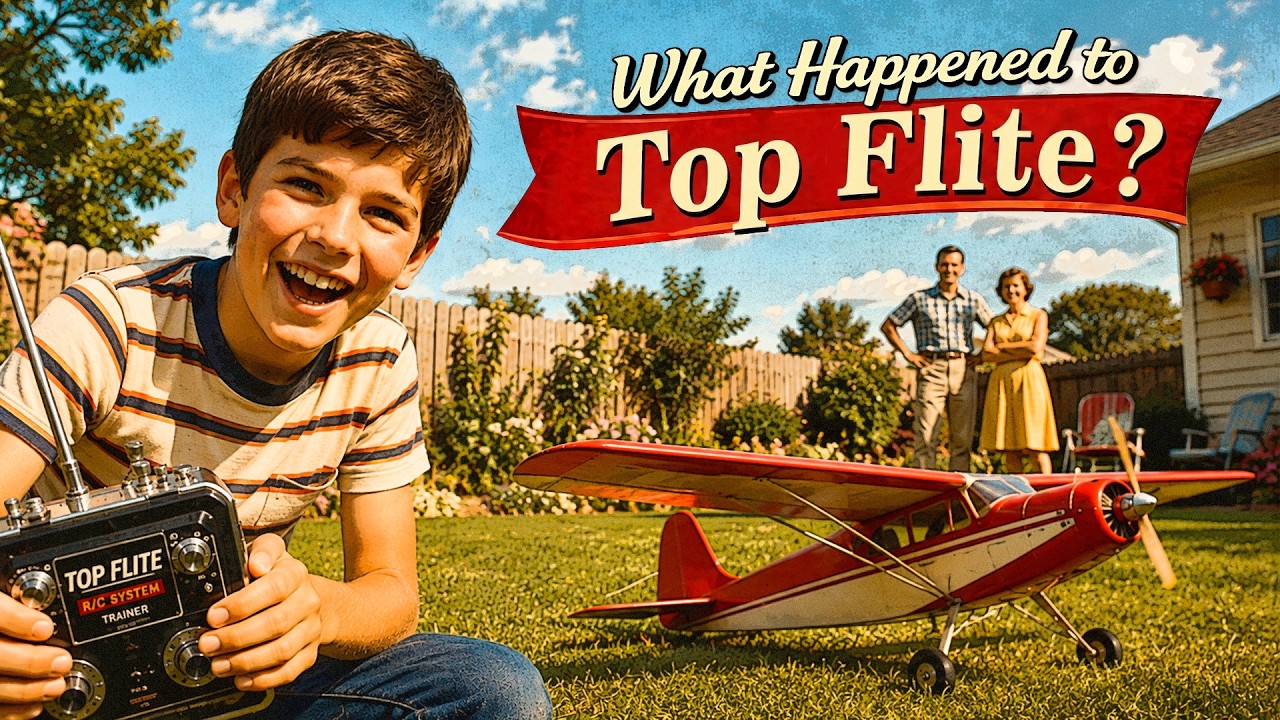
You did that with a roll of colored film and a sealing iron. Top Flite gave you that. Top Flite solved model aviation’s biggest problem and then became one itself. Because before the hobby was saved, it was destroying itself from the inside out.
In the late 1940s, model aviation was unforgiving. The hobby didn’t punish you at the start. It waited until you had spent weeks building, then struck at the final step. Men coming home from World War II felt at ease around aircraft.
Some retreated to basements, garages, and model aviation clubs to build small versions of the machines they had flown or maintained. The hobby was technical and precise. It rewarded patience, but it shut people out in a way no one had yet thought to examine. Building a model airplane in the late 1940s meant this: you stretched fragile Japanese tissue paper over a balsa wood framework.
The paper was so thin you could see light through it. Then you wet it down to start shrinking. Then came the dope—nitrate dope, butyrate dope. Both smelled the same, strong, sweet, and unnatural, like rotting bananas mixed with acetone.
Modelers called it banana oil. Even in January you had to keep the garage door open. You had no choice. Then you waited.
Hours for every coat. Multiple coats, each one dried perfectly before the next. Then you sanded smooth. Then another coat.
Even if you did everything right, cut every notch perfectly, kept every joint even, the dope could still betray you. Uncontrolled shrinking. Too much tension on one side. A trailing edge that warped while you slept.
You’d walk into the garage the next morning and find your wing curled like a potato chip. That wasn’t a beginner’s mistake. It happened to experienced builders too. And if your covering came out just slightly heavier on one side, you wouldn’t notice the imbalance until the moment of flight.
By then, it was too late. The covering process was a failure point that had nothing to do with how well you built the structure. A perfect construction could be ruined by the finishing stage. There was no shortcut, no easy technique that could make the chemical process safe.
Either you had experience or you didn’t. The test of skill wasn’t at the beginning of the build. It was at the very end, the cruelest possible place to put it. Three men in Chicago decided that was not good enough.
In 1947, Sydney Axelrod, Carl Goldberg, and Mike Schlesinger opened a company called American Hobby Specialties on South Wabash Avenue. It would later become known as Top Flite Models. At first, they made propellers—machine-cut to a standard the hobby had never seen. At the peak of production, they supplied over two million propellers a year, more than any other manufacturer in the world.
You could feel the quality before you even mounted one on a shaft. That reputation for perfection became the foundation of the company. But Carl Goldberg had his eye on something bigger. He wanted to design a kit that even a newcomer could build and fly with ease.
Goldberg had been flying model airplanes since the 1930s. He knew exactly what could go wrong in a build, so he engineered the mistakes out of the design before the kit ever shipped. The result was the Jig Time series. Jig Time kits didn’t use plain wood.
The balsa parts came pre-printed with color and design. No painting, no tissue to apply, no overnight drying. Before you made a single cut, you could see what the finished airplane would look like. The assembly method was different too.
Every part had tabs, and every frame had matching slots. The kit physically prevented you from making the most common mistakes. You couldn’t mount a wing wrong, and there was no way to misread the plans and build a crooked fuselage. The geometry was built into the parts themselves.
Printed on the box was a guarantee: it will fly. No fine print. Just that promise. In 1952, for a kid with a little money and zero experience, those words meant everything.
They signaled that this hobby wasn’t only for men with twenty years of experience. It was for him. Goldberg also introduced the Duralum line. Same tab-and-slot engineering, but with aluminum foil bonded directly to the balsa.
No finishing required whatsoever. Out of the box it looked like polished metal. These two products proved something no one had shown the hobby industry before: a kit could be designed to ensure a beginner’s success. Goldberg and Axelrod had done it for rubber-powered models.
Radio control airplanes were another matter entirely. They needed a fuel-proof surface that could withstand the corrosive exhaust of a glow engine. That still meant days of labor with dope. The same banana oil chemistry, the same failure points that had kept generations of newcomers out of the hobby.
Sydney Axelrod had watched that problem for years. One afternoon, sitting at his drafting table, he noticed something. Axelrod had been working with Mylar, the same thin, stable film draftsmen used on their drawing boards. He saw that it shrank evenly and predictably when exposed to heat.
Nothing like dope. He spent about a year adapting it, developing a heat-activated adhesive on one side and a formulation that would adhere to balsa without wrinkling or folding. He worked with General Formulations in Sparta, Michigan, to produce it in large quantities. In the mid-1960s, he brought it to market.
He named it MonoKote. Mono, meaning one. One coat. One step.
The process was simple. Cut the film to size. Lay it over the frame. Run a hot iron across it.
Within about an hour, the film shrunk down even, tight, and drum-smooth. What once took days of chemical work, sanding, and waiting now took a single evening, and it almost never failed. The covering process that had ruined years of builds collapsed into one hour of clean thermal work. The film came pre-colored.
Bright reds, deep blues, Cub yellows—finishes that looked like they arrived from a real airplane factory floor. Usable straight from the box. The hobby shop display told a better story than any advertisement ever could. Rolls of MonoKote stood upright in their bins, dozens of colors gleaming under the lights in a way tissue paper never could.
You could see what the airplane would look like before you even started building. That change in the workshop was real and immediate. The smell of banana oil faded from garages across the country, replaced by the mild warmth of heat-activated adhesive and, later, the clean chemistry of super glue, which became the new standard for balsa joints. The workshop got safer.
The results got more reliable. Within a few years, MonoKote became a verb. It joined that short list of brands so woven into daily use that people stopped thinking about the generic alternative. Kleenex.
Band-Aid. MonoKote. You MonoKoted a wing. What brand of film was in the bin no longer mattered.
An experienced modeler writing in the AMA archive put it plainly. Ray Arden’s glow plug, cheap transistors, and Top Flite’s MonoKote were the three most important advances in postwar modeling—not just in covering, but in postwar modeling as a whole. The barrier that had kept generations of beginners away from the hobby was gone. If you ever ran an iron across a wing panel and heard that pop as the film tightened, that was the moment Top Flite had been working toward since 1947.
Throughout the 1970s, RC clubs were springing up across the country. Saturday mornings brought new members to the field, learning from men who had been flying for years. The hobby was no longer cheap—more people were finishing their builds, which meant more people were flying. And finishing a build was the one thing that turned someone who bought a kit into an actual pilot.
In 1980, walk into any major hobby shop from Chicago to Los Angeles and you’d find Top Flite on the shelves. Boxed kits with technical artwork on the covers. Die-cut balsa sheets arranged inside like a puzzle waiting to be solved. Bags of hardware where every clevis, pushrod, and control horn was counted and bagged.
Nothing was missing, and nothing was left to guesswork. The people who worked at the Narragansett Avenue factory understood one thing. The person opening that box would spend six months with what was inside. A miscut part wasn’t a production statistic.
It was six months of someone’s time that they had just disrespected. The Gold Edition kits took that approach further. Computer-aided design. Interlocking I-beam wing construction.
Pre-formed ABS plastic cowlings and gun covers. Pre-shaped leading edges, so your skill as a craftsman wasn’t required. They took Goldberg’s original Jig Time philosophy and applied it to serious competitive warbirds. Experienced builders flew Top Flite kits at the national championships.
Beginners built their first RC airplanes from the same brand. Maintaining that kind of range was hard. Top Flite sustained it for nearly four decades. More builders meant stronger clubs and more flying fields.
The hobby was growing in ways it never had before, and Top Flite had created the conditions that made it possible. Very few companies build a culture around their product. Top Flite did. By the mid-1980s, Top Flite and MonoKote were the industry standard.
Walk into any hobby shop in the country and you expected them to be there. If you wanted to build something and fly it, this was where you started. But when you completely solve a problem, you don’t always control where the solution goes. Top Flite had spent nearly four decades teaching the market a lesson.
Simple is best. The market learned it perfectly. In the late 1990s, ARF arrived. Almost ready to fly.
Pre-built, pre-covered, usually pre-painted. Install the radio, charge the battery, fly that same weekend. Foreign manufacturers found ways to build and cover airplanes at prices no American kit company could match. A hobbyist with a Saturday off could buy an ARF, put it together in an afternoon, and be at the flying field that weekend.
What Top Flite had proven the market wanted, someone else took to its logical conclusion. A Top Flite Gold Edition could take six months to build properly. An ARF took one afternoon. The people who made that comparison weren’t wrong.
They were just using Top Flite’s own logic against it. Top Flite tried ARF versions of its classic kits and foam electric models, but its identity was built on the process of construction. Remove that process, and the brand struggled to explain why you should choose them over a company known from the start for speed. In 1989, Hobbico acquired Top Flite.
The kits kept coming, but new development slowed. By around 2010, Hobbico distributed more than 150 brands. Top Flite’s traditional balsa kit line required skilled designers, precision tooling, and customers willing to invest months of labor in a single product. The ARF market needed none of those things, and it was serving a far larger, faster-growing segment.
The math wasn’t complicated. Then, in January 2018, Hobbico filed for bankruptcy. That April, Horizon Hobby made the winning bid for their RC assets. There was only one bid.
The kit line was gone. MonoKote went with it. Horizon already had its own covering film. They didn’t need two.
Something you had been able to buy since the mid-1960s suddenly vanished from the shelves. The name still survives. Look around and you’ll find it. But go looking for the kits.
Go looking for MonoKote. Those are gone. What remains is a logo on a website that doesn’t seem to remember what it once meant. Many brands disappear.
Most don’t leave much behind. Top Flite left behind people like you—people who know the feeling of building something piece by piece, covering it with your own hands, and watching it actually fly. You learned that somewhere. Top Flite was the reason it became possible.
For nearly four decades, some child somewhere in America was opening a Top Flite box for the first time, finishing it, flying it, and coming back for the next one. That culture is still with us. If you ever MonoKoted a wing, if you ever heard the film tighten on a cold winter morning, you know.
There are far more of you still out there than you might think.
