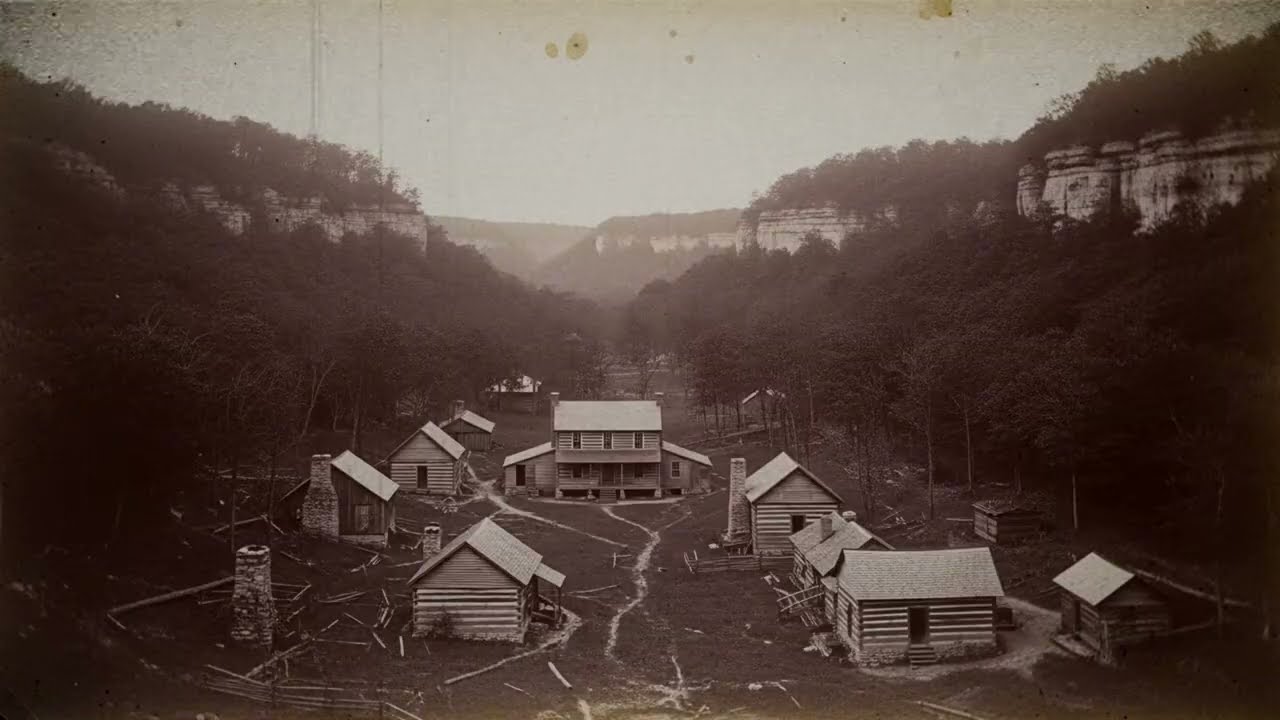
At the edge of a remote valley in the Missouri Ozarks, four people remained where twenty-three had once lived. The sheriff’s deputy who rode in with them in November 1894 found a settlement that felt wrong, too quiet even for a place nearly empty. The four survivors stayed close together in one house and spoke little. When asked where the others had gone, they gave the same answer, almost word for word, that they had moved on seeking better opportunities.
When the deputy suggested searching the surrounding hills, the old man named Mercer looked him in the eye and said, “There is nothing to find, Deputy. Nothing at all. ”
The deputy returned to Eminence, filed a three-sentence report, and the official investigation ended before it had truly begun. The roughly fifteen people who had disappeared from Jasper Hollow in the fall of 1894 were never found.
No bodies were ever recovered. No complete investigation was ever conducted. A settlement that had stood for over two decades was simply erased, and the only official explanation was that the inhabitants had left voluntarily. The name Jasper Hollow no longer appears on modern maps of the Missouri Ozarks.
What had once been a small settlement nestled between rocky hills and dense forests was forgotten and removed from official records after the winter of 1894. The only evidence of its existence comes from scattered county archives, a handful of newspaper clippings preserved in the Missouri Historical Society, and a troubling diary found in a collapsed cellar in 1958. According to what remains of the Shannon County records from that period, about twenty-three individuals resided in Jasper Hollow before the events of October 1894. By December of the same year, census officials recorded only four residents.
The others did not move elsewhere. They simply vanished without explanation. The official story, that harsh weather and economic hardship drove the residents to abandon their homes without notice, contradicts disturbing details that emerged years later. In 1967, Dr.
William Mathieson, a historian researching the social and economic conditions of isolated Ozark communities, uncovered a series of correspondence between the Shannon County sheriff and state authorities in Jefferson City. These letters, previously sealed in the state archives, revealed a troubling reluctance to investigate the disappearances thoroughly. “The Jasper Hollow matter requires no further investigation,” wrote Sheriff Thomas Keller in December 1894. “The remaining residents have provided satisfactory accounts, and pursuing the matter would only burden a department already stretched thin with futile work.
”
The question that has haunted researchers since this discovery is simple but profound. What could have happened in that remote settlement to make local authorities abandon their duty so completely? What horror occurred in those hills that was believed better left buried? The settlement of Jasper Hollow was founded in 1871, in a narrow valley between two wooded hills, about seventeen miles from the nearest major town, Eminence.
The site was not chosen for accessibility or fertile soil. The ground was rocky and the terrain difficult. It offered something more valuable to its founders: isolation. The first settlers, led by Silas Mercer, a former Union Army soldier known for his reclusiveness, sought separation from what they considered the moral decay of post-war society.
Mercer, along with four other families, established a community based on principles of self-reliance and seclusion. They built simple log homes, a small community hall that served as a meeting house, and finally a one-room schoolhouse that functioned as both an educational facility and a repository for the settlement’s limited book collection. By 1894, Jasper Hollow had grown modestly. Records show the settlement included seven principal families: the Mercers, Caldwells, Thorntons, Abbotts, Winstons, Hunters, and Pearsons.
Several unmarried men also lived in cabins at the edge of the settlement, working primarily as hunters or laborers. The community sustained itself through hunting, subsistence farming, and the production of locally distilled whiskey, which was sometimes traded in Eminence for supplies they could not produce themselves. Life in Jasper Hollow followed the rhythm of the seasons and the strict moral code established by Silas Mercer, who, despite holding no official title, functioned as the community’s de facto leader and arbiter of disputes. The isolation that initially attracted the settlers became more pronounced as the years passed.
Visitors were rare, and interactions with neighboring communities grew increasingly limited. The most detailed account of daily life comes from the diary of Eleanor Thornton, wife of the builder Joseph Thornton. Her writings from 1892 to 1893 describe a community that had turned deeply inward. “We see so few new faces that when Mr.
Davenport arrived to repair Joseph’s tools last spring, the entire settlement gathered just to hear news from Eminence,” she wrote in April 1893. “Silas seemed particularly disturbed by the tales of the new railroad being built only thirty miles from our valley. He spoke at length that evening about the corruption that follows progress, and how fortunate we were to remain apart from such influences. ”
Eleanor’s diary entries grew more anxious throughout that year.
She noted rising tensions between certain families, particularly between Silas Mercer and Frederick Winston, the settlement’s newest resident, who had arrived in 1891. “Fred continues to challenge Silas at every meeting,” she wrote in September 1893. “Today, he suggested we should consider allowing the lumber company to begin operations in the northern woods. Silas was furious, calling him an agent of destruction.
The look they exchanged sent a chill through the meeting hall. ”
By early 1894, Eleanor’s writings documented a settlement increasingly divided between those loyal to Mercer’s vision of isolation and those who, like Winston, advocated for greater connection with the outside world. It was a philosophical divide that would soon be overshadowed by far darker events. Her diary ends abruptly in June 1894 with a final, cryptic entry.
“Joseph returned from the caves today. He has not spoken a word since. His eyes look different somehow, empty. Something happened in those depths that he refuses to disclose.
I fear the silence of this house more than any scream. ”
The chronology of events becomes fragmented after this point. What is known with certainty is that on October 3, 1894, Frederick Winston arrived alone in Eminence, appearing disheveled and agitated, according to reports in the Eminence Courier. He requested an immediate meeting with the sheriff but was informed that Sheriff Keller was on official business in Jefferson City.
Winston left a sealed letter for the sheriff’s return and purchased supplies sufficient for several weeks before departing back toward Jasper Hollow. The contents of this letter were never made public, and the original was not among the documents Dr. Mathieson discovered in 1967. On October 17, 1894, a timber scout named Michael Hargrove passed through Eminence on his way to assess timber in the region.
He mentioned to the local innkeeper that he intended to visit Jasper Hollow to discuss potential arrangements with the residents there. This was the last confirmed sighting of Hargrove. His company reported him missing in November when he failed to return to Springfield as scheduled. The first official indication that something was wrong at Jasper Hollow came on November 12, 1894, when Thomas Abbott arrived in Eminence in obvious distress.
According to witness testimony gathered by the newspaper, Abbott appeared gaunt and wild-eyed and requested immediate assistance from the sheriff’s office. Deputy Warren Simmons accompanied Abbott back to Jasper Hollow the following day. What the deputy did or did not find was documented in a brief official report filed on November 15. “Proceeded to Jasper Hollow at the request of T.
Abbott. The settlement appears largely abandoned. The remaining residents claim the others left voluntarily seeking better opportunities elsewhere. No evidence of wrongdoing was observed.
The matter appears to be a simple case of relocation common in struggling settlements. ”
This report, only three sentences long, was the sole official document addressing the fate of at least fifteen missing residents. No additional investigation was conducted. No search parties were organized.
The disappearance of nearly an entire settlement was dismissed as unremarkable by local authorities. The Ozark Mountains have always kept their secrets. Countless caves carve their way through the ancient limestone, some extending for miles in dark passages. Dense forests cover the sloping hillsides, hiding valleys and ravines where the sun barely reaches even at midday.
It is a landscape that swallows sound and light, where one could disappear a few yards from a traveled path and never be found. Jasper Hollow was situated in one such isolated valley, surrounded by forested hills on three sides, with a series of limestone bluffs overlooking a tributary of the Current River on the fourth. The settlement itself consisted of simple buildings arranged in close proximity around a central square. Each family maintained a certain distance from the others, close enough for communication, far enough for the privacy valued by those who had chosen this seclusion.
The Mercer home occupied the most prominent position, situated on a slight rise overlooking the other dwellings. Silas Mercer’s two-story cabin, the largest of them all, served as both residence and informal meeting place for discussing settlement affairs. Within earshot stood the community hall, a simple building with rough benches where residents gathered for discussions, occasional celebrations, and Sunday sermons delivered by Mercer himself. The homes of the Thornton, Caldwell, and Abbott families formed an irregular semicircle east of the central square, each with small gardens and outbuildings.
Winston’s cabin, the newest and most carefully constructed, stood slightly apart from the others at the edge of the northern woods. The remaining families, the Hunters and Pearsons, had established their homes farther into the valley, near the limestone caves that riddled the hillsides. The most distinctive feature of the settlement, according to Eleanor Thornton’s diary, was its perpetual silence. “Even at midday, when everyone is busy with their work, Jasper Hollow maintains a quiet unlike any place I have known,” she wrote in 1892.
“Sounds here do not carry as they should. Sometimes I call to Joseph working just outside the garden, and my words seem to die in the air between us. Silas says it is our valley’s blessing, that the world’s noise cannot reach us here. But I sometimes wonder if it is not a blessing, but a warning.
”
This unnatural quiet became a recurring theme in her writings. The acoustic properties of the valley, possibly resulting from the surrounding hills and perhaps the underlying cave systems, created an environment where sound behaved unpredictably. Whispers sometimes carried astonishing distances, while screams seemed muffled just a few yards away. Daily life in Jasper Hollow followed simple rhythms imposed by necessity and Silas Mercer’s interpretation of righteous living.
The men handled hunting, trapping, and the arduous aspects of farming and construction. The women maintained the households, gardens, food preservation, and textile production the community needed. It was a life of constant labor with few luxuries, nothing beyond a bottle of medicine from the store or a bolt of manufactured cloth purchased during rare trips to Eminence. What distinguished Jasper Hollow from other similar communities of the era was its deliberate rejection of progress.
While many isolated settlements naturally lagged behind urban areas in adopting new technologies and practices, Jasper Hollow actively resisted change. Silas Mercer famously refused to allow a printing press into the settlement when it was offered at a significant discount by a retired printer in Eminence. Similarly, he discouraged regular newspaper subscriptions, arguing that the affairs of the outside world should remain outside. This forced isolation extended to social bonds as well.
Marriage with outsiders was strongly discouraged, creating a closed community that interacted primarily with itself. By 1894, this had led to increasingly complex relationships among the original families with limited options for younger residents seeking partners. The Caldwell family in particular maintained the closest adherence to Mercer’s philosophy of separation. Ezekiel Caldwell served as Mercer’s most loyal supporter, enforcing the community’s unwritten rules with strict devotion.
His wife Martha kept meticulous records of the settlement’s supplies, provisions, and needs, effectively serving as the small community’s quartermaster. The Thornton family represented a middle position, generally supporting Mercer’s leadership while occasionally questioning certain decisions. Joseph Thornton’s skills as a builder and construction worker made him essential to the settlement’s development, perhaps granting him slightly more room to express dissent than others might have enjoyed. The Winston family, as newcomers, occupied the most precarious social position.
Frederick Winston, a former attorney from St. Louis, had come to Jasper Hollow seeking escape from what he described as the moral and physical pollution of urban life following his wife’s death from tuberculosis. Despite his apparent alignment with Mercer’s philosophy, Winston brought with him ideas and experiences that inevitably challenged the established order. His cabin featured glass windows, a luxury by Jasper Hollow standards, and he maintained subscriptions to several periodicals and magazines that arrived via infrequent mail delivery to Eminence.
This fragile balance between isolation and connection, between Mercer’s authority and Winston’s subtle challenges, defined Jasper Hollow in the months before the disappearances. The first major disruption to Jasper Hollow’s routine came in early spring 1894. According to excerpts from correspondence preserved in Shannon County records, a representative of the Missouri Mining Company arrived in the area requesting permission to prospect for potential lead deposits. The company had received reports suggesting the limestone formations in the region might contain valuable ore veins similar to those being profitably mined elsewhere in southern Missouri.
This possibility created an immediate division within the settlement. Frederick Winston, along with Thomas Abbott and Isaiah Pearson, viewed potential mining operations as an economic opportunity that could bring prosperity without necessarily compromising their relative isolation. Silas Mercer, supported by Ezekiel Caldwell and the Hunter family, adamantly opposed any such development, arguing it would inevitably lead to an influx of outsiders and the corruption of their way of life. The debate culminated during a community meeting in April that nearly escalated into physical violence, according to a letter Pearson sent to his brother in Springfield, found decades later among family papers.
“Mercer spoke of the mine as if it were a herald of the apocalypse,” Pearson wrote. “When Winston attempted to present the financial calculations he had prepared, showing how we could benefit while maintaining distance from the actual operations, Caldwell knocked the papers from his hands. I feared they would come to blows had Joseph Thornton not stepped between them. ” The mining representative departed without permission to survey the settlement’s land, but the conflict he inadvertently ignited continued to escalate throughout the spring.
The community had experienced disagreements before, but this represented the first significant challenge to Mercer’s authority since Jasper Hollow’s founding. A second, more mysterious development began in early June. Joseph Thornton and Isaiah Pearson, while hunting in the northern woods, discovered what Pearson described in the same letter as a strange opening in the hillside, narrow but descending deeply. The two men, carrying lanterns, conducted a preliminary exploration of what appeared to be a previously unknown cave entrance.
What they found inside remains unclear. Pearson’s letter only mentions that they discovered chambers extending farther than their light could reach, and unusual formations unlike typical cave structures. He noted that Thornton seemed particularly affected by something they encountered, becoming uncharacteristically silent upon their return to the settlement. Eleanor Thornton’s diary confirms this change in her husband’s behavior following the cave exploration.
“Joseph has not spoken three consecutive words since returning from the hills,” she wrote. “He startles at faint sounds and spent an entire evening staring into the lantern flame without blinking. When I asked what troubled him, he only shook his head and whispered, ‘Some things are better left in the dark. ‘”
What Joseph Thornton experienced in those caves was never directly recorded.
Within a week of the discovery, Silas Mercer organized a group of men to return to the cave entrance. According to Isaiah Pearson’s letter, they spent an entire day working to collapse the opening, effectively sealing whatever lay inside. Mercer declared the area off-limits to all residents, claiming the caves were structurally unstable and dangerous. This explanation might have sufficed, were it not for what followed.
Throughout July and August, residents reported hearing unusual sounds at night, described as low humming, distant machinery, or most disturbingly, voices speaking in unintelligible words. These accounts appear in fragments of letters and in the margins of Martha Caldwell’s household ledger, where she inexplicably began recording instances of hearing voices alongside her usual inventory entries. Frederick Winston, the perpetual skeptic, initially attributed these phenomena to natural causes, such as wind passing through the complex cave systems beneath the hills, or perhaps faint sounds from distant mining operations beyond the settlement’s borders. His rational explanations were accepted by some residents but were challenged by increasing reports of strange occurrences.
Livestock began behaving oddly. Several hunting dogs disappeared without a trace. Gardens that had once flourished began to wither despite adequate rainfall. Most alarmingly, multiple residents reported experiencing similar dreams, visions of standing at the edge of a vast underground chamber listening to whispers rising from the darkness below.
By September, a tangible tension hung over Jasper Hollow. The community was divided into factions, those who believed something truly unusual was happening and those who attributed the events to imagination fueled by isolation. Silas Mercer, surprisingly, remained largely silent on the matter, neither endorsing the supernatural explanations nor offering alternatives. It was during this period of escalating anxiety that Frederick Winston made his fateful journey to Eminence in early October, the journey that resulted in his sealed letter to the sheriff.
What prompted this sudden action after months of rationalization? What had he witnessed or learned that finally convinced him external intervention was necessary? The contents of Winston’s letter remain unknown, but its timing coincides with what Martha Caldwell cryptically referenced in her ledger as “the night of revelation. ” On October 2, the ledger simply stated, “Sleep impossible.
They have finally shown themselves. God help us all. ” The following day, Winston left for Eminence at first light. Whatever happened during that night appears to have been the catalyst that set in motion the events leading to the disappearances.
Whatever Winston had hoped to accomplish by contacting the sheriff, it came too late. By the time his letter could have been read, Jasper Hollow’s fate had already been sealed. What exactly happened in the weeks between Frederick Winston’s return from Eminence and Thomas Abbott’s desperate appearance in town on November 12 cannot be known with absolute certainty. No eyewitnesses came forward with complete accounts of what occurred.
No diaries or letters covering this specific period have been found. The precise sequence of events leading to the disappearance of at least fifteen residents remains obscured by time, terrain, and possibly deliberate concealment. However, certain facts and fragments allow the construction of a probable timeline of the settlement’s final days, a narrative built from the whispers that escaped the valley’s unnatural silence. Winston is known to have returned to Jasper Hollow around October 5 or 6 after leaving his letter for Sheriff Keller.
According to the storekeeper in Eminence who sold him provisions, Winston purchased an unusually large quantity of kerosene, salt, and ammunition. Items suggesting preparation for a prolonged siege or conflict. Michael Hargrove’s arrival, the timber scout, on or about October 17, coincides with what appears to be the beginning of the end for Jasper Hollow. Although there is no direct account of his reception, a fragmented note found years later in a hollow tree near the settlement’s perimeter offers a disturbing hint.
Written in handwriting later identified by handwriting experts as belonging to Isaiah Pearson, it simply reads, “A stranger arrived today. Mercer welcomed him as if expected. Invited to a meeting at sunset. God forgive what we have become.
” This suggests that rather than encountering hostility as a stranger representing business interests, Hargrove may have been deliberately lured into the settlement. The purpose of the meeting referenced in Pearson’s note remains unknown, but the tone suggests something ominous had begun. The next piece of evidence comes from an unexpected source: weather records kept at the Eminence post office. These records show that a major storm system passed through the region on October 19, bringing heavy rain and strong winds.
Such conditions would have made travel difficult and would have effectively isolated Jasper Hollow even more completely than usual. During this storm, if the fragmentary evidence is to be believed, the disappearances began. Martha Caldwell’s ledger, recovered from the root cellar in 1958, contains a rain-damaged entry dated October 20 reading, “Thunder drowns the screams. Winston’s cabin empty this morning.
The Pearson family gone by noon. Silas says it is time to… ” The entry ends abruptly. The rest of the page is torn away.
The next date recorded in any surviving document is October 24, when Ezekiel Caldwell apparently made an entry in the community meeting hall log. “We remain faithful. Mercer, Caldwell, Hunter, Abbott. All others taken or fled.
The barricades hold. The salt lines intact. ”
This cryptic record raises more questions than it answers. Who or what was being fortified against?
What significance did the salt lines hold? Were the missing residents abducted, or did they flee? And what essential difference did Caldwell see between these two possibilities? Between October 24 and November 12, when Thomas Abbott appeared in Eminence, no written records have been found.
This three-week gap represents the darkest period in Jasper Hollow’s history, when the horror, whatever it was, reached its peak, leaving only four survivors from a community of twenty-three. The four who remained, Mercer, Caldwell and his wife, and Abbott, stayed huddled together in Mercer’s home and spoke little. They answered questions without volunteering any information. Abbott, who had been so agitated in town, now appeared with the same vacant features as the others.
Most tellingly, Simmons noted that they all told the same story, almost verbatim, about the others leaving in search of better opportunities. When Simmons suggested organizing a search of the surrounding area to ensure no one had been harmed, the old man Mercer looked him directly in the eye and said, “There is nothing to find, Deputy. Nothing at all. ” Simmons, lacking any evidence of a crime and faced with identical testimonies from the remaining residents, felt he had no reason to proceed.
He returned to Eminence, filed his brief report, and the official investigation ended before it had truly begun. The final record of Jasper Hollow as an inhabited place comes from a mail carrier’s log dated December 18, 1894. The carrier noted an attempted delivery of a package addressed to Frederick Winston but found the settlement seemingly completely deserted. No smoke from chimneys, no response to calls.
He left the package at the Eminence office for pickup. By the spring of 1895, Jasper Hollow had been entirely vacated. When land surveyors visited the site in June of that year, they found the cabins empty, personal belongings still in place as if the residents had simply walked away. Most disturbingly, according to their report, they discovered that all mirrors and reflective surfaces in every dwelling had been smashed or turned to face the walls.
The settlement was never reoccupied. The forest gradually reclaimed the structures, and the wooden buildings decayed until only stone foundations and chimneys remained as evidence that humans had once attempted to make that remote valley their home. The fate of the four survivors, Silas Mercer, Ezekiel and Martha Caldwell, and Thomas Abbott, remains unknown. There is no record of their arrival in the census data of any neighboring town.
No death certificates were ever filed. Just like those who had disappeared before them, they simply faded from official records as if Jasper Hollow had swallowed them entirely. For decades, the disappearances remained a footnote in regional history, occasionally mentioned in Ozark folklore collections but never rigorously investigated. The official explanation of voluntary relocation was largely accepted for lack of a compelling alternative.
The remote nature of the site, the passage of time, and the apparent absence of evidence all contributed to the case fading into obscurity. This might have remained the situation indefinitely, had it not been for the severe storms that swept through Shannon County in April 1958. Heavy rains and flash floods altered the terrain of parts of the former Jasper Hollow settlement, revealing the entrance to a cellar that had been covered with soil and vegetation for decades. A local hunter seeking shelter from the flooding discovered the cellar, and upon exploring it found a metal box containing Martha Caldwell’s ledger, some personal effects, and a sealed glass jar containing what appeared to be a diary.
The hunter, Vernon Hayes, brought these items to the Shannon County Historical Society, where they remained largely unexamined until Dr. William Mathieson’s research brought the Jasper Hollow disappearances back into focus in 1967. The diary, water-damaged but partially readable, proved to be the most disturbing evidence ever found. The diary, written by Ezekiel Caldwell, contained entries from September through late October 1894, painting a picture radically different from the official account of voluntary departure.
Caldwell described a community under siege by escalating terror, not from external threats, but from within. The unusual sounds previously reported had, according to his account, evolved into something far more disturbing. “They speak now through familiar mouths,” he wrote on September 30. “Isaiah Pearson visited us yesterday.
His words were his words, but the voice… the voice was coming from the cave. When I mentioned this to Silas, he only nodded and said, ‘It has begun. ‘”
The most horrifying aspects of Caldwell’s account concern his descriptions of subtle changes he observed in his neighbors.
Changes in posture, speech patterns, and most alarmingly, in reflection. “Winston’s shadow no longer matches his movements,” he noted on October 1. “Martha observed the same phenomenon with Eleanor Thornton yesterday. When they pass before windows or mirrors, there is a delay.
The reflection hesitates, as if unsure how to proceed. ” By October 15, Caldwell was documenting what he called “the replacements. ” Residents who still appeared physically unchanged, but whose behavior had become increasingly mechanical, their eyes reflecting light in unusual ways, especially at dusk. He described conversations that followed familiar patterns but felt hollow, as if the participants were reading from a script they did not fully understand.
Most significantly, Caldwell referred to Silas Mercer not as another victim, but as somehow complicit in everything that was happening. “Silas speaks to them at night,” he wrote on October 17. “I followed him to the sealed cave entrance. He placed his hands on the collapsed stones and whispered for about an hour.
When he returned to his cabin, his shadow remained at the cave until dawn. ”
The diary ends with an entry dated October 22. “They have taken the Hunter and Thornton families now. Only four of us remain, myself, Martha, Thomas, and Silas.
Thomas wants to flee, but Silas insists we are safe if we adhere to the protocols. The salt keeps them away. They cannot cross the thresholds we have protected, but I have seen how Silas looks at Martha when he thinks I am not watching. His eyes reflect nothing, nothing at all.
”
The existence of Caldwell’s diary raises profound questions about what truly happened at Jasper Hollow. If his account is to be believed, the community did not fall victim to economic hardship or conventional violence, but to something inexplicable. Something connected to the caves discovered earlier that year. Something that could somehow alter or replace individuals while maintaining their outward appearance.
Such an explanation invites skepticism and is usually dismissed as the delusion of an isolated mind. However, certain physical evidence recovered from the settlement site lends disturbing credibility to aspects of Caldwell’s account. In 1972, an archaeological survey of the Jasper Hollow site discovered unusual patterns of crystalline mineral deposits around the foundations of each cabin. Deposits that analysis revealed to consist primarily of salt mixed with local clay to form a kind of primitive insulator.
These deposits formed continuous lines encircling each dwelling, consistent with Caldwell’s references to salt lines as protective measures. According to the archaeological report, the reflective surfaces appeared to have been targeted with precision, with minimal damage to frames or surrounding materials, suggesting deliberate and controlled destruction rather than random violence. Perhaps most significantly, when researchers attempted to locate the sealed cave entrance described in multiple accounts, they discovered not one entrance but seven distinct cave openings within a mile of the settlement, all showing evidence of deliberate collapse. Additionally, fragments of mirrors and other reflective surfaces found at the site displayed strange breakage patterns inconsistent with simple vandalism or accidental damage.
Subsequent geological surveys using ground-penetrating radar revealed an extensive cave system beneath the entire valley, far larger and more complex than typical Ozark cave formations. Limited exploration of accessible portions of this cave system in 1975 led to the discovery of unusual acoustic properties that might explain the unnatural silence and strange sound propagation reported by Eleanor Thornton. The specific geological composition created zones where sound waves were significantly dampened and others where distant noises could be heard clearly, a natural phenomenon that might have seemed supernatural to nineteenth-century settlers. Cave exploration was abandoned after two researchers reported experiencing severe auditory hallucinations while in the deep chambers.
The project leader, Dr. Alan Kittredge, noted in his final report that something in the specific resonance of these caves appeared to affect human cognitive function, particularly auditory processing. After prolonged exposure, team members reported hearing voices and music without identifiable sources. These experiences persisted for several hours after leaving the cave system, suggesting a kind of temporary neurological effect.
Could such natural phenomena explain the events that unfolded at Jasper Hollow? Could a combination of isolation, geological characteristics, and perhaps toxic elements in the local water or air have led to a collective psychological breakdown that ended in violence or flight? This more rational explanation has its proponents, especially among academic researchers who have studied the case. They suggest that the community, already stressed by internal conflicts and extreme isolation, may have suffered something akin to mass hysteria, possibly triggered or exacerbated by unique environmental factors at the site.
However, such explanations fail to account for certain aspects of the evidence: particularly the consistent nature of the reported phenomena across multiple independent accounts, the physical evidence of systematic protective measures, and perhaps most disturbingly, the complete absence of remains or any trace of the fifteen individuals who apparently disappeared within weeks. If violence had claimed them, some evidence should have remained, especially given the difficult terrain and the limited means of body disposal available to nineteenth-century perpetrators. If they had truly relocated, there should be a record of their arrival somewhere else in census data, church records, or other public records of the period. Yet comprehensive searches have yielded no trace of any Jasper Hollow resident in any official document after October 1894.
As if they simply ceased to exist, or perhaps as Ezekiel Caldwell’s disturbing diary suggests, ceased to exist as themselves. Perhaps the most disturbing aspect of the Jasper Hollow mystery is the apparent complicity of local authorities in concealing what truly happened. Sheriff Keller’s reluctance to conduct a thorough investigation, despite Winston’s warnings and the disappearance of nearly an entire settlement, suggests either gross negligence or deliberate obstruction. The correspondence Dr.
Mathieson found reveals that state officials in Jefferson City explicitly ordered Sheriff Keller to close the case after Deputy Simmons’s superficial visit. Attorney General Phillips wrote in late November 1894, “The situation at Jasper Hollow does not require further attention from your office. Continuing the investigation would only waste resources and potentially cause unnecessary alarm among neighboring communities. ” This official desire to contain information extended beyond the immediate events.
When the editor of the Eminence Courier attempted to publish a follow-up article questioning the official account in January 1895, he reportedly received a visit from a state official who advised him not to pursue the story further. The planned article never appeared, and the editor, James Harrington, sold the newspaper and moved to Kansas City within six months. This active suppression of investigation suggests the authorities knew or suspected something about the Jasper Hollow disappearances that they considered too troubling to make public. What could have prompted officials, who normally seek to solve crimes and protect citizens, to respond in such a manner?
A possible answer emerges from a detail in Ezekiel Caldwell’s diary that has been overlooked in most analyses of the case. In his entry dated October 1, Caldwell wrote, “Silas claims this has happened before, not here, but in a settlement across the river some 40 years ago. Everyone disappeared within two weeks, and those who investigated soon abandoned their questions. He speaks as if he has direct knowledge, though he was only a child then.
” If true, this suggests what happened at Jasper Hollow may not have been an isolated incident but part of a pattern, a recurrence of something that had claimed victims decades earlier. It raises the disturbing possibility that local officials recognized what was happening and chose containment over confrontation, quarantine over investigation. Perhaps most terrifying of all is the possibility that their response was correct, that some threats are better left unexamined, and some questions better left unanswered. Because if what happened at Jasper Hollow was neither natural disaster nor human violence, but something else entirely, something that could spread beyond that isolated valley, then the decision to seal the caves, and even the information itself, might represent not negligence, but a kind of desperate protection.
In the absence of definitive answers, the expected folklore and legend have accumulated around Jasper Hollow over the decades. Local tales speak of pale humanoids with sunken eyes roaming the woods near the former settlement, or strange lights appearing above the hills on autumn nights. Hikers sometimes report hearing voices conversing in an empty space, or the sound of distant construction coming from areas known to be uninhabited. Most of these accounts can be dismissed as natural exaggerations that occur when stories are passed down through generations.
But occasionally, details emerge that match the documented evidence so precisely that they are difficult to explain away simply. In 1983, a wildlife photographer setting up cameras in the area captured an image of what appeared to be a man in nineteenth-century clothing standing motionless among the trees at 3:17 in the morning. When investigators attempted to determine where the photo had been taken, they discovered the camera had been positioned directly above one of the collapsed cave entrances. In 2002, a research team from the University of Missouri conducted a comprehensive geological survey of the entire valley using advanced imaging techniques.
Their primary focus was mapping the cave system for scientific purposes, but their results included an unexpected anomaly. At a depth of approximately 170 feet, in a chamber located directly beneath where Mercer’s cabin once stood, their instruments detected a perfectly circular chamber approximately 40 feet in diameter. Natural cave formations do not create such precise geometric shapes. When a subsequent expedition attempted to reach this chamber, they found the passages leading to it blocked by relatively recent collapses showing signs of deliberate engineering rather than natural deterioration.
The most recent development in the Jasper Hollow mystery came in 2014 when hikers discovered a small opening in the hillside that appeared to have been recently exposed by erosion. Partial exploration revealed a narrow passage leading deeper into the limestone. Its walls bore unusual symbols that specialists determined did not correspond to any known Native American or settler markings documented in the Ozark region. Before a thorough investigation could be organized, local authorities ordered the opening sealed with concrete, citing safety concerns due to instability.
No photographs of the symbols were released to the public, and the hikers who discovered the opening reported being required to sign non-disclosure agreements before being released from questioning. What lies beneath the hills of the former Jasper settlement may never be fully known. The original case files remain sealed in the state archives, accessible only through special petition, a request that has been denied to every researcher who has applied since 1990. The land is now part of the Mark Twain National Forest, with no markers or memorials indicating the tragedy that once occurred there.
Only fragments remain: a damaged diary, scattered correspondence, archaeological anomalies, and that perpetual silence that still characterizes that particular valley. Visitors to the area frequently comment on the unusual acoustic properties, how sound seems to die in the air, and how even the birds seem to sing less there than in the surrounding forests. In 1967, Dr. William Mathieson concluded his investigation with a observation that may best capture this enduring mystery.
“What happened at Jasper Hollow represents not merely a failure of investigation or a historical curiosity, but a fundamental challenge to our understanding of reality itself. Either something occurred that defies conventional explanations, or human beings, whether victims or those who chose not to seek them, are capable of a darker complicity than we wish to acknowledge. Neither possibility offers much comfort. ”
The Jasper Hollow disappearances remain officially unsolved.
No bodies have ever been found. No survivor has ever come forward with a complete account of what happened. The settlement simply emptied, its inhabitants fading like smoke into the unnatural silence that hung over that remote valley. Today, little evidence remains that humans ever lived there at all.
The forest has reclaimed the clearings. The stone foundations crumble beneath blankets of moss. Only slight depressions in the ground indicate where the cabins once stood. Nature has erased nearly all traces of the community that vanished in the autumn of 1894.
Yet something remains, something felt more than seen. Researchers, hikers, and curious visitors often report the same sensation when passing through that area. A persistent feeling of being watched from just outside one’s field of vision. Many describe an overwhelming urge to speak in whispers, if speech is necessary at all.
Some mention catching glimpses of movement at the corner of their eye that vanishes when looked at directly. Park rangers assigned to the area frequently request transfer within a year. When asked why, most cite isolation or lack of services. A few, when speaking informally, mention the dreams.
Dreams of standing at the edge of darkness, listening to whispers rising from below. Whispers that almost form words they cannot understand, but never quite do. Perhaps it is merely the power of suggestion, the mind creating patterns from the random stimuli of the wilderness. Perhaps the legend and fragmented history of Jasper Hollow have created a self-perpetuating myth that colors perception and experience.
Or perhaps, in that quiet valley surrounded by ancient limestone hills, something still waits. Something that has learned patience over decades. Something that remembers what it feels like to wear a human face and cast a human shadow. Something that knows new voices will come, sooner or later, to break the silence.
New reflections will appear in the still waters. New vessels will arrive to be filled with whatever came out of the caves beneath Jasper Hollow in that fateful autumn of 1894. What makes the Jasper Hollow case particularly disturbing to modern researchers is not merely the disappearances themselves, but the pattern of institutional silence that followed. The deliberate suppression of information by authorities suggests an awareness of something beyond traditional threats.
Something that threatened not just public safety, but perhaps our very understanding of reality. The official documents recovered by Dr. Mathieson in 1967 reveal an unusual level of coordination between local and state officials in managing information about the Jasper Hollow incident. A telegram sent from Jefferson City to Sheriff Keller on November 14, 1894, the day after Deputy Simmons’s visit to the settlement, contained cryptic instructions: “Classify the matter under Special Protocol 7.
No written reports after initial filing. All inquiries directed to the state office. ” The designation “Special Protocol 7” appears in no other Shannon County records from that period, nor in any publicly available official documents. When Dr.
Mathieson attempted to identify the reference for this protocol in the state archives, he was informed that certain historical administrative procedures remained classified even after 70 years. His formal request for access was denied without explanation. This level of secrecy surrounding what was officially deemed a simple case of voluntary relocation seems entirely disproportionate. What aspect of the Jasper Hollow incident warranted such careful containment?
What knowledge were the authorities so determined to suppress? A partial answer may lie in Ezekiel Caldwell’s diary from mid-October 1894. Among his increasingly agitated observations about his neighbors’ changing behavior, he includes one particularly disturbing passage. “Silas finally explained what he believes we are facing.
He claims there are ancient beings that dwell in the depths of the earth, beings that were here before humans walked upright, beings that sometimes yearn for more than just darkness. He speaks of them with reverence, as if they were gods. I fear he has lost his mind. I fear more that he has not.
” Caldwell goes on to describe Mercer’s increasingly strange behavior in the days following the cave entrance discovery. “Silas spends hours staring at his reflection in the water barrel. Sometimes he speaks to it as if conversing with another person. He has begun drawing strange patterns on the ground outside his cabin at night.
When asked their purpose, he only says they need to know we are ready. Who they might be, he will not say. ”
These descriptions align disturbingly with much older accounts found in the personal papers of early settlers in the region. In 1824, a French trapper named Jean Bertrand recorded his encounter with a small, isolated community of settlers in the Ozarks who practiced unusual rituals involving mirrors and underground chambers.
Bertrand described them as unnaturally silent people whose eyes seemed to reflect more light than they received. He noted that they moved as if unsure how to properly use their bodies, and spoke in voices that seemed to emanate from somewhere behind their throats. After a brief and unsettling interaction, Bertrand departed hastily, noting that something fundamental about these people seemed wrong in a way he could not describe. When Bertrand returned to the area with companions the following season, they found no trace of the settlement or its inhabitants.
Local Native American guides refused to approach the valley where Bertrand believed the community had been located, claiming it was a place where shadows walked separately from those who cast them. This account, dismissed by most historians as superstition or frontier exaggeration, gains new significance when viewed alongside the Jasper Hollow incident. Could both cases represent encounters with the same phenomenon? Something ancient and barely comprehensible that occasionally emerges from the limestone depths of the Ozark Mountains?
Geological studies of the region provide intriguing material context for these events. The Ozark Plateau contains some of the oldest exposed rock formations in North America, with certain limestone deposits dating back over 450 million years. The extensive cave systems carved by millennia of water action through this ancient stone create one of the most complex subterranean environments on the continent. In 2008, hydrogeological research revealed that portions of the cave system near the former Jasper Hollow settlement connected to chambers far deeper than previously believed to exist in the region’s geological structure.
Using remote sensing equipment, researchers discovered caves extending at least 600 feet below the surface, far deeper than typical Ozark caves, reaching into much older rock layers. Water samples collected from these depths contained unusual mineral concentrations and several organic compounds that defied immediate classification. More significantly, they contained microorganisms previously unknown to science, extremophiles adapted to the specific conditions of these deep, isolated caves. These organisms possessed unique properties, including the ability to survive in environments with minimal oxygen and the capacity to metabolize certain minerals previously thought incapable of supporting biological processes.
The discovery of these unknown organisms demonstrates how even in a relatively explored region like the Ozarks, the depths can hide secrets, organisms, and environments existing in near-complete isolation from the surface world, following evolutionary paths entirely separate from familiar life. If such biological divergence can occur within known scientific parameters, could other, less classifiable phenomena also emerge from such ancient and isolated environments? This scientific context provides a basis for considering what some researchers have called the infiltration hypothesis regarding the Jasper Hollow disappearances. This theory suggests that the community’s activities, perhaps their mining explorations or the specific location of their settlement, may have inadvertently created a connection between the surface world and something that had evolved or existed in isolation within the deeper caves.
The subsequent events, as documented in fragments, represented the consequences of this unintended contact. Dr. Eliza Montrose, a cultural anthropologist who studied the case extensively in the 1980s, suggested that the Jasper Hollow incident might represent a form of mutual cultural contamination. “If we posit a form of intelligence that evolved in isolation from the surface world within these cave systems,” she wrote, “then any contact with human society would represent a profound shock to that entity, just as it would be for the humans who encountered it.
The behaviors described in Caldwell’s diary, the mimicry, the focus on reflections, the altered vocal patterns, might represent attempts by this intelligence to understand and acquire human characteristics, much as human anthropologists try to understand other cultures. ” This interpretation places the Jasper Hollow incident not as a supernatural event, but as an unusual form of contact between two fundamentally different types of intelligence. One adapted to the light-filled, open-spaced surface world, and the other evolved for the perpetual darkness and confined geography of deep caves. The horror described in the surviving accounts stems not from malice, but from the profound strangeness of encountering something operating according to entirely different existential rules.
If this hypothesis holds any truth, it would explain the authorities’ decision to suppress information rather than investigate more thoroughly. Faced with something that radically challenged contemporary understanding of reality, something that could not be fought or negotiated with in traditional terms, containment and denial may have seemed the only practical response. The question that haunts modern researchers is whether this containment was successful. The apparent abandonment of Jasper Hollow by whatever had manifested there suggests withdrawal, but was it a permanent withdrawal?
The repeated reports of unusual phenomena in the area over subsequent decades suggest otherwise. Like the caves themselves, the mystery may have simply retreated to greater depths, awaiting another opportunity to emerge. In 1966, a hunting party spent the night in a camp near one of the sealed cave entrances. According to their account, published in a local newspaper but soon forgotten amid national news, they awoke in the middle of the night to find a man standing motionless at the edge of their camp.
When they addressed him, the figure did not respond but tilted its head at an unnatural angle, as if listening to something underground. When one of the hunters approached, the figure retreated into the forest. The hunters followed but lost sight of it within yards, despite clear moonlight. Most disturbing was their unanimous description of the figure.
It wore old-fashioned clothing, resembling clothes from the previous century, but they seemed ill-fitting, as if it did not know how clothing should hang. Its face, they said, looked like the face of someone who had never seen a human face except in dim light and was trying to arrange its features from memory. In 1985, a family hiking in the area reported experiencing a strange disorientation, a period lasting approximately three hours that none of them could explain. The mother stated that it felt as though something had been watching us through reflections, something waiting for the right moment to cross over.
More recently, in 2019, a geological survey team working near the former settlement site abandoned their project after three members experienced identical dreams on consecutive nights. Dreams of standing in a circular chamber deep underground, listening to voices speaking in what they described as the language of running water. The three subsequently developed a form of palinopsia, a visual disorder in which images persist or recur after the visual stimulus has left the field of vision. Upon returning home, they discovered that all reflective surfaces in their homes, mirrors, television screens, even polished metal, caused them severe discomfort for several days.
In their case, the persistent image was of human-shaped shadows with indistinct features standing at the periphery of their vision, appearing only when reflected in mirrors or other reflective surfaces. These incidents, though rare and separated by decades, suggest a pattern of ongoing influence emanating from the Jasper Hollow site, something that has not disappeared but merely withdrawn, maintaining a tenuous connection to the surface world through the complex cave system that riddles the ancient limestone. Dr. Mathieson, who devoted the latter part of his career to studying the Jasper Hollow case, offered the most disturbing interpretation in his final unpublished manuscript, completed shortly before his death in 1984.
“What if the disappearances were not an ending, but a beginning? ” he wrote. “What if what emerged from those caves in 1894 did not retreat, but expanded, moving not into the depths of the earth, but into the depths of human society? Nineteen people disappeared from Jasper Hollow.
What if they, or something wearing their forms, simply walked away into the wider world? ” This possibility, that whatever manifested at Jasper Hollow may have succeeded in blending into human society indistinguishably, except for minor quirks that might be dismissed as eccentricity, represents perhaps the most troubling aspect of the entire mystery. If such entities walk among us, how would we know? What signs might reveal their presence?
And how many other isolated communities might have served as entry points over the centuries, quietly vanishing from the records while their inhabitants, or things resembling them, slipped unnoticed into the general population? The Jasper Hollow disappearances remain one of the most disturbing unsolved mysteries in American history. Not because of the number of people involved, or the violence presumed to have occurred, but because of the fundamental questions it raises about reality itself. If even a fraction of the documented evidence represents truth, not illusion or fabrication, then our understanding of what exists in the dark places of the world, and perhaps among us, must be radically reconsidered.
For those who have studied the case closely, perhaps the most troubling aspect is the growing conviction that what happened in a remote Ozark valley in 1894 was neither the beginning nor the end of something, but merely a visible manifestation of a phenomenon far older and ongoing. A momentary emergence of something that usually remains hidden in the depths. A brief illumination of an existence that prefers darkness. As Dr.
Rémy Mathieson wrote in the final lines of his manuscript, “The true horror of Jasper Hollow lies not in what we know happened there, but in the possibility that it continues to happen. ” Perhaps more quietly, but no less significantly, in places and ways we have not yet recognized. The silence that fell over that valley in 1894 was not an ending, but a gestation.
And what was born there still walks among us, casting shadows that move just slightly out of sync with our own.
