On an October morning in 1920, a clerk in the administration of the new German Republic typed out a routine official telegram. It was addressed to a private citizen, a woman registered in Zurich under the name Mrs. Coburg. When the telegram was delivered to her modest hotel room, the recipient read the address aloud, saw what she had been reduced to, and suffered a fatal heart attack on the spot.
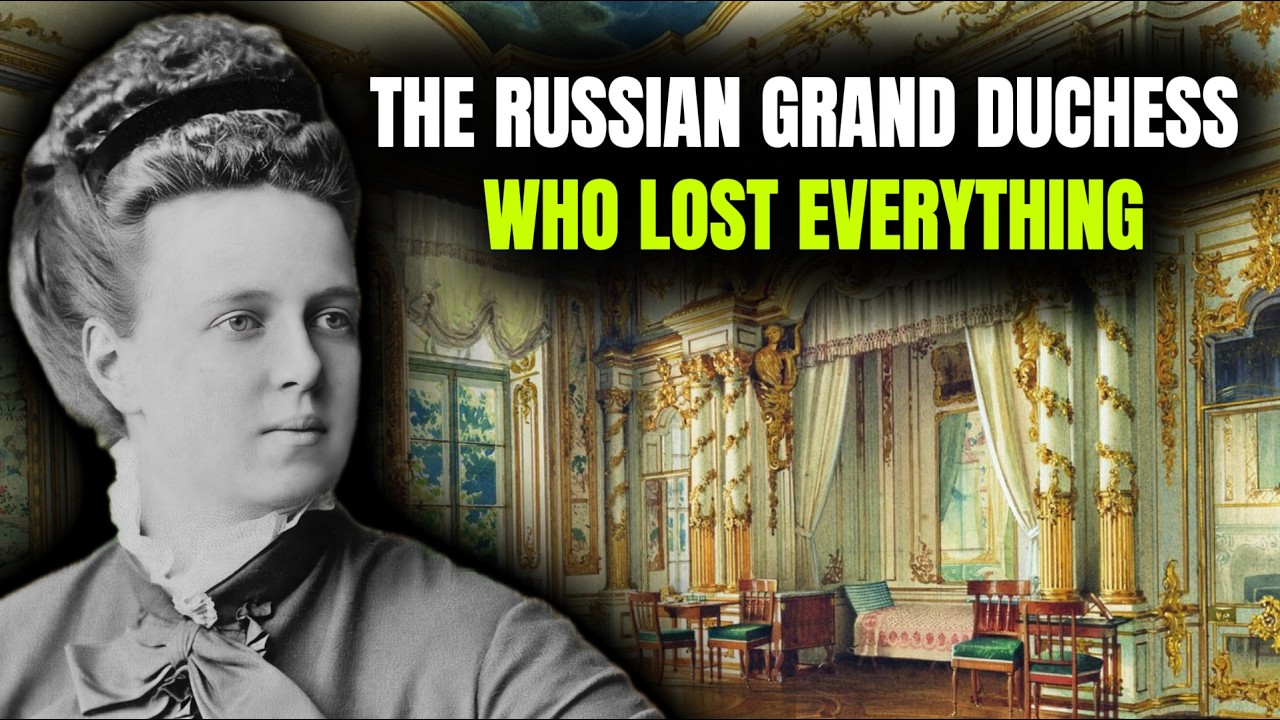
She was Maria Alexandrovna Romanova, born the daughter of a tsar of Russia, married to a son of Queen Victoria, and sovereign duchess of a German state. The telegram addressed to plain Mrs. Coburg was the final humiliation of a life that had already been stripped of almost everything. Maria Alexandrovna Romanova was born on 17 October 1853 at the Alexander Palace at Tsarskoye Selo, near St.
Petersburg, during the reign of her grandfather, Emperor Nicholas I. She was the sixth of eight children and the second daughter of the then Tsesarevich Alexander Nikolayevich and Princess Marie of Hesse and by Rhine, who had taken the name Maria Alexandrovna upon converting to the Orthodox faith in 1841. Her arrival brought immense joy and relief to her parents. Their only elder daughter, Grand Duchess Alexandra Alexandrovna, known affectionately as Lina, had died of meningitis in 1849 at the age of six.
Maria’s birth was received as a blessing, offering comfort to a family still in mourning. Despite the opulence and strict military protocol that defined the regime of Nicholas I, Maria’s early years were surrounded by an affection unusual in royal circles. After Nicholas I died in March 1855, her father ascended the throne as Emperor Alexander II. The new sovereign showed a clear preference for his daughter over her sons, calling her his little cherub and devoting much of his limited free time to her.
Years later, her governess, Anna Tyutcheva, daughter of the poet Fyodor Tyutchev, recorded in her memoirs the deep affection the emperor and empress felt for Maria, writing that the entire family adored the child and that her parents showered her with kisses and affection. That apparent tranquility was threatened when Maria was seven and nearly died from a serious throat illness. Her recovery strengthened her parents’ protective instincts, and a year later they gave her a playhouse and a small farm within the grounds of the Alexander Palace. By her parents’ decision, Maria became the first Russian Grand Duchess raised by English nannies, which gave her a perfect command of the language from childhood.
Beyond Russian and English, she learned to speak German and French fluently, completing the intellectual and artistic education customary for daughters of the Romanov dynasty. The family’s tranquility did not last. In 1865, the imperial family suffered a devastating blow with the death of the heir to the throne, Tsesarevich Nicholas Alexandrovich, who was engaged to Princess Dagmar of Denmark. At twenty-one, the young prince succumbed to cerebrospinal meningitis at the Villa Bermond in Nice, in the south of France, where he had traveled seeking relief from his ailments.
This second loss of a child to the same illness plunged Empress Maria into deep depression and further aggravated her already delicate health. The death of Nicholas Alexandrovich also deepened the estrangement between the emperor and empress. Following the loss of their eldest son, Alexander II and his wife began leading increasingly separate lives. Shortly afterward, the tsar began an extramarital relationship with the young Catherine Dolgorukova, with whom he would have several children, while his lawful wife became increasingly isolated at court.
Because of the empress’s deteriorating health and the domestic tensions in St. Petersburg, she began making lengthy stays in Western Europe, taking with her her three youngest children: Maria, Grand Duke Sergei, and Grand Duke Paul. These prolonged journeys through Germany and Italy strengthened the close bond between Maria and her younger brothers, who became her closest confidants within an increasingly fragmented family. One of those journeys opened a new chapter in her life.
In August 1868, during a customary visit to the Battenberg family at Jugenheim in the Grand Duchy of Hesse, Grand Duchess Maria met Prince Alfred, Duke of Edinburgh. Alfred, the second son of Queen Victoria and Prince Albert of Saxe-Coburg and Gotha, was a twenty-three-year-old naval officer with a reserved and introverted character. Their initial meeting was brief, as Alfred’s naval duties kept him sailing around the world for the following two years aboard HMS Galatea. They met again in the summer of 1871 at Heiligenberg Palace, also in Hesse.
During that stay, Maria, then seventeen, and Prince Alfred shared long walks and conversations, discovering a deep affinity founded primarily on their shared love of music. Maria was an accomplished pianist, while Alfred played the violin with enthusiasm. At the end of the summer, they both informed their families of their wish to marry. The idea immediately encountered significant political and family obstacles.
A marriage between a British prince and a Russian Grand Duchess met strong opposition at both courts, still marked by tensions from the Crimean War, which had ended fifteen years earlier with Russia’s defeat. Tsar Alexander II was firmly opposed to his only daughter settling in the United Kingdom. Although he claimed her youth was the main obstacle, he also found it difficult to accept seeing her live so far from her family and insisted on a waiting period of at least one year. Empress Maria distrusted British customs, which she regarded as cold and unfamiliar, convinced her daughter would not be happy in England.
In London, Queen Victoria also expressed firm opposition. No British prince had ever married a member of the Romanov dynasty. The queen was concerned about the implications of Maria’s Orthodox faith and watched with growing unease Russia’s advance into Central Asia, particularly toward the frontiers of British India. Formal negotiations began in July 1871 and remained virtually deadlocked throughout the following year.
The diplomatic stalemate came to an abrupt end in January 1873 because of rumors circulating among the high society of St. Petersburg. According to these reports, Grand Duchess Maria had compromised her reputation by maintaining a relationship considered far too close with Prince Nikolai Golitsyn, her father’s aide-de-camp. Faced with the risk of a scandal that could damage the Grand Duchess’s reputation, the Russian imperial family was forced to accelerate the pending marriage negotiations.
Prince Alfred refused to believe the rumors and remained firmly determined to marry Maria. In an effort to break the deadlock, the Empress of Russia arranged a meeting in Sorrento, Italy, in April 1873, attended by Maria and Prince Alfred. Although the Grand Duchess fell ill with a fever and the meeting had to be cut short, the determination of the young couple and the British government’s interest in improving diplomatic relations with Russia helped persuade the tsar to give way. The final agreement still had to overcome Queen Victoria’s demands.
On 11 July 1873, during a family gathering in Jugenheim, Germany, Prince Alfred formally asked for Maria’s hand in marriage, and she accepted immediately. That same day, the Duke of Edinburgh sent a telegram to Queen Victoria announcing the news. “Maria and I became engaged this morning. I cannot express how happy I am.
I hope we shall have your blessing. ” Queen Victoria formally congratulated the couple, though she recorded deep reservations in her diary: “Not knowing Marie and realizing that there may still be many difficulties, my thoughts and feelings are very mixed. ”
The confirmation of the engagement sparked a fresh diplomatic dispute between the tsar and the British queen. One week after the announcement, Queen Victoria requested that Alexander II bring Maria to Scotland so she could meet and inspect her future daughter-in-law before the wedding.
The tsar flatly refused, and according to court accounts even referred to the British sovereign as a silly old fool. The Russian empress attempted to mediate by proposing a neutral meeting in Cologne, a suggestion Queen Victoria dismissed as simply impertinent, declaring she was not prepared to travel at the convenience of any little princess. Tensions increased when the British sovereign rejected the appointment of the Prince of Wales as honorary colonel of a Russian regiment and demanded that an Anglican service be held in St. Petersburg immediately after the Orthodox ceremony.
In the end, the British ministers’ interest in resolving the frontier dispute with Russia over the borders of Afghanistan helped break the deadlock and made the marriage possible. The wedding took place on 23 January 1874 in the great church of the Winter Palace in St. Petersburg. Queen Victoria did not attend, represented by her eldest son, the Prince of Wales, and his wife, Princess Alexandra of Denmark.
The wedding consisted of two consecutive ceremonies: the first according to the Russian Orthodox rite, officiated by the Metropolitan of St. Petersburg, and the second, an Anglican service held in the Alexander Hall of the palace, conducted by the Dean of Westminster, Arthur Stanley. Although diplomatic tensions lingered, Maria wrote of her happiness: “How happy I am to belong to him. I feel that my love for him grows every day.
I have a feeling of peace and indescribable happiness and an endless impatience to be entirely his. ” To commemorate the union between the two royal houses, the English bakery Peek Frean created a sweet round biscuit bearing the Grand Duchess’s name, known internationally ever since as the Marie biscuit. The couple spent their wedding night at the Alexander Palace at Tsarskoye Selo, where the tsar had prepared a magnificent honeymoon suite on the ground floor in the hope of persuading them to remain in Russia. The Duke and Duchess of Edinburgh arrived in England in March 1874.
They received a warm public welcome at Windsor, and on 7 March, Queen Victoria recorded a favorable first impression: “I took dear Marie into my arms and kissed her affectionately several times. She has a very friendly manner, a pleasant face, a beautiful complexion, and fine bright eyes. She speaks English wonderfully well. ” The couple established their official residence at Clarence House in London and leased Eastwell Park in Kent as their country retreat, which soon became Maria’s favorite residence.
Despite the warm reception, Maria never truly adapted to her new country. She disliked the damp climate of the British Isles, the food, and the social atmosphere of the London court, which she regarded as dull and provincial compared with the splendor of St. Petersburg. Her proud and distant manner quickly earned her the dislike of London society, which considered her arrogant.
The principal source of conflict at the British court was the dispute over titles and precedents. Having been raised within the traditions of the tsar’s absolute authority, Maria insisted that as the daughter of an emperor she ranked above every woman in the British royal family, including her sister-in-law, Alexandra, Princess of Wales, daughter of a lesser monarch, the King of Denmark. The Grand Duchess demanded to retain the style of Imperial Highness and to take precedence over the Princess of Wales at official engagements. Queen Victoria firmly rejected this and decreed that the style of Royal Highness, which Maria had acquired through marriage, should always take precedence on British soil.
The queen settled the dispute by placing Maria immediately after the Princess of Wales, a decision the Grand Duchess regarded as an intolerable insult. In response, Maria sought various ways to unsettle her mother-in-law. She attended official receptions wearing the spectacular tiaras and necklaces from the Romanov collection with deliberate ostentation, fully aware that the jewels of the Russian imperial family were among the most magnificent in Europe. She also breastfed her children in the presence of the queen and her guests, knowing perfectly well that the sight deeply embarrassed Victoria and many members of her circle.
The conflict was far from over, and the tsar himself would eventually intervene personally. In May 1874, Alexander II paid a state visit to the United Kingdom to see his daughter and reaffirm relations between the two nations. The tsar and Grand Duke Alexei arrived at Windsor after a troublesome journey during which the imperial yacht ran aground on rocks near Dover, forcing the cancellation of the official welcoming luncheon. The tsar eventually reached Windsor by train at ten that evening.
Upon seeing once again the man with whom she had fallen in love during her youth in 1839, Queen Victoria recorded her distress at his appearance: “He is fearfully changed, so thin, and his face looks so old, sad, and weary. ” The visit confirmed the growing distance between the two courts, made worse by Maria’s continual complaints about the humiliations she had suffered over protocol. Although the visit concluded with diplomatic courtesy, the rift between the Grand Duchess and her British in-laws became almost impossible to repair. Despite the tensions, Maria fulfilled her dynastic duties, and the family quickly grew.
Prince Alfred was born in 1874, Princess Marie, the future queen of Romania, in 1875, Princess Victoria Melita, the future Grand Duchess of Russia, in 1876, and Princess Alexandra, the future Princess of Hohenlohe-Langenburg, in 1878. The family’s happiness was shattered when her next pregnancy ended with a stillborn son in October 1879. It was not until April 1884 that her youngest daughter, Princess Beatrice, was born; she would later become Duchess of Galliera through her marriage to Prince Alfonso of Orleans and Bourbon. The upbringing of the children remained almost entirely under Maria’s control, and she proved to be a strict, protective, and deeply devoted mother, determined to occupy a central place in their lives.
Meanwhile, the Duke of Edinburgh spent much of his time away from home because of naval duties. As the years passed, their relationship deteriorated beyond repair. From the 1880s onward, Alfred developed a serious dependence on alcohol and became increasingly irritable, reserved, and unfaithful. Maria maintained the appearance of a stable marriage for the sake of the children, but years later she confessed to one of her daughters that she felt she had never been anything more than her husband’s lawful mistress.
While struggling with the unhappiness of her married life in England, Maria received two devastating blows from Russia. On 3 June 1880, her mother, Empress Maria, died of tuberculosis at the age of fifty-five in the Winter Palace. Barely a month later, Tsar Alexander II contracted a morganatic marriage with his longtime mistress, Catherine Dolgorukova. That marriage deeply wounded the Grand Duchess and caused a temporary estrangement between the emperor and his legitimate children.
The family’s grief reached its height on 13 March 1881, when Alexander II lost his life in St. Petersburg following a bomb attack carried out by members of a revolutionary group. The loss of her father, her greatest source of support, affected her profoundly. From that moment she withdrew even further from the British court and devoted herself increasingly to the upbringing of her daughters.
Between 1886 and 1889, Prince Alfred was posted to Malta after being appointed commander-in-chief of the Royal Navy’s Mediterranean Fleet. The family moved to the island, where Maria enjoyed a warmer climate and greater social freedom far from the direct supervision of Queen Victoria. In 1890, after the end of his posting in Malta, the family settled briefly in Devonport, England, where Alfred held his final active naval command. During these years, Maria devoted much of her energy to arranging advantageous marriages for her daughters, determined that they should never repeat her own unhappy marital experience.
The Duke of Edinburgh and his brother, the Prince of Wales, wished to marry the couple’s eldest daughter, Princess Marie, to her first cousin, the future King George V. Maria firmly opposed the plan. Beyond her lack of affection for the British royal family, the Grand Duchess rejected marriages between first cousins, which were forbidden by the canons of the Russian Orthodox Church in which she had been raised. Displaying her customary determination, she secretly negotiated the marriage of her eldest daughter to Crown Prince Ferdinand of Romania, a member of the Catholic branch of the House of Hohenzollern-Sigmaringen.
The wedding took place on 10 January 1893, ensuring her daughter would establish her life far from the sphere of influence of the British crown. On 22 August 1893, Duke Ernst II of Saxe-Coburg and Gotha, Prince Alfred’s uncle, died without direct heirs. As the Prince of Wales had previously renounced his succession rights to the German duchy, the throne passed to Prince Alfred. The family left their residences in the United Kingdom permanently and settled in Germany.
Upon ascending the ducal throne, Alfred gave up his annual allowance of £15,000 together with his seats in the House of Lords and the Privy Council, retaining only an income of £10,000 for the maintenance of Clarence House in London. The couple established their official residence at Ehrenburg Palace in Coburg and spent long periods at Rosenau Castle, the family’s summer residence. In her new role, Maria became particularly active in promoting cultural projects, supporting the arts, and establishing local charitable institutions. This new period of stability and fulfillment would soon be overshadowed by the tragic life of her only son.
In January 1899, the Duke and Duchess of Saxe-Coburg and Gotha gathered at Friedenstein Palace in Gotha to celebrate their silver wedding anniversary. The occasion was overshadowed by the absence and subsequent tragedy of their only son, Prince Alfred. At twenty-four, the young prince was suffering from severe depression and a serious decline in his health, which some contemporaries attributed to syphilis contracted during his military service in Berlin. He was also facing his parents’ determined opposition to his relationship and alleged secret marriage to an Irish woman, Lady Mabel Fitzgerald.
In the midst of the anniversary celebrations, on 23 January 1899, Prince Alfred shot himself with a revolver in his room at the castle. Although he initially survived the wound, the family decided to transfer him to a sanatorium under the pretext that he needed to recover from nervous depression. Prince Alfred died there two weeks later, on 6 February 1899. Officially, the cause of death was recorded as a chronic disease of the brain.
The death of the heir destroyed the last remnants of the relationship between the Duke and Duchess. Devastated by the loss, Duke Alfred blamed his wife directly for their son’s death and refused to live under the same roof as her for the remainder of his life. Plunged into deep depression and suffering from alcoholism, Duke Alfred died of throat cancer on 30 July 1900 at a cottage beside Rosenau Castle, at the age of fifty-five. As he had no surviving sons, the throne of Saxe-Coburg and Gotha passed to his nephew, Prince Charles Edward, Duke of Albany.
As Dowager Duchess, Maria continued to reside at Ehrenburg Palace in Coburg and Rosenau Castle, retaining considerable influence over the lives of her daughters. Nevertheless, her later years continued to be overshadowed by family scandals. In 1901, her daughter Victoria Melita obtained a divorce from her husband, Grand Duke Ernst Ludwig of Hesse. The proceedings caused a sensation throughout the European courts, particularly in Russia, where Empress Alexandra Feodorovna, Ernst Ludwig’s sister, barred Victoria Melita from entering Russian territory and publicly defended her brother.
Tragedy struck the family once again in November 1903, when the only surviving child of that failed marriage, Princess Elisabeth of Hesse, died of typhoid fever at the age of eight while visiting imperial relatives in Poland. The Victoria Melita scandal deepened further in October 1905, when she married Grand Duke Kirill Vladimirovich of Russia, her first cousin and the son of Grand Duke Vladimir Alexandrovich, Maria’s brother. The wedding, regarded as contrary to the canons of the Russian Orthodox Church because of the close relationship between the couple, took place at Tegernsee in Bavaria without the prior consent of either Tsar Nicholas II or King Edward VII. In response to what he regarded as a grave offense, the tsar stripped Kirill of his imperial titles, his state allowance, his rank in the Imperial Navy, and banished him from the Russian Empire.
Maria herself felt the weight of the scandal and wrote to Empress Alexandra expressing her regret for having encouraged the relationship between the young couple in Coburg, confessing she felt responsible for arranging Ducky and Kirill’s marriage. The outbreak of the First World War in 1914 painfully divided the Dowager Duchess’s loyalties. Despite her blood ties to both Russia and the United Kingdom, she openly supported Germany during the conflict. This position further damaged her relationships with many of her Russian and British relatives.
Anti-Russian sentiment in Coburg also made her an object of suspicion within the German Empire itself. To avoid hostility and growing tensions, she decided to move to Switzerland, settling first in Lausanne and later in Zurich. From her Swiss exile, she witnessed the complete disintegration of the imperial world she had once known. The Russian Revolution of 1917 brought about the fall of the Romanov dynasty and the beginning of a systematic persecution of her closest relatives.
In July 1918, her nephew, the deposed Tsar Nicholas II, together with his wife and their five children, was executed by the Bolsheviks in Yekaterinburg. Tragedy also claimed her own brothers. Grand Duke Sergei had been killed in a bomb attack in Moscow in 1905, while her last surviving brother, Grand Duke Paul, was executed by the Soviet authorities at the Peter and Paul Fortress in Petrograd in January 1919. With his death, Maria became the last surviving child of Tsar Alexander II and Empress Maria Alexandrovna.
The fall of the Romanov dynasty also deprived her of much of her immense personal fortune. The new Bolshevik regime disregarded former agreements of the imperial family and confiscated the properties, investments, and income upon which she depended financially. At the same time, in November 1918, Germany’s defeat in the war brought about the collapse of the German Empire and the forced abdication of her nephew Charles Edward, ending the sovereign existence of the Duchy of Saxe-Coburg and Gotha. Maria spent the final two years of her life in extremely modest circumstances in Zurich.
Deprived of the income that had belonged to her imperial dowry and forced to survive on the limited financial support provided by her daughters, her physical and mental health had been severely weakened by the accumulation of family tragedies and material losses. On 24 October 1920, the Grand Duchess suffered a fatal heart attack at her residence in Zurich. According to the accounts of her daughters and hotel staff, the attack occurred immediately after she received the official telegram sent by the administration of the new German Republic, addressed simply to a private citizen named Mrs. Coburg.
Following her death, the Grand Duchess’s body was taken to Germany. She was buried beside her husband, Duke Alfred, and their son in the ducal mausoleum of the House of Saxe-Coburg and Gotha in the Friedhof am Glockenberg cemetery in Coburg. She had been born the daughter of a tsar of Russia, had become the daughter-in-law of Queen Victoria, and ended her days far from the palaces where she had spent her childhood.
With her passing, the imperial world that had shaped her entire existence disappeared as well.
