By 1962, a company had figured out how to give American children something they’d never been able to own before: their fear. It came as a 98-cent plastic Frankenstein kit, and within two years, it reportedly sold nearly eight million copies. By 1977, the company was gone, not because the craze had run its course, but because adults took it apart. It happened in four distinct ways, four separate decisions spread over fifteen years.
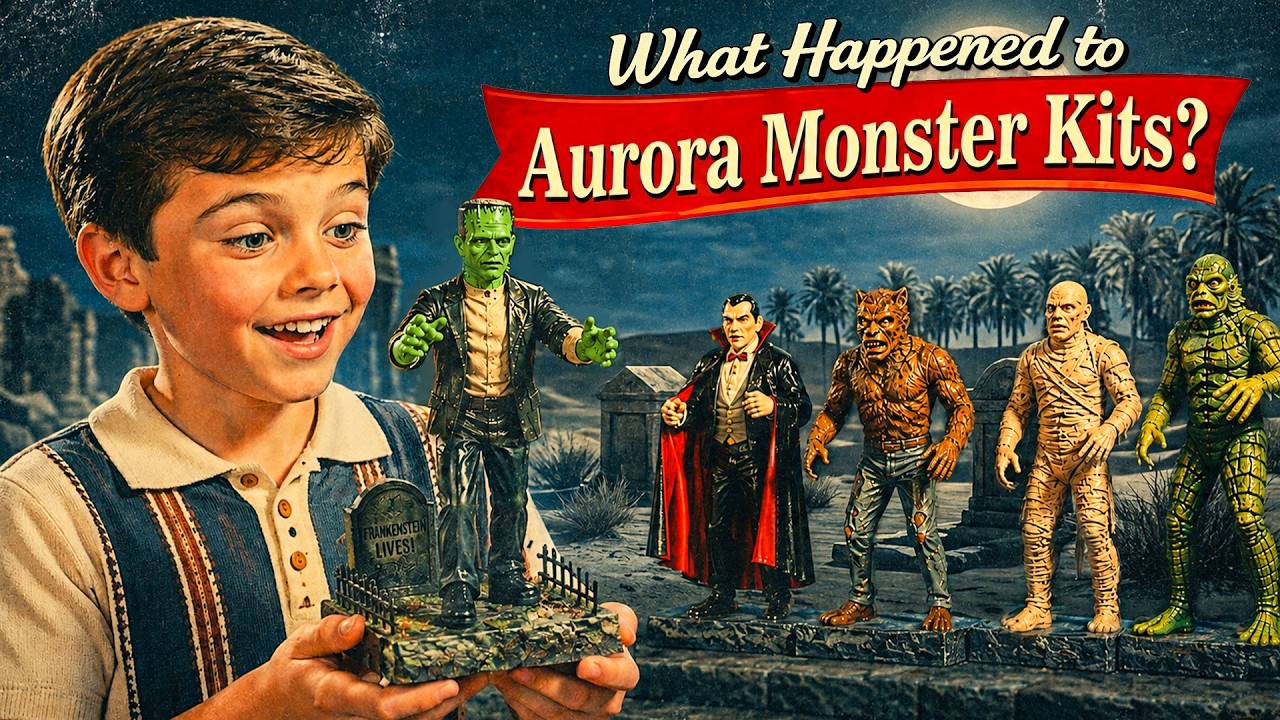
A lobbying campaign cleared monster films from children’s television. An oil embargo broke the price point. Corporate retail abandoned the hobby shops. And an adult corporation acquired Aurora, panicked at what it found, and destroyed the leadership just before Christmas.
The children never outgrew the kits. Adults made sure the next generation never got the chance. The first condition that made it all possible was television, and the story of how adults ended it begins with what the medium built. In October 1957, a company called Screen Gems released a package known as Shock Theater.
It contained 52 Universal horror films: Frankenstein, Dracula, the Wolf Man, the Mummy, the Creature from the Black Lagoon, all of them, suddenly available to local TV stations across the country. Before this, a boy had to go to a movie theater to see these monsters. He paid his nickel, sat in the dark, and then went home, and the monster didn’t follow. After Shock Theater, the monster was right there in the living room.
Saturday afternoon, late Friday night, it was on the screen. Sometimes a parent sat beside him. Sometimes he was alone in the dark, the screen the only light in the room. Local stations hired hosts to introduce the films, figures like John Zacherle, dressed in black, cracking campy jokes between the scares.
It all felt like a costume party where the costume was fear. A boy laughed, but the monster was still real. By 1958, a magazine called Famous Monsters of Filmland appeared on newsstands. It told readers the names of the men inside the makeup, and it made the monsters feel like something you could know, not just something you watched through your fingers.
A fear you know well stops being something that happens to you. It starts being something that belongs to you. All of this created an audience before a single plastic kit existed: a generation of boys who knew every monster by name, by weakness, by origin. The first person at Aurora who suggested turning that appetite into a product was told the idea was too morbid for children.
He disagreed, and what happened next almost didn’t happen at all. Aurora Plastics Corporation was a perfectly respectable model kit company, founded in Brooklyn in 1950 and producing its own kits by 1952. Planes, ships, cars, gladiators, knights in armor. Nothing that would get anyone into trouble.
Then Aurora’s advertising and promotional manager, a man named Bill Silverstein, started pushing an idea nobody at the company wanted to hear. They should make monster models. Management resisted, and the word they kept using was morbid. The belief was that parents would never allow it, that boys didn’t want to spend their allowance on something scary, and that it was beneath a serious company.
According to Aurora company legend, Silverstein was so convinced that he reportedly threatened to quit and start a competing business if they wouldn’t try it. Whatever the pressure was, it worked. In January 1962, Aurora took a painted Frankenstein prototype to the Hobby Industry of America Association convention in Chicago. They set it up in their booth and waited.
The painted prototype sat under trade show lights for four days while buyers moved past airplane kits and military models. Not one adult placed an order. Then, on the last day, a California toy retailer named Al Davis brought his sons to the booth. Glenn and Fred Davis walked past every airplane, past every car, past every ship.
They went straight to the monster. Al Davis placed the first order. A floor full of adult buyers had seen a morbid plastic toy. Two boys had seen the only thing in the room they actually wanted.
Within months, Aurora had something it hadn’t planned for. A craze. Rubber cement and old cardboard. The hobby shop on Main Street.
The spinning wire rack at the drug store. The box the size of a record album, with a green Frankenstein on the front: flat-topped skull, bolts in the neck, arms reaching forward. The boy standing in front of it was around nine or ten years old. Old enough to feel the scare.
Young enough to think the scare was a dare. The 98-cent price was calculated exactly. For a boy in 1962, that sat right at the edge of what he could scrape together on his own. He didn’t need to ask.
He just needed to have had a good week. The box art was what stopped him in front of the rack. Aurora hired an illustrator named James Bama, who painted the first 22 monster kit boxes like Gothic oil canvases: dark skies, dramatic lighting, monsters that looked alive and enormous and threatening. You could stare at a James Bama box for ten minutes before you thought about picking it up.
Bama worked from black-and-white movie stills. There was no official color for Frankenstein, so he invented one. He blended Boris Karloff and Glenn Strange, the two most famous Frankensteins, and decided the skin would be green. That single color decision became the visual identity of Frankenstein for an entire generation.
The first sign that adults were watching came almost immediately. Parents complained that the unpainted gray plastic inside didn’t match the photorealistic painting on the box. Aurora adapted. Starting with the Mummy kit in 1963, Bama had to paint the assembled kit instead: not his vision, but what was actually in the box.
But neither the price nor the box art explains what actually kept the kit selling. When a boy assembled the kit, he wasn’t just watching Frankenstein anymore. He’d clipped the sprues, smelled the cement, held the figure in his own hands, painted it, probably badly, but it was his. Psychologist Dr.
Merav Mendez has described how short-term fear can show a person that they are capable of surviving and can regulate their emotions. The monster on that bedroom shelf wasn’t moving. The boy had built it. He put it there.
He controlled it. By the summer of 1964, demand was still growing. The four conditions were in place. The monsters were fresh on television.
The right generation was exactly the right age. The price sat inside a child’s weekly allowance. And a neighborhood shop in every town stocked the kits at eye level. If there’s an original Aurora kit sitting in a box somewhere in your house, still unbuilt, maybe still sealed, it’s worth looking up.
Most were built, painted, and lost to time, and the people who lost theirs have been searching for replacements ever since. A 16-kit lot sold at Heritage Auctions for $7,200. Individual sealed originals move for anywhere from $150 to over $2,000, depending on the title. But before adults ended the conditions from outside, Aurora’s own management had already started losing the thread from within.
By 1964, Aurora’s adult executives were nervous, and nervous executives make impulse decisions. Their idea was to combine the monster audience with the hot rod audience. Boys liked building Frankenstein, and boys liked building custom cars. So boys would probably love building Frankenstein in a custom car.
The decision was made at the executive level. Nobody asked the boys. They were wrong. The 1964 Monster Hot Rods line put classic monsters behind the wheels of dragsters and go-karts: Dracula’s Dragster, the Wolfman’s Wagon, the Mummy’s Chariot, Godzilla’s Go-Kart, Frankenstein’s Flivver, King Kong’s Thronester.
Six kits, monsters and vehicles. James Bama, the man who’d invented green Frankenstein, who’d built these monsters into icons, actually hated the assignment. He later described painting monsters behind the wheels of hot rods while women in evening gowns rode alongside. He thought the whole thing had lost what made the originals work, and he left Aurora in 1965.
Aurora lost its sharpest eye at exactly the wrong moment. In 1969, another executive decision followed: the Frightening Lightning reissues. The original classics back in stores, but now with glow-in-the-dark parts, phosphorescent heads, glowing hands, a feature added to make an old thing feel new. Kids bought them, but notice what was actually happening.
Aurora’s management was no longer making things worth wanting. It was repackaging what it already had. First monsters in hot rods, then monsters that glow. Each gimmick was an adult decision, and each one was a signal that the original thing had run out of gas.
The executives read it differently. They read it as, “We need to go further. ”
In 1971, they did, and this time the decision was visible enough to draw a crowd. In March 1971, Aurora began shipping a new line called Monster Scenes.
No child designed it; Aurora’s adult executives did. The line included Dr. Deadly, a fictional mad scientist villain; Vampirella, a scantily dressed female vampire from a horror magazine; and a figure called the Victim, a woman molded in skin-toned gray plastic, designed to be placed inside the line’s torture devices. Kits were named The Pendulum, The Hanging Cage, Pain Parlor, Gruesome Goodies.
The boxes were stamped “Rated X for Excitement. ”
Two months after Monster Scenes began shipping, in May 1971, Nabisco acquired Aurora. A biscuit company. They had no idea what they had just bought.
On November 15, 1971, twelve protesters stood in the rain outside Nabisco’s headquarters on Park Avenue in New York. They were from Parents for Responsibility in the Toy Industry and Women Strike for Peace. One was dressed as a hangman. Their signs read, “A toy should be a toy,” and “A toy is to grow.
” They chanted, “Sadistic toys make violent boys. ”
Nabisco called the kits a terrible embarrassment. They halted production of the Hanging Cage and The Pendulum, pulled the remaining United States stock, and shipped it to Canada to be liquidated. And just before Christmas, they fired practically the entire Aurora staff.
Aurora’s marketing VP, Richard Schwarzschild, later said the company had received only 120 complaint letters alongside, he said, a flood of fan mail from children. 120 complaint letters against a flood of fan mail from the kids who actually wanted the kits. The twelve people in the rain weren’t protesting the 1962 Frankenstein. They weren’t protesting a boy who’d spend a Saturday afternoon building something that scared him, painting it badly, putting it on a shelf, looking at it every day until it wasn’t scary anymore.
They were protesting a decision Aurora’s adult executives had made. The boy was never the problem. If anything, he was doing exactly what he should have been doing: building something frightening, making it small enough to hold, putting it where he could see it every day. Thirty years later, child psychologists would put a name to exactly what he’d been doing.
They’d call it healthy. Adults designed Monster Scenes, and adults shut it down. The boy who wanted the 1962 Frankenstein was never consulted. He was just left without the kits.
But Monster Scenes was the loudest adult decision. The other three made no noise at all. Television came first. A lobbying organization called Action for Children’s Television, founded in 1968, spent years pressuring networks to remove horror and action programming from children’s viewing slots.
By 1972, they’d largely succeeded. The horror hosts were gone. The late-night monster films had been cleared from their regular schedules. Kids growing up in the early 1970s weren’t watching Shock Theater.
They were watching Scooby-Doo, a show where the monster is always a man in a mask, always fake, always explained away by adults at the end of the episode. The audience was the condition adults failed to replace. The boys who built Aurora kits in 1962 were born in the late 1940s and early 1950s. They were ten, eleven, twelve when it started.
By 1977, those same boys were in their mid-twenties. They had jobs, some had kids, but the generation behind them never got the same starting conditions. By the time they were old enough, the TV programming had already been cleared, and the other conditions were already going. There was nothing left to recruit them with.
The price broke in October 1973. The OPEC nations announced an oil embargo, and oil prices skyrocketed. The plastic in every Aurora kit was petroleum-based. When oil prices jumped 350 percent, the material cost followed.
Robert Johnson III, a Monogram engineer who was there for the entire acquisition, later documented what the embargo did to the industry. Plastic that had cost pennies per unit was suddenly scarce. The 98-cent price point was gone before the company was. The stores went last.
Monogram made a business decision: prioritize mass retail. By 1976, more than half of Monogram’s annual kit sales were moving through Kmart and Toys R Us. Nobody at Kmart was going to talk to a boy about painting the neck bolts. The hobby shop didn’t close.
It was just cut out of the chain. Aurora reported a $7 million loss in 1976. Nabisco dismantled the company in 1977. The children had been sending fan mail the whole time.
Aurora was the last one to know. And the molds that made every Frankenstein, every Dracula, every Wolf Man, they have their own ending. When Nabisco shut Aurora down in 1977, Monogram acquired everything: the molds, the machinery, the records. The story most people tell is that the molds were destroyed in a single catastrophic train derailment during the transfer.
The derailment did happen, but it wasn’t the whole story. Molds arrived at Monogram’s facility frozen in mud and ice. Shear pins snapped on impact. Some were beyond repair.
But the Monogram engineer who was there for the whole acquisition documented what actually happened. Many molds were deliberately scrapped. Too worn. Too outdated to keep running.
Some items on the original inventory list simply never arrived at all. Their locations never resolved. The loss was real, but it wasn’t a single dramatic moment. It was a slow unraveling decided in warehouses and ledger books over months.
In 2018, Atlantis Models purchased the surviving Aurora molds from the Revell Monogram facility in Elk Grove, Illinois. Some of those kits are back on shelves right now. Different plastic, better-fitting parts, but the same molds, the same green Frankenstein.
That’s the thing that’s left.
