In 2018, a research team studying Central Appalachian populations completed the first county-by-county genetic mapping of the region. They were not expecting a surprise. They were expecting to confirm the standard colonial British signature, slightly muted, slightly isolated, nothing that would require rewriting the textbooks. What they found instead was a gene pool that had been sealed for roughly 250 years, drifting away from every other Anglo-American population in the country, carrying markers that pointed not to generic Britain, but to three very specific corners of Europe that most Americans have never heard of in connection with their own family history.
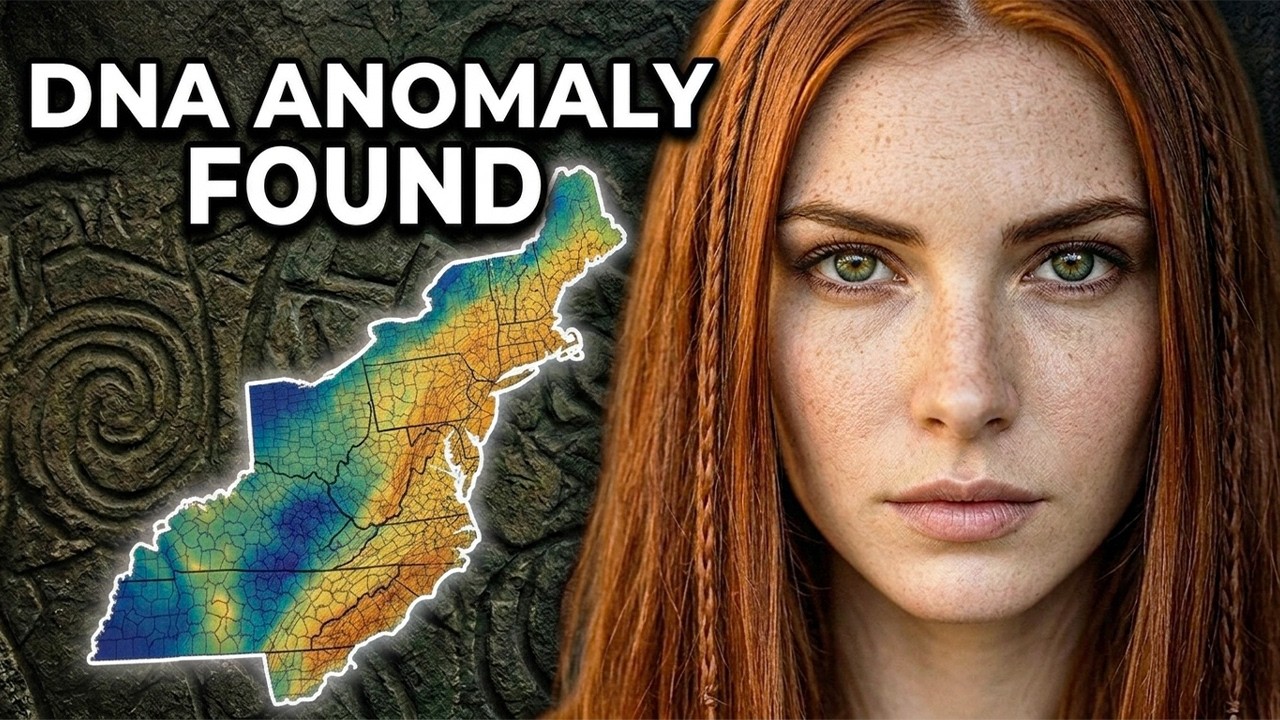
The sample was not a casual collection. The team sequenced over 1,200 individuals drawn from the Central Appalachian counties of Eastern Kentucky, Southern West Virginia, Southwestern Virginia, and East Tennessee. Every individual in the sample had to meet a specific residency requirement: at least four generations of documented family presence in the same county. Not the same state.
The same county. That requirement was deliberate. It filtered out the twentieth-century industrial migrants who had moved into Appalachian cities during the coal boom and the manufacturing era. It isolated the families who had stayed in the same hollows, the same creek valleys, the same ridge lines across the entire post-colonial period.
What that filter produced was a genetic sample of unusual purity. Not pure in any racial sense. Pure in the scientific sense of being geographically stable long enough to carry a clear and readable signal. When the team ran the initial comparison against the broader American genetic database, the Appalachian sample did not cluster with the coastal south.
It did not cluster with the Mid-Atlantic. It did not cluster with New England. It stood apart. A distinct population signal sitting inside the borders of the modern United States, genetically recognizable as its own thing.
That result was the starting point. The question it opened was where that signal actually came from. To understand why the Appalachian DNA signal looks the way it does, you have to understand what happens to a gene pool when it stops moving. The technical term is endogamy: marrying within the same community, the same valley, the same set of surnames across multiple generations.
Endogamy is not unusual in human history. It is, in fact, the default condition of most pre-industrial populations worldwide. What made Appalachia unusual was the duration and the geography. The hollows of Eastern Kentucky and Southern West Virginia are not metaphorically isolated.
They are physically isolated. Narrow creek valleys bounded by steep ridgelines with limited road access until the twentieth century, and almost no railroad penetration until the coal industry arrived in the 1880s. The families who settled those hollows in the late 1700s largely stayed in those hollows. They married the family in the next hollow over.
They married cousins. They married the children of cousins. The same surnames appear on the census rolls of Eastern Kentucky in 1800, in 1850, in 1900, and in 1950: Armstrong, Hall, Elliott, Combs, Mullins, Breeding. When a population practices endogamy for 250 years, the genetic effects are measurable.
Rare variants become common. Regional markers that would dilute and disappear in a more mobile population get amplified instead. The Appalachian sample showed both effects. The research team identified allele frequencies that had drifted significantly from the coastal American baseline, not because a new population had arrived, but because the founding population had been preserved in amber.
The Appalachian genome is not a fresh signal. It is an old signal kept intact. So when the team traced it back to its European source, they were not tracing a blended modern British average. They were tracing the specific founding stock that walked into those hollows around 1780 and never left.
To find where that founding stock came from, you have to go back to a war most Americans have never heard of. Not a war between nations. A war between neighbors. The Anglo-Scottish border, running roughly from Carlisle in the west to Berwick-upon-Tweed in the east, was for three centuries the most violent piece of real estate in western Europe.
Not violent in the way of pitched battles between armies. Violent in the way of a permanent, low-grade, multi-generational blood feud conducted by families against other families across a line that neither England nor Scotland could fully control. From roughly 1300 to 1600, the people who lived in that border country raided each other’s cattle, burned each other’s farmsteads, kidnapped for ransom, and settled disputes through clan warfare that operated entirely outside the legal systems of both crowns. They were called the border reivers.
Reiver is an old English word meaning robber or plunderer. The English crown did not consider them English. The Scottish crown did not consider them Scottish. Both governments considered them a separate administrative problem.
The historian George MacDonald Fraser documented the reiver surnames in his 1971 study of the border country. That surname list reads like a census roll of Appalachia today: Armstrong, Graham, Elliott, Bell, Hall, Johnston, Kerr, Maxwell, Nixon, Robson, Scott, Hume, Crozier, Burns. These are not generic British names scattered evenly across the United Kingdom. These are border names.
Geographically specific, historically traceable, and they cluster in eastern Kentucky and southern West Virginia at rates genealogical researchers have documented as significantly above the national average. The reivers did not come to Appalachia directly. They took a detour, a forced one, and that detour is where the genetic story gets precise. In 1610, King James the First ran out of patience with the border reivers.
The solution he arrived at was not justice. It was geography. He resettled the most troublesome border families across the Irish Sea into the Ulster Plantation in the north of Ireland. The official rationale was colonization: filling Ulster with loyal Protestant settlers to displace the Gaelic Irish Catholic population that had just lost a rebellion.
The practical reality was simpler. The English Crown was relocating its own domestic problem to somewhere far enough away that it would become someone else’s problem. The reivers went. They had no meaningful choice.
They brought their surnames, their clan loyalties, their distrust of central authority, and their habit of solving disputes without reference to courts or governments. They settled the northern Irish counties of Antrim, Down, Londonderry, and Armagh. They became known as the Ulster Scots, or in American historical shorthand, the Scots-Irish. In 2017, geneticist Dr.
Edmund Gilbert, working out of the Royal College of Surgeons in Ireland, published a detailed genetic map of the Ulster Scots population as part of the Irish DNA Atlas study. His findings were specific, and they matter for the Appalachian story. The Ulster Plantation population is not Irish in the Gaelic sense. It is not Scottish in the Highland sense.
It is genetically continuous with the border English and lowland Scottish population that lived between Carlisle and Edinburgh before 1610. The transplant moved the people, but it did not change the DNA. Gilbert’s mapping confirmed what the surname evidence had long suggested: the Ulster Scots carried the reiver signal intact across the Irish Sea. A century later, they would carry it across the Atlantic.
The question is what pushed them out of Ulster and toward a port in Belfast with a ticket to Philadelphia. What pushed them out of Ulster was a cascade. Religious persecution from the Anglican establishment, which refused to recognize Presbyterian marriages, baptisms, or land titles. Economic collapse, driven by English trade laws that deliberately excluded Ulster linen and wool from British markets.
And a series of failed harvests in the 1710s that removed whatever margin the Ulster Scots farming communities had been operating on. Between 1717 and 1775, roughly a quarter of a million Ulster Scots left through the port of Belfast and landed primarily at Philadelphia. The historian James Webb, in his 2004 book Born Fighting, described them as among the most consequential and least documented ethnic groups in American history. A quarter million people in less than sixty years.
They arrived with no capital, no political connections, and no welcome from the Quaker establishment that controlled Pennsylvania. The Quakers sent them south down the Great Wagon Road through the Shenandoah Valley of Virginia into the Carolina back country, and from there up into the creek hollows and ridge valleys of southern Appalachia. The migration was not random. It followed the road, and then it followed the water.
Families settled along creek drainages because creek bottoms had the only flat farmable land in the mountains. The hollows filled from the bottom up, and once they filled, they stayed filled. By 1780, the central Appalachian population was substantially in place. The Ulster Scots migration is the single largest source event for the modern Appalachian genome.
It is the reason the reiver surnames cluster in eastern Kentucky at rates significantly above the national average. It is the reason the border English and lowland Scots genetic signal is the dominant component in the county-by-county data. The wagon road put them there. The hollows kept them there.
If you have taken a consumer DNA test and your results came back labeled British or Irish, and your family paper trail runs through Appalachia, that label is not wrong. It is just not specific enough to be useful. The reference databases at 23andMe and Ancestry DNA do not currently maintain separate categories for Lowland Scots, Border English, Ulster Scots, and West Country English. All four of those populations are real, genetically distinct European groups.
All four of them feed the Appalachian genome in different proportions. But because they are all broadly Northwestern European, the algorithms average them together and hand you a label that points nowhere more specific than the British Isles. The specificity is not lost in your DNA. It is lost in the translation.
To find it, you have to go one layer deeper. The Y chromosome test, available through Family Tree DNA and through the advanced results on 23andMe, is where the Appalachian signal becomes readable at the resolution that actually matters. Two haplogroups dominate the Appalachian male line. R1b U106 is the first.
It is the dominant Y chromosome signal in the modern Netherlands, northwestern Germany, and the eastern half of England. If your paternal haplogroup is R1b U106, your direct male line most likely entered Britain with the Anglo-Saxon migrations, not with the earlier Celtic populations. R1b L21 is the second. It is the Celtic Atlantic signal dominating Ireland, Scotland, Wales, Cornwall, and Brittany.
In coastal American populations, U106 and L21 appear in roughly equal proportions. In central Appalachia, researchers working with the Scottish DNA project have documented a measurable skew toward R1b L21, and specifically toward a subclade called R1b L21d F13, which reaches its highest European frequency in two regions: western Scotland and the Ulster coast of Northern Ireland. Your DNA test is not lying to you. It is just stopping one floor above the answer.
The Ulster Scots were not the only major non-English group moving through colonial Pennsylvania and down into the Appalachian back country. The other stream is the one that produced what later Americans came to call the Pennsylvania Dutch. The name is a mistranslation that stuck. They were not Dutch.
They were Deutsch, Germans. And like the Ulster Scots, they were not a generic German population pulled randomly from across central Europe. They came from specific places, driven out by specific catastrophes, and genetic clustering analysis of Pennsylvania German descendants has identified three distinct source subclusters that tell three different stories. The first and largest subcluster traces to the Rhineland-Palatinate, the region centered on Mannheim, Heidelberg, and Speyer.
Colonial immigration records indicate this subcluster accounts for the majority of documented Pennsylvania German arrivals between 1683 and 1775. The Palatinate had been the most heavily devastated region of Central Europe during the Thirty Years’ War and the subsequent wars of Louis XIV. Entire villages were burned, farmland was destroyed, and the surviving population left in waves. The American colonies were the destination because they were the only option.
The second subcluster traces to the Swiss-German cantons, principally Bern, Zurich, and the Upper Rhine. This is the Anabaptist cluster. The Amish and Mennonite founding populations trace overwhelmingly to this region, and the genetic continuity is the strongest of any colonial-era American ethnic group. An Amish person tested today against a Bernese Swiss person tested today will share more recent common ancestry than two randomly selected modern Germans tested in Berlin.
The third and most overlooked subcluster traces to the Alsace-Baden corridor along the Rhine between the Palatinate and Switzerland. Much of Alsace later became French. The descendants stopped identifying as German, and the subcluster disappeared from the family story while remaining intact in the genome. Underneath the Ulster-Scots signal and alongside the Pennsylvania German stream, the county-by-county data revealed a third source population that most Appalachian descendants never think to look for.
When the research team ran principal component analysis on the full Appalachian sample, a secondary cluster appeared that did not match the Scottish border, did not match Ulster, and did not match the Palatinate. It matched the southwestern English counties of Devon, Somerset, Dorset, and Cornwall. This is the West Country signal, and it arrived in America through a different door than the Ulster Scots. Between 1607 and roughly 1700, the colonies of Virginia and Maryland absorbed somewhere between 100,000 and 150,000 indentured English servants.
The majority came from London and the southwestern port cities of Bristol, Plymouth, and Exeter. When their indenture periods expired, most of them could not afford tidewater land, which had already been claimed by the planter class. They moved west into the Virginia Piedmont, and from there into the upper south and the eastern edge of Appalachia. By the time the Ulster Scots came down the Great Wagon Road in the 1730s and 1740s, the West Country signal was already in the mountains waiting for them.
Sitting inside that West Country layer, researchers at the Welsh DNA project identified a smaller marker that has proven unusually durable: a Welsh component concentrated in eastern Kentucky, southern West Virginia, and the western counties of North Carolina. Welsh DNA is genetically distinct from English DNA and from Scottish DNA. It is the closest living approximation to the pre-Roman population of Great Britain. The Welsh migration to colonial America was small in absolute numbers, perhaps 30,000 to 50,000 arrivals across the entire colonial period.
But it was geographically concentrated, and the marker held. Nine generations of intermarriage with a much larger surrounding population and the Welsh signal is still readable in the data. There is one more layer of the Appalachian genome that requires careful handling, because it sits at the intersection of genetics, family memory, and social history in a way that is genuinely uncomfortable to untangle. Roughly one in three families across Eastern Tennessee, Western North Carolina, and Northern Georgia carry some version of the same story.
A Cherokee great grandmother. Usually female. Usually placed two or three generations back from living memory. Usually unnamed.
The story is told with pride, with specificity, and with complete conviction. The geneticists have looked at this carefully, and the data is precise. Genetic studies of Appalachian populations have found average Cherokee admixture well below one percent. That number includes the individuals with verifiable, documented Cherokee descent: families traceable to the Qualla boundary and the mixed-race communities along the Tennessee and North Carolina line, where intermarriage between Cherokee and European settlers is historically confirmed and genetically visible.
When those documented cases are accounted for, the remaining family stories, the overwhelming majority of them, are not supported by the DNA. The historian Gregory Smithers, in his 2015 work on the Cherokee diaspora, documented what those stories were often replacing. A free black ancestor made invisible after the hardening of racial categories in the nineteenth century. A Melungeon ancestor from one of the mixed-race communities of the central Appalachian ridge.
A Romani ancestor. Or simply darker-featured European ancestry from Southern Italy or the Iberian Peninsula, which became socially inconvenient to claim after the nativist movements of the late 1800s. The Cherokee great-grandmother was the safer story. It carried romance without social penalty.
The DNA, when you run it, mostly traces to Europe. That is not a dismissal of family memory. It is an explanation of what family memory was protecting. If you have taken a consumer DNA test and your results came back labeled British, Scottish, or Irish, with a colonial American paper trail running through Appalachia, here is what you are actually looking at.
The British label is not telling you that your ancestors came from London. It is not telling you that your family has anything to do with the English establishment, the Anglican Church, or the Tidewater planter class that built the early colonial economy. It is telling you that the algorithm cannot distinguish, at the resolution most consumer tests offer, between four populations that are real, historically distinct, and genetically separable if you go one layer deeper. Lowland Scots and Border English: the reiver stock that King James moved to Ulster in 1610.
Ulster Scots: that same population after a century in the north of Ireland, carrying the border signal intact across the Irish Sea and then across the Atlantic. West Country English: the indentured servant population from Devon, Somerset, Dorset, and Cornwall that was already in the Virginia back country before the Ulster Scots arrived. And the smaller Pennsylvania German and Welsh streams that bled into the central Appalachian hollows along the Great Wagon Road and the creek drainages of eastern Kentucky and western North Carolina. Your DNA does not point to Buckingham Palace.
It points to Carlisle, Hawick, Coleraine, Plymouth, and Heidelberg. Specific towns, specific borders, specific feuds that were still being fought when James I decided the simplest solution was to move the fighters to a different island. The county-by-county data is the first time those specific origins have been mapped at the resolution of individual hollows and creek valleys. The label your test returned is the beginning of the answer.
The haplogroup one level underneath it is where the answer actually lives. The hollow was not just a place to live. It was a vault. The families who moved into the creek valleys of Eastern Kentucky and Southern West Virginia in the late 1700s brought a founding gene pool assembled from three specific corners of Europe, sealed it inside some of the most physically isolated terrain in the Eastern United States, and kept it largely intact for 250 years.
The county-by-county mapping completed in 2018 did not discover a mystery. It decoded one that had been sitting in plain sight inside the surnames on the census rolls, the haplogroups in the Y chromosome data, and the family stories passed down through generations of people who knew they came from somewhere specific but had lost the precise coordinates. Those coordinates are now recoverable. The border reiver who was relocated to Ulster in 1610.
The Ulster Scot who walked off a ship in Philadelphia between 1717 and 1775. The West Country servant whose indenture expired in Tidewater, Virginia, and who walked west because west was the only direction with unclaimed land. The Welsh settler who followed a creek drainage into Eastern Kentucky, and whose marker is still readable nine generations later. All of them are present in the modern Appalachian genome.
All of them are now mappable to specific European regions at a resolution that consumer DNA tests are only beginning to approach. The textbook called them Scots-Irish and moved on. The genome did not move on. It held the record with the fidelity of a closed population in a sealed valley, waiting for the sequencing technology to catch up.
Borders move. Bloodlines do not. The hollows kept the signal.
The data finally read it.
