Ray Kroc was fifty-two years old in 1954, a middle-aged salesman with diabetes, arthritis, and a body that reminded him every day that he was running out of time. He had spent decades selling paper cups and milkshake machines, measuring his life in mileage and commissions, watching doors close faster than they opened. Then an order came in that did not make sense. A small restaurant in San Bernardino, California, wanted an unusual number of milkshake machines, more than any single location could reasonably justify.
Kroc did what he always did when he smelled something important. He went to see why. What he found was not a dining room or a famous chef. It was a system.
The McDonald brothers, Richard and Maurice, had stripped a restaurant down to a handful of items and rebuilt the kitchen like a factory line. Every motion was timed. Every burger came out the same. Speed, repetition, and control had turned a simple menu into a machine.
Kroc saw more than a restaurant. He saw a blueprint for an entire country. The brothers had built something that worked, but they were content to keep it manageable. They franchised carefully.
They moved slowly. Kroc wanted chaos. He wanted expansion. He wanted the whole country, and eventually the whole world, and he convinced the brothers to let him take their system and run with it.
From the beginning, they wanted different futures. Kroc pushed expansion with a desperate urgency because his body was failing and his age was catching up. Every new franchise pulled the brand further from the brothers’ control. He fought over contracts, over details, over who had the final say.
And underneath all of it was a fact that haunted him. Kroc did not own McDonald’s. He was building a machine that someone else could turn off. He did not just want success.
He wanted possession. He wanted to be untouchable, and there was only one way to become untouchable. He had to take it. In 1961, he did.
Kroc bought out the McDonald brothers for around $2. 7 million, a sum that made them wealthy but stripped them of everything they had built. Stories about that buyout have been repeated for decades, stories about promises, handshakes, and a percentage of future profits that was discussed but never put into the final contract. The exact details are debated, but the meaning is not.
From that moment forward, the McDonald name was controlled by someone who was not a McDonald. Kroc got ownership, and with it, the ability to reshape the company without negotiation. He moved fast. McDonald’s spread across America, becoming a symbol of modern life, a place that looked the same everywhere and tasted the same everywhere.
Families trusted it because it was predictable. Highways, suburbs, and growing cities made it a kind of edible certainty. But certainty requires control, and Kroc loved control. He pushed standardization.
He pushed franchising. He pushed into real estate, advertising, and supply chains until the company was not just selling food but reshaping how people thought about eating. While this happened, his personal life unraveled. His first marriage ended.
He remarried, and that marriage ended too. His obsession did not leave room for domestic stability. He was becoming a billionaire in a body that still felt like it was betraying him. He was winning in public and fraying in private.
In the mid-1960s, McDonald’s went public, and the company’s value exploded. The expansion plan became a machine that printed wealth. And Kroc did what men like him often do when the money finally becomes real. He built a world that reflected back what he wanted to believe.
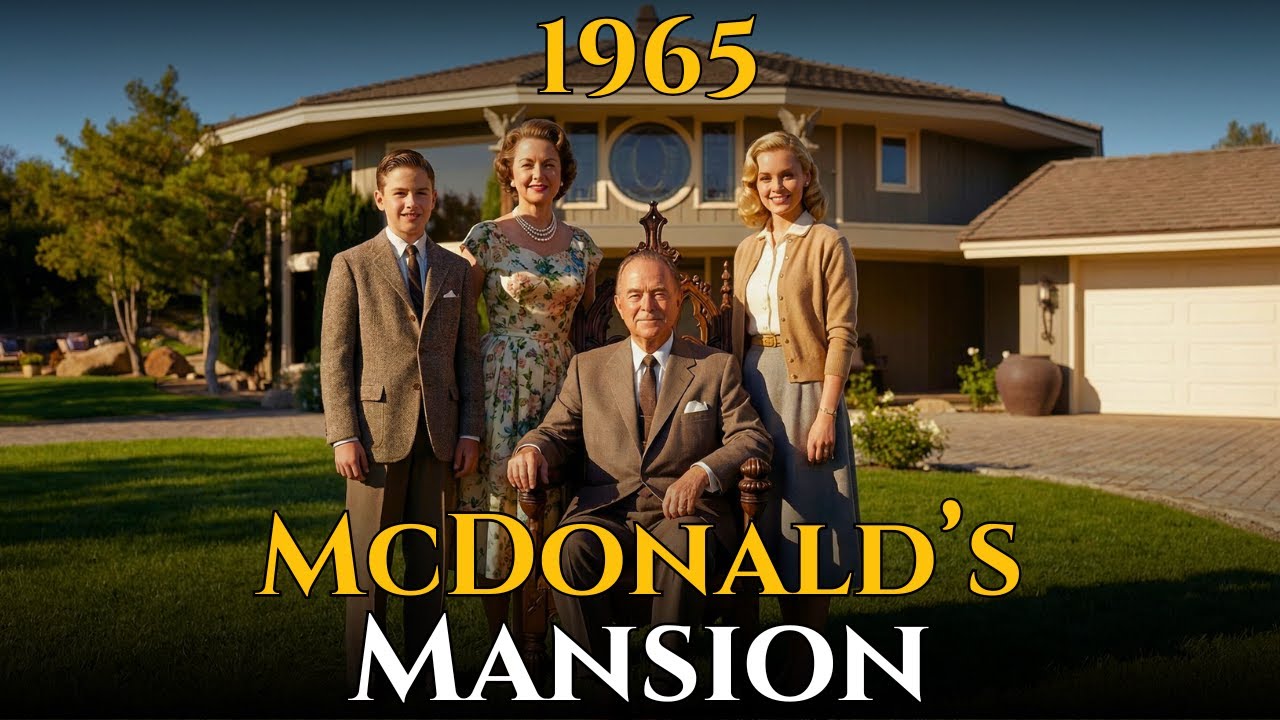
He bought a ranch in the Santa Ynez Valley of California wine country, hundreds of acres of rolling hills, dry grass, and eucalyptus. It was not a flashy city mansion. It was a territory where he could vanish from the world while still controlling it. The property was developed on a scale that could not be accidental.
The main lodge was large enough to host a hundred guests, with suites, massive dining rooms, and a commercial kitchen. Executives could be flown in, fed, entertained, and brought into the inner circle away from cameras and shareholders. It was part retreat, part laboratory, part private resort, a place where the company could live, breathe, and plan. And it was a theater where Kroc could play the role he had chased his whole life.
Here, he was not just the face of McDonald’s. He was the king of it. The ranch was not built just out of luxury. It was built out of insecurity.
Kroc was buying distance, separation from anyone who could remind him that the empire had a beginning he did not control. He was buying a place where the arches could be surrounded by silence, where the only voices were the ones he invited. Inside that silence, decisions could be made without the friction of explanation. Executives gathered there, drank, talked, and drifted into strategy, building the kind of loyalty that grows when people feel chosen and rewarded with comfort and belonging.
Kroc understood instinctively that the environment changes what people say yes to. The ranch became part of the McDonald’s machine, a place where the future of the company was discussed in luxury, not in sterile offices. But the ranch connected the private estate directly to the public consequences of what the company was doing. This was not just a retreat.
It was linked to experimentation and development, to products and systems that would be pushed out into the world. McDonald’s was part of an industrial shift where food was engineered to be consistent at scale, where supply chains grew massive, where taste became something that could be standardized and sold. That transformation was not cartoonish evil. It was something more modern and more unsettling, a quiet change of culture through logistics and branding, the kind that happens gradually until you cannot remember what it felt like before.
Kroc was one of the men who accelerated it. When executives gathered at the ranch to plan, they were not just planning a new building. They were planning a new habit, a new expectation, a new normal. A system that could reshape how families ate, how kids begged, how towns looked, how labor worked, how advertising targeted people, how real estate was purchased.
That is why the ranch matters. It was a symbol of private power built on public consumption. The more the company grew, the harder Kroc’s personality became. People around him described him as intense, sometimes cruel, often obsessed.
He could be charming and inspirational. He could also be punishing. He wanted believers, not employees. Inside the ranch, he told the world a story about himself as the founder, the man who made McDonald’s what it was.
In a business sense, that story had truth. He did build the empire. But the word founder suggests origin, creation. It suggests the thing did not exist until you arrived.
For Kroc, calling himself the founder was not just branding. It was a psychological necessity. If he was not the origin, then he was the man who took someone else’s origin and made it his. And that is a harder story to live with.
So he built a ranch, a lodge, a private world where the story could be reinforced and celebrated until it felt like reality. Yet even inside that world, he could not escape the consequences of the life he was living. Health problems followed him everywhere. Relationships cracked under the weight of his obsession.
His urgency never left him, as if he could feel death standing behind him, waiting. He also had loneliness, the kind that creeps into the corners of massive houses. Mansions amplify whatever is already inside you. If you are content, they feel like heaven.
If you are restless, they feel like a larger room to pace. Kroc was a pacer. Even when he had everything, he still moved like a man chasing something. In his later years, Joan, the woman who would become his second wife and later one of the most famous philanthropists in American history, entered his life.
Their relationship was intense and complicated, a collision of personalities, money, control, and a shared taste for big gestures. The ranch, with its luxury, was part of the lifestyle that surrounded their marriage, a lifestyle that could be both intoxicating and suffocating. Wealth like that buys comfort, but it also buys isolation, the ability to avoid consequences for a long time, the ability to surround yourself with people who will not challenge you because challenging you might cost them access. Kroc, even as he aged, did not like being challenged.
He died in 1984. The public saw the end of a business titan, a founder, an innovator, a man who changed the restaurant industry. But death has a way of leaving behind the complicated truth. He did not take the empire with him.
He left it behind, along with his private estate. And the ranch, like the company, moved into its next chapter. After his death, Joan’s role became central. She was no longer just the wife of the McDonald’s tycoon.
She was the keeper of a fortune, and she had her own impulses about what that fortune should do. She gave away staggering sums, funding community centers, medical research, and a range of causes that made headlines. But big philanthropy creates new conflicts. At different points, the idea of using the ranch for charitable purposes or public-facing programs became controversial.
Local planning fights, neighborhood resistance, the battles that emerge whenever a private estate is poised to affect people beyond its gates. This is the irony of mansions. They are built as escapes from the world. But when their owners die, they become magnets for the world.
The ranch sat at the intersection of two powerful myths, the myth of McDonald’s as a wholesome American brand and the myth of the billionaire as a builder of dreams. It complicated both. It was too lavish to fit the image of the simple burger stand. It was too private to fit the image of corporate transparency.
It was a reminder that behind the friendly brand was a man who lived like a king. And kings attract darker stories because people want to know what was hidden behind the walls. Whispers about how the ranch was used, about how executives behaved, about how corporate decisions were made in private, far from public accountability. The real darkness is structural, the fact that a company that sold cheap food to everyday families generated wealth so immense that its leader could build a private resort in wine country.
The most uncomfortable truth of all is that Kroc built his estate while feeling deeply unsatisfied. He spent his life chasing a feeling that wealth cannot guarantee, the feeling of being secure, of being respected, of knowing no one could take what he had. But the origin of McDonald’s could never be erased. No matter how many times the public called him the founder, no matter how many executives toasted him at his ranch, the brothers existed in the history like a stubborn fact, and stubborn facts are dangerous to fragile egos.
The company’s origin was not his, and he spent the rest of his life trying to make it feel like it was. The ranch outlived him. The company outlived him. The world changed around both.
McDonald’s expanded into new controversies, new debates about health, labor, culture, and globalization. The golden arches became both beloved and criticized, a symbol of comfort to some and of corporate dominance to others. And Kroc, the man who wanted control more than anything, could not control what his empire became once he was gone. That is the final irony of his private estate.
It was built as a fortress of meaning, a place where his identity as the McDonald’s tycoon could be reinforced in private, away from outside judgment. But after his death, it became just another piece of property shaped by forces larger than him, a relic of a personal obsession. A quiet monument to ambition, insecurity, and the kind of success that can feed the world and still leave its creator starving for peace.
