In October 1944, in a scrap yard beyond Aachen, beneath the rain, a German signals officer attached to a tank regiment’s workshop company stood atop the burnt-out hull of an American Sherman. The tank had been ablaze three days before. With a crowbar he forced open the rear of the turret, where the Americans housed their radio equipment. In roughly twenty minutes he drew out the two olive-drab boxes, a transmitter and a receiver stacked one above the other on a shock-absorbing mount, with cables running forward to the commander’s seat and to every crew position inside the tank.
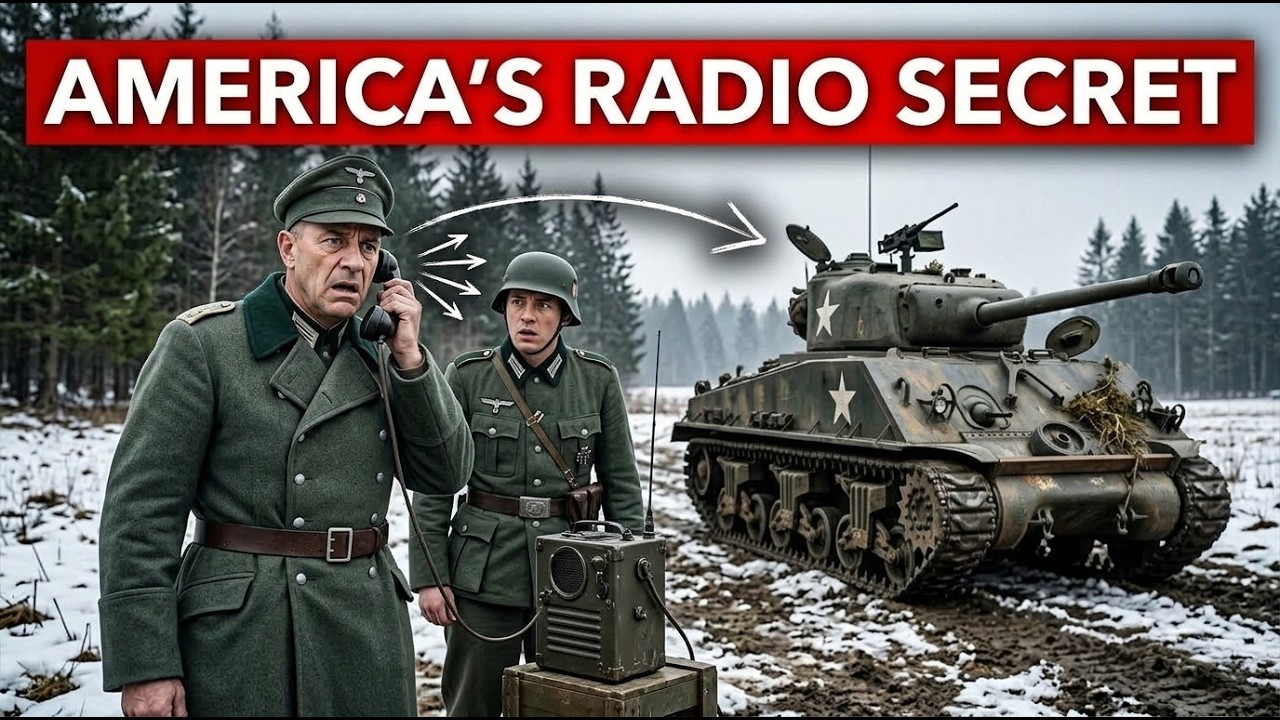
He brought them into a barn, placed them on the workbench, and counted the buttons. There were ten of them, numbered push buttons arranged in a single row across the face of the unit, each roughly the size of a thumbnail. He grasped their purpose at once: preset channels. An American tank commander, gloved, in a moving vehicle under fire, with the loader shouting in his ear and the engine roaring behind him, could switch frequency with one press of his thumb.
No tuning dial, no fine adjustment, no holding a signal steady while the tank lurched over a berm. He wrote his report that night. Dozens of comparable reports survived from German signals officers on the Western Front during the last eighteen months of the war. They set down the hardware, the frequency range, the power output, the crystal control, the quality of manufacture.
German technical intelligence was superb. They took the equipment apart correctly. They grasped every component before them. Yet none of those reports could account for the complaint that kept arriving from the front-line troops, because the complaint was not about the box itself.
The complaint concerned what happened when a German gun crew opened fire on a single American tank at the edge of a wood. You did not fight one Sherman. You fired on one Sherman, and within thirty seconds every American vehicle within two kilometers was answering, together with artillery you could not see, and at times aircraft. The German officer watching through his binoculars could not tell who had issued the order, because there was no time for anyone to issue an order.
What they were struggling to grasp was not a radio. It was a decision taken in an American laboratory eleven years earlier, a decision the whole commercial radio industry in the United States had fought hard to bury. The Germans had in fact invented tank radio, and not by accident. The notion that an armored formation could hold together by voice rather than by flags, messengers, and a plan settled the night before was a German idea, pressed by German officers in the early 1930s, when the world’s armies still regarded the tank as a mobile fortress trudging beside the infantry.
Heinz Guderian had been a signals officer before he became a tank officer. He came to the armored corps out of communications, and he understood before nearly anyone else that the limiting factor of mechanized power was not how fast the tank could go. It was how fast a commander could change his mind and get that change out to his vehicles. So the Panzer arm was built around radio first.
By 1940, German tanks carried the Fu 5, a ten-watt set working on shortwave, with a voice range of a few kilometers and a longer reach using Morse code. Command tanks carried heavier equipment. Signal procedures were drilled without letup. German radio discipline, brevity, standard phrasing, and clean call signs were the finest in Europe.
They performed exactly as promised. In France in 1940, French tanks were individually superior in several respects. The Char B1 bis was better armored than anything the Germans fielded. The French had more tanks in the theater, and they lost partly because a French tank company commander who wanted to redirect his unit often had to go and do it in person, while the German company commander flicked a switch and spoke.
So when a German signals officer stood in a barn outside Aachen holding an American radio, he was not a man confronting a new idea. He was a man from the country that had invented the idea, examining someone else’s version of it, trying to work out why his own version had ceased to be enough. Part of the answer had nothing to do with hardware. It was a physical problem the German set could not escape, while the American set was built to avoid it.
The Fu 5 was an amplitude modulation radio. AM carries information in the strength of the wave. That is a fine way to run a radio in a quiet room. It is a poor way to run a radio inside a steel box holding a large unshielded gasoline engine, a power generation system, and a crew wearing headsets, moving across a battlefield where hundreds of other engines are running and dozens of stations are broadcasting on nearby frequencies.
Every spark plug firing behind your back adds noise to your signal, because noise is an amplitude fluctuation, and amplitude is precisely what your receiver is listening to. German crews dealt with it the way everyone did: shielding, suppression, discipline, fine tuning, repeated words, and then drift, because a tuned circuit heats up, the frequency shifts, and someone has to reset it. In a tank under enemy fire, the man resetting the frequency is the man not fighting. The Americans had made a different bet, and they had made it before any of this mattered to anyone.
In 1933, an American engineer named Edwin Howard Armstrong demonstrated a method of broadcasting that encoded the signal not in the strength of the wave but in small changes in its frequency: frequency modulation, FM. Armstrong was no marginal figure. He had already given the world the regenerative circuit and the superheterodyne receiver, the internal design of every radio receiver built since. He was one of the most important radio engineers in history.
The American commercial broadcast industry, which had sunk enormous capital into AM, did not want FM to exist. What followed was a long, bitter commercial and legal fight that consumed the rest of Armstrong’s life. That part has nothing to do with tanks, except for one detail. While the industry fought it, the US Army Signal Corps was running secret tests.
The officers who ran those tests found something the broadcasters did not want to hear. FM had a property AM did not. In the laboratory it looked like a scientific curiosity. On the battlefield it was decisive.
It is called the capture effect. An FM receiver receiving two signals on the same frequency does not blend them into garbled noise. It locks onto the stronger signal and suppresses the weaker one almost entirely. Ignition noise, atmospheric static, the electrical noise of a moving vehicle, all of these are amplitude noise.
A receiver that depends on frequency rather than amplitude is almost deaf to them. Put that in plain terms: the American tank commander heard a clean voice. Not a voice buried under static. Not a voice he had to strain to hear or ask to repeat.
A voice in his headset that came through as clearly at the far end of the net as at the near end, even with the engine at full power and the gun firing. The Signal Corps pushed that bet further than any other army in the world. The armored sets, the SCR 508 and its relatives, were FM, crystal-controlled, running in the 20 to 28 MHz range, with those ten preset buttons so that switching nets was a thumb movement rather than a procedure. Crystal control counted for as much as FM.
A crystal-controlled set does not drift. You set it in the morning and it remains exactly where you left it that night. Every other set in the battalion remains exactly where they left theirs. A tank that had been out of communication for six hours could rejoin the net with one button.
Then came the decision that looks minor in a procurement document and is not minor at all: every tank had a transmitter. Not the platoon leader, not the company commander. Every tank. The soldier driving the fifth tank in a five-tank platoon could send a contact report to the company net himself, in his own voice, in real time, without asking anyone’s permission.
German assumptions were logical, sound doctrinal assumptions, the same ones that had broken France. When a German gun crew fired on one Sherman, they expected a sequence: the hit tank reports, the report reaches the platoon leader, he assesses and passes it up to the company, the company commander decides, the decision comes back down, somewhere in the chain artillery is requested and that request travels through a channel of communication with its own procedures and its own delays. Say a few minutes. German officers carried a number in their heads for how long a competent enemy needed to respond.
Everything they did, shoot-and-scoot, deployment plans, withdrawal positions, retreat timing, was built around that number. What actually happened was this: the tank that had been fired on sent its report. Every other tank in the company heard it at the same moment, in the original voice, no retransmission, no summarization, no delay from a man deciding whether it was worth passing on. The platoon on the flank did not wait for orders because the platoon on the flank had already heard the contact report directly and was watching the same situation develop on the same net.
Two tanks began moving before anyone above them had spoken a word, and the company commander could reach the guns without leaving his own net. Armor, infantry, and artillery could talk to each other. The forward observer with the field artillery battalion, the infantry battalion command net, the tank company: these were not sealed compartments with liaison officers standing between them as translators. Sets were exchanged, nets were linked.
The artillery observer rode inside a tank. A tank commander could get fire support because the man giving it to him was on a radio reachable with his thumb. Then there was the smallest, most revealing piece of equipment in the whole story, and it did not come out of a laboratory. It came out of a maintenance tent.
By the middle of the Normandy campaign, American tank and infantry units faced a deadly, specific problem: the tanks and the infantry fighting in the same field could not talk to each other. The riflemen who could see the machine gun position had no way to tell the tank fifteen meters away except to climb onto the vehicle under fire and bang on the hull with a rifle butt. So units in the field started mounting a standard field telephone, an EE-8, a box with a handset, into an ammunition box welded to the rear plate of the tank and wired into the intercom system. The infantryman walked behind the tank under its armor, picked up the handset, and spoke directly into the tank commander’s headset.
No one designed it. Crews and ordnance men improvised it because they were tired of watching men die on the rear deck, and it worked well enough that it spread across the theater and became standard production. By late 1944, German formations in the West were being pieced together from scattered remnants. A regiment might have one battalion of veterans with a trained signals section and another raised last month from air force and navy personnel with no armor signals training and no compatible equipment.
Crystals, tubes, batteries, copper, trained operators, every one of those was a supply chain. By late 1944, every German supply line in the West was being cut by day and bombed by night. German units operated under increasingly strict radio restrictions because they had learned, correctly, that transmission brought direction-finding, artillery, and aircraft. A unit that cannot safely transmit is a unit whose beautiful radio doctrine has become theory.
The set was in the vehicle, but it could not be used. On the other side of the line, the Americans transmitted constantly on tactical nets, in volume, all day, because they had also calculated, correctly, that the tactical advantage of talking outweighed anything the Germans could do about it in the time available. The American tactical radio was an integrated family. The armored set in the turret, the backpack SCR-300 that gave an infantry company commander a voice, the small handheld SCR-536 that a platoon leader carried in his fist.
These were built as an interconnected infrastructure and produced in numbers that are hard to comprehend. Tens of thousands of backpack sets, well over a hundred thousand handheld sets, enough for a rifle platoon leader in an ordinary infantry division to have a radio, with enough spare parts behind him that if his set broke, he was handed another one. The German platoon leader in most formations in 1944 relied on his voice and a runner to pass orders. When the Germans asked how every American tank responded at once, they were asking a question about one vehicle.
The answer was an entire structure. The verdict is not that American radios were better than German radios. In many measurable ways, that is true. The decision to use FM was one of the most far-sighted technical bets any army made in the twentieth century.
But that is not the result. The result is that the two armies had different theories about what a radio was for. In German theory, the radio was a command tool. It existed so that the commander’s intention could reach his subordinates faster than a runner could carry it.
That is a good theory. It is the theory that broke France. Under it, you invest in the commander’s set. You train procedures relentlessly, and you keep the net pure by keeping traffic minimal and hierarchical.
In the American setup, which nobody committed to paper as doctrine, which simply emerged because the gear was on hand and the troops put it to use, the radio was not an instrument of command. It was shared awareness. It was there so that everyone on the net knew what everyone else knew, at the same instant, without first waiting for the information to be processed at some higher level. Under German theory, the fifth tank in the platoon has no need to transmit, because the fifth tank makes no decisions.
In the American setup, the fifth tank does transmit, and every vehicle within earshot turns based on what it has just heard. The commander, nominally in charge, discovers that his unit has already carried out half of the correct maneuver by the time he opens his mouth. The signals officer in the barn had the equipment right in front of him and could not locate the answer inside it, because the answer was not in the box. The box was merely a display.
The answer was that the United States had built enough boxes to put one in every vehicle, one on an infantryman’s back, and one in a wooden box bolted to a rear plate by a sergeant whose name was never recorded, and then trusted the men carrying them to speak without permission. You cannot capture that with a crowbar. You can only capture the radio. The officer in the barn is a composite figure.
The recovery yards existed. The captured equipment existed. The German technical reports on the American armor radio existed. The phenomenon the German front line kept reporting, that firing on a single American vehicle brought a response from an entire formation in under a minute, is documented from Normandy to the Rhine.
Edwin Armstrong, who gave the US Army the physics that made it all possible, spent his final years in litigation over patents granted to him that he could not defend, and died in 1954. He never fought a war. He never sat in a tank.
Every clear voice in every American headset in Europe was his.
