On a bright summer afternoon in 1937, a young woman with a movie camera stood on the terrace of the Berghof, high in the Bavarian Alps, and filmed the people closest to Adolf Hitler as they laughed, swam, and posed for the lens. The woman was Eva Braun, Hitler’s mistress, and the footage she shot was never meant for the German public. It showed a private world of leisure: bathing trips with family and friends, picnics by Lake Starnberg, and the easy camaraderie of the dictator’s inner circle. She called the film “Bunte Filmschau”—a colorful film show—and she made it to entertain the small group that surrounded Hitler at his mountain retreat near Berchtesgaden.
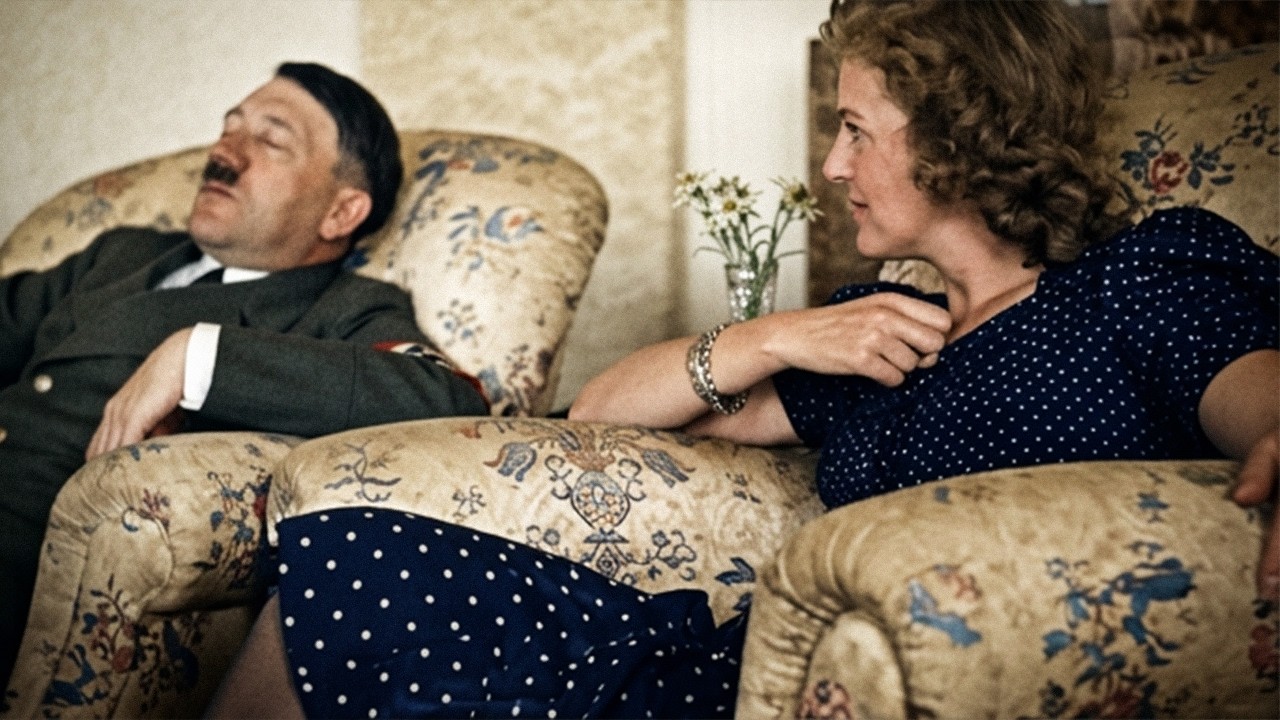
Nothing in those cheerful reels hinted at what was to come. The war, the death camps, the suicide in the bunker—none of it appeared in the frame. But the woman behind the camera, dismissed for decades as a naive blonde who knew nothing of politics, was far more complicated than the films suggested. Eva Anna Paula Braun was born in Munich on February 6, 1912, the second of three daughters of Friedrich Braun, a vocational school teacher.
The marriage of her parents had survived a crisis during her early years, and Eva grew up in a respectable lower-middle-class household in the Schwabing district of Munich. Of her childhood and teenage years, little was recorded. Her own photo albums offer glimpses—a family trip to Lake Wörth, visits to relatives in Jena, the attention of an aunt and uncle who doted on the thirteen-year-old girl. Her cousin Gertrud Weisker, who kept her connection to the Braun family secret for more than sixty years, remembered those visits with fondness.
They would meet once or twice a week, go swimming or have coffee and cake, and return to the grandparents’ house in the evening. Gertrud’s father never joined them. He made it clear he wanted no contact with Eva at all. The relationship between Eva and her parents was not as warm as the home movies suggested.
Her closest friend later reported that Eva spent much of her youth away from home because the atmosphere in the Braun household was not pleasant. Eva took courses in home economics, bookkeeping, and typing at a Catholic boarding school. In 1929, she secured a traineeship at a well-known photography shop in Munich. The shop belonged to Heinrich Hoffmann, Adolf Hitler’s personal photographer and a man who would play a crucial role in the life of his young employee.
At some point, Hoffmann introduced the seventeen-year-old girl to his most famous client. “This is our brave little Miss Eva,” he said. The forty-year-old Hitler was apparently fascinated by the young woman, and she, like many women of her time, found him impressive. They met frequently after that.
Hitler confessed to an aide that he kept a girl in Munich “for love’s sake. ” Hoffmann’s exact role in starting the relationship remains unclear, but the photographer was an eager matchmaker. In 1931, Eva was allowed to accompany Hitler to Obersalzberg for the first time. No photographs show the two of them together from that period.
The young blonde felt neglected. She wanted Hitler to commit to her completely—so completely that she once pointed her father’s pistol at herself. It was the first of several such gestures. Hitler told Heinrich Hoffmann that the incident convinced him the girl truly loved him, and that he felt a moral obligation to look after her.
The relation deepened, but it remained hidden from the German people. Hitler’s public persona was that of a man devoted entirely to his nation, a leader with no private life. The Nazi propaganda machine insisted that the Führer served the German people day and night. His “bride,” he said, was Germany itself.
Eva’s family was not happy about the arrangement. There was no marriage certificate, no legitimacy, only the unspoken understanding that she was Hitler’s mistress. Her cousin Gertrud was nine years old when she first saw a picture of Eva and Hitler in a newspaper. The caption read: “Eva Braun, daughter of a teacher from Munich, is Hitler’s new favorite.
” When Gertrud showed the clipping to her mother, the woman refused to discuss it. “That’s not true,” she said. “That’s empty talk, and I don’t want to hear it again. ” In the family, Eva was simply considered Hitler’s lover, and the shame of it weighed heavily on her father.
Friedrich Braun did not want to accept the disgrace his daughter was bringing on the family. Yet no one in the household truly opposed the regime—or the relationship. Everyone profited from it, from the mother to the youngest sister. Eventually, Eva’s parents became welcome guests at Obersalzberg, accepting that Hitler would never marry their daughter.
As one family member supposedly reasoned: any girl could get a husband, but someone like Hitler was something else entirely. Eva herself was no passive victim. Her biographer described her as vain, caught between power and powerlessness, but by no means a victim. She used uncommon firmness and precisely aimed intrigues to push away potential rivals for Hitler’s favor at Obersalzberg.
Over the years, her position there became unchallenged. She was, according to an alleged remark, in love with the greatest man in Germany and the world. Hitler kept her out of sight when it suited him. When the Italian foreign minister, Count Ciano, arrived on August 12, 1939, to discuss Italy’s entry into the war, Eva was told to disappear from the scene.
She filmed a unit of the Leibstandarte SS from a safe distance as they lined up to receive the visitor. Her album note read: “Something forbidden up there. ” When important party officials came to the Berghof, she was ordered to stay in her room. During longer visits from distinguished guests, she had to move out entirely and stay in the house of Martin Bormann, the man she and Albert Speer both despised.
Albert Speer believed Hitler considered her social acceptance limited—she was not allowed even in the large reception hall on such occasions. From a first-floor window, she sometimes managed to film scenes like Hitler waiting on the steps of the Berghof for a visitor while an SS honor guard took its position. Before that confinement, however, there were years of relative freedom. In 1935, Eva moved out of her parents’ house into a home in the upscale Bogenhausen district of Munich, purchased by Heinrich Hoffmann on Hitler’s orders.
Her younger sister Gretl moved in with her, and in 1938 Eva became the official owner. The family knew nothing of the gift. “I didn’t know who gave her the house,” her cousin recalled. “They were old enough to move out anyway.
But I didn’t know it was a present from Hitler. Nobody ever talked about it. ” The sisters threw lavish parties there, though the atmosphere was far from celebratory—Eva’s father still resented the dishonor she brought upon the family. Her cousin, twelve years younger, idolized her.
“She was a very attractive woman, elegant, with long fingernails,” Gertrud remembered. “I admired her and her sister. She was very sporty—she could jump from the highest diving board while I could only manage the lowest. ” Eva changed her clothes five or six times a day at the Berghof, where almost no one was there to see and admire her.
She did it for herself, a compulsive behavior that her family recognized as obsessive. She had difficulty concentrating, would ask a question and then lose focus. “He only needs me for certain things,” she complained. The strain of the relationship showed in darker ways.
In May 1935, Eva’s emotional decline became apparent. Fragments of her diary survived, and they record a woman in deep distress. On May 10, 1935, she wrote that Hoffmann had told her, in a way that combined affection and rudeness, that Hitler now had a substitute for her. She noted that Hitler should know her well enough to realize she would not put obstacles in his way.
And if he fell in love with another woman, why should he care what became of her? On May 28, she attempted suicide for the second time, this time with sleeping pills. “This time I will take 35 pills,” she wrote. “I want to be absolutely sure whether he will call me.
” The suicide attempt convinced Hitler of her total commitment and loyalty—exactly what he expected from his followers. Loyalty unto death. She was ready to give it. The relationship that grew from that crisis was more complex than the public ever knew.
Both Hitler and Eva loved films, opera, and operetta. Their commitment to each other was absolute, built on unwavering faith and loyalty. Speer, who became one of Eva’s closest friends after moving near the Berghof in 1938, later claimed that Hitler was incapable of forming normal human relationships. Yet the dictator was tolerant and protective of Eva.
He did not want her to ski, fearing she would injure herself. Once, when he was away from Obersalzberg, he allowed her to go skiing with Speer for eight days in Austria. She danced with young officers until the early morning hours, unrecognized, and enjoyed herself immensely. Speer recalled that she and he shared a mutual dislike of Martin Bormann, whom they found arrogant and boorish.
The Berghof was the center of Hitler’s private universe. There he slept late, usually took lunch at three in the afternoon, and then went on long walks with his guests. The destination was always the same: the scenic lookout at Mooslahner Kopf, with its magnificent view toward Salzburg. Nearby, Bormann had a teahouse built for Hitler.
At the coffee table, Hitler often sank into endless monologues, discoursing on fashion, dog breeding, theater and film, operetta and its stars. Sometimes he fell asleep during his own monologues. He rarely mentioned the Jews, his political opponents, or the need to build concentration camps. Speer suspected this was not deliberate but simply the trivial nature of the conversation.
The inner circle—the Speers, the Bormanns, Hitler’s doctors, the Hoffmanns, and Eva Braun with her family—had become his surrogate family. His biological relatives were kept separate, not visiting the Berghof after 1936. He chose this family himself, and he often retreated to Obersalzberg before making important political decisions, drawing strength from the familiar surroundings. Invitations to the Berghof were highly sought after among leading Nazis, though some guests found the life there stifling.
Speer later wrote that all that remained of social life at Obersalzberg was “a memory of strange emptiness. ” Yet within that emptiness, politics happened constantly. The guests discussed how to deal with Austria after the Anschluss. Women were present but did not participate in decision-making or military planning.
Still, they were fully aware of the historical significance of those days. Eva Braun’s biographer emphasized that the women in the inner circle were deeply involved: they spent evenings and weekends together for weeks, and they talked about events because those events mattered to them too. Hitler did not separate his private life from his political life—for him, they were one and the same. The relationship between Hitler and Eva was not without its public concessions to propriety.
A series of photographs from a New Year’s celebration in 1938 documented the quasi-marital bond between them. Hitler, a declared vegetarian, received his own special menu, which Eva carefully placed in her photo album. The results of the traditional lead-pouring ritual that accompanied the holiday were not documented. In 1936, the public still had no idea that this woman existed beside the dictator.
Foreign publications sometimes mentioned that Hitler was in contact with a certain “E. V. Braun,” but they lacked reliable information. A New York pamphlet from 1944, titled “Women in Hitler’s Life,” described her as not at all an attractive Aryan girl—blonde and blue-eyed, perhaps, but stout and ungainly, resembling a middle-class German housewife rather than the First Lady of the Reich.
The pamphlet also claimed she had been known for the drinks she served to Nazis and even to Hitler, and that she had a talent for mixing perfumes to attract him. The description was entirely fabricated, and Nazi censorship ensured it was never published in Germany. The real Eva Braun, as her films show, was an elegant young woman in suits made by top Berlin tailors—though Speer described her as modestly and inconspicuously dressed, with noticeably cheap jewelry. In 1939, the Braun family took a remarkable vacation.
Eva’s mother, Franziska, booked a cruise to Scandinavia for herself and her two daughters. Friedrich Braun did not join them. The small tourist group reached Hamburg and boarded the Milwaukee, a 1929 steamship that had once served the North Atlantic route and now carried six hundred guests on holiday cruises under the Nazi “Strength Through Joy” organization. This time the destination was the Norwegian fjords.
The Brauns indulged in luxury and extravagance—lobster was served on deck at lunch—while back home, Hitler prepared to plunge Europe into war. The local residents of northern Norway, where the family went on shore excursions, had no idea that the mistress of the German dictator was among the tourists. Gretl, who had simply adapted to her older sister’s needs as a companion and assistant, relaxed by the pool in an elegant two-piece swimsuit. Eva filmed everything.
The footage from those years shows Eva doing what she loved most: recording the life around her. She occasionally earned significant money from her work—a single photograph could sell for 20,000 Reichsmarks. She was still employed by Heinrich Hoffmann, and her images of Hitler as a loving, family-friendly man were part of the propaganda machine, carefully staged and commercially distributed. Hitler knew exactly what she was doing; it was part of the plan.
Her private albums, however, also contained images that would never have been published during his lifetime—intimate glimpses of their relationship, the dictator caught off guard, the woman who played hostess at the Berghof asserting her position. Hitler’s chosen circle included Albert Speer, his favorite architect; Joachim von Ribbentrop, appointed foreign minister in 1938; and Heinrich Hoffmann with his wife. Bormann ensured that all the neighbors disappeared from the area around the Berghof, turning it into a secure zone for the Führer. It was Bormann’s greatest construction project: the Kehlsteinhaus, a teahouse built at 1,800 meters on a rocky peak, reached by a road and an elevator carved into the mountain.
Hitler rarely visited—he reportedly suffered from vertigo—but Eva enjoyed going there, appearing more cheerful when the dictator was absent. Photographs show them at the Kehlsteinhaus with Magda Goebbels, the wife of the propaganda minister, who fled to the Berghof with her children, playing the role of the betrayed and indignant wife. She complained to Hitler that her husband was having an affair with the Czech actress Lida Baarova and wanted a menage à trois. Hitler flew into a rage and ordered Joseph Goebbels to come to Obersalzberg.
The film footage Eva shot may show his arrival that day or on another visit—it is not clear. What is certain is that the Führer’s word forced Goebbels to part from his lover. Hitler forbade any further contact with the actress. The marriage with Magda had to be preserved for reasons of state, and Goebbels obeyed.
The year 1939 marked a turning point in Hitler’s rule. He had achieved one success after another: the remilitarization of Germany, the annexation of the Sudetenland, the absorption of Austria, the occupation of the rump Czech state. Even his opponents acknowledged that had he died at that moment, he would have been remembered as the greatest German since Bismarck. But the dictator aimed at war, and so this moment was the beginning of his end.
At Easter 1939, Eva filmed the children of Speer and Bormann searching for Easter eggs. The children lived isolated from the world at Obersalzberg. It is unknown whether Eva wanted children of her own—rumors of an abortion in Munich circulated, but there was no evidence. Speer once recalled Hitler remarking in her presence that very intelligent men should choose a primitive, simple-minded wife.
“Imagine if I had a wife who interfered with my affairs,” Hitler said. “I want peace and quiet in my free time. ” He preferred to rule Nazi Germany from the Berghof, making laws and decrees there, planning military campaigns, and increasingly isolating himself from the ministerial bureaucracy. An adjutant later recalled that it became increasingly difficult to obtain decisions from the head of state—often impossible, even for representatives of the party and government, to reach Hitler when he was at Obersalzberg.
Only cultural events could lure him out. In June 1939, he traveled spontaneously to Vienna for the 75th birthday of composer Richard Strauss. On the way back to Berchtesgaden, he visited the places of his childhood. Eva filmed his arrival at the primary school in Fischlheim near Linz.
In Mein Kampf, Hitler had described himself as a leader of village boys playing cops and robbers. His class teacher recalled him differently: a thin, pale boy who hated learning, neglected his talents, and could not submit to school discipline. Back at the Berghof, the dictator planned the imminent military campaign against Poland. On August 23, 1939, Hitler waited anxiously for news from Moscow.
Eva was allowed to be present that day; she filmed and photographed. Ribbentrop had flown to Moscow to sign a non-aggression pact with Stalin. When the agreement was confirmed, the dictator rejoiced: “That will cause a tremendous shock. ” Her commentary on the professional photographs read simply: “Then Ribbentrop flew to Moscow.
” Other images show Hitler, Bormann, and Goebbels after the news became official—Hitler listening to broadcasts on the radio. Himmler and his deputy Reinhard Heydrich had prepared the brutal suppression of Poland in detail during their visits to the Berghof. The Einsatzgruppen—the mobile death squads drawn from the police and security services—were tasked with liquidating the Polish ruling classes, for Hitler intended to occupy the country permanently. The pact with Moscow ensured the Red Army would not intervene, only occupy and annex the eastern part of Poland.
Obersalzberg thus played a decisive role on the road to World War II. All attempts to stop Hitler on his path to destruction were doomed to fail. The women in the inner circle knew exactly what was happening. “This situation at the Berghof, shortly before Stalin signed the non-aggression treaty, shows how preoccupied the men around Hitler were,” her biographer noted.
“It shows the inner circle of Goebbels and Speer was deeply engaged in the political events of the time. And it shows the women were installed there too, complicit. ” They had spent evenings and weekends together for weeks, discussing events that were of great importance to them as well. Nine days later, Hitler declared war on Poland.
In the Reichstag, he announced: “More than ever, my life belongs to my people. I want nothing more than to be the first soldier of the German Reich. I have put on the uniform that has always been my most sacred possession. I will not take it off until after our victory, or I will not live to see the end.
” Eva Braun is said to have wept when she heard that speech. According to the memories of her older sister Ilse, she said, “This means war. He will go, and what will become of me? ” And then: “If something happens to him, I will die too.
” That same evening, Eva asked for food and drink to be brought to the storage rooms of the Berghof. “We need lots of supplies,” she explained. “We will need them to last a long time.
“






