The cave mouth swallowed the last group of five, and Erich Priebke followed them in. It was the second or third group he had entered with, and in his hand he carried an Italian machine pistol. Inside, the prisoners were forced to kneel, and shots were fired into the backs of their heads. Priebke raised his weapon and shot one man, then another, before the executions continued and the names on his lists were crossed off one by one.
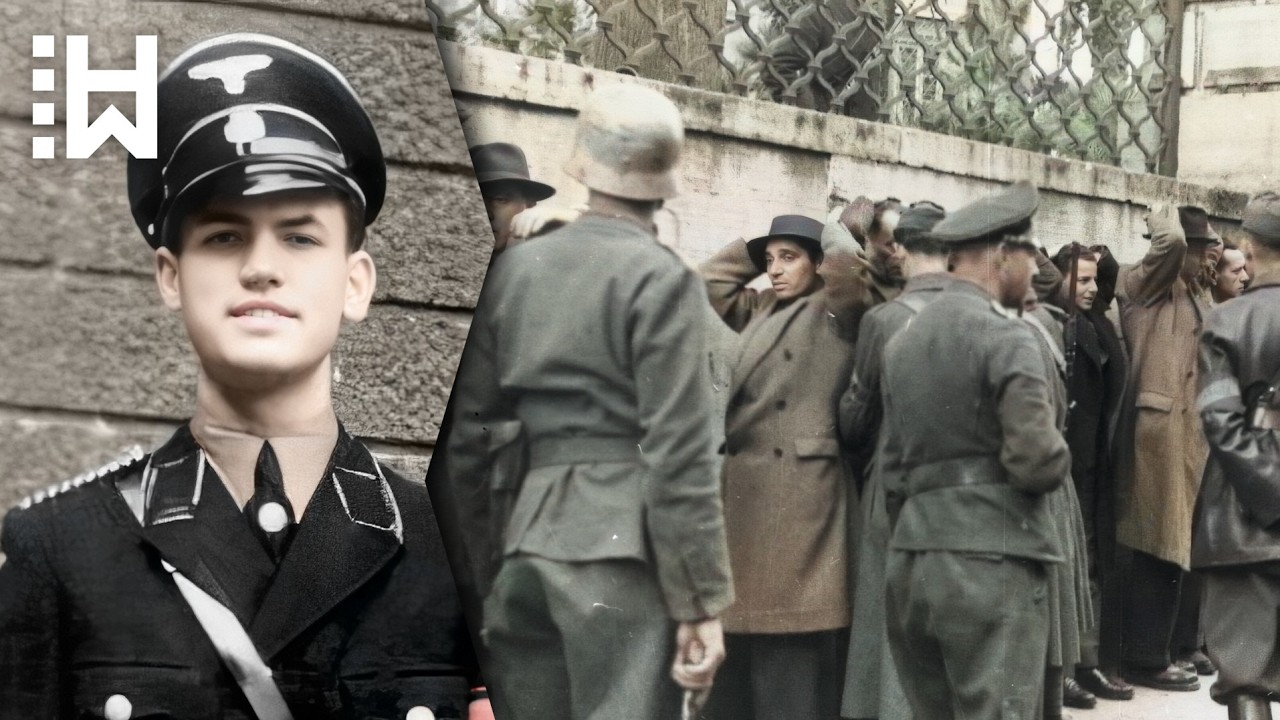
It was the 24th of March, 1944, and by the time the killing ended, 335 people lay dead in the Ardeatine Caves outside Rome — five more than the number the German High Command had ordered. Priebke, who had helped compile the lists of the condemned and then supervised the executions, had failed to notice in the confusion that five additional prisoners had been brought in by mistake. That oversight would follow him for the rest of his life, though for nearly fifty years, it seemed he had gotten away with it. Priebke was born on the 29th of July, 1913, in the town of Hennigsdorf, then part of the German Empire.
His parents died while he was still young, and he was largely raised by an uncle. As a young man, he worked as a waiter in Berlin, at the Savoy Hotel in London, and later on the Italian Riviera. He married Alicia Stoll, and together they had two sons. On the 30th of January, 1933, Adolf Hitler was appointed Chancellor of Germany, and in July of the same year, Priebke joined the Nazi Party.
In December, 1936, he entered the Gestapo, the Nazi secret police, and later joined the SS. The Second World War began on the 1st of September, 1939, when Nazi Germany invaded Poland. Italy entered the conflict on the 10th of June, 1940, joining Germany in the war against Britain and France. Under Benito Mussolini’s fascist regime, Italy hoped to expand its power and revive the glory of ancient Rome.
Italian troops fought alongside German forces in North Africa, the Balkans, and on the Eastern Front, but military defeats, shortages, and heavy losses gradually weakened both the army and the regime. Because of his knowledge of Italian, Priebke was stationed in Rome beginning in 1941, where he served under SS-Sturmbannführer Herbert Kappler. In July, 1943, after Allied forces invaded Sicily, Mussolini was removed from power and arrested. Soon afterwards, Italy signed an armistice with the Allies.
Germany reacted immediately by occupying central and northern Italy, disarming Italian forces, and seizing control of Rome. Mussolini was later rescued by German commandos and installed as head of a German-controlled puppet state in northern Italy. Under occupation, arrests, executions, and deportations became part of daily life. Resistance groups grew bolder, and attacks against the occupiers became more frequent.
The occupiers responded with collective punishments. Civilians were executed, hostages were taken, and entire communities were threatened. In this atmosphere of fear and violence, the Ardeatine Caves massacre would soon follow. The immediate trigger came on the 23rd of March, 1944.
In the afternoon, around three o’clock, a bomb exploded in Via Rasella, near the center of Rome. The attack was carried out by members of the Italian Communist Resistance. The explosion struck a marching unit of the 11th Company of the SS Police Regiment Bozen, made up largely of South Tyroleans. Thirty-three Germans were killed, and dozens more were wounded.
The timing of the attack was symbolic, as it was the anniversary of the founding of the fascist Blackshirts by Mussolini on the 23rd of March, 1919. The message was clear, but the German reaction was immediate and ruthless. Following the attack, the German occupation authorities ordered reprisals. Italian hostages were to be executed at a ratio of ten Italians for every German soldier killed.
Names were drawn from prison lists: Jews waiting for deportation, political prisoners, resistance members, and men arrested simply for being in the wrong place at the wrong time. Some had been imprisoned for months, others for only a few days, and many had never been sentenced or formally charged. There were teachers, workers, lawyers, officers, artists, priests, fathers, sons, and brothers. Some families would later discover that more than one relative had been taken.
One of the officers involved in organizing the massacre was Erich Priebke, who held the rank of SS-Hauptsturmführer, equivalent to a captain in the United States Army. He personally helped compile the lists of those selected for death. On the night before the massacre, Priebke went through police records containing the names of suspected resistance sympathizers and ordered the arrest of additional political prisoners in order to complete the required number of hostages. Moreover, he put some inmates on the list simply because they were Jewish.
On the 24th of March, 1944, the prisoners were transported in trucks to the Ardeatine Caves on the outskirts of Rome. Their hands were bound with rope to limit their movement. Inside the caves, they were led forward in groups of five and ordered to kneel, and shots were fired into the backs of their heads. Priebke went inside together with the second or third group and shot a man with an Italian machine pistol.
Toward the end, he shot another man with the same gun. As the executions continued, names were crossed off the lists one by one. Bodies piled up on the cave floor, and the next victims were forced to kneel on top of the dead. The killings lasted for hours, while prisoners waiting outside could hear the gunshots echoing from inside the caves.
After the final executions, explosives were detonated to seal the tunnels. Some victims may still have been alive when the rock collapsed on them. In total, 335 people were killed. According to later investigations, five more had been brought in by mistake, and Priebke, who supervised the executions and checked the lists of victims, failed to notice in the confusion.
After the liberation of Rome on the 4th of June, 1944, the sealed caves were opened, and the truth was finally revealed. Officials found bodies buried beneath collapsed rock and dust, piled one on top of the other, exactly as they had fallen. The air was heavy, and the space was narrow, making the recovery slow and painful. Many victims were still bound with rope, some unrecognizable because of injuries and decomposition.
Personal belongings, scraps of clothing, documents, and rings were carefully collected to help families identify their loved ones. In the years that followed, most of the 335 victims were identified. Seventy-five of those murdered were Jews. The youngest victim was fifteen years old; the oldest was seventy-four.
The Ardeatine Caves massacre, which became one of the clearest symbols of Nazi brutality in occupied Italy, was not the end of Priebke’s wartime activities. According to some accounts, he was involved in the events that led to the La Storta massacre. As Allied troops entered Rome, fourteen political prisoners were taken from the notorious Via Tasso prison and executed near the village of La Storta outside the city. Most of the victims were socialists connected to the Matteotti Brigades or members of the underground military resistance.
Among those murdered was the socialist trade unionist and former member of parliament Bruno Buozzi. On the 14th of June, 1944, Priebke became liaison officer to the headquarters of the fascist Republican National Guard in the city of Brescia. There, he participated in raids, arrests, and anti-partisan operations aimed at destroying resistance networks in northern Italy. Hundreds of prisoners, resistance fighters, and suspected partisans captured between Lombardy and Veneto passed through Canton Monbello prison before being transferred to German headquarters, where Priebke often personally conducted interrogations.
One former partisan courier, Agape Nulli, who had been arrested at the age of eighteen, later recalled: “I remember the day of the interrogation. Priebke entered the room pointing his finger at me and suddenly asked, ‘Have you read the Bible? ‘ I answered, ‘No. ‘ I understood it was a trick question to find out whether I was Jewish.
Then, he asked where my brothers were hiding. They were also partisans, but I could not know because I had already been in prison for more than a month. My interrogation ended there. Others were far less fortunate.
” Bruno Gilardoni was brought back to his cell half dead after hours of interrogation hanging from the ceiling by a rope. Others were sent to concentration camps and died there. The Second World War in Europe ended on the 8th of May, 1945. Priebke was arrested and held in a British prison camp in the Italian city of Rimini, but in 1946 he escaped.
He later claimed that the escape had been assisted by a Catholic rat line organized by the Austrian bishop Alois Hudal. Using the false identity Otto Pape, he eventually fled to Argentina, where he settled in the town of Bariloche in Patagonia. For nearly fifty years, Priebke lived there openly and without punishment. He worked as a waiter and later opened a delicatessen.
Over time he became a prominent figure within the local German-Argentine community and traveled freely between Argentina and Europe. In 1994, an ABC News investigation tracked him down in Bariloche. During an on-camera interview, he openly admitted his role in the Ardeatine Caves massacre and defended his actions by claiming he had only followed orders. In a later interview with the newspaper La Repubblica, Priebke stated: “Yes, at the Ardeatine Caves I killed.
I fired. It was an order. Once, twice, three times. I do not remember exactly.
What difference does it make? I was an officer, not a bookkeeper. We were not even particularly interested in revenge. The soldiers killed in Via Rasella were from Tyrol, more Italian than German, but Kappler was uncompromising.
He even forced the cook to shoot. We executed five extra men. It was a mistake, but they were all terrorists anyway, so nobody really cared. ”
After lengthy legal proceedings, Priebke was brought back to Italy for trial in 1996.
He was eventually sentenced to life imprisonment for his role in the massacre. Because of his age, he spent his final years under house arrest in Rome, where he died on the 11th of October, 2013. He was 100 years old. His request to be buried in Argentina alongside his wife was rejected, while the Diocese of Rome banned any funeral ceremony in Catholic churches in the city.
His hometown in Germany also refused to accept his remains, fearing the grave could become a neo-Nazi pilgrimage site. After the Diocese refused to conduct the funeral, Priebke’s family turned to the Traditionalist Society of Saint Pius X, which agreed to hold the service in Albano, near Rome. The funeral ultimately took place without any of Priebke’s relatives present, as rioting outside the church between fascist sympathizers and anti-fascist protesters prevented his family from entering.
Italian authorities later seized the coffin and buried Priebke’s body in a secret location near Rome.
