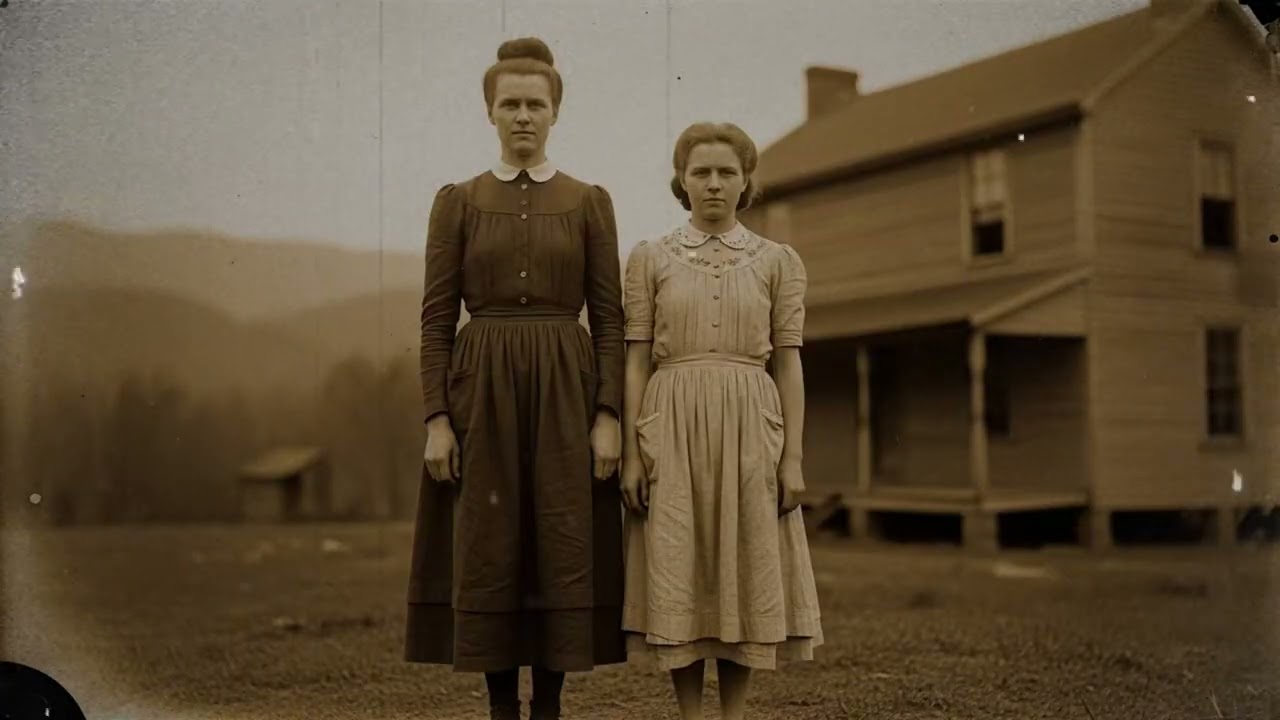
In December 1952, a mailman by the name of Thomas Whitley was making his usual rounds to a farmhouse in McDowell County, West Virginia, when he noticed that the Blackwood sisters’ mailbox was crammed with close to two weeks’ worth of mail that no one had collected. The sisters, Eleanor and Margaret, thirty-two and twenty-nine respectively, had been living by themselves on the property ever since their parents passed away five years before. They had a reputation for being extremely particular about everything, and Whitley, who had known the family since he was a boy, knew right away that something was off. The front door was hanging partly open in the freezing cold.
A kettle rested on the wood-burning stove, its water boiled away long ago. On the kitchen table, two cups of tea sat untouched, the liquid frozen solid inside them. There was no evidence of a break-in, no signs of a struggle, no blood, and no bodies. To Whitley, as he would later recount to investigators, it seemed as though the sisters had just stepped outside for a brief moment and meant to come back.
But they never returned. Sheriff James Harden, a no-nonsense man with nearly two decades of experience in law enforcement, took charge of the first phase of the investigation. A heavy snowfall that had started the night before the sisters’ absence came to light had buried any footprints or other possible evidence around the property. The sisters’ clothing appeared undisturbed, and a tin box in Eleanor’s bedroom held $47.
A hunting rifle still hung above the fireplace. Nothing pointed to the women having made plans to go anywhere. The sisters had been brought up in almost complete isolation. Their mother, Vivien, who had once worked as a schoolteacher, had taught them at home.
Eleanor had spent a short time at the local high school but left after less than a year to assist in caring for her sick father. Her teachers recalled her as a standout pupil with an extraordinary memory. Margaret, the younger of the two, had never received any formal education. People who knew the family said the sisters shared an exceptionally tight bond, with Eleanor being quiet and thoughtful and Margaret more sociable and open in her manner.
Following the deaths of their parents, people in the area noticed that the sisters’ behavior had shifted. They grew more watchful and pulled further into themselves. The owner of a local shop remembered that a few months before they vanished, Margaret had inquired whether anyone strange had been spotted around town, remarking that the house had felt different lately, as though it were breathing when no one was watching. The man who ran the hardware store said Eleanor had bought an unusually large number of locks and door reinforcements in the months before the sisters disappeared.
The first sweep of the property turned up little beyond what Whitley had already seen. Down in the basement, investigators came across a locked wooden chest holding partial journal entries written in Margaret’s hand. One entry, from roughly three months before the disappearance, described noises resembling breathing during the night. Another, dated two weeks before they vanished, noted marks that had begun appearing on the back porch: straight lines arranged in groups of five.
The last entry, dated December 5th, stated that the sisters had decided to split the night into shifts, with one of them always awake and always keeping watch. A sweep of the nearby woods turned up nothing, though half a mile from the house the searchers came upon strange markings on the trees, straight lines in sets of five, carved with a sharp tool. With no sign of foul play, investigators began to entertain the idea that the sisters had gone away of their own accord. A ticket agent at the bus station in Charleston said he might have spotted two women who fit their descriptions, but the bus company’s records showed no tickets bought under the Blackwood name, and since no photographs of the sisters existed, a firm identification was out of the question.
As time went on, the investigation lost momentum. Then, in the summer of 1953, a geology student from West Virginia University who was exploring abandoned mining tunnels in the area stumbled onto something that would breathe new life into the case. Robert Caldwell had gone into a tunnel that had been shut down since 1945, part of the very mining operation where the sisters’ father, Howard Blackwood, had once been employed. Around 800 meters inside, he came across a small side chamber that someone had gone to the trouble of sealing off with mining debris.
Inside were objects that were later verified as belonging to the Blackwood family: a woman’s shoe that matched footwear known to have been Eleanor’s, a silver locket holding a photograph of the sisters as young girls with their parents, and a leather-bound ledger filled with Howard Blackwood’s handwriting. The ledger, covering the years from 1939 to 1947, started around the time of Howard’s mining accident and ran up to shortly before his death. Though a great many of the entries were ordinary, others were unsettling. One from 1942 described how Howard’s wife had pressed him to stop telling their daughters about what had happened down there.
Another, from 1944, noted that Margaret had found one of the artifacts close to the entrance of the old east tunnel. An entry written one week before Howard died in 1947 stated that they were watching the house and that he knew where all the bodies were buried. Sheriff Harden reached out to the state police for help, and Lieutenant Samuel Crawford, someone from outside McDowell County, was given the job of reviewing the case. Crawford’s work brought to light that in 1939, the year Howard was hurt, a major cave-in had taken place in one of the mine’s main tunnels.
The official records listed three miners killed, but Crawford found newspaper stories indicating the true number of dead may have been much greater, perhaps fifteen men in all. A number of those unaccounted for were transient laborers with no ties to the area, men whose vanishing would go unnoticed. Vivien Blackwood, the sisters’ mother, had spoken with a lawyer in Charleston about the possibility of taking legal action against the mining company before she passed away. The lawyer’s widow remembered that Vivien had been truly frightened, and that her husband had called it one of the oddest situations he had encountered in thirty years of practicing law.
In January 1954, Crawford set up a public gathering at the Welch courthouse to ask for any information. Few people showed up, and one local man cautioned him that he was stirring up matters that had been laid to rest long ago. Crawford put together a careful exploration of the tunnel where Caldwell had found the artifacts and uncovered a narrow passageway, intentionally hidden behind boards painted to blend in with the rock around them, that led into a natural cave system running underneath the Blackwood property. Within that cave system, Crawford’s team came upon a deeply unsettling scene.
The chamber held the remains of a living area: a cot with rotting blankets, shelves stocked with canned goods and water containers, and a wooden chair positioned to face a far wall that was covered with dozens, possibly hundreds, of photographs reaching back across the decades. The pictures showed all sorts of places around the county, with faces circled in red ink. A number of the photographs depicted the Blackwood sisters at different ages, their faces each marked with a distinct X. The most recent one, showing the sisters standing on the porch of their home, was dated November 1952, only weeks before they disappeared.
The chamber also held a desk covered with newspaper clippings about unexplained disappearances across the county going back to 1940. A large number of these cases involved transient workers, lone hunters, and elderly people living in remote spots. Not one had ever been solved. A fresh search of the Blackwood property turned up a trap door in the floor of the tool shed, hidden beneath heavy equipment and cleverly concealed with a layer of soil spread across its top surface.
It opened onto a slim corridor that ran straight into the cave network. Whoever carved out that space had been coming onto the Blackwood land from underneath, possibly for years, and the sisters never knew. Martha Connelly, who ran the general store, then stepped forward with something she had held back at first. Roughly a month before the two women vanished, Margaret Blackwood had shown up at the store by herself, which she had never done before.
She looked shaken and murmured that if anything should happen to them, someone should check the mining records from 39, and look for the names that weren’t there. Connelly confessed she had been too frightened to speak up, since her late husband had been employed by the mining company. Crawford set the payroll lists from before and after the 1939 collapse side by side.
Around twenty men who had been on the company payroll before the accident were absent from it afterward. Just three were recorded as dead. The others, every one of them outsiders with few ties to the area, had merely dropped out of the paperwork. In April 1954, the tool shed on the Blackwood land burned in a fire that was deliberately set, and the tunnel mouth caved in.
Crawford began receiving anonymous threats, one of them left on his windshield, cautioning that outsiders who dig too deep end up buried too. Crawford secured a court order granting him access to sealed company files kept in the archives of a Charleston law firm. Those papers showed that in the weeks preceding the collapse, miners had reported strange geological formations in the eastern tunnels. The company had called in specialists from outside who spent weeks carrying out research that was never disclosed before the collapse happened.
A partial transcript from a meeting held shortly after the collapse referred to artifacts secured and shipped off for further study, and observed that the three casualties offered adequate cover for operations. The remaining personnel had accepted financial incentives in exchange for cooperation and relocation. In August 1954, a former miner by the name of Joseph Reeves, who had served on the rescue team with Howard Blackwood, got in touch with Crawford. Reeves told of entering a vast natural cavity inside the collapsed tunnel that held stone tablets bearing unknown markings and carved figures he described as humanlike yet wrong somehow.
At the middle of the chamber yawned a perfectly round pit that appeared to descend forever. A lantern let down on a hundred feet of rope never reached the bottom. Reeves said the original rescue team had been pushed aside by company officials and unidentified men in suits, made to sign non-disclosure agreements, and handed bonuses to stay silent. Howard Blackwood had been unsettled by what they discovered, and he kept insisting the artifacts ought to be examined by scientists.
Reeves, who was dying of cancer, said he could not carry the secret into his grave. A more careful sweep of the underground chamber uncovered a second, smaller room, where investigators came upon a journal kept by a man who called himself only the keeper. The author described a mission he had taken on himself to watch over what lies beneath, claiming to be one of several tasked with keeping potential access points under surveillance. The last entry, dated December 6th, 1952, said only: It is done.
They have made their choice. The secret remains protected for another generation. There was no physical trace of violence done to the sisters. In November 1954, Crawford was instructed to wrap up the investigation within thirty days.
He filed his final report, setting the disappearance down as unresolved for lack of evidence and recommending the case stay open but inactive. Many of his findings about the 1939 incident were later classified by state authorities. Before he turned in that report, Crawford made copies of the key documents and sealed them inside a waterproof container at a spot only he knew. The Blackwood land was taken back by the county over unpaid taxes.
The house decayed and was torn down in the early 1960s. The cave entrance was sealed for good during highway construction in 1965. Crawford quit law enforcement to take up graduate studies in archaeology. In September 1968, he did not come back from a solo expedition near the old Blackwood property.
His vehicle turned up on a forest service road, his gear arranged neatly alongside it. Footprints led off into the woods, but Crawford was never located. Inside the vehicle lay a sealed envelope holding a hand-drawn map of the cave systems with one area circled in red, and a note that read: I believe I’ve found the original chamber. If I’m not back by nightfall, seal the entrance at these coordinates.
Some secrets should remain buried. In 1972, a geological survey team came across a waterlogged metal container hidden in a hollow tree close to where Crawford’s vehicle had been found. One document, partly still legible, held a letter signed by Crawford that referred to finding them alive, a community of keepers and willing participants in something larger than any of us understood. More than seven decades after Eleanor and Margaret Blackwood disappeared, the case is still unsolved.
People around here talk about hearing women’s voices on cold winter nights in the hollow where the house once stood, and a stretch of highway running through the old property is said to bring on frequent mechanical breakdowns and electronic glitches. The old local warning still holds: some things are buried for a reason, and some secrets belong to the mountains alone.
