In March 1945, in Germany, a soldier walked into Patton’s office. No one had sent him. No one had ordered him to come. He had come on his own, sat down, and then said something no soldier had ever said to a general.
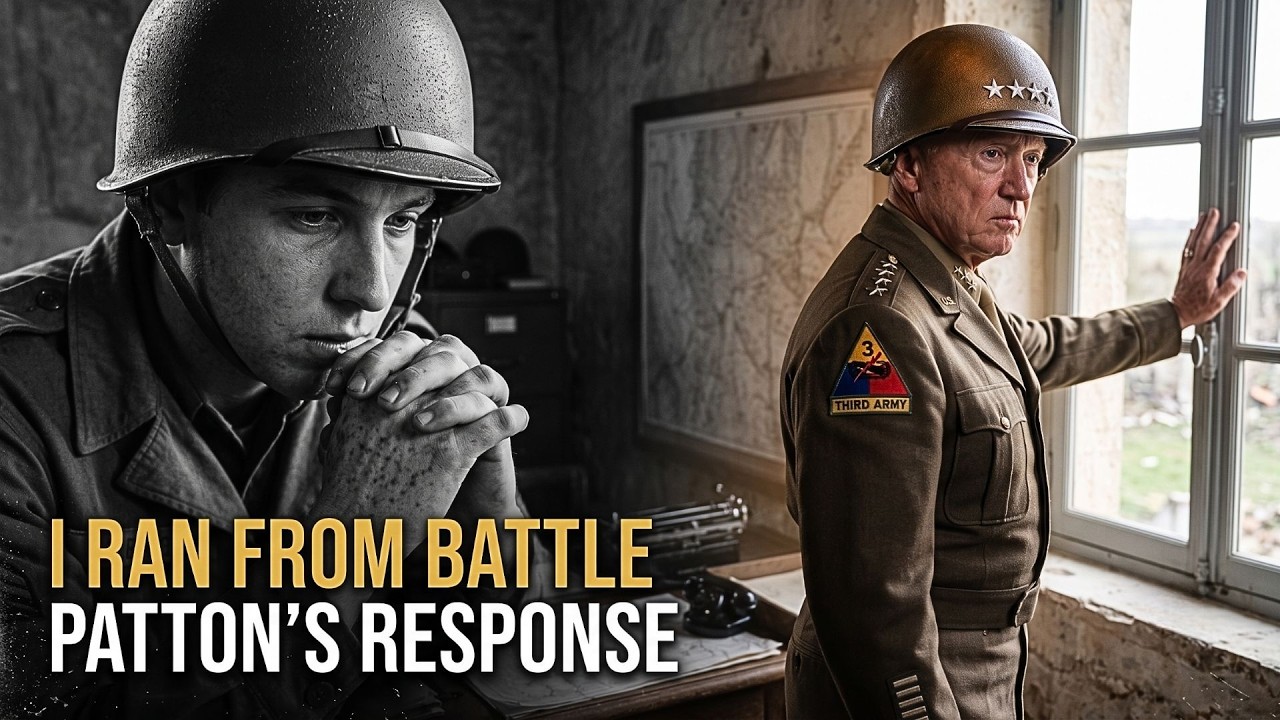
He said: Sir, I want to tell you what I did. Patton looked at him. At the battle of Remagen three weeks earlier, he hesitated for a moment. Then ran.
The room fell utterly silent. I ran, he said again. Two of my men stayed. They are dead now.
And I have been alive for three weeks knowing that I ran and they did not. I do not know what to do about that. It is confusing. He looked at his hands.
I came here because I did not know where else to go. Patton did not move. He looked at the soldier for a long time. The soldier was twenty years old.
He had not slept soundly in three weeks. He looked like a man carrying a heavy load for so long that the load itself had changed his face. Patton rose from his desk, walked to the window, and stood there with his back to the soldier for a long moment. Then he turned around and said something no one expected.
It was March 17, 1945, ten weeks before Germany’s surrender. The crossing of the Rhine at Remagen had been one of the pivotal moments of the final push into Germany. American forces had seized the Ludendorff Bridge on March 7 before German engineers could destroy it, and troops had poured across the river in the days that followed. Fighting on the eastern bank was fierce, often close-quarters, with units moving rapidly through unfamiliar terrain.
Contact with German defenders came suddenly and without warning. Private First Class Samuel Reeves was twenty years old, from a small town in Tennessee. He had spent five months in Europe. He had fought enough battles to know the sound of combat, the feel of it, what it demanded of him.
Deep down, without telling anyone, he believed he could handle it. On the morning of March 3, his division entered a building complex on the eastern bank of the Rhine to clear it. The Germans were supposed to have withdrawn. They had not.
The engagement began inside the building, in a tight space, with no room for organization and no time to think, only sound and movement and the particular terror of not being able to tell where anything was coming from. Reeves ran. He could not fully explain what happened afterward. His body moved before he made a decision.
He was outside the building before he realized he was leaving. He stopped about twenty yards out. He turned and looked back. He could hear the gunfire continuing inside.
He did not go back. Two men from his squad did not come out: Corporal Frank Hayes, twenty-four years old, from Ohio, and Private David Nolan, nineteen, from Massachusetts. The official report listed their names as killed in action during the clearing operation. The report was accurate as far as it went.
It did not mention Reeves. No one mentioned him, because no one had seen him leave. No one knew. No one but Reeves.
He carried it for three weeks. He ate with his unit, slept in the same barracks, answered when spoken to, cleaned his weapon, wrote letters home, did everything required of him, and carried it every hour of every day since March 3. He began to realize he could carry it indefinitely. That was the terrifying part.
He could carry it forever and no one would ever know, and the prospect of carrying it alone forever became worse than the prospect of telling someone. He walked into Patton’s headquarters and asked to see the general. The duty officer looked at him. A private first class asking to see a four-star general, no appointment, no orders, no reason that fell within the usual categories.
The duty officer told him that was not how things worked. Reeves sat down in the waiting room and said he would wait. He waited two hours. He did not move.
He did not explain himself to anyone who asked. He sat there with his hands on his knees. Colonel Thomas Reed finally came out, read the note Reeves had written, and went back inside. Three minutes later he returned and told Reeves to go in.
Patton looked at the soldier standing before him, a private first class, twenty years old. The expression on his face was not one Patton saw often. It was the look of a man who had made a decision that had cost him everything and was now committed to it no matter what. He ordered him to sit.
Reeves sat. He said everything at once, without stopping. The firefight, the building, the running, the two men, the three weeks of knowing. He said it without pausing and without lifting his eyes from his hands, because he had learned over the past three weeks that looking up made it harder to continue.
When he finished, the room was silent. Patton did not move. He looked at Reeves for a long time. I remember, he said.
Then he slowly rose and walked to the window. He stood there with his back to the room for nearly a full minute. Reeves, who had been standing by the wall the whole time, watched Patton and said nothing. He had served with him for two years.
He had never seen him go to the window like that after any conversation. Then Patton turned around. He said: I am going to tell you something, and I want you to hear all of it before you say a word. Reeves looked at him.
Patton said: I have been afraid in every battle I have ever fought. Every single one. Anyone who tells you he was not afraid in combat is either lying or he was not paying attention. Fear is not the question.
Fear happens to everyone. He paused. What happened to you in that building is that your body moved before your mind could stop it. That happens.
It has happened to soldiers in every war in history. That does not make you a coward. It makes you a man who was in a situation that exceeded what you were prepared for in that moment. He looked directly at Reeves.
But here is what I have to say as well. Two men died. You know that. You have known it for three weeks.
And nothing I have just said to you changes the fact that those two men are dead and you were there and you left. Reeves nodded. He was not going to argue with any of it. Tell me their names, Patton said.
Tell me their names. Reeves told him. Patton picked up a pen from the desk. He wrote them down slowly.
Frank Hayes, David Nolan. He looked at what he had written. You will carry these names for the rest of your life, Patton said. That is not a punishment.
It is simply the truth. You already know that. You have been carrying them for three weeks. He set the pen aside.
The question is not whether you will carry them. The question is how. He looked at Reeves. You came here because you wanted someone to take this burden from you.
I cannot do that, and no one can. But I can give you another assignment. He picked up the pen again. I am reassigning you.
Graves registration. You will spend the rest of this war identifying American soldiers killed in action, recording their remains, and caring for them. You will make sure that every soldier who falls in this army is found, documented, and treated with dignity. You will make sure their families are notified and that the record is complete.
He looked at the paper. You will do this work until the war is over. And while you do it, you will carry the names of Hayes and Nolan, not as a burden, but as a purpose. Every soldier you find, every body you document, every family you give an answer to, that is what you do with what happened in that building.
The men who died in that building deserve someone who cares enough to carry their memory. You are that someone now. He signed the reassignment order and handed it to Reed. That is all, he said.
Reeves stood. For a moment he just stood there. Then he came to attention, properly and precisely, the way a man comes to attention when he means it. He walked out without speaking.
Reed followed him into the outer office. Reeves watched him go. Then he went back inside. Patton was looking at the two names on the paper.
He came here, Patton said. He did not have to do that. He could have carried this quietly for the rest of his life and no one would ever have known. He could have told himself a hundred different stories about what happened in that building and no one would have contradicted him.
But he came here and said it out loud. He paused. That takes something. A different kind of something than what is required in a firefight.
But it is something. Samuel Reeves served in the graves registration section from March 1945 through the end of the war, working in Germany and then in France as the documentation work moved west. He identified and documented the remains of 412 American soldiers, learning their names, recording their details, and making sure the record was complete so that the most accurate notice possible reached their families. He was discharged in October 1945 and returned to Tennessee, where he worked in a hardware store for thirty years.
He had two sons. He never told anyone what happened in the building complex on March 3. He never told anyone about his visit to Patton. He kept two photographs on the shelf above his bed, side by side in a single frame.
His daughter found them after his death in 1988 and did not know who the two men were. She brought them to a small group of his army friends who attended the funeral and asked if anyone recognized them. One of them read the names written on the back of the photographs: Frank Hayes, David Nolan.
