The Mellon family’s rise began in 1818, when Thomas Mellon, a twenty-eight-year-old Irish immigrant, stepped ashore in Philadelphia with little more than a plan to reshape American capitalism. He found a nation of farmers and small merchants, where banking was rudimentary and industry starved for capital. While other immigrants took up farming or trades, Thomas studied the flow of money. By 1834, during a devastating depression in Pennsylvania, he was ready to exploit it.
When the panic struck, thousands of farmers faced foreclosure. Thomas had spent years cultivating relationships with bank officials, lawyers, and court clerks, the very men who controlled the foreclosure process. He had also hoarded actual cash while others transacted on credit. Farmers facing ruin needed hard money immediately, and Thomas was often the only buyer with it.
His first major purchase was a two-hundred-acre farm outside Pittsburgh, valued at three thousand dollars two years earlier, which he bought for four hundred dollars in cash. Within five years, he resold it for forty-five hundred dollars. But Thomas recognized that the real money lay not in land but in controlling the financing behind every transaction. He began lending short-term at interest rates of twenty to thirty percent, then foreclosed when borrowers inevitably defaulted.
Between 1835 and 1840, he initiated over two hundred foreclosure proceedings, amassing more than three thousand acres. He was systematically manufacturing distressed properties and accumulating the most valuable currency of all: detailed knowledge of local economic conditions. In 1841, Thomas liquidated much of his real estate for fifty thousand dollars and opened T. Mellon and Sons.
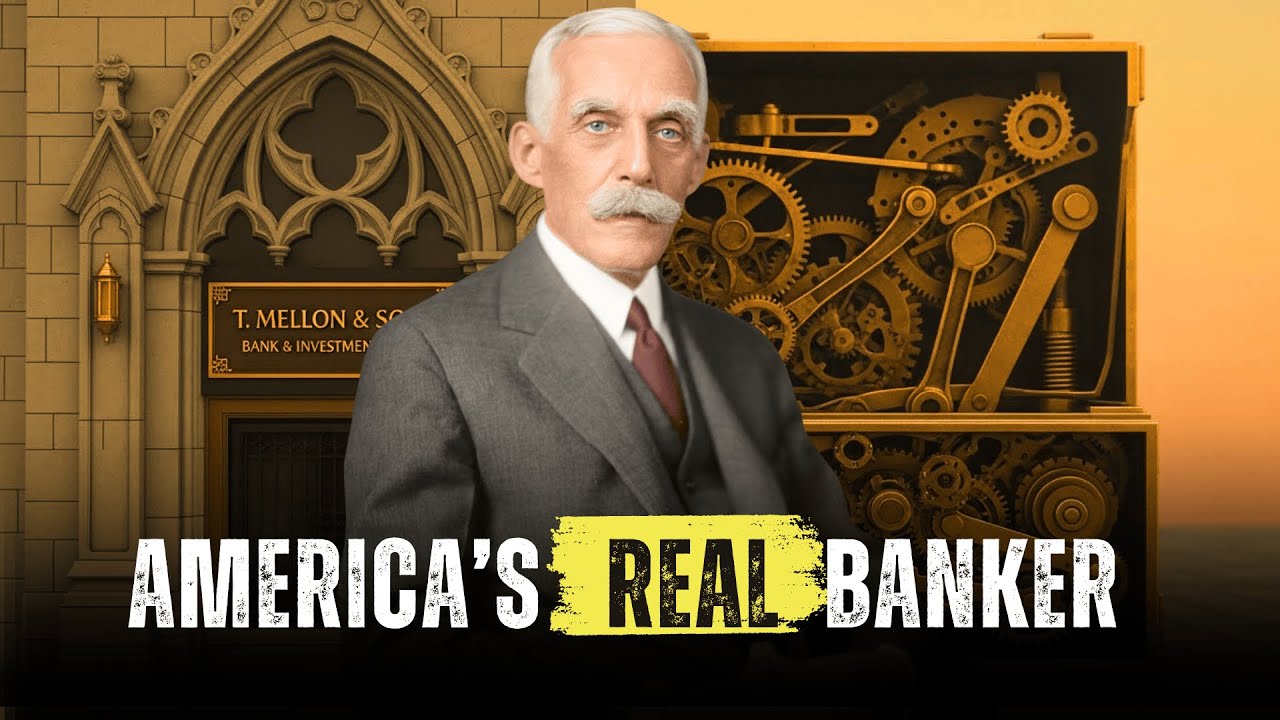
It was not merely a bank but a comprehensive financial service, offering deposits, loans, real estate financing, business consulting, and investment management. His first major client was Andrew Carnegie, who needed capital for his steel investments. By 1850, the bank was Pittsburgh’s most successful. When Thomas’s eldest son, Andrew, took control in 1882, he transformed the regional bank into the second-largest financial institution in America.
He extended loans to smaller banks, controlling far more capital than his own books showed. A million-dollar loan to a regional bank gave him influence over ten million in assets. Within a decade, he had woven a network of dependent institutions that functioned as branches of his empire. Andrew’s real breakthrough came from identifying the link between banking and emerging industry.
In 1886, inventor Charles Martin Hall approached him with a process for cheaply producing aluminum. Every other financier had dismissed it. Andrew funded Hall with two hundred fifty thousand dollars, secured controlling ownership, and built the Pittsburgh Reduction Company, later known as Alcoa. By 1900, Alcoa controlled ninety percent of American aluminum production.
He applied the same logic to oil. The petroleum sector was fragmented, and Andrew systematically acquired companies throughout Pennsylvania and West Virginia, consolidating them under centralized control. When independent producers dared to compete, he slashed prices below cost until they went bankrupt, then restored prices. His banks funded the losses, using depositor money to finance monopolistic practices.
By 1915, the Mellon empire held controlling interests in aluminum, oil, steel, coal, and transportation, assets valued at roughly 1. 3 billion in today’s dollars. Steel became his quiet obsession. While Carnegie built his empire through public battles and headlines, the Mellons acquired distressed companies in silence.
Union Steel, on the brink of bankruptcy in 1899, accepted Andrew’s emergency loan with a catch: if it failed to repay within two years, ownership transferred to the bank. It never repaid. Andrew repeated this pattern across Pennsylvania and Ohio, acquiring twenty-three steel companies between 1901 and 1907. He specialized in high-value products for automobiles, aircraft, and precision machinery, generating double the per-ton profit of commodity producers.
When J. P. Morgan formed U. S.
Steel in 1901, Andrew did not fight it directly. He focused on custom orders and niche markets, coexisting profitably with the giant. By 1915, Mellon companies controlled fifteen percent of American steel production. World War I was the empire’s zenith.
Military aviation demanded advanced alloys, naval construction required specialized armor, and artillery needed precision components. Mellon profits soared by over four hundred percent between 1914 and 1918. When the war ended, competitors collapsed under excess capacity and debt, and Andrew acquired twelve more companies at bargain prices. By 1925, he controlled thirty-five firms producing six million tons of steel annually, roughly twenty percent of American output.
He was the largest private steel producer in the world, and almost no one knew it, because each company kept its own name, deliberately avoiding the antitrust scrutiny that plagued Rockefeller and Carnegie. Oil proved even more consequential. While Rockefeller defended his existing monopoly, Andrew quietly assembled teams of geologists to find new fields. In 1901, months after the Spindletop gusher made headlines, his geologists identified a similar formation two hundred miles away.
He bought fifty thousand acres at two dollars per acre. When his drills struck oil six months later, the land was instantly worth over five hundred dollars per acre. By 1915, Mellon oil companies produced more than any other private operation in America. He acquired coal mines across Pennsylvania, West Virginia, and Kentucky, and integrated everything so tightly that his companies bought coal from his mines, shipped on his railroads, and borrowed from his banks.
The family’s most audacious move came in 1921, when Andrew orchestrated his own path to the Treasury Department. Republican leaders needed funding for Warren Harding’s campaign, and Andrew contributed over a million dollars, the equivalent of thirteen million today. When Harding offered him the Treasury secretary position, he accepted eagerly, refusing to divest his business holdings. Over the next eleven years, he cut the top income tax rate from seventy-three percent to twenty-five percent, eliminated the excess profits tax, and engineered the oil depletion allowance, which let oil companies deduct twenty-seven and a half percent of gross income.
His family controlled more oil than anyone else, so they reaped the largest benefit. Between 1921 and 1929, Mellon wealth grew from one hundred million to over five hundred million dollars. The foundation of this wealth was a tax system so complex that the IRS still struggles to understand it. Andrew established the Mellon Institute in 1913 as a scientific research foundation, followed by educational, cultural, and health foundations.
Donations were tax-deductible, and the research conveniently benefited Mellon businesses. He created family trusts so assets were held by institutions rather than individuals, avoiding estate taxes. He moved profits through the Bahamas, shifting income from high-tax American operations to low-tax havens. When he died in 1937, his estate officially paid seven million dollars in taxes, but investigators later uncovered over two hundred million concealed in trusts and offshore entities.
He died under the cloud of a tax evasion accusation and was acquitted only posthumously, after congressional hearings exposed the scale of the schemes. The Great Depression only expanded the empire. While other families suffered, the Mellons used their preserved capital to buy distressed assets at pennies on the dollar. By 1940, their tax avoidance had effectively doubled their net worth.
Today, the family controls over twelve billion dollars in assets. Their true power, however, lies in institutions. The Mellon Foundation funds universities, museums, and cultural programs. Carnegie Mellon University, created from a 1967 merger with Andrew Carnegie’s endowments, trains future leaders in technology, business, and public policy.
Foundation-funded research flows into think tanks, which shape policy recommendations that then appear in media as neutral expert consensus. The family quietly influences environmental policy, education reform, and financial regulation without holding public office. In 2024, Timothy Mellon shattered the family’s tradition of discretion. He funneled sixty-five million dollars to Donald Trump’s campaign and a super PAC aligned with Robert F.
Kennedy Jr. , and became the largest private donor to the Texas border wall. It was a dramatic departure from the shadows. The Mellon story spans two centuries.
What began with one Irish immigrant lending cash to desperate farmers became the architecture of modern American capitalism: banks, steel, oil, coal, aluminum, and the tax structures that wealthy families still use today. The dynasty’s greatest achievement was not the money itself, but the system that kept it growing, invisible, and untouched by the public scrutiny that destroyed so many rival fortunes.






