On Good Friday, April 1, 1988, eight-year-old April Marie Tinsley was walking between friends’ houses in Fort Wayne, Indiana. Spring was arriving slowly, and a light rain had begun to fall. April realized she had left her umbrella behind. It was around three in the afternoon when she told her friends she was running back to get it.
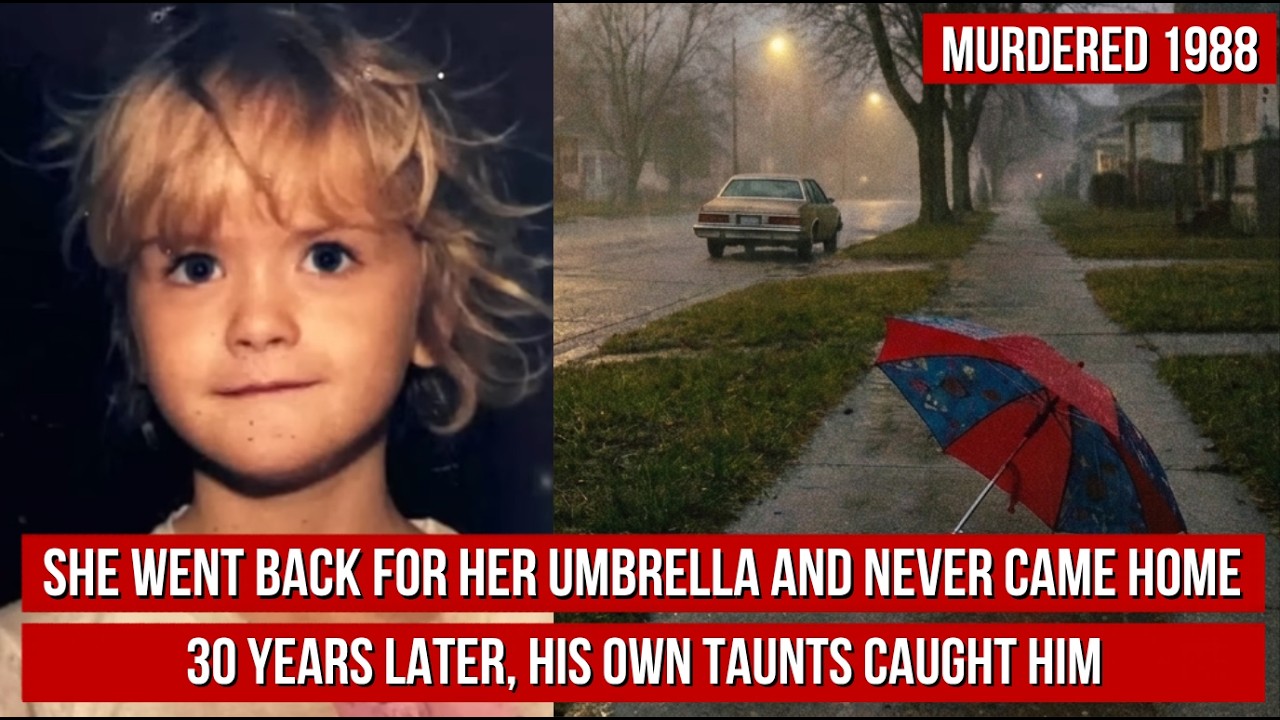
They waited. She never returned. By evening, her mother, Janet Tinsley, knew something was terribly wrong. April was supposed to be home for dinner.
Police were called, and the response was immediate. Roughly 250 officers from the Fort Wayne police and other agencies, joined by about 50 volunteers, fanned out across the neighborhood searching through the night. Then a witness came forward with a chilling report: they had seen a white man in his thirties forcing a girl who looked like April into a blue pickup truck. This was not a wandering child.
She had been taken. For three days, the city held its breath. April’s face appeared on telephone poles, in store windows, and on local news. The community prayed for a miracle.
The hope grew thin as the hours turned into days, and the search for a missing girl became a search for a body. On April 4, 1988, a jogger on a quiet country road about twenty miles north of Fort Wayne in rural DeKalb County made a horrifying discovery. In a ditch lay the body of a small child. It was April Tinsley.
An autopsy confirmed the worst fears: the eight-year-old had been sexually assaulted and strangled to death. Investigators estimated she had been dead for one to two days. Near her body, they found one of her shoes, a detail that would later become a grotesque signature. DNA evidence was carefully recovered from her clothing, but in 1988 the technology to identify a suspect from that microscopic trace did not yet exist.
It was a clue waiting for a science that had not caught up with the crime. Her memorial service was held four days later, on April 8, at the same church where she had sung joyfully in the children’s choir. The city mourned with her family. An early suspect was arrested but later acquitted, and the investigation stalled.
A child killer was loose in Fort Wayne, and no one knew who he was. Parents held their children tighter and wondered if the monster was living among them. They would soon learn that he was, and that he wanted to talk. Two years passed.
Then, in May 1990, the killer broke his silence. A message was discovered scrawled on the wooden wall of a barn in what looked like crayon or marker. It read: “I kill 8-year-old April M. Tinsley.
Did you find her other shoe? Haha. I will kill again. ”
The detail about the shoe was a terrifying display of inside knowledge.
It was not a confession born of guilt; it was a predator marking his territory and tormenting the family and police. The message was a psychological grenade, and fear returned to Fort Wayne with a vengeance. Then the killer went silent again. In 2004, he committed what would ultimately be his most foolish act.
Around Fort Wayne, a series of disturbing notes appeared, left in baggies on the bicycles of young girls or in their mailboxes. They again claimed responsibility for April’s murder. But this time, the killer had included something else: used condoms and disturbing Polaroid photographs of his own body. His arrogance gave investigators the break they needed.
Lab technicians developed a full DNA profile from the condoms and confirmed it matched the DNA recovered from April Tinsley’s body sixteen years earlier. The ghost now had a genetic fingerprint. But when they ran the profile through CODIS, the national database of convicted offenders, there was no match. The killer had managed to stay off the police radar, with no criminal record requiring his DNA to be collected.
The case went cold again, but this time investigators held his genetic code in storage. The years that followed were a period of deep frustration. The case became one of Indiana’s most infamous cold cases, featured on national television programs. Thousands of tips poured in, leading nowhere.
The public nature of the tragedy was so intense that the Tinsley family was forced to move away from Fort Wayne for a time. Detectives who had worked the case in 1988 retired, passing the heavy files to a new generation. The FBI’s Behavioral Analysis Unit created a profile, concluding the killer was likely a preferential child predator, someone who specifically targeted children, probably hiding in plain sight within the community. As the twentieth and then the twenty-fifth anniversaries of April’s death passed, hopelessness began to settle over the case.
It seemed destined to remain unsolved. By 2018, the world had changed. Millions of people curious about their family history had sent their DNA to companies like AncestryDNA and 23andMe. Many had uploaded their genetic data to public websites like GEDmatch, hoping to find long-lost cousins.
They had no idea they were also building the most powerful tool ever created for catching killers. The technique was called forensic genetic genealogy, and it was about to blow the April Tinsley case wide open. In early 2018, thirty years after April’s murder, Fort Wayne law enforcement partnered with a Virginia company called Parabon NanoLabs, which specialized in turning unknown DNA profiles into leads. They handed the case to a genetic genealogist named CeCe Moore.
Her job was to take the killer’s genetic code and use it as a key to unlock the public library of DNA on GEDmatch. She was not looking for the killer himself. She was looking for a relative. Within just eight hours of uploading the killer’s profile, the family tree took shape.
Genetic lines pointed to a single family, and within that family, to two brothers. One of them had to be the killer. After thirty years, the ghost finally had a name, a family, and a location. The family tree pointed to two brothers in the Fort Wayne area.
One was a fifty-nine-year-old man named John D. Miller, who lived a quiet life in a trailer home in Grabill, Indiana, just a short drive from where April’s body had been found. He was a ghost hiding in plain sight, a face in the crowd while police chased leads across the country. Police placed Miller under surveillance.
They needed a direct DNA sample to confirm the match, and they had to obtain it legally without his knowledge. In early July 2018, investigators collected his trash after it was put out for collection. Sifting through the garbage, they found three used condoms. The DNA extracted from them was a perfect match to the DNA from the 2004 taunting notes, and most importantly, to the DNA recovered from April Tinsley’s body in 1988.
On July 15, 2018, detectives drove to the quiet trailer park in Grabill. They knocked on John D. Miller’s door and asked if he would come to the station to talk. He agreed.
At the police station, an investigator asked if he knew why they wanted to speak with him. Miller did not fake ignorance or ask for a lawyer. He spoke two words: “April Tinsley. ”
For the next several hours, Miller confessed to everything.
He told investigators he had been driving around on April 1, 1988, looking for a child to abduct. April was simply the one he spotted. He described luring her into his car, taking her back to his trailer, and sexually assaulting her. He strangled her with his bare hands to keep her from going to the police, and admitted it took ten minutes for her to die.
After she was dead, he sexually assaulted her corpse. The following night, he dumped her small body in the ditch where she would be found. He admitted to writing the taunting notes and leaving the condoms. There was no remorse, only a cold recitation of facts.
The thirty-year manhunt was over. Faced with the mountain of DNA evidence and his own detailed confession, Miller pleaded guilty to murder and child molestation on December 7, 2018. On December 21, he was sentenced to eighty years in prison. At fifty-nine years old, it was effectively a life sentence.
A memorial, April’s Garden, was created in Fort Wayne, a place of life and peace, shifting the focus from the monster to the victim. John Miller was sent to the New Castle Correctional Facility, with an earliest possible release date calculated to be 2058, when he would have been ninety-nine years old. He would not live that long. On September 4, 2025, after serving just under seven years of his sentence, John D.
Miller died of natural causes in an Indianapolis hospital. He was sixty-six years old. The man who had terrorized a community for decades died quietly in a hospital bed, his final chapter written not by a judge but by his own failing body. His taunts, which he believed proved his cleverness, had become the trail of breadcrumbs that, combined with the power of genetic genealogy, led detectives directly to his door.
In the end, the case is not about the monster who took April’s life. It is about a bright-eyed girl who loved to sing and who, on a gray spring day, just went back to get her umbrella. In the heart of Fort Wayne, in a garden that bears her name, her memory lives on.
