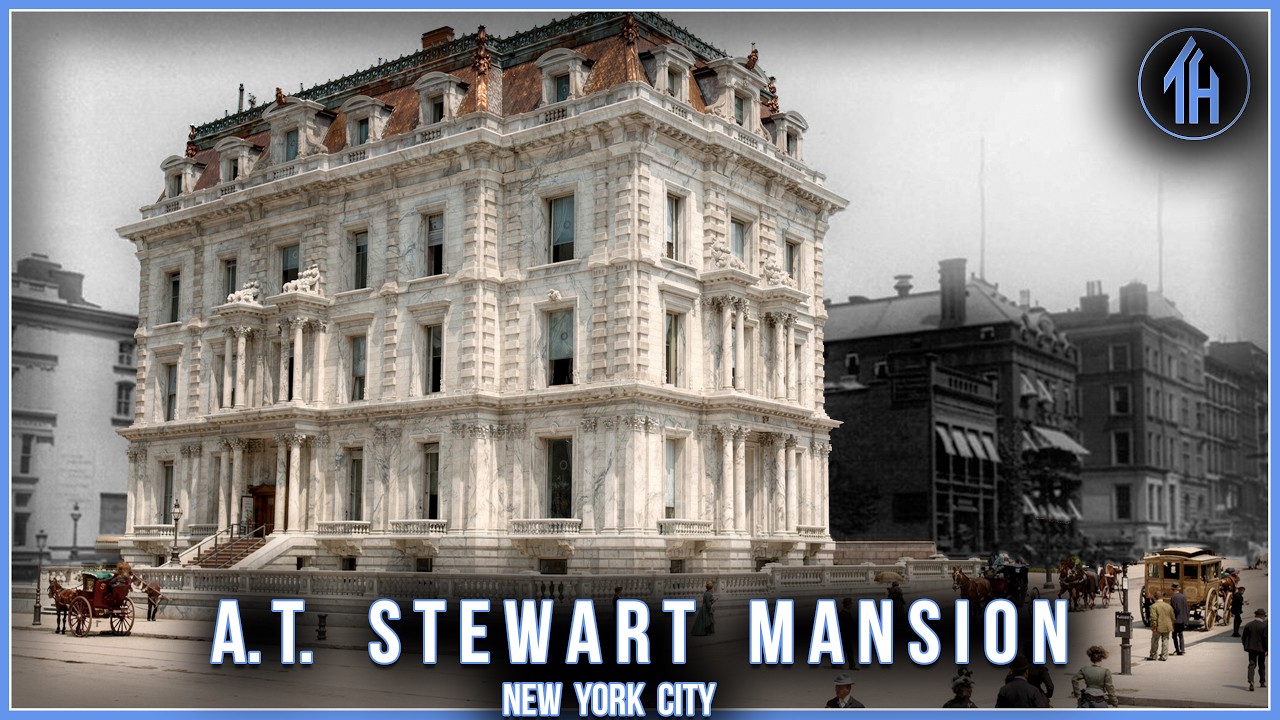
The marble rose out of the brownstone like a bolt of lightning frozen in stone. On the northwest corner of Fifth Avenue and 34th Street, a house of dazzling white Tuckahoe marble rose four stories above a rusticated basement, crowned by a mansard roof and delicate cast-iron cresting. Visitors compared it to the palaces of Europe, and New Yorkers called it the first truly palatial house in their city. Within a single generation, it was gone.
The man who built it had arrived in New York with nothing but the clothes on his back and a tutor’s wages. Alexander Turney Stewart was born in 1803 into a poor Irish family near Lisburn. With few opportunities before him, he sailed for New York while still in his teens and scraped by teaching the children of wealthy families. When his grandfather died, Alexander inherited a meager estate.
He sailed home to Ireland and spent nearly the entire inheritance on Irish lace and fine linens, then carried them back across the Atlantic to sell. In 1823, he opened a small dry goods shop on Broadway and began breaking every rule of American retail. Shopping in that era was combat; every price tag was an opening bid, and customers either haggled or got fleeced. Stewart refused to play.
He marked every item with a single fixed price, the same for a society matron as for her housemaid. He welcomed everyone to browse without buying. He accepted returns, held clearance sales, and trained his clerks to be courteous rather than pushy. The shoppers of New York, especially the women, rewarded him with a fortune.
By 1846, he had built a gleaming marble emporium on Broadway, a store so grand that New Yorkers dubbed it the Marble Palace. Historians still call it the cradle of the American department store. Sixteen years later, he topped himself with a cast-iron palace farther up Broadway. Behind those counters stood an empire of mills, factories, and warehouses stretching across America and Europe, with profits flowing into Manhattan real estate.
By the 1860s, Stewart ranked among the three richest men in America, spoken of in the same breath as Astor and Vanderbilt. For all his reputation as a shrewd businessman, Stewart was capable of staggering generosity. During the Irish Famine, he chartered a ship, packed it with food for the starving towns around his native Lisburn, and offered free passage to America on the return voyage to anyone desperate enough to take it. Late in life, he poured money into a grand hotel for working women in Manhattan.
And in 1864, with all of New York watching, he began building himself a house unlike anything the city had ever seen. The ground itself carried history. The Samuel Townsend Mansion, a celebrated residence, had once stood there until Stewart bought it and had it torn down. The site anchored the neighborhood near the Astor family homes.
To design his house, Stewart turned to John Kellum, the architect who had already built his great store. Together they broke sharply with fashion. Where the avenue was lined with brownstone, Kellum sheathed the residence entirely in gleaming white Tuckahoe marble and dressed it in the new French Second Empire style, newly arrived from Paris. The house was so grand that it could turn its shoulder to Fifth Avenue and present its formal face to 34th Street.
Construction stretched across the second half of the 1860s and was completed by 1869 at a reported cost of two million dollars, the modern equivalent of nearly fifty million after adjusting for inflation alone. Frank Leslie’s called it perhaps the handsomest and most costly private residence in the country. Against the sober rows of brownstones, it looked like a European palace dropped into Manhattan. Inside, the first and second floors were clad in Carrara marble, with a grand white marble stairway and railing and ceilings that rose about nineteen feet in every room.
The vast entrance hall had the hush of a museum, lined with life-size statuary and fluted marble columns that carried a gilded ceiling. To the right of the hall lay the reception room, furnished in blue china silk and hung with fine paintings. Like the rooms around it, it doubled as a gallery, for works of art were distributed everywhere Stewart could find a wall or a pedestal. The heart of the house was the picture gallery at the rear, measuring about fifty feet by thirty and holding the principal treasures of a collection valued in its day at six hundred thousand dollars.
On its northern wall hung the centerpiece: the monumental *Friedland 1807*, which Stewart had purchased directly from the artist, sight unseen. Around it gathered a remarkable company of European canvases and marbles, including Rosa Bonheur’s *The Horse Fair*, works by Jean-Léon Gérôme, and a body of sculptures known as the Stewart statues. There were more than 165 oil paintings in all, far more than the walls could hold, so canvases were propped against the walls and against the bases of the statues. The drawing room ran the full length of the Fifth Avenue front, its furniture of gilded white wood covered in pale yellow satin.
Its ceilings and wall panels were the work of the Italian decorative painter Mario Regaldi, who had earlier decorated the Imperial Palace of Dom Pedro in Brazil and who reportedly spent a full year working in nearly every room of the house. Along the same marble hallway stood the music room, one of the formal parlors on the right of the entrance hall. Here too, art was everywhere, for sculptures, porcelains, paintings, and tapestries were scattered throughout these rooms as freely as in a public gallery. On the second floor, directly above the drawing room and running the full width of the Fifth Avenue side, was the library, where the books hid behind the mirror doors of black walnut bookcases.
Gobelin tapestries hung on the walls, gilt-bronze chandeliers lit crimson carpeting and wall panels, and life-size portraits of Alexander and Cornelia Stewart looked down over the room. The family’s bedrooms occupied the third floor, appointed with the same care as the showrooms below, including luxurious guest suites. One of them, long known as General Grant’s room, was furnished in rosewood. Even the practical needs of washing and dressing were hidden away in cabinetry, with wardrobes and washstands combined, so that opening a central mirror door revealed the lavatory apparatus discreetly concealed within.
Alexander Stewart caught a cold at the start of April 1876 that turned gray, and on April 10th, he passed away in the mansion as crowds gathered outside. His body was laid out in the second-floor lace room amid a mountain of floral tributes. After an imposing funeral, he was placed temporarily in the vault at St. Mark’s Church in the Bowery.
Then came one of the most macabre episodes in the city’s history. On the morning of November 7th, 1878, the sexton at St. Mark’s discovered that the vault had been broken open and Stewart’s remains carried off, along with the silver coffin plate. The thieves demanded as much as two hundred fifty thousand dollars as ransom for the body.
By the account of former police chief George Walling, Cornelia Stewart ultimately paid about twenty thousand dollars and received a bag of bones. Cornelia, left with an estate estimated at fifty million dollars, lived on quietly in the marble house until her own passing in 1886. After she was gone, the vast art collection was sold by the American Art Association, with the paintings offered at Chickering Hall that March. Following Cornelia’s passing, the mansion sat silent and empty.
Then, in 1890, the Manhattan Club signed a long lease and made the marble palace its clubhouse. The club could not carry the cost of maintenance, and in 1899 it moved out, trading places with the University Club, which briefly occupied the house. In 1901, the mansion was demolished to make way for the Knickerbocker Trust Company’s new building, designed by Stanford White of McKim, Mead and White, and built at the corner over the following years. The marble that had once defied the brownstone city came down, and on its ground rose a bank.
The first truly palatial house in New York had lasted barely a generation.
