In 1897, the crowds pressed six miles deep through the streets of London, and the cheering was so loud that the 78-year-old Queen could hardly hear the bands. Victoria, Empress of India, passed before them in an open carriage, the embodiment of imperial confidence. Yet the woman who received that ovation had spent four decades hiding from the public, a widow in perpetual black who had once been so crushed by grief that her own ministers wondered if she had simply gone to sleep. But the Widow of Windsor, as she was known, was not what she appeared to be.
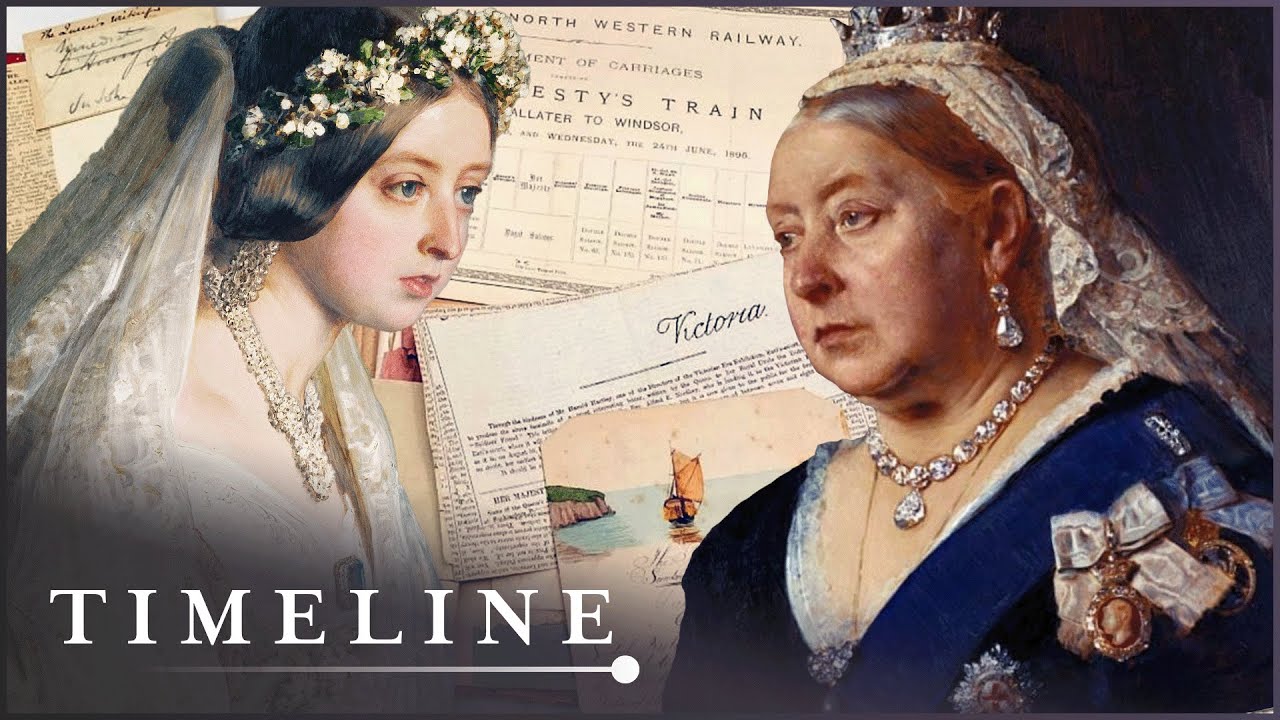
Behind the stout old lady at her writing table lived a passionate, contrary, and surprisingly free human being—a woman who had used her widowhood to escape the shadow of the men who had controlled her, and who had committed more than fifty million words to paper along the way. The year 1861 was Victoria’s annus horribilis. Within months, she lost both her mother and her husband, Prince Albert. The double blow left her distraught, and she fled London entirely.
The public assumed she was doing nothing, left inert by sorrow. But in her journal, she poured out her loss: her lover, her friend, her crutch was gone. “He did everything everywhere,” she wrote. “Nothing did I do without him from the greatest to the smallest.
” Her first word, she confessed, had always been, “I must ask Albert. ”
What the 42-year-old Queen failed to realize was that marriage had infantilized her. She had come to rely on her husband for everything, even asking him each morning what dress she should put on. Albert had restrained and controlled her, in politics and in personal life alike.
Now his life was over, but hers was not, and little by little she began to flap her wings. Her first steps toward freedom were taken in Coburg, in what is now Germany—the birthplace of Albert and of her mother, and a place Victoria adored. She confessed her love of Germany openly in her journal: “If I were not who I am, my real home would be here. ” She was three-quarters German and idolized the land and its people.
The very air, she felt, smelled like Albert. When she returned to Coburg, her brother-in-law Ernst expected her to stay at his grand baroque palace in the center of town, but she preferred the quiet hunting lodge at Schloss Rosenau, five miles out, where Albert had been born. There, surrounded by hills and forests, she signed the visitors’ book in 1862 as “Victoria Regina, the desolate widow of my beloved Albert. ”
Grief-stricken she certainly was, but inert she was not.
She was about to demonstrate her political astuteness in a Germany that was then not a unified country but a mere notion. The central question of the age was whether the small German duchies and city-states would come together in a peaceful federation or allow themselves to be bullied by the northern kingdom of Prussia into becoming a modern militaristic nation. In that drama, Victoria stood plum center stage. In the summer of 1863, she came to Schloss Ehrenburg and thrust herself between the twin camps of Prussia and Austria, before any of her diplomats had moved.
It was her first major activity since being widowed, and she was terrified. “Felt so nervous, all being in state and I alone,” she wrote. “I have no longer my beloved Albert to guide, cheer, advise, and pilot me through the great difficulty. ” In the Hall of Giants, where her parents had been married, she met with the Emperor of Austria, and together they drank a toast to the unity of Germany.
Here was the British Queen, alone but independent, negotiating not particularly on behalf of England but on behalf of a peaceful Europe. She had found the inner strength to carry on Albert’s political work herself, acting as an arbiter between Austria and Prussia, still hoping for a peaceful solution to the German question. While British newspaper editors assumed the Queen had gone into hiding, she was in fact deeply engaged through back channels, seeing herself—because of Albert—as a diplomat in her own right. Partly through her own marriage and the marriages of her children, she had become intimately involved in European politics.
Her eldest daughter, Vicky, was married to the Crown Prince of Prussia, while her son Bertie had married the Princess of Denmark. When war broke out between those neighboring states, Victoria was caught in the middle, with members of her own family fighting on opposing sides. “Oh, if Bertie’s wife was only a good German and not a Dane,” she lamented. “It is terrible to have the poor boy on the wrong side.
”
While Victoria showed her fortitude on the world stage, she was also finding freedom at home. As a young woman, she had always sought father figures, from the flirtatious Lord Melbourne to her angel Albert. Now she had another man by her side. “I feel I have here, and always in the house, a good, devoted soul whose only object and interest is my service,” she wrote at 45.
“And God knows how much I want so to be taken care of. ” Those words were about Albert’s Highland servant, a Mr. John Brown, brought down from Balmoral to attend Victoria at Osborne in 1864. It is difficult to overstate what Brown meant to her.
One biographer of the servant put it plainly: without the Highlands and John Brown in the ten years after Albert died, Queen Victoria would have gone stark staring mad. She had always loved Scotland, and the unaffected character of the Highlanders was a refreshing change after the stuffiness of Windsor and Buckingham Palace. So it was that the bearded, kilted John Brown, seven years her junior, became Victoria’s next male dependency and closest companion. She spent far more time with him than with any other person, certainly more than with any member of her family.
He attended her whenever she needed him, understood her loneliness in a way her ministers never could, and told her openly, “I think you’re just a lonely wee bairn that needs to be brought out of herself. ” That was exactly what he did. He pulled her out of her depression, devoted his life to her, never took a holiday, and was always there. His agenda, from dawn to dusk, was Queen Victoria.
Alongside that devotion came an abruptness and a complete disregard for court etiquette, which enraged the household but made Brown the ideal companion for the Queen. Albert had been sickly and fussy, and had not shared his wife’s love of hearty eating and drinking. Brown loved his whisky and was often tipsy. He liked pouring whisky into the Queen’s milk, telling her, “Don’t stay thirsty.
” Victoria reveled in it. Brown released her inner capacity for hedonism and fun, and she knew it. Where she had been suppressed by the cruel workings of Sir John Conroy in her childhood and had struggled with an overbearing and scheming husband, she loved Brown’s openness and his dedication to her and her alone. “It is a real comfort,” she wrote, “for Brown is devoted to me.
So simple, so intelligent and so unlike an ordinary servant. ”
No one could talk to Victoria as John Brown did. On one occasion, a footman dropped a tray and the Queen erupted in rage, demanding he be dismissed to the kitchens. Brown intervened immediately.
“Woman, what are you doing to that poor laddie? ” he asked. “Have you never dropped anything yourself? ” The footman was reinstated.
The straight-talking Scotsman had put the Queen of England in her place, and she enjoyed it. He also filled a deep emotional need. On the fourth anniversary of Albert’s death, Victoria defied convention by bringing Brown to pay his respects at Albert’s mausoleum. That day, Brown was deeply affected.
“He said in his simple, expressive way, with such a tender look of pity while the tears rolled down his cheeks,” she recorded, “‘I didn’t like to see you at Frogmore this morning. I felt for you. But what could I do for you? I could die for you.
‘”
What came next showed the contradictory nature of Victoria’s character. The woman who shied away from public life decided to share her private thoughts with everyone. In 1868, she published extracts from her journals as *Leaves from the Journal of Our Life in the Highlands*. No monarch had ever published a book before.
It was an instant bestseller, chronicling her outdoor frivolity, her elation in the Highland landscape, local dances, and the annual games. “The games began about 3:00,” she wrote. “One, throwing the hammer. Two, tossing the caber.
Three, putting the stone. A pretty wild sight. But the men looked very cold with nothing but their shirts and kilts on. They ran beautifully.
” Soon, more than 100,000 copies had sold. The hero of the book was unmistakably John Brown. Victoria’s children hardly got a look in and were not best pleased, but she seemed unaware. She wrote to Vicky asking for validation: “You have never said one word about my poor little Highland book, my only book.
I had hoped that you and Fritz would have liked it. ”
The reason Vicky may have avoided the subject was that her mother’s shameless adoration of Brown was causing a scandal. A scurrilous pamphlet entitled *John Brown’s Legs* appeared in New York, joking about the Queen looking at her damaged knee. Even as the Americans penned their mockery, Victoria herself was writing a third volume of her Highland journal—in effect, a biography of John Brown.
The court and the politicians were horrified, and somebody had to be delegated to tell her the book was inappropriate. They chose the poor young Dean of Windsor, who went in and told her that writing these memoirs of her life with Brown would be misconstrued. She erupted with rage. But she took the young man’s advice, and the matter was never mentioned again.
Whether the manuscript survives somewhere in the Windsor archives, or whether Princess Beatrice, “the wrecker,” destroyed it, no one knows. It is poignantly sad that so avid a recorder of her times had her words suppressed. Victoria’s youngest daughter, Beatrice, systematically deleted Brown and anything else deemed unsuitable from her mother’s voluminous journals. But the suppression had precisely the opposite effect intended: instead of making people forget John Brown and Victoria, it made them obsessed.
What is known is that in favoring Brown, Victoria showed herself desperate for companionship, regardless of social cost. Of course, people suspected them of being lovers. There is a feminist issue here, as one historian noted: had Victoria been a male monarch going to bed with a parlor maid, no one would have batted an eyelid. It was the idea of a woman crossing the class barrier that appalled them, especially as rumors mounted of a secret marriage, even a love child.
The man who probably knew the most about the true nature of their relationship was her last doctor, Sir James Reid, who kept forty tiny diaries. His grandson’s wife, Lady Reid, still preserves them, written in minuscule script that requires a magnifying glass. Reid was not allowed to examine the Queen medically, nor to carry her up and down the stairs—but Brown was allowed to fold her in his arms. In one entry, after the Queen had a fall, she laughed about it.
The next day, Reid noted, “the Queen walked a little in the room. Brown lifts his kilt and says, ‘Is it there? ‘ And she lifts her skirt laughing and says, ‘No, it’s here. ‘” The doctor’s family teased his widow about the relationship, but she always clammed up, laughing and dismissing it.
The Reids themselves doubted a physical affair. After the Queen’s death, Dr. Reid’s examination revealed a prolapsed uterus, which would have made intercourse extremely painful, probably impossible. And the Queen was so open about loving Brown, about wanting him to hold her and carry her in public, that a secret covert relationship seems unlikely.
The likeliest truth, as one biographer put it, is that they had a tactile, loving relationship involving lots of hugging, but that they were not lovers in the true sense of the word. Victoria was never one for convention. Despite giving her name to an era of propriety and prudishness, she was anything but. Where she loved the openness of Brown, she could not stand those who were reserved around her.
So when it came to her buttoned-up Liberal Prime Minister, W. E. Gladstone, she had no tolerance at all. “Mr.
Gladstone is a very dangerous man and so very arrogant, tyrannical, and obstinate with no knowledge of the world or human nature,” she wrote. She used every weapon in her armory—psychological illnesses, physical illnesses—to combat what she believed were assaults by the Liberals on the monarchy itself. One such confrontation came in the summer of 1869, when the Lord Mayor of London and Gladstone asked her to open the new Blackfriars Bridge. The Queen was determined to wriggle out of it, and the drama went on through the summer and autumn.
She thought she had made it clear that opening the bridge in the heat of summer was impossible, but as Mr. Gladstone seemed still in doubt, she repeated her sincere regret. As July wore on, she dug in her heels: “The Queen is much surprised being again teased and tormented about this bridge. ” Republicans, the press, and even true monarchists were asking the same question: if the country functioned perfectly well with the head of state spending most of the year in Balmoral or on the Isle of Wight, why have a monarch at all?
Gladstone was determined to parade the little woman on the bridge; she was equally determined not to be bullied. In the end, she decided she could open it—but only after causing a tremendous palaver. Frequently caught in the crossfire was her private secretary, Colonel Henry Ponsonby. His great-granddaughter Laura preserves many of Victoria’s letters, with their almost illegible handwriting and heavy black borders of mourning.
Ponsonby knew it was no good contradicting the Queen. There is a famous story: when he said two and two make four, the Queen insisted they make five. He said no, he thought they made four. She said no, he was wrong.
He let it drop and returned to it later. He also had a great sense of humor, which was the saving thing. He got everyone laughing at the dinner table, and the Queen was known for what was called her “furia”—a mad laugh that started with giggles and ended with tears and shaking. Gladstone was not particularly humorous, and it was the weird mix of Victoria’s humor and hysteria that the politicians could not come to terms with.
So much so that they feared for her sanity. When Gladstone stayed at Balmoral, he was awkward and did not speak to the Queen, and she often refused to speak to him. So they corresponded while living in the same house—sometimes as often as six times a day. His letters were beautifully written, a little pompous, absolutely rational; hers were frantic scrawls, as if somebody were screaming through paper.
One afternoon note read, “It is not to Tahiti, but to Honolulu that the complaints relative to Prince Alfred refer. ” What that was about, history does not relate. Victoria maintained her hostility to Gladstone to his dying day. When the grand old man, prime minister on and off for 26 years, finally resigned after devoting his entire life to the service of his country, she offered him not one word of thanks.
She trusted he would enjoy peace and quiet with his excellent wife, and that his eyesight might improve. She would gladly have conferred a peerage, but she knew he would not accept. Gladstone’s decline had little effect on the Queen. Years earlier, she had unashamedly fallen for his political opponent, Benjamin Disraeli, whose one-nation Toryism was her kind of politics.
Besides, he knew how to make her laugh. At Disraeli’s home at Hughenden, curator Robert Bandy keeps the numerous gifts Victoria lavished on him: portraits with crowns on top, and a remarkable copy of the collected speeches of Prince Albert. Their friendship had not started warmly—Victoria disliked Disraeli when he was merely a member of the House—but he grew useful to her. Whereas Gladstone referred to her as though she were a public meeting, Disraeli gave her the opposite: the tittle-tattle and gossip of Parliament, written in notes he sent daily.
She laughed over his letters. On an unconventional visit to Hughenden in 1877, Disraeli collected the Queen from the station with two carriages, one with slightly faster horses, so he could welcome her on the platform, then race ahead and welcome her a second time at the front door. He was mindful that she was a short lady, and had the bottom two inches of his dining table sawn off so her feet rested flat on the floor. On the chimney piece sits a photograph of John Brown, given by the Queen to Disraeli—two relative outsiders drawn closest to her.
Disraeli did not treat Victoria as a stupid woman. He treated her as an exotic and wonderful Queen, as an equal. He made her feel that together they were ruling the country. He dubbed her “the fairy” or “the fairy Queen,” and knelt to kiss her hand, saying, “In loving loyalty and faith.
” He was genuinely fond of her, but he was also prepared to exploit the friendship for political ends. As the franchise expanded, Disraeli knew thousands of lower-middle-class and working-class men were natural Tories, and Victoria became the perfect figurehead for his one-nation conservatism. On January 1, 1877, he announced that Victoria was Empress of India. She was delighted.
“I have for the first time today signed myself as V. R. I. , Empress of India,” she wrote.
Sophisticated people flinched at the title, but Victoria and Disraeli knew the vast proportion of British people thought the empire made Britain rich. In India, she was extraordinarily popular, seen as almost a goddess figure, though she never went there in her life. The pair’s political romance could not last forever. Disraeli fought on to his dying day, and Victoria showered attention on him to the end, bestowing a peerage as Lord Beaconsfield.
At his death, she was distraught: “I cannot write in the third person at this terrible moment when I can scarcely see for my fast-falling tears. ” She made a remarkable confession to a friend: “I know you will feel for me in my great and irreplaceable loss. ” The words are striking because they came soon after the death of her beloved daughter Alice, and show how close Victoria had grown to Dizzy, both in politics and in her heart. Gladstone was the dictatorial Prime Minister; Disraeli was the true and trusted friend.
Just two years later came the death of the man who may have been the love of her life. John Brown died, and the Queen was devastated. “I am terribly upset by this loss which removed one who was so devoted and attached to my service,” she wrote, in words that escaped the Windsor censorship. “It is the loss not only of a servant but of a real friend.
”
Through love and loss, time and again, Victoria had the fortitude to carry on. Far from her widowhood constraining her, she reinvented herself, and at 68 was visibly a new woman celebrating her Golden Jubilee. “The crowds from the palace gates up to the Abbey were enormous,” she wrote. “This never-to-be-forgotten day will always leave the most gratifying and heart-stirring memories behind.
” The celebrations extended across the empire. On the Isle of Wight, she added a fantastic wing to Albert’s Italianate villa: the Durbar Room, a symbol of her liberation from the Albertian past, and of her imaginative grasp of her empire. She had never been to India, but she far preferred exotic stories of India to conversation with her boring, Oxford-educated politicians. In her Jubilee year, a taste of India was sent to her: two Indian servants from Agra.
One of those servants would become her last great attachment. The man in question was 24-year-old Abdul Karim, hired as little more than a footman. Victoria loved his company. Down the corridors of Osborne House wafted the aromas of the spices he had brought from Agra—cinnamon, cloves, turmeric, cumin, nutmeg—drowning out the smell of overboiled cabbage and mutton.
Unlike Brown, Karim was a married man, and his wife came to court as well, veiled, along with his mother and mother-in-law. The Queen was excited: these were the first pardah ladies at court. Abdul was soon promoted to the position of Munshi, the Queen’s Indian teacher. She wanted to learn about the ordinary people of India, to learn the language.
When Indian princes came to visit, she loved casually using a Hindustani phrase. He taught her standard phrases like “tea is too hot” or “the egg is not boiled enough,” but also more intriguing ones: “I will miss the Munshi very much” and “hold me tight. ”
It was a relationship on many levels—mother-son, grandmother-son, closest friend. Like John Brown, Abdul Karim was a physically strong man, six foot two, standing next to her and looking after her.
The physical and sensual element, as one biographer put it, was very much part of it. None of Victoria’s English courtiers liked the Munshi. They thought he was John Brown in a turban, but Victoria seemed not to notice, or chose to ignore their snobbish and racist feelings. Writing to Vicky, she was all praise: “He is so good and gentle and understanding.
All I want and is a real comfort to me. ” Anything Abdul Karim wanted, he got. He was given John Brown’s old room. He had his own carriage.
The resentment among the household grew, and the Queen accused her courtiers of racism, insisting they behave courteously toward him, which they did not. The Munshi did not help his own cause, strutting about and lording over the other Indian servants—but that was the position he had been given. A shameless display of favoritism in June 1890 further incensed the household. The Queen lost a brooch while climbing into her carriage.
A footman said he had seen Abdul Karim’s brother-in-law, Hormuz Ali, hovering about at the time. The Queen’s dresser, Mrs. Tuck, was told Ali had pinched the brooch and sold it to a jeweler in Windsor, and there was a note from the jeweler to prove it. The Queen was furious—but not with the thief.
She rounded on Mrs. Tuck, claiming that in India it was perfectly normal to pick up things that did not belong to you, and it was not considered dishonesty at all. Then she said, “This is what you English call justice. ” “You English”—coming from the Queen who had never really felt at home in Britain, despite spending fifty years on its throne.
Dr. Reid was not keen on how much time the Queen devoted to the Munshi, especially as the man was so often unwell. Reid sometimes had to attend him until midnight, and the Queen would visit the Munshi in his room, stroking his hand, taking Hindustani lessons, smoothing his pillows. The poor Munshi had suffered from scabies, and then developed a large boil on his neck.
Reid disliked him hugely, thought him a bad egg, horrible to his fellow Indians. He could not understand what the Queen saw in him. But the Queen was oblivious to convention, and turned a blind eye to the unhappiness of her court. Things came to a head when she insisted the Munshi join her on her annual trip to the Riviera.
Victoria had always loved France as a place of escape, traveling there after Albert’s death under the name of the Countess of Balmoral. In 1897, she stayed at the New Excelsior Hotel in Cimiez, with superb views of the Mediterranean. “Drove through the town along the fine Promenade des Anglais, close to the sea, which looked so lovely in a wonderful deep blue color,” she wrote. But the holiday plans were going awry.
Dr. Reid, most improperly, told the others that the Munshi had yet again gone down with a dose of gonorrhea. They seized on this as the perfect excuse: if the Munshi went to Nice, they were not coming. They were going to strike.
Mrs. Phipps was chosen to tell the Queen that the household would collectively resign if the Munshi came. This precipitated the mother of all tantrums. The Queen flew into a screaming rage, threw everything from the tables—letters, pots, inkwells crashing down—and Mrs.
Phipps left the room in tears. In the end, they did not resign, and the Munshi traveled with the Queen, as he always did. It was a victory for the Munshi, and a victory for the Queen. When Victoria paraded with the Munshi on the Promenade des Anglais, a local newspaper described him as a mere servant.
The Queen was infuriated and insisted on a retraction, stating that the Munshi was a learned man, her Indian secretary, her preceptor in the Hindustani tongue, and one of the most important personages in her suite. “Remember, he is my Indian secretary and considered as a gentleman in my suite,” she insisted. In Victoria’s eyes, a gentleman was not a wealthy landowner but someone with admirable qualities, regardless of class or race. Her biographers find this one of her most lovable qualities: her complete lack of snobbishness and her disregard for social constraint.
Victoria spent the last forty years of her life after Albert finding freedom in the most unlikely of relationships. Despite living shying away from the public, she emerged as an icon of the era. Just four years before her death, in 1897, the streets of London were lined with her public celebrating her Diamond Jubilee. “No one ever, I believe, has met with such an ovation as was given to me passing through those 6 miles of streets,” she wrote.
“The cheering was quite deafening, and every face seemed to be filled with joy. ”
Victoria died in January 1901, after a remarkable 63 years on the throne. She had left written instructions for her dresser, Mrs. Tuck, and for Dr.
Reid, telling them what she wanted placed in her coffin. She was to have the Prince Consort’s dressing gown, photographs of favorite grandchildren and servants, and locks of their hair. Perhaps most significant, she was to be holding a framed photograph of John Brown, and on her finger was the ring he had given her—his mother’s wedding ring. The image is emblematic of a Queen who liked drama in life and now in death.
But it was not an image her children could tolerate. All traces of Victoria’s unconventional attachments were erased. The Munshi was deported. Her children destroyed statues of John Brown, censored her journals, burned her letters.
But many of her words survive. They reveal a woman who overcame a pressurized childhood in a controlling political system, fought through the power struggles of a marriage to a man who restrained her, and emerged in the midst of grief as a woman free to move in the world of politics and make deep friendships without constraint. She was anything but Victorian: blind to class and color, with a great sense of humor, and a love of life in all its richness. When you look at her statue, she seems so stiff, so formal—the Queen Empress.
But in her words, Victoria lives.
