In 1950, New York City had more than 200,000 single-room occupancy hotels, the cheap, no-frills rooms that housed the city’s working poor, its elderly, its recent immigrants, and its single men and women. By the early years of the twenty-first century, that number had collapsed to around 19,000. The same story played out in city after city across the United States. Chicago lost 81 percent of its SRO housing between 1960 and 1980.
San Francisco destroyed roughly 40,000 residential hotel rooms through urban renewal. Seattle demolished half of its downtown SRO stock in a little over a decade. Researchers estimate that nearly one million of these units vanished nationwide between 1955 and 2013. This was not the slow decay of an obsolete market.
It was the deliberate, systematic dismantling of an entire category of housing, carried out through zoning laws, building codes, tax policy, and federal subsidies, and it happened over the course of about seventy years. To understand what was lost, it helps to understand what came before. In the nineteenth century, the boarding house was the default housing arrangement for a vast share of urban Americans. According to historian Wendy Gamber, whose study of the boarding house remains the definitive account of that vanished world, between a third and a half of all nineteenth-century urban residents either took in boarders or lived in a boarding house themselves.
In Boston in the 1830s, that meant a staggering portion of the entire city shared this arrangement. By 1860, Boston alone had 583 licensed boarding establishments concentrated in the West End and the South End. In Philadelphia, roughly one in four houses took in boarders. In New York, boarding houses accounted for a massive share of the housing stock for a hundred years.
This was not a fringe arrangement for the desperate. It was the way most working people found a place to sleep. The structure was simple and effective. A proprietor, usually a woman and frequently a widow, would rent out individual rooms in a converted single-family home.
For a weekly fee, boarders received a private sleeping space, access to shared bathrooms, two meals a day served family style, and often laundry and cleaning. The price in 1869 New York ranged from $2. 50 a week at the low end to $40 a week at the top, meaning there was something for almost everyone. Boarding houses existed on every rung of the economic ladder, from respectable middle-class establishments catering to young clerks and bookkeepers to working-class houses where Irish longshoremen or German brewers crammed several to a room.
There were houses for actors, for sailors, for medical students, for Jewish immigrants, for Chinese laborers, and for Black workers in the segregated North. For a newcomer arriving in a city with no savings, no credit, and no family nearby, the boarding house solved everything at once. You showed up, paid a week’s rent, and had a bed and dinner that night. If you lost your job, you moved out the next week.
If you did better, you moved up to a nicer house across town. Flexibility was the point. Affordability was the point. Community was the point.
The women who ran these houses were not peripheral figures. They were, in many cases, the first large wave of female entrepreneurs in American urban history. In an era when a woman could rarely own property outright and had almost no respectable path to earning real money, running a boarding house was one of the only ways a widow or single woman could support herself and her children without becoming a domestic servant or a mill worker. One study of nineteenth-century New York State found that women who kept boarders earned between 18 and 23 dollars per boarder annually, often enough to pay the rent on the entire house with margin to spare.
This was quiet, informal, and enormously important economic power. Every one of those women lost that income stream when boarding houses were later legislated out of existence. The first wave of destruction began in the 1880s with the Progressive Era urban reform movement. Reformers in cities like New York, Boston, Philadelphia, and Chicago looked at the overcrowded tenements, the disease outbreaks, and the chaos of fast-growing industrial cities and concluded that the solution was moral and architectural uniformity.
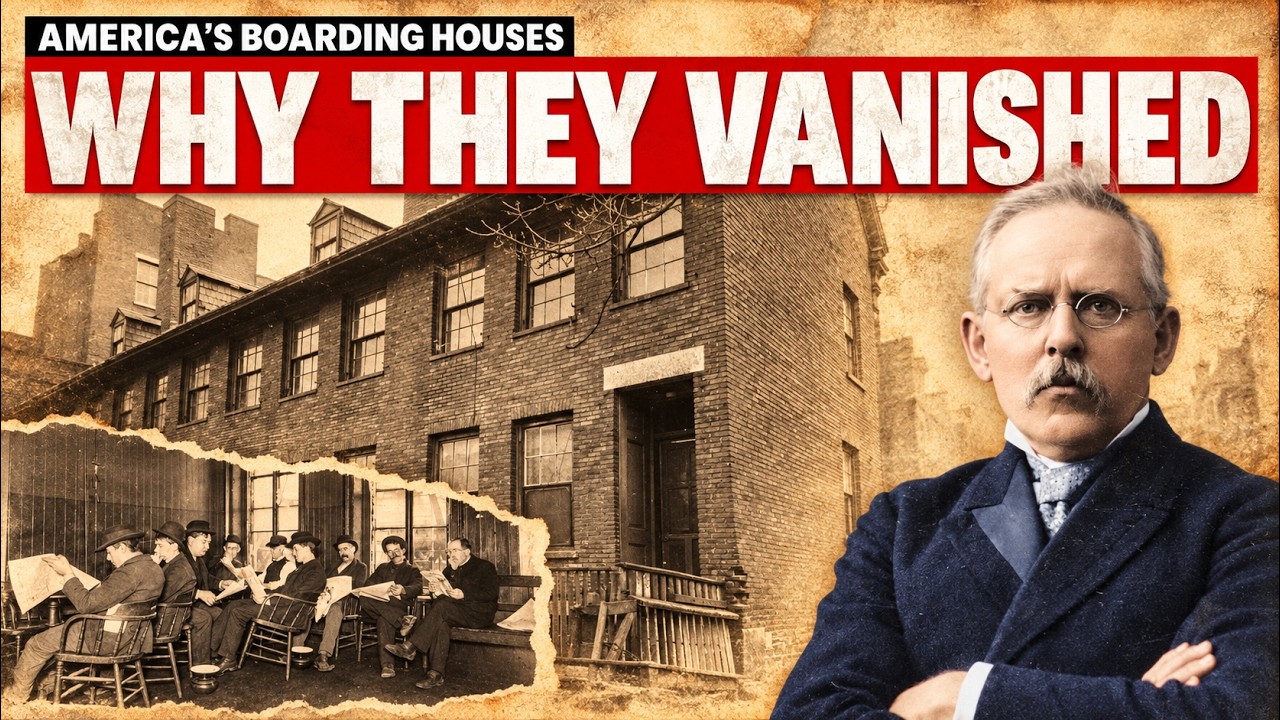
The ideal, laid out in the writings of Lawrence Veiller, the influential New York housing reformer who essentially wrote the template for modern American zoning, was the detached single-family home occupied by a nuclear family. Everything else was suspect. Multi-family dwellings were suspect. Shared housing was suspect.
The boarding house, with its unmarried men and women living under the same roof, its women earning independent income, its communal meals, and its mixing of social classes, was reframed as a social and moral problem. One 1905 book called The Lodging House Problem in Boston set the tone, lumping boarding and rooming houses together as a grave and far-reaching social problem. Critics argued that boarding houses weakened the family, encouraged vice, bred disease, and produced the wrong kind of citizen. The language was moralistic, but the underlying anxiety was about class, immigration, race, and the growing economic independence of women.
Moral disapproval alone could not kill a form of housing that served millions. For that, the reformers needed law, and starting in the 1910s they found it in zoning. The first comprehensive American zoning code was enacted in New York City in 1916. By the mid-1920s, with the publication of the Standard State Zoning Enabling Act, drafted with Veiller’s involvement, cities across the country rushed to adopt their own zoning laws.
These laws were almost universally written to protect single-family residential districts from everything the reformers disliked, including boarding houses, lodging houses, SRO hotels, and apartment buildings. Vast swaths of American cities and nearly all of their suburbs were designated single-family only. In those zones, you could not legally build a boarding house, operate a rooming house, or even subdivide an existing large home to take in paying tenants without violating zoning. The legal infrastructure for killing boarding houses was locked into American city planning.
The second wave came from the federal government. In 1934, in the depths of the Great Depression, the Roosevelt administration created the Federal Housing Administration, the FHA, to revive the construction industry and make home ownership accessible to middle-class families. The actual effect was to pour an avalanche of federal subsidy over the next three decades into one very specific type of housing: the detached single-family home in a newly built suburb. Between 1934 and 1962, the FHA and the Veterans Administration financed more than $120 billion worth of new housing.
By 1972, the FHA had helped roughly 11 million American families purchase a home. But the FHA’s underwriting guidelines strongly preferred single-family detached houses in new suburban developments and disfavored multi-family buildings, older urban structures, and anything in a racially diverse neighborhood. The FHA’s underwriting manuals institutionalized redlining, with the result that only around two percent of that $120 billion in federally backed postwar housing went to non-white families. The federal government placed its enormous financial weight behind exactly the type of housing that zoning had already designated as the only acceptable kind, and against exactly the type of housing where boarding houses and SROs lived.
If you were a landlord in 1950, you could not easily build a boarding house because zoning forbade it, and you could not easily get a federally insured mortgage for multi-family housing. Meanwhile, the middle class was being lured out of the city by developments like Levittown, where a new three-bedroom house with a yard could be bought for a down payment of a few hundred dollars. The third wave hit in the mid-1950s, when policy makers turned their attention to what remained of urban boarding houses and SROs and decided to finish them off. In 1954, New York City’s housing maintenance code was amended to effectively prohibit any new privately built SRO construction.
The following year, the city formally banned the creation of new SRO units and launched a tax abatement program that created direct financial incentives for landlords to convert existing SRO buildings into market-rate commercial hotels or office space. The city was paying owners to get rid of their low-income tenants. By the time the city tried to stop the process in the mid-1980s, more than 100,000 SRO units had been lost in New York alone. Since 1955, roughly 175,000 have been eliminated in the city.
Chicago lost more than 23,000 SRO units between 1973 and 1984. Minneapolis bulldozed its entire Gateway District, the city’s main SRO neighborhood, in the nation’s first federally funded urban renewal project. Boston’s SRO stock dropped from 35,000 units in the early 1950s to just 9,500 by 1968. These urban renewal programs, backed by billions in federal dollars through the Housing Act of 1949, explicitly targeted the neighborhoods where SROs and cheap lodging houses were concentrated.
The buildings were condemned, the residents scattered, and the land handed to private developers for convention centers, luxury hotels, and office towers. The people who lived there lost the cheap diners, the informal labor markets, and the small ecosystem of institutions that let people living on the margins hold on to some version of normal life. When urban renewal demolished these neighborhoods, it did not just destroy buildings. It erased the social infrastructure that had kept hundreds of thousands of marginal Americans housed, fed, and connected to work.
Then came the bill. In the 1980s, with the SRO stock gutted, zoning laws making it illegal to build cheap new shared housing almost anywhere, federal housing subsidies cut by the Reagan administration to roughly a tenth of their late 1970s level, and psychiatric hospitals releasing thousands of mentally ill Americans into communities with nothing left to catch them, modern mass homelessness erupted onto American streets. According to the social scientist Christopher Jencks, the homeless population grew from a little over 100,000 in 1980 to around 400,000 by 1987 and 1988. In the 1970s, there had actually been more rooms in flop houses than people who needed them.
By the early 1980s, the demand for cheap single rooms exceeded the shrunken supply, and the people who could not get in ended up on the sidewalks. Dennis Culhane, a professor of social policy at the University of Pennsylvania, has pointed directly at this chain of causation, noting that many people attribute the growth of street homelessness in the eighties to the loss of the SRO stock that began in the sixties. The forces that destroyed the boarding house did not stop in 1990. They are still shaping American cities.
Most of the land in most American cities is still legally restricted to single-family housing, with more than 70 percent of residential land in many metropolitan areas zoned exclusively for detached homes. Building anything denser, cheaper, or more communal is illegal across the vast majority of residentially zoned terrain. The lowest rungs of the housing ladder were removed by law. Suburban homeowners won because restricted supply protected the value of their houses.
Developers of high-end housing won because prime downtown land was handed to them through urban renewal. Banks and mortgage insurers won because the federal subsidy pipeline for suburban home loans turned real estate into one of the most profitable sectors of the economy. Who lost? Single working people lost their most affordable housing option.
Immigrants lost the dignified entry point that had let generations of newcomers establish themselves. Women lost one of the few paths to independent urban income. The elderly lost the ability to live independently in cities as they aged. The mentally ill lost the loose network of SROs that had absorbed them when state hospitals closed.
And hundreds of thousands of people lost housing of any kind and ended up on the streets where they remain. A slow reckoning is now underway. In 2024, the state of Washington passed a law requiring cities and counties to permit single-room occupancy or co-living housing in areas zoned for multi-family use. Philadelphia has pushed to legalize single-room residences across the city.
Boston is studying whether a return of SROs could help address its own housing crunch. A nonprofit in Los Angeles has created dwellings for more than 2,000 formerly homeless people in what used to be condemned residential hotels. But reversing a century of policy is slow and politically brutal. Every attempt to legalize cheap shared housing runs into fierce opposition from existing homeowners who use the same language the Progressive reformers used in the 1890s, that these are the wrong kind of residents, that property values will fall, that the character of the neighborhood will change.
The fingerprints of Lawrence Veiller are still visible on every planning commission meeting where a modest proposal to legalize a few duplexes or a small boarding house gets voted down. The infrastructure of exclusion is still in place. The ladder is still broken. The vanished boarding houses of nineteenth-century America are not just a lost chapter of history.
They are a reminder that there was once a working model for cheap urban living, that it served millions of people for over a hundred years, and that it was destroyed on purpose. The question of whether something like it can be built again is now one of the most consequential questions facing American cities.
