The story of the American middle class begins in the summer of 1945, when the United States emerged from World War II in a position no nation had ever occupied before or since. America held roughly half of the world’s economic output with only about five percent of its population. Every other industrial power—Britain, France, Germany, Japan, the Soviet Union—was bombed into rubble or financially exhausted. American factories, cities, and infrastructure were intact.
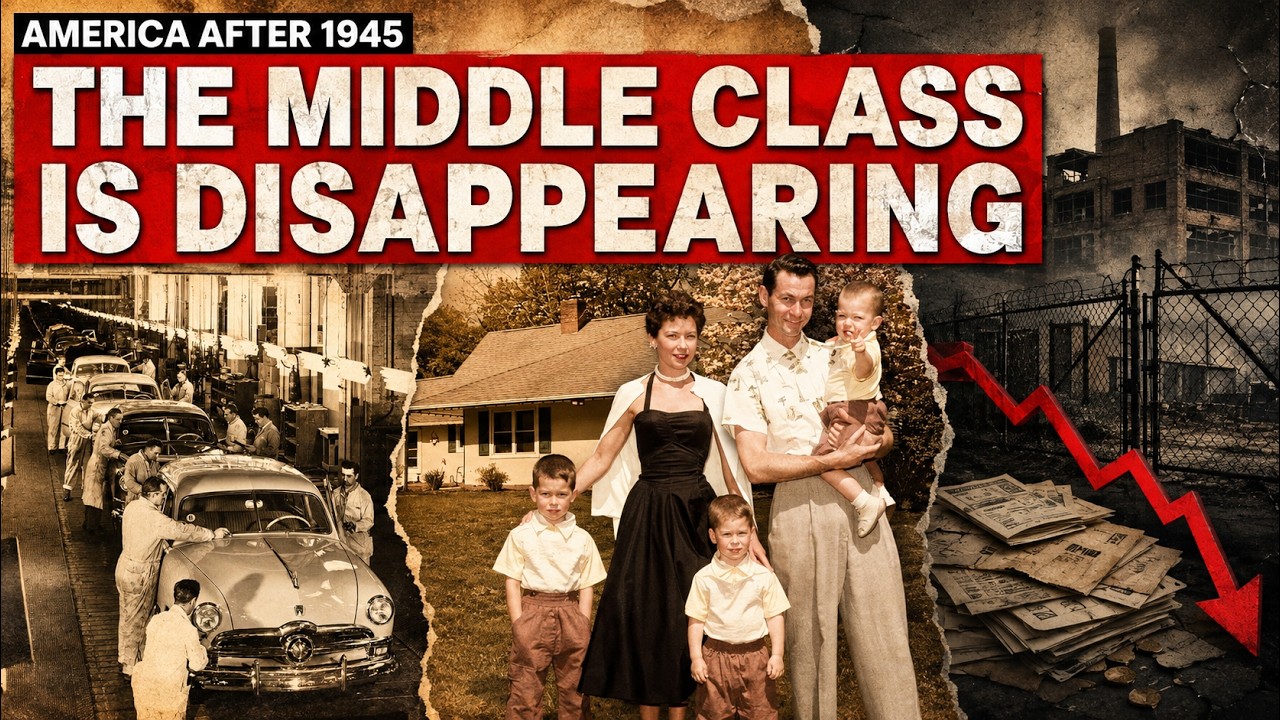
Not a single bomb had fallen on the continental United States. But it wasn’t just that America was untouched. It had been transformed. Before the war, the country was still recovering from the Great Depression, with unemployment near twenty-five percent and bread lines stretching around city blocks.
The New Deal had helped but hadn’t cured the underlying sickness. What cured it was the war economy. Between 1941 and 1945, the federal government effectively took command of American industry. Automobile factories built tanks and aircraft.
Textile mills turned out uniforms. Unemployment vanished. Wages rose because labor was in high demand, and because consumer goods were rationed, workers saved enormous amounts of money. By the war’s end, American households sat on a mountain of pent-up demand backed by real savings.
Then the government made a decision that would define the next half century of American life. On June 22, 1944, President Franklin Roosevelt signed the Servicemen’s Readjustment Act, known as the GI Bill. It was one of the most transformative pieces of legislation in modern history. It paid for college, and roughly eight million returning veterans took advantage of the education benefits.
Universities that had been small and exclusive were suddenly flooded with students; the University of Syracuse tripled its enrollment almost overnight. Higher education, once the province of the wealthy, became a middle-class expectation within a single generation. The bill also offered low-interest home loans, which, combined with Federal Housing Administration mortgage insurance, made home ownership possible for millions of families who had never dreamed of it. Developers like William Levitt pioneered mass production techniques for housing, building entire neighborhoods of modest, affordable homes at record speed.
These Levittowns became the blueprint for the American suburb. The bill also provided unemployment insurance and small business startup capital, though less than twenty percent of the money set aside was ever distributed—jobs were so plentiful that most veterans didn’t need it. The result was an economic explosion. New car sales quadrupled between 1945 and 1955.
By the end of the 1950s, roughly seventy-five percent of American households owned at least one car. In 1965, the automobile industry hit its peak, producing over eleven million vehicles and accounting for one out of every six jobs in the country. The Federal Aid Highway Act of 1956 authorized over 41,000 miles of interstate highways. The baby boom amplified everything.
From 1946 to 1964, the birth rate effectively doubled, and more babies meant more houses, more schools, more consumer goods. The economy didn’t just grow—it compounded. And the growth wasn’t just happening at the top. Between 1945 and 1973, real wages for ordinary workers rose in lockstep with productivity.
Median family income roughly doubled in inflation-adjusted terms. A single factory worker could support a family of four, own a home, take vacations, and save for retirement. That wasn’t a fantasy; it was the statistical norm. Unions were a massive part of why this worked.
At their peak in the mid-1950s, about 33. 5 percent of the American workforce was unionized. Unions didn’t just negotiate for their own members—they set wage standards across entire industries. When General Motors agreed to a contract with the United Auto Workers, non-union companies had to raise wages or risk losing their best workers.
The 1940s were what economists Claudia Goldin and Robert Margo called a decade of extraordinary wage compression. The gap between the highest-paid and lowest-paid workers shrank dramatically. The tax code reinforced this. During the 1950s, under President Dwight Eisenhower, the top marginal income tax rate sat at 91 percent.
Almost nobody paid that rate on all their income, but it put an effective ceiling on how much wealth any individual could accumulate in a year. The incentive structure pushed corporate profits back into the business, into wages, into expansion, into research and development, rather than into the pockets of executives and shareholders. But this golden age was not permanent, and the cracks were already forming. The first crack was exclusion.
The GI Bill was administered largely through state and local agencies, and in the South, black veterans were systematically denied the same benefits white veterans received. They were steered away from four-year universities and into vocational programs. Redlining—where the FHA literally drew red lines on maps around black communities and labeled them too risky for mortgage insurance—denied them home loans in white neighborhoods. The suburbs built by the GI Bill and FHA loans were, by design, overwhelmingly white.
Levittown explicitly barred black families through restrictive covenants in its property deeds. Because home equity was the primary vehicle through which middle-class families accumulated wealth, this exclusion had compounding effects across generations. The second crack was structural. America’s manufacturing dominance was partly a function of the fact that every other industrial nation had been bombed flat.
As Europe and Japan rebuilt, often with American aid through the Marshall Plan, they became competitors again. By the late 1960s, German and Japanese manufacturers were producing autos, steel, and electronics that rivaled or exceeded American quality at lower cost. The American share of global manufacturing began to shrink. The third crack was ideological.
By the late 1960s and early 1970s, a new economic philosophy was gaining traction. It held that the postwar consensus—high taxes, strong unions, heavy regulation, government spending—was holding the economy back. The real engine of growth, it argued, wasn’t shared prosperity but individual entrepreneurship, unfettered markets, and capital accumulation at the top. This philosophy would soon be called supply-side economics.
On August 15, 1971, President Richard Nixon went on live television and announced what he called the new economic policy. He suspended the convertibility of the United States dollar into gold. This was the Nixon shock. Since the end of World War II, the international monetary system had operated under the Bretton Woods agreement, with currencies fixed to the dollar and the dollar fixed to gold at thirty-five dollars per ounce.
That system imposed discipline. But by the late 1960s, the cost of the Vietnam War and Lyndon Johnson’s Great Society programs had created massive budget deficits. The Federal Reserve created more dollars to finance the gap, and foreign governments began to worry there wasn’t enough gold to back them. France, under Charles de Gaulle, started converting its dollar reserves into gold and shipping it home.
Gold was flowing out of the United States at an alarming rate. Nixon’s advisers, including Treasury Secretary John Connally and a young Paul Volcker, convinced him the only way to stop the hemorrhaging was to break the link entirely. In a single address, Nixon ended the monetary system that had underpinned the postwar order. Without the gold anchor, the dollar floated freely and began losing purchasing power more rapidly.
Inflation climbed, made worse by the OPEC oil embargo of 1973, which quadrupled the price of petroleum virtually overnight. The economy entered a nightmare condition economists hadn’t believed possible: stagflation—high inflation, high unemployment, and stagnant growth all at once. Wages couldn’t keep up with rising prices. Savings lost value.
Interest rates climbed into double digits. This is also the moment when productivity and wages diverged. From 1945 to roughly 1973, they rose together in parallel. After 1973, productivity kept climbing—soaring by about 81 percent between 1979 and 2024—but hourly pay for typical workers grew by only 29.
4 percent over that same period. The enormous surplus of value that workers created but didn’t receive flowed upward, to corporate profits, executive compensation, shareholders, and the financial sector. The first and most consequential decision driving that divergence was the deliberate destruction of organized labor. When Ronald Reagan entered the White House in January 1981, approximately twenty percent of private sector workers were unionized.
By the time he left office in 1989, that number had fallen to twelve percent. Today it sits near six percent. Reagan set the tone in August 1981, when the professional air traffic controllers organization went on strike. He didn’t negotiate.
He fired all 11,000 plus striking workers. The symbolism was unmistakable, and corporate America took notice. Over the next decade, employers became far more aggressive in opposing unionization efforts, hiring anti-union consultants, threatening plant closures, and permanently replacing strikers. The decline of unions removed the countervailing force that had kept wages rising for everyone.
Simultaneously, Reagan overhauled the tax code. The Economic Recovery Act of 1981 slashed the top marginal income tax rate from 70 percent to 50 percent, and a 1986 reform dropped it further to 28 percent. Capital gains taxes were cut, corporate taxes were reduced. The theory, championed by economist Arthur Laffer, was that cutting taxes at the top would stimulate enough investment and growth that benefits would trickle down to ordinary workers.
The economy did grow during the 1980s—about twenty million jobs were created over the decade—but the benefits concentrated overwhelmingly at the top. Deregulation opened the floodgates in financial markets, driving a boom in Wall Street profits while planting the seeds of the savings and loan crisis, which ultimately cost taxpayers roughly 130 billion dollars. Then came globalization. In the 1990s, under President Bill Clinton, the United States embraced free trade with unprecedented enthusiasm.
NAFTA went into effect in 1994. In 2000, Congress granted China permanent normal trade relations, paving the way for China’s entry into the World Trade Organization. Between the late 1990s and early 2000s, an estimated 2. 4 million American jobs were lost to Chinese competition alone, according to research by economists David Autor, David Dorn, and Gordon Hanson.
The manufacturing sector was gutted. In 1950, roughly a third of American workers were employed in manufacturing; by 2019, that number had fallen to about eight percent. The replacement jobs were overwhelmingly in the service sector—retail, hospitality, food service, healthcare—jobs that paid less, offered fewer benefits, and were far less likely to be unionized. Factory towns across the Midwest and South were hollowed out.
As factories closed, tax revenues fell, schools deteriorated, infrastructure crumbled, drug addiction surged, and life expectancy in some communities actually began to decline—a phenomenon economists Anne Case and Angus Deaton documented as deaths of despair. Then came 2008. In the years leading up to the crash, banks had issued mortgages to borrowers with little ability to repay them, so-called subprime loans. These mortgages were packaged into complex securities and sold to investors worldwide.
Rating agencies stamped these toxic products with AAA ratings. When the housing bubble burst, home values fell roughly thirty percent in real terms. Over six trillion dollars in accumulated housing wealth was erased. Twelve million homeowners found themselves underwater.
American household net worth fell from 67. 4 trillion dollars in the third quarter of 2007 to 51. 4 trillion by early 2009—a full decade of wealth accumulation wiped out in eighteen months. The federal government stepped in with massive bailouts for the financial sector, including the 700 billion dollar Troubled Asset Relief Program and trillions in Federal Reserve support through quantitative easing.
The banks were saved. The stock market recovered. But for the twelve million families underwater on their mortgages, no comparable bailout ever materialized. Housing makes up roughly two-thirds of middle-class wealth but a much smaller share for the richest Americans, whose portfolios are dominated by stocks.
The recovery flowed disproportionately to those who held financial assets. The 2008 crisis accelerated every negative trend—wealth inequality widened, home ownership rates fell, student debt exploded to over 1. 7 trillion dollars, and median home prices soared far beyond what median incomes could support. Consider the full picture.
In 1971, 61 percent of American adults lived in middle-income households. By 2021, that figure had fallen to around 50 percent. The costs of the three things that defined middle-class security—housing, healthcare, and education—have all risen far faster than incomes. Real wages for the median worker have barely budged in half a century.
Between 1979 and 2023, real earnings for the top 0. 1 percent grew by 354 percent; for the bottom 90 percent, by just 44 percent. The share of total income flowing to the combined upper middle class and wealthy surged from 28 percent in 1979 to 68 percent by 2024. Middle-class families have turned to debt to maintain a standard of living their wages can no longer support, leaving them enormously fragile.
The golden age was built by a specific set of conditions and policies: massive public investment, strong labor protections, a tax code that constrained inequality, a regulatory framework that prevented financial speculation from destabilizing the real economy, and a global environment in which America had no serious industrial competitors. Over the past fifty years, every single one of those conditions has been weakened, reversed, or eliminated. None of this was inevitable. None of it was ordained by the laws of economics or the march of technology.
These were choices, made by elected officials, corporate executives, lobbyists, and voters. The golden age wasn’t a gift from the universe. It was built.
The question now is whether anything like it can be built again.
