On the morning of Monday, October 19, 1891, a cattleman named H. Brule rode up the creek road to the Fenward homestead in the Ozark hollow of Ash Creek, Missouri, about forty miles south of Springfield. He had arranged to meet his neighbor Otis Fenward to discuss splitting the cost of a new fence line. When he arrived around eight o’clock, he found the front door slightly ajar.
The mule was still in the paddock. The chickens were loose in the yard. A pot of coffee sat cold on the stove, a ring of mold already forming on its surface. Brule called out.
No one answered. He walked through the house and found every room intact. Beds were made. Clothes hung on their hooks.
Dorinda Fenward’s apron was draped over the back of a kitchen chair as if she had just taken it off. Pearl’s boots sat by the back door, cleaned and oiled. There was no sign of struggle, no broken furniture, no blood. Nothing was out of place except the silence itself, which Brule later described as so complete it made his ears ring.
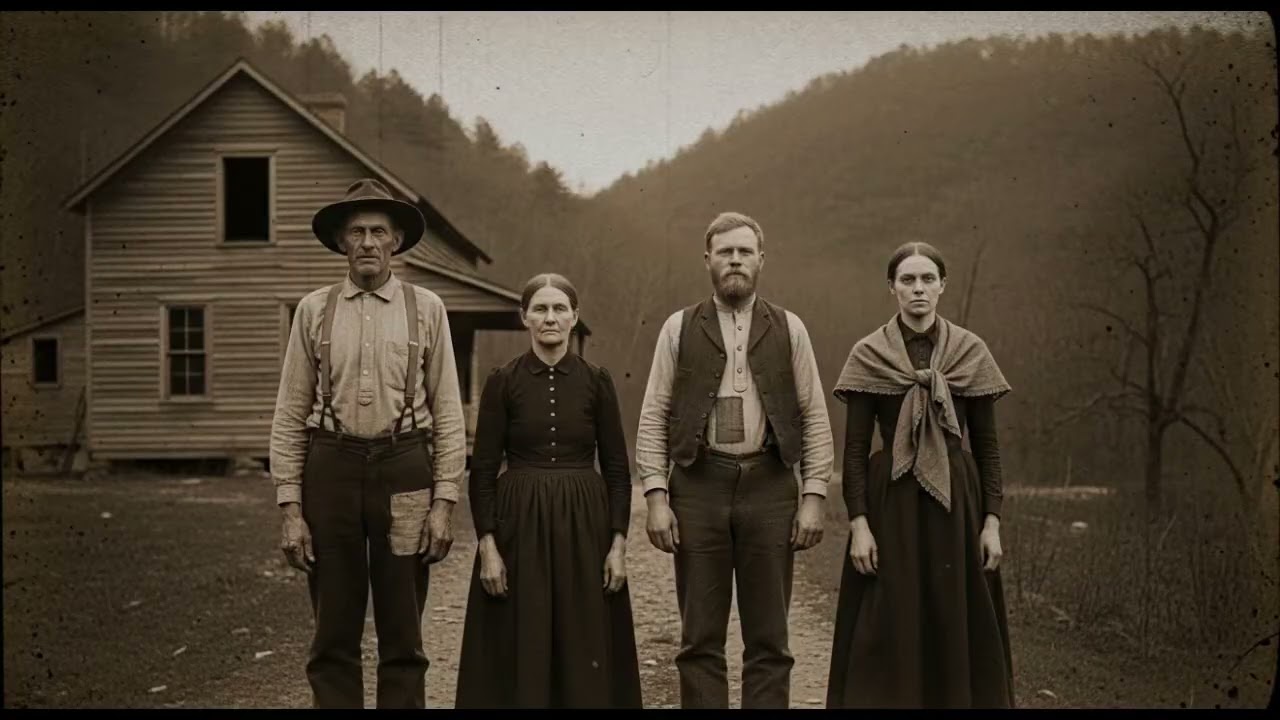
Four people had lived in that house on the morning of Saturday, October 17: Otis Fenward, forty-seven, a tall, narrow-shouldered farmer who had lived on the property for over twenty years; his wife Dorinda, forty-three, who managed the garden, livestock, preserves, and finances; Otis’s younger brother Pearl, thirty-nine, who had come to live with them after a logging accident in 1886 crushed his right hand and left him unable to swing an axe; and a twenty-six-year-old woman named Zella Cray, who had arrived in the spring of 1890 claiming to be Dorinda’s distant cousin from somewhere near the Kentucky border. She rarely spoke, never attended church, and was often seen walking alone along the creek at odd hours. By Monday morning, all four of them were gone. They had packed nothing and taken nothing.
It was as if they had simply ceased to exist in the middle of a normal day. By Tuesday, a small group of men from the hollow organized a search. They walked the woods behind the homestead in a loose line, checking creek banks, old logging trails, and the caves that pockmarked the ridge line. They found nothing.
Not a footprint, not a scrap of cloth, not a single sign that anyone had walked into those woods at all. While the search was underway, the store owner, a man named Griff Almond, returned to the house alone. Something about the kitchen had been bothering him since Brule first described it. He found his answer on the kitchen table.
Beneath the salt dish, folded once, was a piece of brown paper torn from a feed sack. It was in Dorinda’s handwriting, which Almond recognized because she used to write inventory lists for his store. The note contained one sentence: “We should have listened to her. ” No signature.
No date. Almond put the note in his coat pocket and did not show it to anyone for three days. The question of who “her” referred to split the community apart. Some believed it meant Zella, pointing to her strangeness, her midnight walks, and the fact that no one could confirm her claim of kinship.
A neighbor named Opelene Strawther said she had seen Zella standing motionless in the garden one evening in August, staring at the tree line for twenty minutes without moving. When Opelene looked again minutes later, Zella was gone, as if she had never been there. Others believed the note referred to someone else entirely. An older woman named Hanalore Vetch, who had lived in the hollow longer than anyone, said the Fenward land had a history.
Decades before Otis’s grandfather first cleared the property, she claimed, a woman had lived alone in the woods above the ridge. No one knew her name. The few people who encountered her said she warned them not to build in the hollow. She said the ground there was not right, that something underneath it was sleeping, and that the sound of hammers and saws and human voices would eventually wake it up.
The search continued for over a week. Men came from as far as twenty miles away, bringing dogs. The dogs picked up a scent at the back door and followed it about two hundred yards into the woods before stopping. Every single dog stopped at the same place: a circular clearing roughly thirty feet across where the ground was bare, dark, and packed.
The dogs refused to enter it. One large hound sat down at the edge and began to howl in a way its owner said he had never heard before. The men examined the clearing and found no tracks, no drag marks, no sign of digging. But several of them noticed the dirt was warm, noticeably warmer than the ground around it, as if something beneath the surface was generating a faint, constant heat.
A former soldier named Aldus Pemrook knelt and pressed his palm flat against the earth. He held it there for about ten seconds before pulling away. He said it felt like pressing your hand against the side of a sleeping animal, not just warm, but alive, with a slow, deep rhythm like breathing. The men argued about whether to dig.
In the end, they decided to come back the next day with more men and proper tools. But when they returned the following morning, the clearing had changed. It was smaller by five or six feet, and the bare earth was now covered with a thin layer of fine gray-white ash. There were no scorch marks on the surrounding trees.
No smell of smoke. The warmth was gone. The ground was cold, colder than it should have been for mid-October. Aldus knelt again and touched the earth.
He pulled his hand away immediately. He said it felt like touching a stone that had been sitting in a river all winter, as if the ground was pulling the warmth out of his hand. They did not dig that day either. By the end of October, the official search was called off.
The county sheriff spent two days asking questions and filed a report classifying the disappearance as unexplained. He noted the absence of evidence of foul play. He noted the discovery of the note but concluded it was too vague to be useful. He mentioned the clearing in the woods but described it only as an area of unusual soil conditions, probably caused by a natural mineral deposit.
He did not mention the warmth, the ash, or the dogs. The homestead sat empty through the winter. No one in the hollow wanted to go near it. Brule, whose property bordered the Fenward land, began hearing sounds at night: a low, steady humming from the direction of the ridge behind the house, like a telegraph wire in a strong wind, though there were no telegraph wires within fifteen miles.
On the nights the sound was there, his cattle would not sleep. They would stand pressed together in the far corner of the pasture, facing away from the ridge, until dawn. In February of 1892, Opelene Strawther reported seeing a light in the upstairs window of the Fenward house just after midnight. Not a lamp or candle, something steadier, pale, almost white, illuminating the window frame from within as if the entire room were filled with it.
She watched it dim gradually, like something closing its eye. She told Griff Almond about it the next morning. He told her she had probably seen moonlight reflecting off the glass. Opelene looked at him and said the moon had not been out that night.
In March, Hanalore Vetch died at age eighty-one. In her final days, she told her daughter-in-law that she had been dreaming about the Fenward house every night since the disappearance. In the dream, she stood in the kitchen looking at the table, and the note beneath the salt dish said something different. Instead of “We should have listened to her,” it said she was right about what lives underneath.
She said there was always someone standing behind her in the dream, a little closer each night, and its breath on her neck was cold, like air rising from a well. When her daughter-in-law found her dead in bed on the fourteenth, the room was freezing. Every other room in the house was warm. Over the next several years, people who went near the property began experiencing things: a feeling of being followed, sounds like whispering on the wind, the smell of ash where nothing had burned.
Brule began sleepwalking in the summer of 1892. His wife would find him standing in the yard at two or three in the morning, facing the ridge, completely still. His feet would be dirty, and the dirt was always that same dark, fine-grained soil from the clearing in the woods. She begged him to sell the property and leave.
He refused, saying he was not going to be driven off his land by stories and bad dreams. Then, one night in September, his wife woke to find him in the yard again. This time, he was not alone. There was a figure standing next to him, tall and thin, darker than the shadows around it, leaning toward him the way you might lean to whisper in someone’s ear.
She screamed. Brule woke. The figure was gone. They were packed and gone from Ash Creek within a week.
The stories might have ended there, but they did not. In 1908, Brule’s wife wrote a letter to the county historical society describing what she had witnessed. The letter was filed and forgotten until 1937, when a graduate student named Clement Willow found it while researching abandoned settlements in the Ozarks. He was writing his thesis on depopulation patterns in rural Missouri and had no interest in ghost stories.
But the practical details caught his attention: the timeline, the pattern. What Willow found was that the Fenward disappearance was not the first strange event associated with that piece of land. The property had changed hands at least seven times since it was first settled in 1832, and every transfer had been preceded by some unexplained event. In 1841, the original homesteader, Otis’s grandfather, abandoned the property suddenly and moved sixty miles north.
No reason was recorded. In 1853, a family named Hullgrave lived there for less than two years before leaving; a neighbor’s account mentioned they had become afraid of their own cellar, saying sounds came from it at night, a steady rhythmic tapping like something knocking on the underside of the floor. In 1867, a man named Burl Ashton lasted only one season, telling people the soil was too rich, that things grew too fast and too wrong. He planted corn, and the stalks grew seven feet tall in three weeks, then turned black overnight as if poisoned from the roots up.
The Fenward family reclaimed the land in 1870. Otis’s father lived there for twenty years without incident, at least none he reported. When he died in 1889, Otis inherited the property. Two years later, everyone in the house was gone.
Willow compiled his findings into a chapter of his thesis. His adviser told him to remove it, calling it anecdotal and unprovable. Willow removed the chapter but kept his notes for the rest of his life. When he died in 1971, his personal papers went to the university library, where they sat in a box in the archive for decades.
There is one final event in the story of Ash Creek. In the spring of 1893, a traveling preacher named Reverend Morse Gillespie came through the hollow. He had been visiting the community for over a decade, and when he heard about the disappearance, he insisted on visiting the homestead himself. Griff Almond tried to talk him out of it, but Gillespie was not the kind of man who could be talked out of anything.
He rode up the creek road on a Tuesday afternoon in May and went inside the house. A year and a half of dust covered everything. The coffee pot was still on the stove. The apron was still on the chair.
Pearl’s boots were still by the back door. Gillespie walked through every room, and he said the house felt wrong, but not in the way he expected. It felt expectant, like a room set for dinner waiting for the guests to arrive. As the afternoon light began to shift, the silence in the house thickened, and something changed in the quality of the air.
He looked at the window, and the light was wrong, too amber, too heavy. The shadows on the floor pointed in the wrong direction. He walked to the back door and looked out toward the ridge. At the tree line, about a hundred yards from the house, he saw a figure: tall, thin, dark, not a shadow but not entirely solid either.
It raised one arm slowly and pointed down at the ground. At its feet, the earth was bare, dark, warm-looking even from a distance. A circle of bare earth at the edge of the trees, smaller than the one the search party had found, but unmistakable. When Gillespie looked back up, the figure was gone.
He rode back to the store and told Almond what he had seen. Almond listened without expression, then reached into the drawer behind the counter and pulled out the folded piece of brown paper. Gillespie read it: “We should have listened to her. ” Then Almond said something Gillespie carried with him for the rest of his life.
He said he had heard that woman in the woods twice: once when he was young and too foolish to listen, and once more the night before the Fenwards disappeared. She was standing at the edge of the road in the dark, and she said three words: “It is waking. ” Gillespie asked what was waking. Almond said he did not know, and he did not want to know.
He said there are old things in these hills that do not have names and do not need them, things that sleep in ways that are not like our sleep. And when they stir, the world above them changes, just enough that people begin to feel it without knowing what they are feeling. Sometimes, Almond said, those things reach. Gillespie asked if he believed that was what happened to the Fenwards.
Almond did not answer directly. He said, “I believe those four people are still on that property. I believe they never left. I just do not believe they are still in a place we can reach.
”
That was the last meaningful conversation anyone in Ash Creek ever had about the Fenward disappearance. Within five years, the hollow was nearly empty. By 1900, only three households remained. By 1910, one.
By 1915, Ash Creek was a ghost town. The road washed out, the buildings rotted, the forest crept back in from the edges. But the Fenward house did not rot. Willow, the graduate student, visited the site in 1938 and found every other building in collapse.
The Fenward house was intact, as if the forces that decompose wood and stone had simply decided to leave it alone. He did not go inside. He wrote in the margin of his notebook, in handwriting so small it was almost illegible: “Did not enter. Could not explain why.
Felt as though entering would constitute an agreement to something I did not understand. ” In 1962, a county surveyor mapping the area for a proposed timber road found the house still standing and still intact. He noted a circular area of bare earth behind it, about fifteen feet in diameter, where nothing grew. A soil sample tested as unusually rich in organic material but contained no seeds, no roots, and no microbial activity.
The report described it as “sterile and vital simultaneously. ” No one knew what to make of that. The report was filed and forgotten. The last known visit to the property was in 1978, when two hikers wandering off trail in the Mark Twain National Forest stumbled onto the homestead by accident.
They said the house was still standing, the door open, a pot on the stove, boots by the back door. The air inside smelled like fresh ash, as if something had been burning minutes before they arrived. And while they stood in the kitchen, they heard a sound from beneath the floor: a low, rhythmic tapping, steady and deliberate, like a heartbeat, or like someone knocking from underneath. They left and did not go back.
Nobody has. No explanation for the Fenward disappearance has ever been given. No bodies were recovered. No suspect was named.
The county sealed the case file in 1903, and it has never been reopened. The land is still there, and whatever happened in that hollow in the autumn of 1891 remains unexplained. Otis Fenward built a life on top of something that had been sleeping for longer than anyone can measure, and one October weekend, whatever was sleeping beneath that dark, warm earth opened its eyes and reached up, and took them somewhere that has no name.
