December 9th, 1864. Fort Sully, Dakota Territory. The Missouri River sits frozen against its banks, and the wind slices through the stockade walls as if it has no plans to let up. In through the front gate come eight to twelve Sihasapa chiefs, and in their midst a white woman — gaunt, her skin burned beyond recognition, wearing the tattered remnants of Sioux clothing.
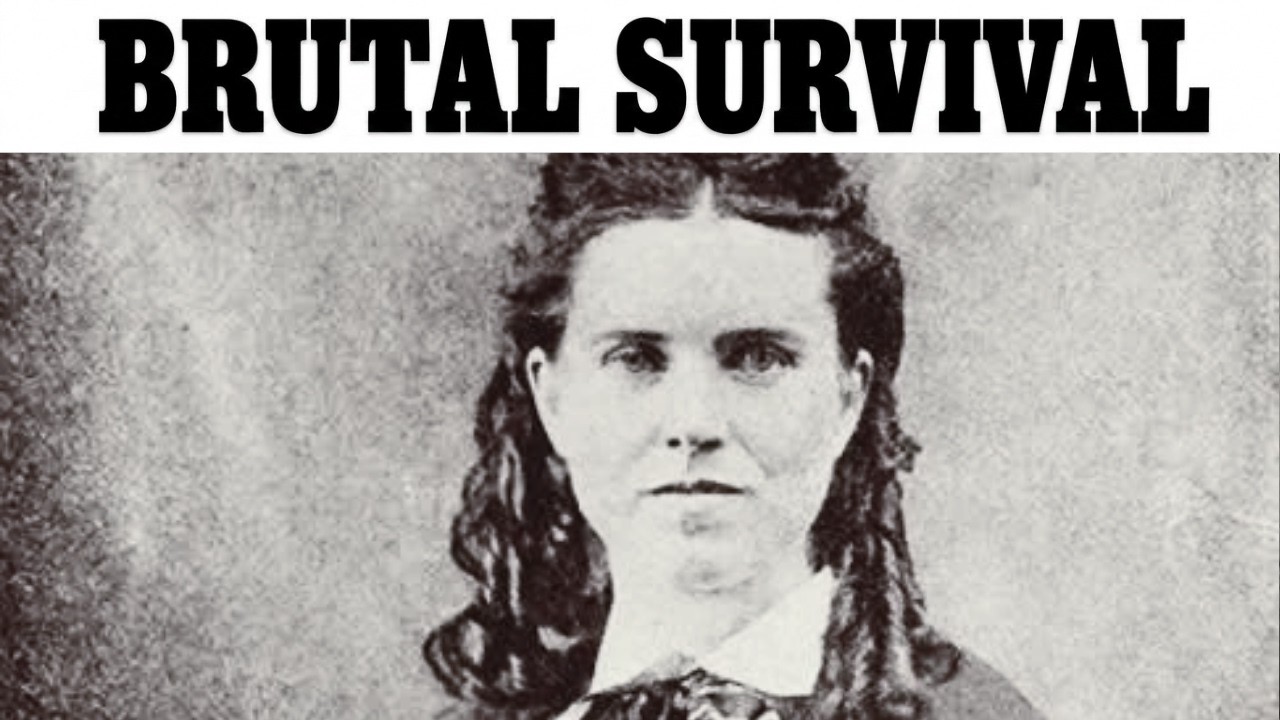
She has gone five months without speaking English to a friendly ear. The commanding officer refuses to accept that she is who she claims to be. She must prove her own identity. Behind the small group, the gates swing shut.
The soldiers who shut them did it deliberately. They had been told this was no peace offering. It was a trap. The woman walking among those chiefs is the reason the trap failed.
She wrote the letter that spared the garrison. But the girl she was carrying when the raid began five months before did not come through those gates with her. The girl did not last the first night. The woman who entered Fort Sully that winter was born Fanny Wiggins in 1845 in Orillia, Ontario, Canada.
Her parents, James and Margaret Wiggins, had little money. They were Irish immigrants in a colony that promised land and little else. When Fanny was eleven, the family gathered everything they owned and set off south into the United States, bound for the new settlement of Geneva, Kansas. They did not all arrive.
James Wiggins died of cholera along the trail. The family buried him somewhere on the way and pressed on. Margaret Wiggins settled her children in Geneva with no husband and no plan beyond getting through each day. That was where it began.
A fatherless girl in a Kansas settlement that hardly had a name yet. In 1863, Fanny married Josiah S. Kelly, a farmer and discharged Union soldier at least fifteen years her senior. She was eighteen at most.
Josiah was restless and his health was giving out. He wanted drier air, better ground, a fresh start in the gold country to the west. The destination was Idaho Territory, perhaps Montana. The route was the Oregon Trail, straight across the northern plains.
With them would travel Fanny’s young niece, a girl named Mary Hurley, about seven years old. Fanny had taken Mary in and raised her as her own daughter. Mary called her mother. They also brought two Black servants named Franklin and Andy, a neighbor named Gardner Wakefield, and a Methodist minister named Mr.
Sharp, who joined them along the way. A few weeks in, William and Sarah Larimer and their eight-year-old son Frank left a larger wagon train to travel with the Kellys. Noah Daniel Taylor came along to drive the Larimers’ wagon. It was a small party.
Too small for the road they had chosen. The warnings came early, and they came from people who knew. Military personnel at the outposts along the trail told them that small parties were being attacked. The northern plains in 1864 were not contested territory.
They were a war zone. Two years earlier, the Dakota uprising in Minnesota had killed hundreds of white settlers and set off a chain of military reprisals that swept across the entire Sioux nation. By the summer of 1864, Brigadier General Alfred Sully was leading punitive expeditions through Dakota Territory — burning Sioux villages, destroying winter food stores, killing men and women who had no part in the Minnesota fighting. The Sioux did not distinguish between soldiers and emigrants.
The government had put them all on the same road, and then made all of them targets. The Fort Laramie Treaty of 1851 had assigned the Sioux their territory. White emigrant traffic cut straight through it. The government acknowledged the right of passage, but enforced it for neither side.
The Sioux had been promised the land. The emigrants had been promised protection. Both promises were already broken before Fanny Kelly packed her first trunk. Mary Hurley was seven years old.
She had no say in any of it. She did not choose to leave Kansas. She did not choose the Oregon Trail. She was a child on a horse, following the only family she had into a place the adults around her had been warned was dangerous — and went to anyway.
Everything the story is about to do to Mary Hurley, the adults chose for her. On July 12th, 1864, the Kelly party had crossed Little Box Elder Creek in what is now Wyoming when roughly 250 warriors appeared on the bluffs ahead. They were Miniconjou, Hunkpapa, and Oglala Sioux, painted for war, and led by a chieftain named Ottawa. By Fanny’s account, the emigrants tried to placate them.
They offered provisions. They shared food. One Sioux account tells a different version. The warriors had come to see the white man’s road they had heard about.
They ate and smoked with the travelers. And then a messenger arrived with news. American soldiers had killed their relatives along the Missouri River. Some reports say the soldiers displayed the bodies.
The mood shattered in an instant. Mr. Sharp, Noah Taylor, and Franklin were killed where they stood. Gardner Wakefield was struck by three arrows but stayed alive.
Josiah Kelly, William Larimer, and Andy fled into the scrub. The women and children did not. Fanny, Sarah Larimer, young Frank Larimer, and Mary Hurley were seized and carried off. That first night, in the chaos of a forced march on horseback, Fanny made a decision.
She helped Mary slide off the horse into the darkness. The plan was simple. The child would hide on the prairie until the Sioux had passed, then follow the road back to a settlement. It was a desperate plan.
Fanny tried to follow her into the dark but was caught and beaten. She never saw Mary again. A few days later, Mary’s body was found by her uncle. She had been scalped and pierced with arrows.
She was buried near the creek where the attack began. She was seven years old, and no one recorded her last words, because there was no reason to believe she had the chance to speak them. Sarah Larimer and her son Frank escaped the following night. They reached Deer Creek Station and were reunited with William Larimer.
They returned to Kansas. Fanny did not escape. She was alone now, the only white captive among hundreds of Sioux, and no one was coming for her. The five months that followed tested everything Fanny Kelly had.
Not courage in the way people usually mean it, not defiance. Survival. She was claimed as property by the elderly Chief Ottawa, whom she described as over seventy-five years of age and partially blind. She was put to work catching pack horses, fetching water, preparing tobacco from red willow bark, sewing, carrying weapons during marches.
She was not a guest. She was a captive laborer. She was nearly killed more than once. She dropped and broke Ottawa’s ceremonial pipe.
The elderly man flew into a rage at once, and it was genuine. Fanny calmed him down by putting banknotes into his hands and telling him what they were worth. On another occasion, she accepted a gift of stockings from one of the chief’s relatives. In Sioux custom, that was an accidental insult.
Enraged, the chief slaughtered a horse belonging to his brother-in-law. The brother-in-law aimed his bow at Fanny. A young man called Jumping Bear wrested the weapon from him. Jumping Bear had shielded Fanny from the very first night.
He would go on doing so, again and again. In a world where a single gesture could mean death, he was the nearest thing she had to an ally. General Sully’s troops caught up with the village and struck. As the camp scattered into the badlands, Fanny was carried off along with the women and children.
Soldiers were visible to her. Gunfire reached her ears. Freedom lay only yards off, and it slipped past her. Sully’s men chased the band for a few days, then abandoned the pursuit.
Once the Sioux came back to their homes and tallied their dead, their fury fell on Fanny. A council gathered to determine whether she should be burned at the stake. Ottawa argued for her life. She was spared, but she now grasped that her survival was counted in days and in one old man’s readiness to keep standing up for her.
In September, a large Sioux band assaulted a wagon train under Captain James Fisk. The raid was driven off, with casualties on both sides. The Sioux compelled Fanny to write letters to Captain Fisk, dictating their demands in the hope of putting the emigrants off guard. But none of the Sioux could read English.
Fanny wrote down what they instructed her to write. Then she added words of her own. She alerted Fisk to the coming attack. She let him know she was alive and held captive.
She pleaded with him to spread the word. Fisk was in no position to ransom her, but he gave his word that he would inform the army. Fanny had converted her captors’ inability to read into a weapon. Along the road to rescue there were other betrayals too.
A Sioux warrior by the name of Porcupine reached the camp bearing a letter from Captain Marshall of the 11th Ohio Cavalry. Marshall had set out the army’s rescue efforts and sent Porcupine with a reward to help secure her release. Porcupine took in the information and did nothing. He would not carry any message back.
During her captivity, the Sioux chief Man Afraid of His Horses met with Fanny and seemed sympathetic. Josiah Kelly sent two costly sets of goods as ransom through go-betweens. Man Afraid of His Horses took the payment. Then he informed Josiah that he was unable to locate her.
He kept the ransom for himself. Rescue was dangled before Fanny from every side, and from every side it came to nothing. In time Fanny was traded from the Oglala to the Sihasapa band. Whether she was kept as a servant, as a political bargaining chip, or as something worse is a question the historical record leaves murky.
Fanny’s memoir maintains that she was never violated. Other accounts, one of them attributed to Sitting Bull himself, indicate that she was taken as a wife by a Hunkpapa warrior named Brings Plenty, who was so taken with her that he called her “real woman.” Such accounts are hard to verify and impossible to fully reconcile. What is beyond doubt is that she was not free, and she knew it.
Jumping Bear turned up once more. He came to see Fanny in the Sihasapa camp. He reminded her that he had saved her life that first night, and he told her that he wanted to be more than a friend to her. Fanny asked him to take a letter to the commanding officer at Fort Sully.
He said yes. The letter cautioned the garrison that the Sihasapa meant to use her return as a trick to get inside the fort and slaughter the soldiers within. She was staking everything on a man whose motives were not entirely unselfish. But she had no other move to make.
Jumping Bear got the letter through. Fanny never laid eyes on him again. December 9th, 1864. Fort Sully.
A line of Sihasapa warriors draws near the fort with a white woman in their midst. The gates swing open. The chiefs stride inside. And behind them, the gates swing shut.
The soldiers stand armed and waiting. They had read the letter. They knew what was planned. The attack never came, because the woman they meant to use as bait had already warned the men inside the walls.
Fanny Kelly walked free of captivity the same way she had endured it. By outthinking the people who held her, and by being luckier than she had any right to be. Two months afterward, Josiah Kelly reached Fort Sully. He confirmed what Fanny already knew.
Mary was gone. There was no body to bring home. There was no grave for her to visit. Nothing remained of the child but the memory of a seven-year-old on horseback in the darkness, sliding away across the prairie because her mother had told her to run.
Fanny and Josiah went back to Kansas. They made their home in Ellsworth. They opened a hotel. They had a child.
On July 28th, 1867, cholera took Josiah. He was the second man in Fanny’s life claimed by that disease. She was twenty-two years old, a widow, with a newborn, in a Kansas town that held out no more to her than Geneva had held out to her mother ten years earlier. Fanny relocated to Washington.
She set about writing her memoir. She completed a manuscript, and it was stolen. Sarah Larimer, the woman captured with her who had escaped on the second night, brought out her own account in 1870 drawing on material Fanny claimed had been lifted from her notes. Fanny went to court.
A court granted her $285. The woman who had endured five months of captivity now had to endure the theft of her own story. She brought out her book in 1871. *Narrative of My Captivity Among the Sioux Indians*.
It sold well. It was reprinted, pirated, and disputed. It stands as one of the most detailed captivity accounts in American frontier literature. In 1870, Fanny made the trip to Washington to petition Congress.
What she sought was compensation, not for her suffering, though she had earned that, but for her service. Her warning letter had saved the garrison at Fort Sully. Her concealed messages to Captain Fisk had tipped off the army to Sioux movements that summer. Chained to a horse in Dakota Territory, she had done more for the federal government than most officials had managed from behind a desk.
In the end Congress agreed. They granted her $5,000. $5,000 for a dead daughter, a dead husband, a stolen manuscript, five months of captivity, and the intelligence that saved a fort. She took it, because it was all they offered, and because she had no power to ask for more.
In 1880 she married William F. Gordon, a journalist. She became a government employee and a public speaker. She joined the women’s branch of the Grand Army of the Republic.
For over twenty years she made her home in Washington without fanfare. General Alfred Sully—the same officer whose harsh campaigns had helped set off the bloodshed that wiped out Fanny’s family—went on fighting in the Indian Wars. He never came to her rescue. His soldiers came within a few miles of where she was held and abandoned the chase.
He died in 1879 at Fort Vancouver, in Washington Territory. People recalled him as a capable though unexceptional officer. The Sioux held a different memory of him. Chief Ottawa, who had shielded Fanny when his own people wanted her killed, vanishes from the records after 1864.
Jumping Bear, who saved her life no fewer than twice and bore the letter that brought her captivity to an end, drops out of sight altogether. We do not know when or where he died. We do not know whether he carried the letter for Fanny’s sake, for the reward, or because he hoped she would recall what he had done for her. The record simply ends.
That was how most lives on the frontier came to an end. The question this story has been building toward is not whether Fanny Kelly was brave. She was. No one disputes that.
The question is what kind of system places a nineteen-year-old woman and a seven-year-old girl on a road it cannot protect, across territory it has already promised to another people, in the midst of a war it began. The government told the Sioux the land was theirs, then drove a road straight through it. The government told the Kellys the road was safe, then sent no escort. General Sully burned Sioux villages to punish a war that started when the government broke its own treaties.
The Sioux attacked the Kelly wagon train after word reached them that soldiers had killed their relatives. And then the very government that had created every condition for the disaster left Fanny Kelly to plead with Congress for $5,000 across a stretch of years. No one in this story acted outside the logic of the system that held them all trapped. That is the worst part.
The system did precisely what it was built to do, and it ruined everyone it touched. Fanny’s memoir became a best seller not because readers craved a horror story. They wanted confirmation that the people who endured those years had been failed by the men in charge. They already knew it.
Fanny set it down on the page. The captivity narrative ranked among the most popular literary forms in nineteenth-century America because it told a truth the government would not: that ordinary people, women above all, paid the price for policies made by men who never once set foot on the trail. The spot where the wagon train was attacked, near Little Box Elder Creek in what is now Wyoming, is marked. Mary Hurley’s grave is recorded, though the exact resting place of her remains is uncertain.
Fort Sully is gone. The original post was drowned by the building of the Oahe Dam in the 1950s. The Missouri River swallowed it. Fanny Kelly lies buried in Washington, D.
C. She died on November 15, 1904, of a cerebral hemorrhage. It was her fifty-ninth birthday. Two figures on the same horse, five months apart.
A girl slipping away into the darkness of a Wyoming prairie because her mother told her to hide. A woman walking through a fort’s gates in December because she wrote a letter no one thought her brave enough to send. One of them made it home. One of them never left that creek bed.
The gates closed behind them both.
