In the 1840s, a plow near Murphy, North Carolina, turned up a carved soapstone figure. Two bodies joined at the back, twin faces almost worn away, and eyes carved far larger than any human head. No one knows who made it. Today it sits in a county museum, eyeless and silent.
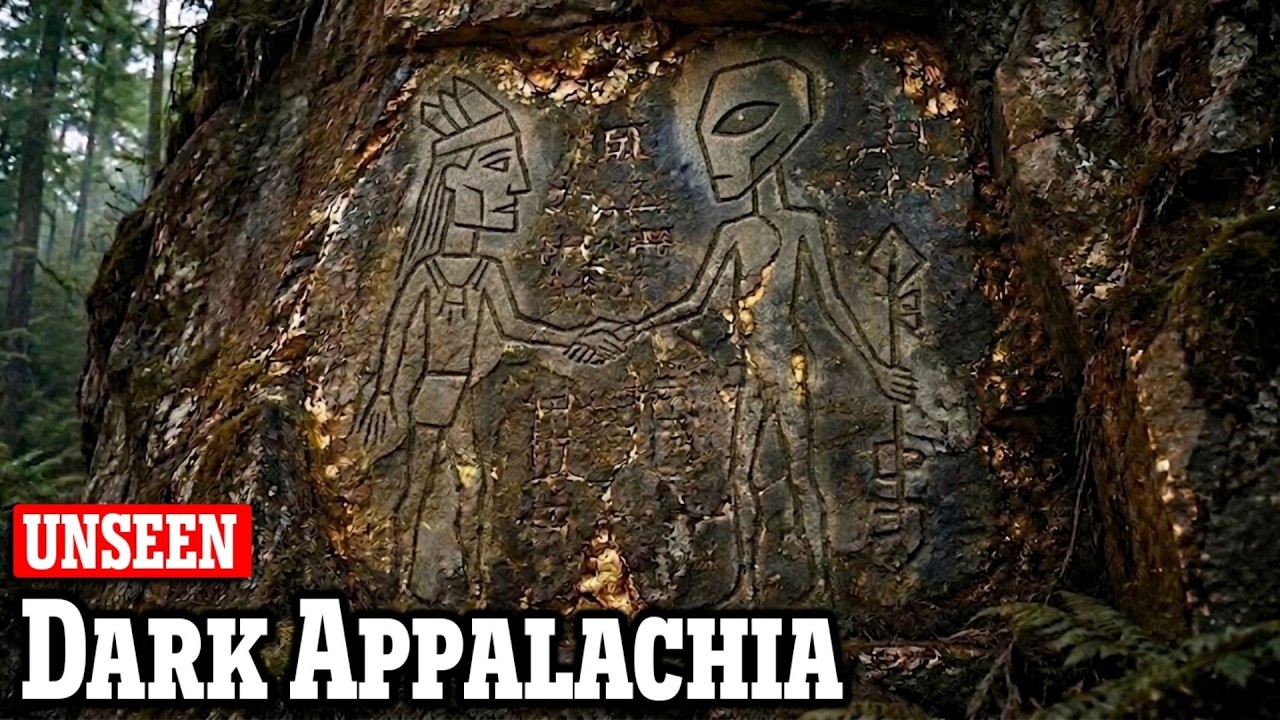
It is one of eight. Scattered across these mountains are carved stones, stacked walls, and statues left behind by people who had no writing and no name we can pronounce. Settlers called them the “Lost Race. ” Eight sets of marks.
Seven of them were never meant to be read by us at all. Track Rock Gap, in Union County, Georgia, is a notch on the eastern side of Brasstown Bald. Inside a chain-link fence sit six soapstone boulders, their surfaces covered in more than a hundred carvings. Circles, crosses, long parallel scratches, and shapes that look like animal footprints pressed into wet stone—which is how the place got its name.
The people who made them controlled this country from roughly 1000 to 1500. They farmed the bottomlands below the gap, traded for marine shell brought from the Atlantic coast, and buried their dead near their homes. Excavations in the surrounding valleys have revealed their storage pits and hearths. They stayed here for five centuries.
Then, around 1500, they left. No one recorded a battle they lost. No ash layer marks their village sites, no mass graves, no siege wall. Their settlements simply shrank and emptied out over a few generations, and the fields returned to forest.
The Cherokee, who came to hold this land later, told early travelers the marks were there before they arrived. They never claimed them. Records show that the white settlers who followed refused to believe native hands had made them, and repeated the story that an extinct race had done the work. That lie lasted more than a century, and it made destruction easier.
Archaeologists have counted the figures, measured their depth, and photographed them under raking light at every hour of the day. Not a single symbol has ever been read. The oldest are estimated at more than a thousand years old. Some could be much older.
The stone is soft. That is why it was carved, and that is why it is fading. Visitors have scratched their own first names over the old marks for two hundred years. The fence went up in the twentieth century, too late, after the damage was done.
Track Rock, at least, is protected now. Monongahela petroglyphs, in western Pennsylvania, sit at the waterline along the Ohio River and its tributaries. Thunderbirds, human figures with radiating heads, and serpents carved into flat sandstone appear only when the river drops—usually a few weeks in late summer. The people who made them are called Monongahela, after a river bearing that name.
It is not what they called themselves. Starting around 1050, they built round villages on hilltops, with dozens of houses clustered around a central plaza, the whole settlement ringed by a wooden palisade. Digs have identified more than 400 of their villages. They grew corn.
They traded for shell from the coast. They lasted 500 years. By 1635, every one of those villages was empty. One detail sets them apart from everyone else on this list: no European ever recorded meeting them.
Not once. By the time the first traders pushed into their country, the towns were already ruins covered in young trees. These people had a five-century history, hundreds of settlements, and a name of their own. We will never know it.
Excavation reports from the last villages describe shrinking settlements, signs of malnutrition, and defensive walls being strengthened while the population dwindled. Tree-ring records show a series of severe droughts in the late sixteenth century. The corn failed. Then came epidemics that moved inland decades before colonists arrived, and raiding wars fought over the fur trade after 1630.
Some survivors fled south. Others were absorbed by neighboring tribes. No one knows. The stones on the riverbanks remain the only sentences these people left.
You can describe them. You cannot translate them. In the twentieth century, dams and navigation locks permanently raised the water level on many of these rivers. Records show that panels documented in the 1930s have not been seen since.
A whole civilization died just outside the edge of written history. Its last words were flooded. In Tennessee River Valley petroglyphs, where the river cuts through the Cumberland Plateau, rock walls above the water were carved for thousands of years. Surveys recorded panels of concentric circles, bird forms, and human figures with raised arms spread across cliff shelters and exposed boulders along more than 30 kilometers of the valley.
Some stood barely above summer water level. Others required ropes to reach. The archaeologists working here in the 1930s had a deadline, and they knew the date. The Tennessee Valley Authority had begun building dams on the river.
Teams were given a few seasons to record what they could before the reservoirs filled. They photographed what they could reach and drew what they could not, then filed their reports. The gates closed and the water rose. Panels documented in those field notes now lie under 30 meters of reservoir.
Some were never reached at all. The 1930s surveys are the only record that certain petroglyphs ever existed—and those surveys were pencil drawings on paper. Before the flood, a few hundred panels were recorded. Visible today: a handful on the highest cliffs.
Yuchi tribes inhabited towns along this stretch of river. Their language was unique, unconnected to anything else on earth. No known relatives, no known ancestor. Josephine Wildcat Bigler, one of the last fluent speakers, died in 2016.
Whatever her ancestors called the figures carved on those walls left with her. Someone once stood on that rock face with a stone tool and worked for days to cut a single bird. Then someone else did the math on the waterline. The next petroglyphs were not drowned.
They were sold. At the Etowah Indian Mounds, on the southern edge of the Appalachians in north Georgia, a Mississippian town of earthen pyramids rose around the year 1000. The largest mound still stands 19 meters tall. It took an estimated 4 million basketloads of earth carried by hand, load after load.
The mound-building peoples carved shell, copper, and marble. In 1954, archaeologists opened a pit and found two marble statues, a kneeling man and woman, hastily hidden when the town came under attack. No one ever came back for them. Trade shells from these towns carry a symbolic system repeated across hundreds of kilometers: a cross inside a circle, a square with rings, a running figure with a forked eye.
The same marks appear at sites from Georgia to Oklahoma. They meant something specific. Every researcher agrees on that. No one can say what.
At Etowah, in one burial, archaeologists found a child buried with a shell ornament carved in the figure of a dancer. Someone loved that child enough to give them the most precious thing the town could make. Then time buried the town itself. Population at its peak: several thousand.
Population today: zero. Pothunting at mound sites in these valleys began in the nineteenth century and never stopped. Carved shell gorgets bearing these symbols are sold privately, without provenance, without record. Records show looters using bulldozers at Appalachian mound sites over the past twenty years.
Four sets of glyphs so far. Marks scratched up by tourists. A river gorge replaced by electricity. A symbolic system dug up for sale.
All different, all sharing one thing in common: someone, somewhere, decided the people who made them were expendable. And the climb is not finished. On the bank of a creek in the highlands of Jackson County, North Carolina, a single soapstone boulder is covered with more than 1,500 designs. Spirals, crossed lines, a hand with seven fingers.
It is the largest petroglyph site in the eastern United States. In over 200 years of study, it has never been deciphered. Archaeologists date some of the carvings to 3,000 years old, making them older than the Pisgah people who farmed these valleys from roughly 1000 to 1500, and older than the Cherokee. The marks were not made in one session.
They were added over centuries, by different hands. One layer cuts across another. Layers of people. Layers of meaning.
All unreadable. The Cherokee consider the mountain sacred. They say the marks were left by Judaculla, a slant-eyed giant who leapt from the summit of his mountain and landed on the rock. Researchers have tried everything.
Latex molds in the 1930s, which damaged the surface. Chalk, which damaged it more. Photogrammetry and 3D laser scanning in recent years, which finally recorded the whole boulder without touching it. The surveys revealed figures no one had noticed in two centuries of study.
Soapstone erodes. The boulder now sits in a quiet field behind a wooden viewing platform, protected from feet, exposed to rain and frost. Fifteen hundred sentences no one will ever read, fading at their own pace. The next set of petroglyphs is not on stone at all.
Deep in the sandstone caves of the southern Appalachians, in dry chambers where rain never reaches, drawings cover the ceilings. Charcoal and clay, applied by finger. Some are more than a thousand years old. They survive only because nothing has ever touched them; one brush of a hand destroys the image permanently.
The figures are not decorative. They depict human forms, animals, and shapes that appear nowhere else in the region. Researchers who documented them describe compositions that look deliberate and sequential, as if arranged to be read in order. No one can read them.
Most of these sites are unpublished. Their locations are deliberately withheld because publishing a location means someone will arrive with a flashlight and a marker within a year. Many known chambers are already damaged beyond repair. So the clearest messages in these mountains are the ones almost no one is allowed to see.
The Cherokee tell of a people who lived in these highlands before them. They were small and pale, the story goes, with large eyes made for the dark. They could not see in daylight. They lived in the heights, built with stone, and were driven off long ago, fleeing west into legend.
The Cherokee called them the Moon People. The story is not new. Records show that a frontier official named Benjamin Smith Barton wrote it down in 1797, noting that the Cherokee said an older race had built the ancient structures in their country. Whatever the legend, the old walls are real.
On Fort Mountain in Georgia, a zigzag wall of stacked stones runs 270 meters along the summit. No gate, no defensive line, no clear purpose. No one knows who piled them. Farther west, the Adena and Hopewell peoples built geometric enclosures beginning around 500 BC.
Circles, squares, octagons—some covering more than 20 hectares. Some align with moonrises across the 18. 6-year lunar cycle. Their builders had no metal tools, no draft animals, no writing.
They had baskets, and they had time. These are the largest symbols on this list: shapes carved into the earth itself, readable only from above, by people who never saw them from above. Then, around 400 AD, the building stopped. Not in a single collapse, but site by site, generation by generation, until the tradition simply ended.
A thousand years of engineering, followed by silence. In recent years, LIDAR surveys have digitally stripped away the forests and found earthworks hidden for centuries, emerging from the laser data like photographs developing. In 2023, a group of Hopewell earthworks was inscribed as a UNESCO World Heritage Site. One of the greatest, an octagon aligned to the lunar standstill, spent more than a century as a private golf course.
Members hit balls across a 2,000-year-old observatory. The course finally closed in 2025. Stand on Fort Mountain at dusk beside stones stacked by hands no one can name, and the legend stops sounding like just a legend. Every symbol on this list is unreadable.
The last one is read again. In the 1820s, a man named Sequoyah did something no one else in recorded history has done alone: he built a writing system for a language that had none—86 characters, one for each syllable. Within a few years, thousands of Cherokee could read. They printed a newspaper.
They wrote a constitution. They created their own symbols on their own terms, and everyone who needed them could read them. Then gold was found in Georgia. In 1838, federal soldiers gathered about 16,000 Cherokee at bayonet point and forced them to march west in winter.
An estimated 4,000 died on the trail. A Georgia soldier who took part in the roundup wrote years later that he had seen men shot to death in war, but the removal was the cruelest work he ever knew. That was the verdict of a man who helped carry it out. A few hundred refused to go.
Some clung to their rights under earlier treaties. Others vanished into coves and high mountain passes the soldiers never searched. Through an ally named William Holland Thomas, who could legally own land, they bought back their mountains, acre by acre, with their own money. That land became the Qualla Boundary.
Their descendants, the Eastern Band of Cherokee Indians, live there today—more than 11,000 people. Not a reservation granted by the government. A homeland bought back from it. By the first decade of the 2000s, fluent Cherokee speakers had fallen to a few hundred, most of them elderly.
So the Eastern Band built an immersion school where children spend their days learning in Cherokee and reading Sequoyah’s syllables. The last speakers are no longer the last. Eight sets of marks in these mountains. Seven silent.
One made by a man who watched every other system being erased and built one no one could take away. The losses are not ancient history. Dams flooded mountain passes within living memory. The golf course closed last year.
The looting is happening now. In nearly every case, someone said these marks mattered—and was ignored. The Appalachians do not look like a library. They look like rocks and trees and water and a boulder in a field, until you learn what is carved on them.
Then they look like everything.






