Born into the most celebrated acting dynasty in Britain, Natasha Richardson seemed destined for the stage from her first breath. Her mother was Vanessa Redgrave, already hailed as the greatest actress of her generation and a fiery political force. Her father was Tony Richardson, the Oscar-winning director who had helped redefine British cinema with gritty, realistic films. Her grandparents were Sir Michael Redgrave and Rachel Kempson, founders of a theatrical line that rivaled royalty.
But for the girl at the center of this legacy, the inheritance felt less like a gift and more like a prison. From her earliest moments, Natasha was compared to her mother. The luminous skin, the wide intelligent eyes, the assumption from every teacher and journalist that she would follow the same path. She was terrified of the comparison.
She feared that any success would be dismissed as nepotism, and she feared even more that she would try and fail, humiliating the family name. As she later admitted, she was absolutely certain she would not act, driven by a conscious rebellion born of fear. That rebellion shaped her childhood. Her parents’ marriage collapsed when she was four, after her father began a public affair and the private truth of his bisexuality fractured the golden family.
Natasha and her younger sister Joely were shuttled between two worlds, two continents, and two larger-than-life parents. She became fiercely independent, developing a poise beyond her years as armor against the chaos. She was the family fixer, the one who remembered birthdays, mediated arguments, and seemed the most adult person in the room even as a teenager. Educated at two of London’s most prestigious schools, she became perfectly bilingual in French and proved she had the Redgrave intellect, not just the talent.
She considered other careers, journalism among them. Anything but the stage. But when she performed in a school play as a teenager, she discovered the feeling was like a drug. She had found her calling, but she was determined to do it her way.
She refused to use family connections, auditioned for the Central School of Speech and Drama, and before graduating left for the unglamorous world of repertory theater in Leeds, hundreds of miles from the London spotlight. In 1985, the inevitable finally arrived. A West End production of Chekhov’s The Seagull cast Vanessa Redgrave as the aging actress Arkadina and twenty-two-year-old Natasha in her official debut as the tragic young Nina. The press sharpened their knives, wondering if the cub could play the lion’s game.
But from the moment she stepped on stage, the narrative was rewritten. She was not her mother. She was, as one critic wrote, a different but equally bright light. She matched Vanessa on stage in a breathtaking collaborative dance.
The triumph, however, did not set her free. It solidified her role as crown princess. So her strategy became simple. She would go where her mother was not.
In 1986, she starred in Ken Russell’s Gothic, a wild, sexually charged psychological horror about the night Frankenstein was born. She played Mary Shelley with complete abandon, a shocking choice for the Redgrave heir. Then came the role of Patty Hearst in 1988, a raw and recent American trauma. She cut her hair, dieted to gauntness, and spent most of the film blindfolded in a closet, conveying the terrifying process of brainwashing through voice and trembling fear alone.
The film was a commercial failure but a critical triumph. She had proven she was a serious, transformative artist. She carried the family’s political fire in her own way as well, starring in the 1989 adaptation of Margaret Atwood’s The Handmaid’s Tale. She played Offred, a woman performing the role the world assigned her while fighting to keep her true identity alive inside, a reflection of her own lifelong struggle.
By 1990, she was a certified star of independent film. That year she married Robert Fox, a powerful theater producer, and her life seemed perfectly in control. Then a phone call shattered everything. Her father was dying of AIDS.
In 1990, the disease was a death sentence wrapped in fear, homophobia, and stigma. Natasha and her sister flew to his side and became his primary caregivers. She moved in, managed his medications, held him, fed him, and stood guard against the press and the whispers. Tony Richardson died on November 14, 1991.
Natasha was heartbroken, but the experience forged her. She joined the board of amfAR, the foundation for AIDS research, and for the rest of her life she raised millions of dollars for the cause. It was a daughter’s promise made in the trenches of a plague. In 1992, she decided to conquer New York.
She chose Eugene O’Neill’s Anna Christie, a gritty American masterpiece, and the Roundabout Theatre cast her co-star: a forty-year-old Irish actor named Liam Neeson, then a respected working actor known for Darkman. The chemistry between them was immediate and overwhelming. They poured the forbidden energy into the play, and the reviews were ecstatic. Frank Rich of the New York Times called their pairing a sight to behold, a bonfire that warms all of New York, writing that it was what it feels like to fall in love.
Natasha was nominated for a Tony. She had conquered Broadway entirely on her own. The bonfire was not an act. She divorced Robert Fox, and in the summer of 1994, just months after Schindler’s List had made Liam Neeson a global icon, they married on their secluded farm in upstate New York.
They bought an 1810 farmhouse in Millbrook, a sanctuary far from the chaos of her childhood. Her sons Michael and Daniel were born in 1995 and 1996, and motherhood became the undisputed center of her universe. In those happy golden years, she and Liam made a pact. If either of them ever ended up in a vegetative state, the other would pull the plug.
It seemed like a promise they would never need to keep. Her career shifted with her family priorities. In 1998, she starred in The Parent Trap as Elizabeth James, the warm, elegant, hopelessly romantic mother. The film was a massive global hit and made her a beloved icon to a generation.
But her true artistic peak came the same year. Sam Mendes cast her as Sally Bowles in his dark, immersive revival of Cabaret. Her interpretation was the opposite of Liza Minnelli’s. She played a woman trying to be a star and failing, desperate and fragile while the world collapsed into Nazism.
In June 1998, she won the Tony Award for Best Actress in a Musical. The girl who was terrified of her mother’s shadow had won Broadway’s highest honor in a role entirely her own. Beneath the golden couple myth, however, the family faced its most profound private struggle. In July 2000, Liam Neeson shattered his pelvis in a motorcycle accident.
The recovery was long, and in the years that followed he began drinking heavily, using whiskey to numb the pain and pressure. Natasha did not respond with drama or threats. She simply came to him and said, Liam, this is not working. You have to get help.
This is not you. Her intervention worked. He went to rehab and got sober. More than any film role, this was who she was.
The guardian who saved the men she loved. By 2009, her life seemed almost perfect. Her husband had become the world’s most bankable action star after Taken. Her sons were thriving teenagers.
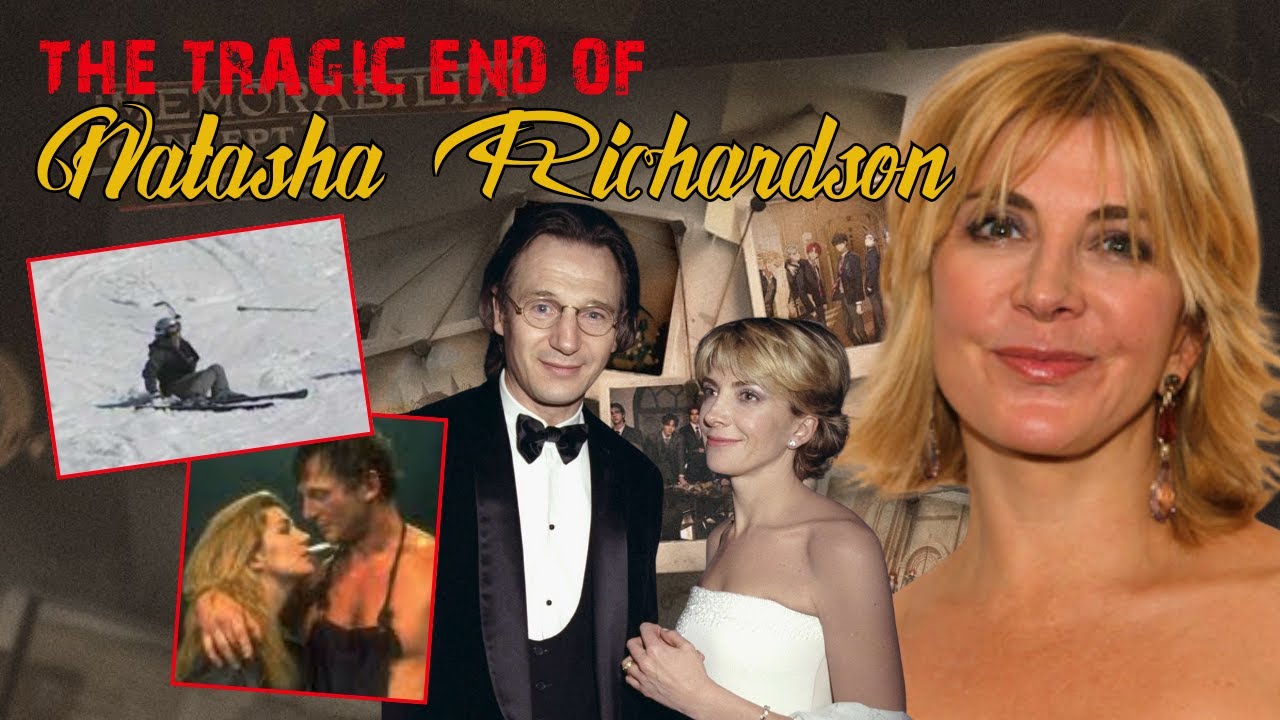
She had just completed a light comedy called Wild Child and was scheduled to return to Broadway with her mother in A Little Night Music. She was forty-five years old, vibrant and beloved. On March 16, 2009, she took her sons on a short ski vacation to Mont Tremblant in Quebec. She was a novice skier on the Nansen, a wide, gentle green run for beginners.
She was not wearing a helmet, which was not unusual at the time. Near the bottom of the slope, she caught an edge. It was a low-speed tumble, and the side of her head struck the hard-packed snow. She did not lose consciousness.
She laughed it off and refused medical aid, signing a waiver absolving the resort of responsibility. She walked back to her hotel room, feeling perfectly normal. But the fall had torn an artery just inside her skull, outside the brain’s protective lining. This was an epidural hematoma.
Because the bleeding was outside the brain, she experienced what doctors call the lucid interval. She felt fine while blood rapidly pooled in the confined space of her skull. About an hour later, the headache came. Then confusion.
An ambulance was called, but by law it took her to a small local hospital completely unequipped for a catastrophic neurological event. The doctors there realized she needed a level one trauma center in Montreal, an hour away. Precious hours were lost. Liam Neeson was on a film set in Toronto when he received the call.
He chartered a private jet and raced to Montreal. A doctor he had never met showed him an X-ray of his wife’s brain, crushed against the side of her skull by a massive pool of blood. She is brain dead, the doctor said. Liam walked into her room, remembered their pact, and told her he loved her.
He said, Sweetie, you’re not coming back from this. You’ve banged your head. You’re gone. You and I made a pact.
He had her flown back to New York on life support so her family could say goodbye. On March 18, 2009, two days after she laughed and said she was fine, Natasha Richardson was taken off life support. She was forty-five years old. Because they had discussed the unthinkable, they had also discussed organ donation.
In her final act, she saved the lives of three strangers with her heart, liver, and kidneys. Her death sparked a global phenomenon journalists called the Natasha Richardson effect. Ski helmet sales spiked dramatically, and ski schools made helmets mandatory for children. Her story educated millions about the lucid interval, teaching parents everywhere that I’m fine is not an answer.
Thousands of people are alive today simply because Natasha Richardson died. In 2018, her son Micheál, now an actor, legally changed his last name to Richardson to honor his mother and carry her legacy. The woman who spent her life terrified of her family’s shadow had created a legacy of love so powerful that her own son chose her name over the name of one of the biggest movie stars on earth. Her final performance, a documentary she had voiced called The Wildest Dream, was released a year after she was gone.
Audiences heard her voice one last time, warm, intelligent, and crackling with life, a voice that through her art, her children, her advocacy, and her final generous act found a way to become immortal.






