On May 8, 1945, when the American Monuments Men arrived at the Altaussee salt mine in the Austrian Alps, they did not know whether they would find a treasure hoard or a tomb. For weeks, rumors had swirled through Allied intelligence about what the Nazis had hidden deep inside the mountain. The officers who climbed down into the mine’s vast chambers were prepared to discover the greatest art collection ever assembled. They were not prepared for what they actually found: thousands of paintings, sculptures, tapestries, and crates of rare books, stacked on wooden shelving in cathedral-sized caverns, preserved in perfect temperature and humidity.
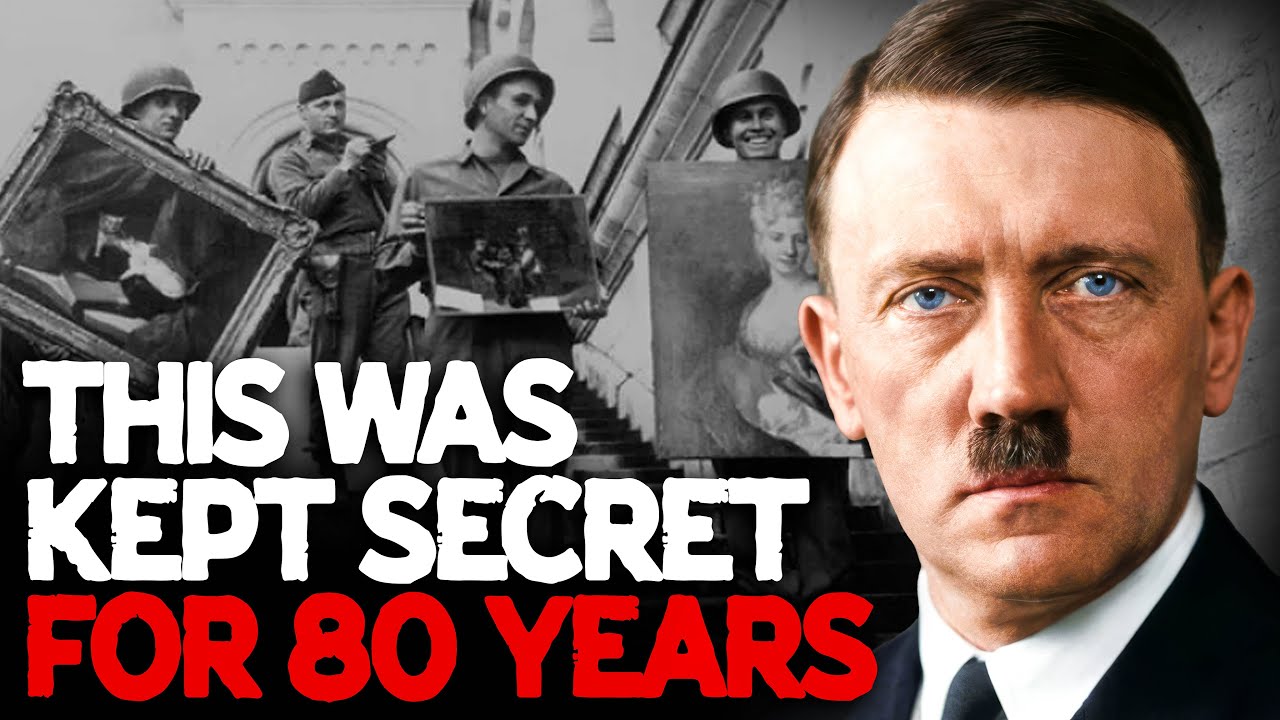
And beneath it all, the Americans found eight five-hundred-pound bombs, wired and ready, buried under camouflage designed to make them look like shipments of marble. The bombs had been placed there on the orders of August Eigruber, the Nazi Gauleiter of the region, who had received instructions—possibly from Hitler himself, though the exact source remains disputed—to destroy everything rather than let it fall into enemy hands. The detonation would have turned the mine into a mass grave for some of Western civilization’s greatest treasures. That it never happened was not the work of the Allies.
It was the work of the miners. The local Austrian miners who had been forced to work in the facility understood exactly what was at stake. These ordinary working men staged a quiet rebellion. On May 3, 1945, just days before American forces arrived, they blocked the main entrance of the mine with rubble, sealing the bombs inside and making them impossible to detonate.
When the Monuments Men arrived, they found the mine intact and its treasures saved by men who chose preservation over destruction. To understand how the world’s greatest art collection ended up in a salt mine, and why so much of it remains missing nearly eighty years later, one must begin with a rejected painter from Vienna. Adolf Hitler had applied twice to the Vienna Academy of Fine Arts and been rejected both times. The humiliation festered into an obsession.
Once in power, he did not merely want to collect art. He wanted to reshape the cultural landscape of Europe according to his ideology. His grand vision was the Führermuseum in Linz, his childhood hometown. This was not to be just another museum.
Hitler envisioned a colossal cultural complex that would dwarf the Louvre and every other institution in existence. It would house the greatest collection of Germanic and classical art ever assembled, proving once and for all the supposed superiority of Aryan culture. To stock this fantasy museum, Hitler and his henchmen—particularly Hermann Göring and Alfred Rosenberg—unleashed a systematic plundering operation unprecedented in human history. The Nazis did not just steal art opportunistically.
They industrialized theft with bureaucratic efficiency. The Einsatzstab Reichsleiter Rosenberg, known as the ERR, was created specifically to confiscate what they cynically called “ownerless Jewish property”—a euphemism for stealing from families who had been murdered or forced to flee. They cataloged, photographed, and systematically documented their theft with meticulous German precision. The numbers are staggering.
Researchers estimate the Nazis looted approximately one-fifth of all art in Europe, somewhere between 600,000 and 650,000 artworks. That does not count the countless religious artifacts, tapestries, sculptures, rare books, and cultural treasures that disappeared into the Nazi machine. One in every five artworks across an entire continent was stolen in just twelve years. Göring, Hitler’s corpulent second-in-command, was perhaps even more voracious than his Führer.
His collection at his estate, Carinhall, rivaled Hitler’s own ambitions. He would station himself at the Jeu de Paume Museum in occupied Paris, where confiscated art was stored and displayed. Like a grotesque king in a candy store, he would waddle through the galleries pointing at masterpieces, declaring, “That one for me, that one for the Führer. ” By war’s end, Göring had amassed a personal collection of more than 1,400 pieces.
The Nazis created a tiered system for the art they seized. Works by artists they deemed Aryan—Dürer, Rembrandt, Vermeer—were preserved for German collections. Degenerate art, modern works by Picasso, Kandinsky, Chagall, and any Jewish artists, was either sold abroad for foreign currency, destroyed, or used for target practice. In March 1939, Berlin firefighters burned approximately 5,000 works of modern art in the courtyard of the city’s main fire station.
Works by Picasso and Klee literally went up in flames to feed Nazi ideology. The operation had its own bizarre economics. Art dealer Hildebrand Gurlitt, whose son Cornelius would make headlines decades later, served as one of Hitler’s primary art procurers. Gurlitt bought degenerate art from German museums at fire-sale prices, then sold it internationally at enormous markups, funneling foreign currency back to the Reich while building his own secret collection.
It was a money-laundering scheme wrapped in cultural destruction. As Allied bombs began raining on German cities in 1943 and 1944, the Nazis faced a logistical nightmare. How do you protect a stolen empire of priceless art? The answer lay deep underground in places that sound like settings from an adventure film but were all too real.
The Altaussee Salt Mine in Austria became Hitler’s primary art bunker. Located in the Austrian Alps near Salzburg, this labyrinthine mine had been excavating salt for centuries. Its vast chambers, some as large as cathedrals, maintained perfect temperature and humidity for preserving art. Nazi curators converted these chambers into climate-controlled storage galleries, complete with wooden shelving and careful organization systems.
By war’s end, Altaussee contained roughly 6,500 paintings, including masterpieces like Vermeer’s The Art of Painting, Michelangelo’s Madonna of Bruges, and the Ghent Altarpiece, a fifteenth-century polyptych considered one of the most important paintings in Western art history. The mine also held sculptures, furniture, tapestries, and an enormous collection of rare books and manuscripts. But Altaussee nearly became art’s greatest tomb. In April 1945, with Soviet forces approaching from the east, Eigruber received his orders to destroy everything.
His bombs could have erased a millennium of human creativity in a single blast. The miners’ rebellion stopped him. The Monuments, Fine Arts, and Archives program, immortalized in a 2014 film but rarely understood in its true complexity, consisted of approximately 345 men and women from thirteen nations. These were not all tweed-jacketed art historians with pipes.
They included architects, museum directors, artists, educators, and archivists—people who understood that cultural heritage was worth fighting for even as bullets flew. Their task was overwhelming. Beyond Altaussee, the Nazis had hidden art in approximately 1,500 repositories across Germany, Austria, and occupied territories. Castles, monasteries, mines, tunnels, barns, and even private homes concealed stolen treasures.
The Merkers salt mine in Thuringia, Germany, held not just art but also the entire gold reserves of the German Reichsbank: 100 tons of gold bars, plus millions in looted currency and personal valuables taken from concentration camp victims, including gold teeth. When General Dwight Eisenhower himself toured Merkers in April 1945, even he was stunned. The mine, located 2,000 feet underground, required a four-minute elevator descent. What Eisenhower found shocked him: rooms filled with currency from dozens of countries, artwork stacked floor to ceiling, and the personal belongings of Holocaust victims—wedding rings, pocket watches, jewelry—all cataloged with Nazi efficiency.
The Monuments Men worked frantically. They would arrive at a location, often with incomplete intelligence, and have to secure, inventory, and transport thousands of objects before looters, weather, or warfare could destroy them. In many cases, they were racing against Soviet forces who had their own ideas about war reparations and showed less interest in eventual restitution to original owners. One particularly dramatic episode involved the rescue of the Ghent Altarpiece, which had been moved multiple times during the war.
This massive multi-panel masterpiece by Jan van Eyck had been coveted by conquerors for centuries. Napoleon had stolen it, and now Hitler wanted it as the crown jewel of his Linz collection. When the Monuments Men finally located it in Altaussee, they discovered that one panel was missing. It had been stolen in 1934 and has never been recovered, making it one of the most sought-after missing artworks in history.
By 1951, the Western Allies had established central collecting points—massive warehouses where recovered art was gathered, cataloged, and theoretically prepared for return. The largest was in Munich’s Führerbau. Ironically, it was one of Hitler’s own administrative buildings. At its peak, the Munich collecting point held over 500,000 objects.
But what happened next was not a simple fairy tale of art returned to rightful owners. It was a bureaucratic nightmare, a legal quagmire, and in many cases, a continuation of injustice. First, there was the sheer problem of provenance: determining who actually owned what. Nazi records were often deliberately vague, destroyed, or falsified.
A painting might have passed through five hands, been sold under duress, or been traded for exit visas that meant life or death. How do you untangle that? The Allies established rules requiring claimants to prove ownership. But many Jewish families had lost everything—their homes, their documents, their very lives.
Asking survivors to produce pre-war receipts for paintings was often impossible. Second, there was the Cold War. As tensions between East and West escalated, the urgency to return art diminished while the desire to win propaganda points increased. The Soviets took an estimated 200,000 artworks back to Russia as war reparations, many of which remain there today.
Russia argued these were legitimate compensation for the 27 million Soviet citizens killed and for the massive destruction of Soviet cultural sites. Stalin viewed art as tangible compensation for Soviet suffering, and Soviet trophy brigades systematically stripped museums, palaces, and private collections across occupied Eastern Germany. The Pushkin Museum and the Hermitage in Russia still hold thousands of these pieces. When Russia finally admitted in the 1990s that they possessed these treasures, international outrage erupted.
But Russian law now classifies wartime acquisitions as legal spoils, making restitution nearly impossible. Third, and perhaps most troubling, was the complicity of museums, dealers, and governments in keeping stolen art. Many institutions that received recovered works simply absorbed them into their collections without rigorous investigation into wartime gaps in ownership. The Swiss art market, which remained neutral during the war, became a laundering operation for looted art, and Swiss bank secrecy laws protected both Nazi wealth and stolen cultural property.
By 1951, the Allies essentially gave up on comprehensive restitution. Remaining works were transferred to the German government with the understanding that Germany would continue restitution efforts. But postwar Germany, divided and devastated, had other priorities. Thousands of works simply disappeared into museum collections, private holdings, or were sold at auction with sanitized provenances that conveniently skipped the years from 1933 to 1945.
The Führermuseum, of course, was never built. The site in Linz remained empty, a monument to megalomania that thankfully never materialized. But what happened to the specific pieces designated for it reveals the chaos of postwar art distribution. Some went to Austrian museums, some to German institutions, and many languished in storage for decades.
Then came the bombshells that proved this was not ancient history gathering dust in archives. In 2012, German authorities raided the Munich apartment of an elderly recluse named Cornelius Gurlitt. What they found stunned the art world. 1,280 paintings, drawings, and prints, including works by Picasso, Matisse, Chagall, and Renoir, were crammed into a small apartment.
These were remnants of his father Hildebrand’s dealings with the Nazis, hidden for seven decades. Cornelius Gurlitt had lived surrounded by artistic masterpieces worth potentially a billion euros. He never sold them, never displayed them. He simply kept what had become a strange shrine to his father’s complicated legacy.
The discovery reignited debates about restitution, the statute of limitations, and the responsibility of current holders of looted art. Gurlitt died in 2014 and bequeathed his collection to a Swiss museum. Legal battles over individual pieces continue to this day. The Gurlitt affair exposed something uncomfortable: how many other collections remained hidden?
How many families had quietly held onto Nazi-era acquisitions, passing them down through generations who either did not know or did not want to know their true origins? The answer, as subsequent discoveries proved, was many. The Gurlitt case was not isolated. In 2015, the heirs of Jewish art dealer Paul Rosenberg won a legal battle to recover a Pissarro painting from a Spanish museum.
In 2018, the Supreme Court ruled on a case involving a Klimt painting, forcing American courts to hear claims about Nazi-looted art regardless of where it currently resides. In 2021, French investigators discovered dozens of looted artworks in the personal collection of a deceased French resistance hero, proving that even heroes of the war sometimes kept spoils. Modern technology has revolutionized the hunt. The Conference on Jewish Material Claims Against Germany maintains a database of over 600,000 items still missing.
The Art Loss Register tracks stolen and looted works globally. Artificial intelligence now scans auction catalogues and museum inventories, cross-referencing against databases of looted art. In 2023, a Kandinsky watercolor was identified in a Dutch museum as having been looted from a Jewish collector. It had hung on museum walls for decades with nobody questioning its wartime journey.
Austria has been particularly aggressive in recent restitution efforts, returning over 15,000 objects since 1998. The Netherlands established a comprehensive research program investigating Dutch museum collections. Germany created a lost art database and has returned hundreds of pieces. But these are voluntary programs, and many countries still resist systematic investigation of their collections.
The emotional and financial stakes remain enormous. When Austria finally returned Gustav Klimt’s Portrait of Adele Bloch-Bauer I to the heirs of Ferdinand Bloch-Bauer in 2006, the painting sold for $135 million, then a record. But beyond money, these restitutions represent something deeper: acknowledgment, justice, and the restoration of family legacies erased by genocide. Yet thousands of artworks remain in a legal twilight zone.
Museums claim they purchased works in good faith from reputable dealers. Current owners argue that decades have passed and that disrupting settled ownership creates its own injustices. Some families have given up, lacking resources for expensive international litigation. Others have accepted compromises, sharing ownership or accepting financial settlements rather than the art itself.
Some of the most disturbing revelations have emerged from examining the role of Allied soldiers themselves. While the Monuments Men worked heroically to save art, not every soldier was so noble. American GIs looted smaller items—silverware, jewelry, and small paintings—that they could easily transport home. In 2009, a former American soldier’s family discovered they had been living with a stolen Dutch masterpiece for decades, hanging innocently in their living room.
Perhaps most cynically, some art dealers who had collaborated with the Nazis simply rebranded themselves as victims or resistance fighters after the war. They would discover caches of artwork they had personally helped the Nazis acquire, then sell these pieces on the open market, pocketing profits twice—once from the Nazis and once from postwar buyers. Major auction houses held sales throughout the 1950s and 1960s featuring works with suspicious provenances that nobody questioned too closely. The psychological toll on families seeking restitution is rarely discussed but profoundly significant.
Imagine discovering that a painting your grandmother loved now hangs in a museum that insists it was purchased legally. You must then embark on years of legal battles, dredging up painful family histories, all while being portrayed as greedy opportunists. The retraumatization is real and ongoing. Even when families win restitution cases, the victories are bittersweet.
The recovered artwork can never resurrect murdered relatives or restore childhoods shattered by persecution. It is a material fragment of a destroyed world—valuable, but ultimately incapable of healing what was broken. The story of Hitler’s art collection does not end. It evolves.
Researchers continue discovering provenances that reveal wartime theft. Auction houses now face intense scrutiny. Museums hire provenance researchers specifically to examine their collections for gaps between 1933 and 1945. The art market has reluctantly accepted that the crimes of World War II cast shadows that do not fade with time.
Hitler’s art collection became a diaspora scattered across museums, private collections, government warehouses, and dusty apartments. Some pieces found their way home. Many never will. A Rembrandt portrait hanging in a museum might seem like just art, but to someone whose grandmother owned it before being murdered at Auschwitz, it is a ghost, a gravestone, and a last connection to an exterminated world.
And perhaps that fractured, incomplete resolution is somehow fitting for a story born from humanity’s darkest chapter, where resolution and justice remain forever partial, forever incomplete, forever marked by what was irretrievably lost.






