In the spring of 1898, Olaf Erickson signed on with a bridge crew at Selleck, Washington. He was twenty-eight, born in Småland, Sweden, to a line of timbermen who had felled spruce for the Swedish Navy across three generations. He had reached America in 1893, spent two years in the Wisconsin North Woods, then drifted west after the work like everybody else. His wage was $3.
25 a day, which counted as top-tier bridge pay, because he could climb. The foreman’s notes called him quick, sober, and nearly wordless. His English was thin, but he had been a steeplejack back in the old country, which meant he understood how to work with one hand on a rope, a boot on a cap timber, and his eyes fixed on the next pin. He could drive drift pins faster than any man on the crew.
On September 17th, 1899, Erickson was working the upper bent of a trestle above Boxley Creek, 176 feet over the canyon floor. The bent had been raised that morning, and he climbed up to seat the cap pins. He was swinging a four-pound maul with a short handle, the tool standard for the job. He had on wool trousers, hobnailed boots, a denim coat, and a leather belt of pins slung around his waist.
A cap timber the crew had set was a touch out of plumb. Erickson stretched out his left hand to steady himself against the brace of the bent behind him so he could swing the maul with his right. That brace had been pinned the evening before by another man, and the pin had not been driven flush. When Erickson leaned his weight against it, the brace shifted half an inch.
He fell. The bridge boss on the deck below watched him go straight down, not tumbling, simply dropping, until he struck the canyon floor 176 feet beneath. The coroner’s report gave the cause of death as multiple compound fractures and severance of the spinal cord. Erickson had been on the line 412 days.
He had meant to send for a younger brother in Sweden once he had saved enough for the passage. The brother never came. The contractor handed Erickson’s final week of wages, $22. 75, to a Lutheran church in Tacoma that buried him.
That was one man. The Pacific Northwest bridge records that survived name at least 470 bridge monkeys killed on trestle work between 1885 and 1915. The true figure was likely past a thousand. Records burned, camps pulled up stakes, names were misspelled or never written down at all.
The men who did this work were raising something that should not have stood. By 1880, the United States was exhausting the timber it could reach east of the Mississippi. The great pine forests of Michigan and Wisconsin had been felled. The hardwood ridges of Pennsylvania and New York were stumps.
The country needed wood for railroad ties, mine timbers, ship hulls, house frames, and for cities that doubled in size every decade. What remained was the Pacific Northwest. Washington, Oregon, and a sliver of northern California held the largest standing softwood forest on the planet: Douglas fir three hundred feet tall, western red cedar eight feet across at the base, Sitka spruce that had been growing since the time of Christopher Columbus. The lumber companies looked at that forest and saw money.
The trouble was getting it out. The timber did not stand on flat ground. It stood on the western slopes of the Cascades, the Olympics, and the Coast Range, on ridges and in canyons and creek-cut valleys so steep that a man on foot could not walk a straight mile in any direction. There were no roads.
There were no rivers wide enough to float the great logs down. A wagon could not haul a thirty-ton log out of a Cascade canyon. A river could not carry it. The only thing that could move that timber was a railroad.
And the railroads could not be laid on the canyon floors, because those floors were vertical-walled and choked with windfall. The railroads had to go across the canyons, on the air. That is what a logging trestle is. It is a railroad floating two hundred feet above an empty canyon, held up by stacked timber and the engineering judgment of a man who learned his trade by climbing.
The man who designed most of these trestles in the Pacific Northwest was named Frank Hewitt. He was born in 1864 in Wisconsin, the son of a Methodist circuit rider. He apprenticed at fourteen on a logging spur outside Eau Claire, learned to dress timber with a broad axe and an adze, and by his early twenties he was running his own bridge gang in the Michigan North Woods. When the Eastern pine ran out, he went west with the work.
By 1895, he was chief bridge engineer for the Northern Pacific’s logging subsidiaries in Washington state. He held no formal engineering degree. He could not have passed a college entrance exam. What he had was twenty years of climbing.
Hewitt designed by sketch on the back of brown paper torn from store receipts. His working drawings survive in the archive at Forest Grove: clean lines, dimensions in his own handwriting, load calculations penciled in the margins. The handwriting is small and tight, the way a man writes when the men above him are waiting on every line. The basic unit of every trestle Hewitt built, and of every wooden trestle built anywhere in America between 1870 and 1930, was something called a bent.
A bent is a single vertical frame: two timber posts standing upright, leaning slightly inward toward each other, joined at the top by a crossbeam called a cap, with diagonal braces between the posts forming an X. That is one bent, sixteen to twenty feet tall. The whole structure was made of squared timber, hand-hewn or mill-sawn from the same forest the trestle was being built to harvest. Now stack the bents.
A second goes directly on top of the first, locked into the cap with drift pins. A third on top of that. A fourth. The bents narrow as they rise, because the load above is lighter than the load below.
By the time you reach two hundred feet, you have stacked ten or twelve bents, each one slightly smaller than the one beneath it, all tied together with diagonal cross-bracing that runs the full height of the structure on both faces. The whole thing weighs perhaps a thousand tons. It carries a steam locomotive of eighty tons across a gap of three hundred feet. It is held in place by drift pins, tree nails, and the weight of itself.
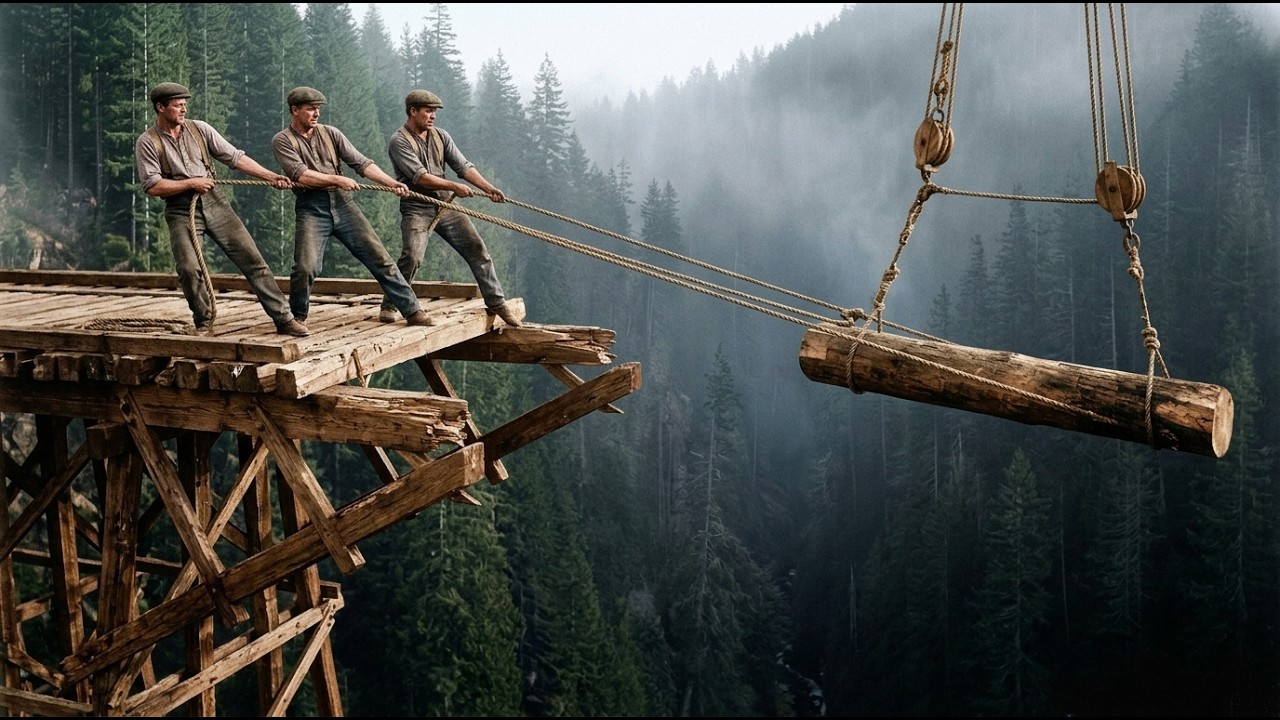
And the bridge gangs that put these things up did it without scaffolding. There was no scaffolding. The men who built a two-hundred-foot trestle stood on the trestle they were building. The first bent went up on the canyon floor or on a stone footing carved into the wall, with pile drivers if the floor was soft, dry-stacked rubble piers if it was rock.
After the first bent stood upright and braced, the following bent was raised and set down on top of it, and a man climbed up to drive the pins. He worked from the cap of that first bent, sixteen feet off the ground. Then the second bent was in place. He climbed thirty-two feet.
Then the third, sixty. By the time the trestle reached its full height, the crews were laboring two hundred feet above open air, poised on a cap timber eight inches across, hammering pins with a four-pound maul, with no rope securing them and nothing but space below. People called them bridge monkeys. The term carried no warmth.
It described a job that demanded a man climb like an animal, since no other method existed. Height was not the only hazard. The hazard lay in how a timber trestle shifts beneath a load. A trestle is not a stiff structure.
It is a controlled compression frame built to take the weight of a passing locomotive through sway, through deflection, through bracing that spreads the load over dozens of joints, each yielding a fraction of an inch. When a logging train crossed a tall trestle at speed, the whole thing rocked. Witnesses describe the upper bents visibly rocking from side to side, at times by as much as a foot, as a fully loaded log train went over. To someone watching from the canyon floor, it seemed the trestle was about to come down.
To Frank Hewitt, its designer, that sway was the structure behaving exactly as intended. A rigid trestle would have cracked apart at the joints within months. The trestle that swayed endured. The men who kept the trestles in repair, known as bridge inspectors, walked the full length of the structure once a week carrying a small hammer.
They struck every cap timber, every brace, every pin. A clear ring told them the timber was sound. A flat thud meant rot within. A rotted timber was swapped out on the spot, with trains still running across the structure while the work went on.
Inspectors died as well. Now and then a tapped timber was rotten enough to collapse under the inspector’s own weight, and the man would drop through the deck before he could step back. Henri Beaupre was a pile driver man. He was born in 1871 in Trois-Rivières, Quebec, and arrived in Washington state in the fall of 1893 with the surge of French Canadian loggers who flooded into the Pacific Northwest once the eastern timber ran out.
He could read and write French, but not English. The bridge boss who hired him at the Cedar River trestle recorded his name as Henry Beaupre on the payroll, and that is the form it takes in the records. The pile driver was a vertical steam engine bolted to a barge or a timber frame at the foot of the trestle, hoisting a 1,500-pound hammer eight to ten feet up a vertical track and letting it fall onto the head of a piling. The piling was a Douglas fir log forty feet long, driven into the canyon floor to anchor the lowest bent.
A single piling might need two hundred drops to seat completely. A trestle of any size called for forty to sixty pilings. The pile driver’s danger was in the timing. The hammer was raised by a steam-driven cable on a clutch.
When the operator let the clutch out, the hammer fell by gravity. If a man on the deck was adjusting the piling head, or freeing a fouled cable, or merely standing too near, and the clutch slipped, the hammer came down early. Fifteen hundred pounds of cast iron dropping eight feet leaves a man on the deck no time to step back. The records for the Cedar River project alone name eleven men killed by pile driver drops in a single eighteen-month stretch.
Beaupre lasted three years on pile driver crews before he was killed on August 4th, 1901. The clutch on the hammer cable gave out during a routine drop. He had been signaling the operator to hold the hammer at the top of the track while he reset a piling head. The hammer released on its own.
He was crushed in the chest. He was thirty years old. He left behind a wife in Trois-Rivières named Marie and a son he had never met, born the winter before. The contractor paid Marie the equivalent of $42 in Canadian funds and a return passage steamship ticket she never used.
John Tahoma lived. He was born around 1875 on the Skokomish reservation on the Hood Canal of Western Washington. The Skokomish and several other Coast Salish peoples had worked as climbers and bridge monkeys for the Pacific Northwest logging railroad since the 1880s. Bridge bosses favored them for the high work because, as one foreman put it in 1896, they seemed to have no fear of falling.
The truth was that Skokomish boys grew up climbing cedars to collect bark for canoes and rope making. They had been trained climbers since the age of six. Tahoma worked as a high bent man on at least nine major trestles between 1895 and 1912: the Cedar River, Boxley Creek, the Snoqualmie Falls Spur, and a trestle outside Forks that was rebuilt three times after fires. He earned the same wage as a white bridge monkey, which was uncommon for the time.
The bridge gangs ran on a kind of meritocracy of risk. The men who did the work bore the same cost, so they drew the same pay. Tahoma left bridge work in 1912 at the age of thirty-seven with nothing more dramatic than worn-out knees. He went back home to Hood Canal.
He fished. He raised three children. He told one of his grandsons in the 1940s that he had quit climbing the day he realized he had to think before reaching for the next handhold. Until that day, the next move had always come without thought.
After it, he could feel his body questioning whether it would hold. He climbed down the trestle he had been working on that morning, walked to the rail station, and never joined a bridge crew again. He died in 1961, at eighty-six, having outlived every other bridge monkey in the gang he had started with. The trestles themselves are mostly gone.
They peaked in number around 1910. By one Forest Service estimate, more than 30,000 miles of logging spur railroad ran through Washington and Oregon at that peak, and along those miles stood somewhere between fifteen and twenty thousand wooden trestles of varying heights. The largest concentration was in the western Cascades and on the Olympic Peninsula. The tallest stood near 220 feet.
The longest ran over a third of a mile. They were not built to last. A wooden trestle exposed to Pacific Northwest rain had a working lifespan of twenty to forty years before the bottom bents rotted out from ground contact. The upper bents might last longer if they stayed dry, but the joints worked themselves loose under decades of train sway and weather.
Once the timber on the spur’s watershed ran out, most trestles were either dismantled or set alight where they stood. With the trees gone, a logging outfit had nothing left worth keeping a railroad for. Crews ripped up the rails for scrap and left the timber to fall apart at its own pace. Sparks from coal-burning locomotives would catch the dry, creosote-soaked decking, and flames could race the full length of a trestle in a matter of minutes.
In 1933, the notorious Tillamook Burn wiped out several large trestles across the Coast Range in the space of one afternoon. The Selkirk Trestle in Washington came down in 1927 after an inspector overlooked a decayed cap timber, sending a line of loaded log cars crashing through the upper deck. Eleven men lost their lives, the inspector among them. Only a handful walked away.
A few have survived. Goat Canyon Trestle, out in the desert mountains east of San Diego, was finished in 1933 at 633 feet long and 185 feet tall, and it still stands in the Anza-Borrego Desert, abandoned yet mostly whole, since the arid air has kept the timber sound. On Vancouver Island, the Kinsol Trestle, 614 feet long and 145 feet high, was restored in 2011 and today carries a hiking trail. A handful of smaller trestles remain in Oregon’s Tillamook State Forest and along the old logging grades north of Mount St.
Helens. Yet almost everything that was built has vanished. The cuts remain, though. Walk the abandoned logging grades through the Cascade foothills and you can trace the ghost of where the trestles once ran: a level shelf of dirt carved into a hillside, then a stretch of open air, then that same flat shelf picking up again on the far side of a canyon.
Scramble down into the canyon beneath and you may still come across the stone footings of the lower piers, hand-cut blocks of local rock laid in dry-stacked courses. Now and then a bent pin still rusts away between two stones. Now and then a wooden cap timber, toppled and half sunk in moss, still bears the adze marks of the man who shaped it more than a century ago. Frank Hewitt died in 1931, at sixty-seven.
For the last ten years of his life he wrote letters to forestry students at Oregon Agricultural College, spelling out how a bent was built, why the diagonal bracing counted, and what the early bridge gangs had learned the hard way. His estate was modest. He willed his drawings and his transit to the college library, where they remain cataloged to this day. In the Cascades, there is no plaque for Olaf Erickson.
No marker for Henri Beaupre. The few headstones that remain for bridge monkeys in the little cemeteries of King County, Snohomish County, and Clackamas County are frequently unreadable now. Most of the Swedish, French Canadian, and Skokomish men who raised the trestles were buried where they fell, or in pauper’s graves at the fringes of logging towns that have since disappeared.
Only the canyons they spanned, and the cuts they carved into the hillside, and the country that came into being because they worked out how to balance a railroad two hundred feet up in the air on stacked timber.
