In the autumn of 1857, a thin man in a black coat stood at the mouth of a narrow canyon in southern Utah Territory and offered a United States territorial surveyor named Seth Armstrong the use of a book. The offer was made softly, in careful, circumlocutory language, and it concerned the settling of any accounts a plainsman might have come west to settle. Armstrong did not go inside. He turned his animals around in the dust of the trail and rode east through the night.
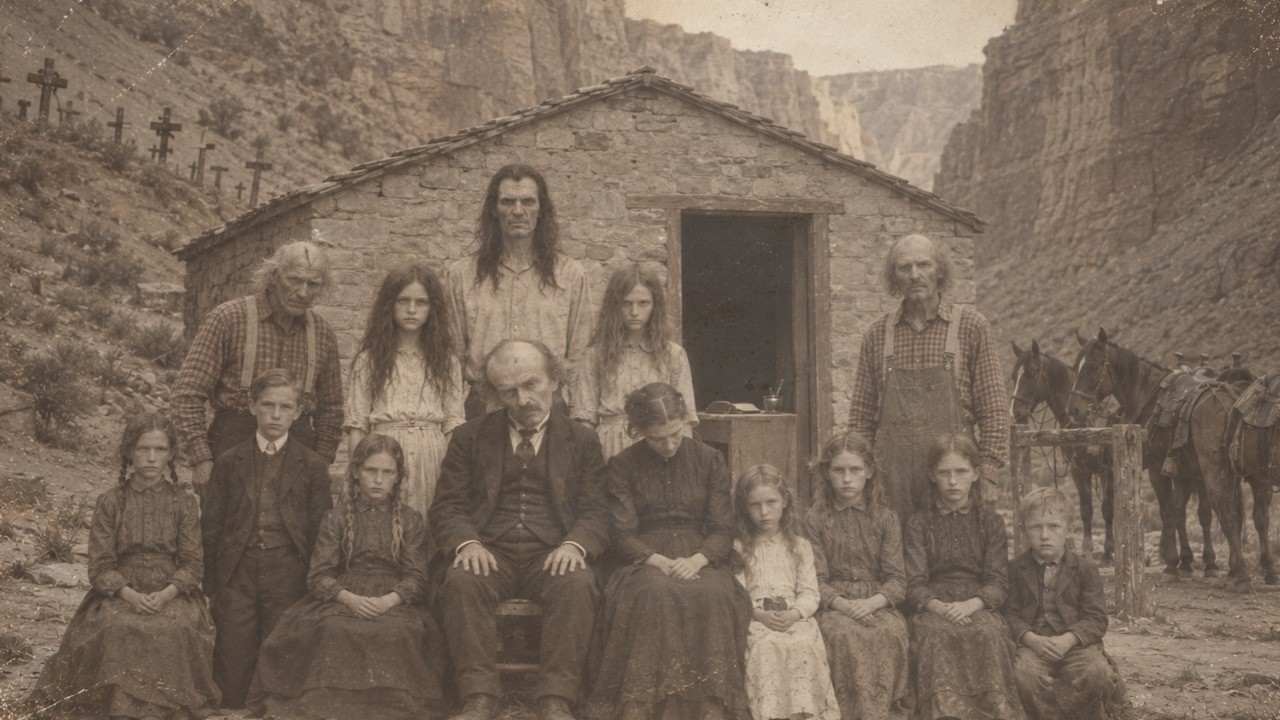
In his private fieldbook, he wrote the one line no official report of his would ever carry: “I do not think these people worship. I think these people transact. ”
The canyon was shaped like a long shallow spoon laid handle up into the plateau. At the bowl of the spoon stood a low, windowless building of dressed pale stone, with no bell and no cross and only a single door.
The family that kept it took no tithes and read no sermons. They asked only one thing of every traveler who came in off the old Spanish trail, cold and tired and hunted by the troubles of a bad year: they asked you to sign the book. The book was a ledger with a soft black cover and a plain lock, resting on a flat pale table of the same stone the floor was cut from. The ink was plain iron oak gall in a horn pot; the pens were goose quills; the paper was common foolscap.
There was nothing in the room any traveler could point to afterward and name as the thing that was wrong. The thing that was wrong was the floor. It was a single seamless pale gray plane, flat as still water, cold under the hand even in July. It was not laid by the family and not cut from any quarry in the territory, and it ran under the whole bowl of the canyon and out past the ridges and under the plateau beyond.
The family had learned, by the slow sacrifice of their own early dead, exactly what it did when a true full name was written in a human hand on a sheet of paper and the paper was laid down upon it. The floor read the name. The floor took the name as a kind of deed. Whoever had written the name in his own hand on paper that touched the stone held, from that moment, a quiet claim upon the life whose name it was—a claim the floor would honor to the smallest letter and the longest patience until the written life ended early and quietly in whatever way the land could arrange.
The inheritance, the standing, the work, and the days of that written life passed by a transfer no court would ever see into the hands of the one who had done the writing. In that territory in the autumn of 1857, with the army on the plains and the wagon trains refused, and the roads full of frightened strangers running from one trouble into another, there were a great many men willing to pay a great deal of money to sign a book they did not understand in a cold stone room they would try to forget. The family that kept that book took in more than any of them lived to know. The researchers who have pieced the story together across more than a century and a half have counted.
From the ledger pages that survived, and the pages hidden in the hollow back of a wagon seat for seventy years, something like 340 names were written and claimed in that one small building over a thirty-year span, by a family of never more than fourteen souls. The land books of three southern Utah counties still show the quiet consequences: farm by farm, deed by deed, where a long-dead stranger who passed through once signed in and never signed out, and whose only known heir died within a year of a fall or a fever or a bad well, and the land went by law to a man none of the dead had ever met, whose last name was Halen. Armstrong’s chainman, who did go inside, who signed, is listed in the territorial records as having died of a horsefall nine days later on a trail he had ridden safe for twelve years. His small savings, meant for a sister in Illinois, were paid out through a quiet probate held in a town he had never visited, to an estate administered by Uriel Halen of Snow Hollow, Utah Territory.
There are 339 other short stories exactly like it. The canyon the family called Snow Hollow does not appear by that name on any modern map. When the last keeper of the book sealed up the building in the autumn of 1904, she spent her last clear-headed year writing a long, patient letter to the county recorder, the territorial land office, and two newspaper editors, asking—without ever saying why—that the family name and the canyon name both be struck from every public document that could still be reached. She was by then an old woman with a reputation for mild, harmless strangeness, and the request was granted the way such requests often were, by men who did not care to argue with a widow about an empty canyon in a corner of the state nobody wanted.
The canyon is still there under a different name on a modern forest service map, in a corner of the plateau country north and west of the real Mountain Meadows and south and east of the main Mormon corridor of the time, where the ridges fold tight enough that the sun leaves the canyon floor by three in the afternoon even in June. The meeting house is gone above ground, pulled down in 1904 as the last keeper’s last public act, the stones carted off into the foundations of two sheep barns and a small school a day’s wagon ride away. But the pale gray floor is still there under the sage, dead flat, dead cold. The land, by the research of a woman named Nell Weatherford, is privately held, and the private holder has given a standing instruction that the parcel is never to be sold, never to be leased, never to be drilled, never to be grazed, never to be surveyed, and never built upon.
The parcel pays its own small tax out of a trust set up a hundred years ago for that one purpose. The family came out to Utah in the summer of 1847 with the first Mormon companies. In the first winter they settled a side canyon off the Spanish Fork and tried to farm it. In the second winter, the father and oldest son were called by the church to go further south on a scouting assignment, and they came back in the spring of 1849 with a story about a dry side canyon off the old Spanish trail that they said had come to them in a dream, and that they intended to settle with their family only, as a kind of personal mission.
The local bishop’s minutes book, which Nell Weatherford found archived under the wrong year, records that the request was heard patiently and denied. If they went south alone, they went south alone with no sanction and no supply. The minute-taker wrote two words in the margin that have carried down through the years: “dysfellowshipped quietly. ”
The family left Spanish Fork the next week in two wagons with every head of stock they owned and every pound of grain they could buy, three Bibles, and the father’s private papers.
They drove south along the old Spanish trail for eleven days until they came to the mouth of the canyon the father said had come to him in his dream. They drove up to the head of the bowl and stopped by the shallow spring. The father got down, knelt beside the spring, put his hand flat on the ground, and held it there a long time without saying anything. Then he stood up and said, “This is the place.
”
The father was named Uriel Halen, thirty-eight years old that spring. Born in upstate New York, raised a Methodist, converted to the Mormon faith at twenty-two, he came west with the saints in the ’47 migration. By every account he was a quiet, studious, earnest man with a particular interest in the older parts of the Old Testament and in what he called, in a surviving letter to a brother in Ohio, the ordinances of the first fathers. He was not a cruel man.
The thing he found at the head of the canyon that spring was not something he went looking for. The land books of the following year record that he filed a quiet claim on the bowl of the canyon and three thousand acres of surrounding scrub. In the spring of 1850 he laid, by his own hand and the hands of his two oldest sons, a foundation of common sandstone for the stone meeting house. The foundation was laid in a careful rectangle, thirty-one feet by nineteen, with the long axis canted about one degree north of true east, for a reason Uriel noted in his private papers only as follows: “The floor beneath lies canted, and the walls above must follow the floor, lest the floor refuse to receive what the walls above present.
”
The thing he had found, the thing his hand had felt when he knelt beside the spring, was the top edge of what the family would come to call in all their private writing the pale floor. It lay a bare three inches under the surface inside the bowl, a seamless flat sheet of pale gray stone that none of them in all the years of their keeping were ever able to break with a pick, scratch with a file, drill with any auger a wheelwright could sharpen, or heat with any fire a mason could build. The floor was cold even in the hottest afternoon of summer, and in deep winter it was warmer than the dirt by just enough that frost formed on the dirt and not on the stone. If you knelt and put your bare palm on it for a slow minute, you could feel the warmth of your blood running down out of your hand into the stone and away, as if the stone had somewhere cold and far to put that warmth where you could not follow it.
The floor extended, by Uriel’s careful probing with iron rods over the first three summers, in every direction out from the bowl as far as he had patience to probe, which was eventually a mile and a quarter. It was not the floor of a chamber, not the slab of a tomb, not the lid of a well, but a single continuous flat plane of made pale stone, older than the folding of the plateau above it. Uriel, being a quiet, earnest man with a particular interest in the ordinances of the first fathers, concluded that the floor was the sign of a work the first fathers had done before the flood and had left in the earth for the latter saints to find. He built his meeting house over it, as he wrote, to receive the work worthily.
For the first six years, the family kept the meeting house, farmed the mouth of the canyon, ran a small flock of sheep on the plateau above, and did their best by Uriel’s instruction to understand what the floor actually was. They sang over it, and it was silent. They read scripture aloud, and it was silent. They burned incense upon it, and it gave nothing back.
They prayed over it in common prayer and private prayer and in the laying on of hands upon the stone, and the floor received their prayers the way the ground receives rain. In the early summer of 1851 they laid upon the floor the bodies of their two dead children, who had died of a winter fever that had taken half a dozen other children in the territory that year. They knelt by the little bodies and prayed for a sign. The sign they received was silence.
In the morning the children were still dead. They buried them on the shoulder of the ridge and understood that the floor was not a floor that reversed what the Lord had taken. Then, on a cold still afternoon in October 1856, Uriel’s second-oldest son, a boy of seventeen named Orin, who was by all accounts bright and quick and prone to the restless experimenting a father is right to worry about, slipped alone into the building after the morning service and did a thing he had been turning over in his mind for a month. He wrote out in his own careful hand upon a sheet of common foolscap the full name of the girl in the next settlement whose father had, the summer before, refused Orin’s suit of her hand.
He laid the paper flat upon the pale gray stone of the floor at the center of the building, knelt beside it, and said aloud, “Lord, if there is anything in this floor that will hear me, let her see sense, and let her father see sense, and let the thing be as I have set it down. ”
Nine days later a rider came down the trail from the next settlement with the news that the father of the girl had died in the night of what the doctor called a bad heart, that the girl had refused the hand of the second suitor her father had been pressing on her, and that she had sent by the rider a short folded note to Orin Halen of Snow Hollow, asking whether his earlier offer still stood. Orin read the note at the breakfast table in front of his father, his mother, and his two younger sisters, and his face went the color of the pale stone under the building. He got up and walked out into the dust of the yard.
When his father came out and asked what the matter was, Orin said, “Father, I need to show you something inside the meeting house, and I am afraid I have done something, and I do not know what it is I have done. ”
Uriel listened in silence and asked only one question: “Where is the paper? ” The paper was still there, in the center of the floor, dust-dry and clean, lying flat where Orin had laid it nine days before. Uriel knelt, picked it up, read what Orin had written, folded it carefully in half, and put it into the inside pocket of his coat.
He said, “Say nothing of this to anyone, not to your mother, not to the girl, until I have had time to think. ”
He thought for three weeks. At the end of those three weeks he went back into the meeting house alone on a still cold Sunday afternoon in December with a second sheet of common foolscap, and he wrote in his own careful hand the full name of a man he had known briefly in Ohio twenty years before, who had cheated Uriel’s late father out of a small sum of money the family had never been able to recover. He laid the sheet flat upon the floor and knelt and said nothing at all, because he had decided that whatever the floor was, it was best not to speak aloud to it, lest the speaking itself be a thing it caught and turned.
Thirteen days later, a short notice in an Ohio paper carried the news that the man had been found dead on his own porch, a shotgun of unknown ownership lying beside him. His small estate, which included a parcel of land in a county where Uriel still had cousins who might act on his behalf, was in probate, and any legitimate creditor might present a claim. Uriel presented his claim through a cousin with documentation twenty years old and plainly in order, and the court awarded him the full value of the estate, which came to $1,140. 62—in the Utah Territory in the spring of 1857, enough to buy a second herd of sheep, a saddle, a second plow, and the services of a hired man for a full year.
Uriel came in from the mail office in Spanish Fork on the day the draft arrived, sat in his kitchen, looked at the paper draft a long time, and said aloud to his wife Mariah, “I think we may have been given something very dreadful, and I think we are going to have to decide what to do with it. ” Mariah Halen, who would later keep the first fair copy of what the family wrote down about the floor, said, “Uriel, we had best write it down from the beginning, and we had best decide our rules first, because the thing has already begun, and the thing that is begun cannot be made unbegun. ”
The rules Uriel and Mariah set down in the first week of the first book, which Nell Weatherford has transcribed in full in an unpublished monograph, were the operating manual of what the family would do for the next thirty years. First, the name written must be the full true given name and surname of the person as that person themselves understood it.
A pet name, a shortened form, a nickname, a stage name, a mistaken form did not take. Second, the name must be written in the writer’s own hand with pen and ink upon paper, and the writer must know at the moment of the writing what the writing was for. An idle name scribbled by a child did not take. A name copied out of a Bible by a scribe did not take.
A name written by one person at another’s dictation, with the dictator understanding and the scribe not, did not take. Only a name written by a person who knew what the writing was for, with intent, counted. Third, the paper must be laid within one day of the writing, flat upon the pale gray stone of the floor inside the meeting house, with no cloth or paper or object between the ink of the name and the surface of the stone. A paper laid upon a desk, a table, a chair, a Bible, or another paper did not take.
Fourth, the paper, once laid, must remain upon the stone for not less than one full night and not more than three. A paper taken up early had not been read. A paper left longer than three days was spoiled, and the only remedy was to burn it and begin again. Fifth, when the reading was complete, the paper was to be lifted, folded once, and placed into the ledger.
The ledger was to be kept closed and locked, the key worn around the neck of the keeper of the day, who was to be a baptized member of the family above the age of fifteen, relieved at sundown by another. The ledger was never to be removed from the meeting house, and the meeting house was never to be left open to a stranger who had not been invited by the keeper. Sixth, no name of a member of the family itself was ever to be written in the ledger by any hand, at any time, for any reason, under pain of what Uriel wrote only as “the greatest loss. ” This rule, which Verilla Halen would in the last year of her life quietly and deliberately break, was the only rule Uriel underlined twice.
Seventh, and most important, the taking was not to be done except in cases of plain justice. The family was to write only the names of men who had cheated, stolen, lied, killed, oppressed, or sinned against the family or against the family of a friend. The family was not to accept payment for a writing. The family was not to write a name at a stranger’s request.
The family was not to use the floor to enrich itself beyond the ordinary bread of a Christian household. This rule, which Uriel wrote out three times in the first book, which Mariah countersigned, which Orin and Thomas initialed in the margin, was the rule the family broke first and most completely under the keeping of Uriel’s grandson, Orson Halen, who took the book in 1878 and ran it as a plain commercial transaction for the next twenty-eight years, and prospered and died in his bed, old and respected, and against whom no justice was ever brought while he lived. For the first fifteen years, from the first writing in the autumn of 1856 through the death of Uriel in the hot August of 1871, the family kept the rules. They wrote only the names of men who had plainly earned the writing, and the writing worked every time in the ordinary, quiet, patient ways the floor seemed to prefer.
A written man died within somewhere between nine days and four months of the paper going down upon the stone, in the ordinary ways men die on a hard frontier: of a horsefall, of a bad well, of a shotgun that went off in his own hand while climbing a fence, of a fever that nobody else in the house caught, of a wagon axle that broke on a familiar grade, of a drowning in a creek he had crossed a hundred times. The man’s affairs went into probate. The court found a legitimate claim from a careful, quiet correspondent in Utah Territory. The court honored the claim.
The land or the stock or the money or the deed came through the mails to the small adobe house at the mouth of Snow Hollow. Uriel used the proceeds in those first fifteen years to pay the debts of three families in the territory pressed hard by crop failure, to buy the freedom of a man indentured in Ohio to a creditor who had been one of the earlier writings, to fund the schooling of two of his nieces, and to tithe, in the private way of a dysfellowshipped man who still believed himself a saint, to the church that had cast him out, by anonymous donations placed at long intervals in the bishop’s locked box at Spanish Fork. The surviving account books reconciled against the land books show that Uriel took in through the floor something close to $52,000 and spent, by his own reckoning, every penny on the needs of others and the discharge of older debts. He died in his small adobe house in August 1871 with $11.
40 in his coat pocket, no land of his own except the deed to Snow Hollow, and the quiet certainty written in the last page of his private papers that what the Lord had put beneath Snow Hollow was a mercy and not a temptation, and that his son Thomas would guard the mercy and would not fall into the temptation. Thomas Halen took the ledger in August 1871 and kept it in the same quiet, patient manner his father had taught him. He was a careful man of forty-one, married with four children, and he kept the floor for seven years without writing a single name that was not a plain case of justice. The seven years of Thomas’s keeping saw forty-one names written and forty-one transfers quietly honored.
The money that came in was distributed, as before, to the poor of three counties, to the schools, to the discharge of family debts, and to a small, careful fund Thomas began to set aside against what he called “the day the floor refuses”—the day, which he privately suspected must come eventually, when the floor would stop reading, or would read differently, or would ask of the family some return it had not yet asked. Thomas died in the spring of 1878, suddenly, of what the local doctor called an apoplexy of the brain, at the age of forty-eight, in his own kitchen, in front of his wife and his son Orson, then nineteen, who had been apprentice to the keeping for a year. The keeping passed to Orson Halen—Uriel’s grandson, Thomas’s oldest surviving son, the brightest and quickest and most restless of the whole line. In the one year of his apprenticeship under his father, he had read every page of the three ledgers that then existed, memorized every rule, understood every mechanism, and privately come to a conclusion his father had never come to, and that his grandfather, had he still been alive, would have struck him across the face for voicing.
The conclusion was this: the floor did not know the difference between a just name and an unjust one. The floor read the paper. It read the name. It read the intent of the writer and took the writing as a deed.
Whether the one who was written had cheated the writer or had been cheated by the writer, whether the writing was a cry for justice or a cry for a pasture, was nothing to the floor, which could not read a human heart and had never pretended to. The rule his grandfather had underlined three times in the first book was not a rule the floor enforced. It was a rule the family enforced, and the family could stop enforcing it. Orson kept this knowledge to himself for the first six years of his keeping, and in those six years he dutifully wrote only plain cases of justice.
Then, in the autumn of 1884, when he was twenty-five, with a wife and a baby daughter he adored, he received through the mails a letter from a man in Beaver County offering, in careful circumlocutory language, a quiet sum of money for a quiet service in a difficult family matter. Orson sat with the letter a long hour and walked the ridge above Snow Hollow the whole afternoon and said nothing to his wife. In the morning he wrote back accepting the commission at a sum fifty percent higher than the man had offered. The commission was for the writing of a man who stood between the client and a piece of grazing land.
The writing was accomplished in the ordinary way three weeks later, and the land passed to the client through the ordinary machinery of a probate court within four months, and $1,500 in gold passed to Orson through a private messenger. By the end of 1885 Orson had taken five commissions; by 1886, fourteen; by 1887, thirty-one. By the time he had been keeping the ledger for ten years, he had taken, by Nell Weatherford’s careful reconciliation of the private pages of what became known as the second book, something like 290 commissions at an average rate of $1,900 apiece. He accumulated, in a quiet string of banks under a quiet string of names in Salt Lake City, Denver, St.
Louis, and San Francisco, a personal fortune of close to $500,000. He bought land, stock, a small freight line, an interest in a mine, a block of commercial buildings in Salt Lake. He gave handsomely to the ward in Spanish Fork, was invited back onto the rolls of the church, was called as a state clerk, served on committees, and was known throughout the southern settlements as a quiet, unassuming, prosperous man with a gift for the discreet handling of difficult probates. He kept the ledger for twenty-eight years, from 1878 to 1906, and in those years he wrote, by the final reckoning, 267 of the 341 names the ledgers of the family contain.
He collected on every one. He died in his bed in the autumn of 1906 at the age of forty-seven, of what the doctor who sat with him called a quiet failure of the kidneys. He was buried in the churchyard of the ward he had served, mourned sincerely by a great many people. No justice ever reached him in his life.
The only justice ever done against him was done in the private pages of the last book by his own daughter, in a small, quiet, patient hand, over the last three years of her own life. That private justice did not punish him and did not undo what he had done. It did one thing only: it ended the business he had built. Verilla Halen was Orson’s only child, born in the autumn of 1885.
She was raised in a family that was by that time quietly wealthy, that attended ward services every Sunday in Spanish Fork, that gave generously to every public cause. She grew up without the slightest suspicion that there was anything in her family beyond ordinary piety and prosperity. She was taught, as every Halen child above fifteen had been taught, that the family had a particular private responsibility to a small building up Snow Hollow that must not be spoken of outside the family. When she was fifteen, her father took her up the canyon and showed her the meeting house, the pale cold floor, and the two surviving ledgers she was then permitted to see: Uriel’s first book and Thomas’s second book.
He told her, in words she would later recall exactly, that the family kept a solemn mercy for the Lord upon this place, and that she, as the only child of the keeper, would in her turn be the keeper, and that the mercy had been kept in exactly the way written down for fifty years and would be kept in that same way for as long as there were Halens upon the earth. He did not show her the third book, his own private book, locked in a different drawer in a different cabinet in a different room, to which only Orson had the key, which contained the record of 267 commissions and the quiet banks in which the proceeds were quietly held. Verilla did not know of the existence of the third book until her father was three weeks dead. She found the key in the pocket of his funeral coat, went into his private study, took out the third book, and sat on the floor, reading in the businesslike hand she had known all her life as her father’s hand the full exact record of what he had actually been doing for the twenty-eight years of her life, from the first commission to the last.
It took her the whole night and the next day. She did not eat and did not drink. When she had finished in the small hours of the second morning, she closed the book and sat on the floor a very long time, hands folded. She did not weep and she did not pray.
Before dawn she stood, took the third book under her arm, walked the three miles up the canyon in the dark, went into the meeting house, laid the third book down on the pale cold floor, and knelt beside it. She said aloud, into air into which no human voice had been raised with intent for the thirty years of her father’s keeping, “This is my father and this is what he has done and I am his daughter and I do not know yet what I am going to do but I am going to do something and I am going to begin by telling you that I know. ”
She picked the third book up, walked back down the canyon in the pale cold morning light, sat down at her father’s kitchen table, and began in her own careful hand, in the back blank pages of the third book, the first page of what Nell Weatherford has called the fourth book—the only book of the four ever written by a Halen who understood from the first word exactly what she was writing and exactly what she intended to do about it. The first entry is dated the 11th of November 1906: “I will undo my father’s work by the only means left me, and I will spend the rest of my life doing it, and when I have finished, I will seal the house and burn the books and set a trust so that nobody will ever come up this canyon again and find out what my father was.
God forgive me for being his daughter and God forgive him for being my father and God forgive the floor for being here at all. Amen. ”
The problem Verilla faced was not a problem she had any good solution to. The floor could not be destroyed: the books were full of Uriel’s early experiments to break, mark, scratch, drill, heat, chemically dissolve, or in any way injure the pale gray stone, and every one had failed.
The floor could not be covered: Thomas had laid a wooden floor over the stone and found the floor still read a paper laid on the wood if the wood was thin enough, and a thicker wooden floor, and found the floor still read a paper if a nail from above pinned the paper through the wood into contact with the stone, and tried tile, brick, and a slab of granite, and found that whatever he laid between the paper and the pale stone, the pale stone could, with the right slight extra condition, still reach the paper. The floor could not be sealed: Uriel had sealed the whole meeting house with earth and stone and left it covered for a full year, and found when he dug it out that the floor was unchanged, cold, clean, and ready, and that the one paper he had laid upon it before the sealing had taken normally. The floor could not be abandoned, because any family that lived within riding distance of the canyon could, with the right knowledge, use it. The knowledge was out there in the three books, and the books could not safely be destroyed, because the destruction of the books would leave no record of the rules by which the floor could be constrained, and a future user who found the floor without the rules would use it in whatever way came to his hand—worse than the way her father had used it, because her father had at least known the limits.
The floor could not simply be left to grow quiet either, because Verilla understood from a careful reading of the ledgers that the floor had been used continuously for fifty years at an increasing rate under her father, and that a floor so used was no longer the floor Uriel had found. Her father had, by the sheer volume and frequency of his commissions, taught the floor something about the kind of attention it could expect from the surface of the world. If that attention was suddenly cut off, Verilla reasoned, the floor would grow—in some sense she could not quite name but could feel—hungrier, and reach harder, and the reaching might not stay inside the meeting house, might not stay inside the canyon. She wrote in the fourth book, in one of the clearest paragraphs of her careful hand, the sentence that is the center of her whole decision: “My father has fed this thing for 28 years, and I cannot stop feeding it all at once without consequences I am not willing to leave to the people who live within 50 miles of this canyon.
And I cannot keep feeding it in the way he fed it without becoming him. There is only one path open to me, and it is to wean the thing down slowly over the rest of my own life by feeding it only the one meal it has not yet been fed, which is the only meal I am willing to pay for it myself, and that is the slow, steady, deliberate feeding of myself in daily careful pieces until I am used up and the thing is quieted. God help me if I am wrong about the arithmetic. ”
The method she chose, worked out in the first months of 1907 and practiced faithfully for the next twenty-eight years, was this.
On the first still night of every week, after dark, after the household had gone to sleep, Verilla walked the three miles up the canyon alone, carrying a lantern, a single sheet of common foolscap, a small pot of iron oak gall ink, and a quill. She entered the meeting house, locked the door, sat at the pale stone table, and wrote in her own clear, careful hand a single sentence, never the same sentence twice—a short true statement about herself. One week: “I, Verilla Louise Halen, give this night from my life. ” Another: “I, Verilla Louise Halen, am a woman who did not marry because I could not bear to pass on what I inherited, and I give this bitterness from my days.
” Another: “I, Verilla Louise Halen, remember that I loved my father, and I give the memory of his face as he taught me to ride from the stock of my memories. ” Each sentence began with her full true given name and surname as she herself understood it. Each transferred, by the terms of her grandfather’s three conditions, a small true thing out of her own self into the reading of the floor. The floor took it, and she went home in the hour before dawn and slept.
In the week that followed she felt a little tired, a little grayer, a little smaller than before, as if she had put a small coin from her own pocket into a very deep well. She did this once a week for twenty-eight years. By her own count, which Nell Weatherford has gone over carefully, she wrote and laid down 1,456 papers, giving 1,456 small true pieces of her own single life. She aged as if she were living two lives at once.
By her sixtieth year she had the face and stooped shoulders of a woman of eighty. By her seventieth, the face and hands of a woman of one hundred. In the autumn of her seventy-first year, in 1935, she wrote in the fourth book that she judged the weaning was within a year of complete. She intended to spend that last year closing the house, burning the books, and setting the trust.
If she succeeded in the closing, she would walk up the canyon one last time in the first still night after the closing and lay down a last paper that would give the whole of what remained of herself, and seal the thing into its deep quiet. She wrote that she had learned, in the long slow bleeding of herself into the floor, something her father had never understood: that the floor was not evil and was not hungry and was not alive, but was a machine built by somebody long gone, left running by accident when the builders went away. A machine that reads the deeds a human hand writes upon paper laid upon it is only a dreadful thing because of the hands that write. When there are no more hands, there will be no more deeds, and the machine will be only a slab of cold, pale stone under a sage-covered canyon, waiting on nothing and reading nothing and taking nothing.
The only mercy a Halen could offer was to be the last hand that wrote. She finished the fourth book in the summer of 1935 with a short, sober sentence: “I will do my best, and if I do not live to lay the last paper, I ask that these books be sealed, and that whoever finds them not write a word, and understand that the only safe path is a hand that does not reach for the pen. ”
She did not quite finish. In the autumn of 1935, with the house sealed and the ledgers packed into a locked tin box and the trust set up through a lawyer in Salt Lake, Verilla Louise Halen set out on foot up the canyon in the cold still twilight of a Tuesday.
She walked the three miles slowly, in the pace of her seventy-one years, reached the meeting house at full dark, unlocked the door, lit the lantern, sat down at the pale stone table, and began to write her last sentence. She finished the first clause, in a slow, careful hand noticeably weaker than the hand of the fourth book: “I, Verilla Louise Halen, give the whole of what remains to this stone, and I ask it in exchange only—”
There the sentence stops. The quill was found on the table beside the paper, dry on its point. Verilla Louise Halen was found slumped forward over the pale stone table with her forehead on the paper, her right hand still curled around the quill.
The small heart that had held out faithfully through seventy-one years of a quiet, patient bleeding had, on the one night it had been asked to carry her the last mile, failed her. She died in the lantern light at the center of her grandfather’s meeting house before she could finish the last sentence of her life. The paper with the half sentence upon it was never laid flat upon the pale cold floor, because her forehead was on the paper and her body was on the table, and the paper did not go down. Nell Weatherford, who found the fourth book in 1979 in a locked tin box in a storage room of the Spanish Fork Historical Society, where it had sat untouched for forty-four years, writes that it is impossible to say with any certainty whether the last half sentence, which was not laid upon the floor, counts in the strange reading of the thing beneath the meeting house as a reading or as nothing.
The floor did not take the paper. The paper did not touch the stone. The sentence was unfinished. By the three conditions of Uriel’s first book, the writing was not complete and should not have been read.
But Verilla had, by that night, spent 1,455 earlier readings bringing the floor steadily down from the loud, raised feeding her father had given it to the quiet low sip it would reach in a thousand years. She died trying to deliver the one last payment that would close out the long account of what she called her father’s work. She did not finish. Whether the almost-finished weaning was close enough to count, or whether a small restless remainder of the raised appetite her father had taught the floor was still there under the meeting house the morning after she died, is the question Nell Weatherford has lost sleep over for forty-five years.
There is no way to answer it except by waiting, and the waiting will outlast every person reading these words. What we have besides the four books and the seventy years of silence since Verilla’s death are the three outside witnesses Nell Weatherford has quietly assembled over the four decades of her patient work, and one geologist letter from the 1970s that she did not go looking for, but that arrived by accident in a box of unrelated donations in the summer of 1991. The first outside witness is Seth Armstrong, the United States territorial surveyor, whose field book of the autumn of 1856 Nell Weatherford located in the General Land Office in Washington, misfiled under a different name, in 1983. Armstrong rode into the mouth of Snow Hollow on the 12th of October 1856, three weeks before Orin Halen laid his first paper on the floor, as part of a routine resurvey with a crew of two.
His compass, he writes, took almost four seconds to settle on north at the mouth of the canyon and five seconds at the center of the bowl—a behavior he had seen only once in his career, in the iron hills of Upper Michigan, suggesting a very large mass of something metallic lying close under the surface, except that his probing with iron rods struck not iron but a flat cold stone three inches down, which his rods could not scratch and his pick could not chip, and whose extent he could not measure in the four hours he had before dark. He writes that the family who met them at the mouth of the canyon were quiet and polite and did not invite them to stay, and that a thin man in a black coat, whom Armstrong later identified by careful description as Uriel Halen himself, came out to speak to Armstrong privately at his wagon and offered him the use of a book in a small building up the canyon and a chance to settle any accounts a plainsman might have come west to settle. Armstrong writes, in a hand noticeably more careful than the rest of his field book: “I do not think these people worship. I think these people transact.
I do not know what their coin is, and I do not care to learn. I will file my official report without this encounter, and I will not come back to this canyon. And if the general land office wishes to resurvey this parcel, they may send another man. My chainman, who stepped briefly into the small building while I was in conversation with the thin man, told me when we were a half day up the trail that there is a floor in there that is not a floor from this country, and that he laid his hand on it, and his hand was still cold at supper.
He is a steady man, and I believe him, and I do not care to know more. ”
The chainman is listed in the territorial records as having died of a horsefall nine days later on a trail he had ridden safe for twelve years. His small savings were paid out to an estate administered by Uriel Halen—the detail that caused Nell Weatherford, when she first read it, to go back and read Armstrong’s field book a third time with cold hands. The second outside witness is a Methodist missionary named Ruben Kimbro, who came through the territory in the summer of 1863 and wrote four long letters home to a brother in Illinois, which Nell Weatherford located in a private family collection in Bloomington in 1987.
The second letter contains a long passage about a small side canyon off the old Spanish trail, which Kimbro calls only Halen Hollow, where he passed a cold night at the hearth of a family who were quiet and courteous and did not try to convert him. He writes: “There was something in the mother of the household, a quiet, watchful woman of about 50, that reminded me of a woman I had seen in a Boston hospital some years before who had been nursing cholera cases for a long time and had taken on, I thought at the time, the look of a person who is daily in the presence of a thing she cannot speak of. ” He asked her, in the privacy of her kitchen, whether there was any trouble of soul upon her, and she said, “Elder, there is a work the Lord has put upon this family, which is not for a stranger to hear of. But if you have a care for the people who come south through this country, I will say to you only that there is nothing we can do about it, except to keep it, and that there is a day coming when we will not be able to keep it any longer.
And when that day comes, I pray God the ones left will know enough to walk away. ”
Kimbro writes that he did not understand her at the time, suspected her of some private Mormon strangeness he was not meant to see, did not press, and rode out in the morning with the family’s blessing and a loaf of their bread. For the rest of his life, as he worked other circuits in other states, he thought about Mariah Halen in the kitchen of that small adobe house, and came to believe she had been trying to tell him something plain in the only language a woman like her could have used to say it to a stranger, and that he had failed her by not pressing, and hoped the Lord would forgive him for a kindness missed. Mariah Halen—Uriel’s wife, the quiet watchful woman who kept the first fair copy of the first book, who understood from the first week what she and her husband were sitting on top of—died in 1870 of a cancer that took her slowly across the whole of her last year.
In the private pages of a short diary Nell Weatherford has also located, she writes in the last entry before her death that she hopes her son Thomas will do better than his father has done, and that she fears her grandson, then eleven and already too bright, will do worse than any of them. And that if she had understood on the first day what she understood on the last, she would have asked her husband to seal the house and walk away, and would have accepted the quiet starving of a small canyon as the lesser of the two evils she had been given a choice between, and which she had let her husband choose the wrong one of out of love for a man she could not bring herself to oppose. The third outside witness is an army surgeon named Hullbrook Fell, stationed at Camp Floyd in Utah Territory from 1859 through the spring of 1861, whose private case book was donated to the medical school at the University of Michigan in the 1930s and sat in a basement archive until Nell Weatherford pulled it in the summer of 1993 on a hunch. Fell never went into Snow Hollow, but he was the attending physician at the deathbed, in the winter of 1861, of a man named Josiah Cord, who had, by his own confused confession in the last hours of his life, signed his name to a book in a cold stone room in a small canyon south of Spanish Fork two months before, in exchange for a promise from a smiling thin man in a black coat that his land dispute with a brother back in Missouri would be settled in his favor by spring.
Cord had taken sick on his way back north with a fever Fell could not match to any disease in his training, and had lingered eleven days in a steadily deepening cold, growing more peaceable as he weakened, speaking in the last three days of a thing he said he had done and could not undo. He died on the twelfth day, saying only, “Doctor, I am going now. I believe I have been collecting on it the whole time, and I am sorry for the man in Missouri. ” Fell records in the margin of the case book, in his own hand: “I do not know what to do with this account, and I do not know who to tell, and I have decided for the present to tell no one.
”
The land dispute was quietly settled the following spring in favor of the brother in Missouri, by means of a probate held in a county Cord had never visited. The brother in Missouri had not written his own name on the paper. The paper had been written by Josiah Cord himself, and the collection had been made against Cord. Thomas Halen, by every surviving note in the second book, had understood only that he was writing the paper for a Missouri petitioner who had been plainly wronged by his brother, had taken no coin for it, and had slept the night the paper went down believing himself a just steward of a strange mercy, never knowing that the man he had helped had, through a quiet chain of correspondence, arranged to have the inheritance taken out of the dying hands of the brother who stood between him and it.
Fell’s case book is the one piece of outside evidence that proves, by a route independent of the Halen books, that the floor was by 1861 already being bent through a petitioner’s lie to purposes it would be fully turned to under Orson twenty years later in the open. The geologist letter, which arrived in 1991 in a box of unrelated donations and which Nell Weatherford read twice through at her kitchen table with no appetite for food, was written in the autumn of 1977 by a man named Paul Morstead, a consulting geologist for a mining concern that in the winter of 1976 had held a brief and quietly terminated option on the Snow Hollow parcel. Morstead had been sent down in October 1976 to walk the parcel and take a preliminary look at the subsurface by portable magnetometer and a small drill rig. He spent three days on the parcel, wrote up his report, refused in writing to sign the final version his supervisor had cleaned up for him, quit the firm a month later, and two years after that wrote the letter Nell Weatherford would eventually find, to a university professor he had known in graduate school and had trusted.
The magnetometer readings, he writes, showed a continuous, flat, perfectly level, jointless, high-density horizon beginning about three inches below the surface of the canyon bowl and extending in every direction his portable instrument could reach, running past the ridges and under the plateau beyond, with no edge, no joint, no thinning, no break of any kind. The small drill rig, when he set it up at the center of the bowl and ran the bit down three inches, encountered a surface his diamond bits skated across and could not chip, could not dust, could not even scratch—in his twenty-one years of field geology, never matched by any natural stone in any formation. The temperature logs his assistant ran into the shallow hole showed heat flowing downward out of the dirt into the horizon below, the inverse of the heat flow one expects in a sedimentary basin—not an insulating formation, not ordinary bedrock, but an active heat sink, which, as he writes still more carefully, is not a thing a natural geological formation does. On the third evening, as he was packing his gear for the last time, standing on the swept pale surface of the bowl, he had a passing, perfectly clear thought that he knew was not his thought: that there was something he had never written down that he could write down now on the pad in his jacket pocket and lay flat on the ground and finally have settled.
The thought had come in his own voice and had felt like his own tiredness. He put the pad firmly back in his pocket, got in his truck, and drove out of the canyon without looking back. He wrote and mailed a careful official summary saying only that the parcel presented unusual subsurface conditions that, in his professional judgment, made it unsuitable for mineral exploration. He refused to sign the version his supervisor rewrote to make the parcel sound promising, left the firm, and never spoke of the matter in a professional context again.
In the letter he wrote that he had come to the conclusion that there was a very old machine of some kind buried under southern Utah, still running, still waiting on a particular kind of input, and that it was almost certainly waiting on him as much as on anyone, and that he was glad every day he was still alive that he had kept the pad in his pocket. The professor who received the letter did not know what to do with it, kept it, and died in 1988. His widow donated a box of his papers to a historical society in Utah in 1991. The box reached Nell Weatherford by the ordinary routing of such donations.
She read the letter and wrote to Morstead at the address on it; the letter came back marked deceased. Morstead had died in 1986 in his sleep at home in Oregon, at the age of sixty-three, of a quiet failure of the heart. The widow confirmed over a long telephone call that her husband had never gone back to Utah, had refused ever after to work on what he called “old ground,” and had, in the last year of his life, asked her to burn in his presence every scrap of writing paper in his home office, which she did dutifully in the fireplace, with him watching her feed each sheet in one at a time. When the last sheet was gone, he said, “I think we are through with it now.
” He died the next week in his sleep. She had been a little relieved, because for the last five years he had slept badly, and had often got up in the middle of the night, gone to his study, sat at his desk without turning on the light, and come back to bed shaking, and had never once told her why. What Morstead saw with his instruments is the thing Nell Weatherford has spent four decades piecing together. What is under Snow Hollow is not local to Snow Hollow.
The flat, seamless, pale gray plane that Uriel Halen first touched with his bare hand on a spring morning in 1849 runs under the whole southern plateau and out beyond the ridges in every direction his son, grandson, and great-granddaughter were ever able to probe, and runs by Morstead’s magnetometer further still, and by the published geology further still, under the Wasatch front, under the Four Corners country, under the dry basins to the west and south—a single continuous flat, perfectly level, jointless plane of pale gray stone, older than the folding of the mountains that fold around it and above it, canted ever so slightly north of east, as if the whole continent had been tilted on it after it was laid down. It is still cold, every inch of it, in a cold that is a direction and not a temperature, drawing warmth down into itself from the dirt above it the way a drain draws water. Under Snow Hollow, the plane comes closer to the surface than under almost any other place in the southern territory, bare three inches at its shallowest. That is why the little meeting house built above it worked the way it worked, and why no other site in the region was ever used in all the decades of their keeping, and why Verilla sealed the house and set the trust and died trying to lay the last paper.
But the plane runs everywhere. Wherever it comes close enough to the surface for a human hand to lay a paper on it in still air, it will in its slow, patient reading read what the hand has written and transfer, in the quiet way the floor transfers, the deed of the written life to the hand that wrote. Nell Weatherford has located at least four other canyons in the southern plateau country where the floor appears to come within a foot of the surface. In each she has traced through the old land records a vanished family that lived at the mouth of the canyon for a generation or three and then was gone, whose tenure corresponds to a quiet run of inheritance transfers.
She has not written these up. She has fenced the four other canyons by the same patient means by which the Halen trust fences Snow Hollow, through quiet instructions to small county recorders, small land trusts, and small heirs. There are, she judges, by the pattern of warm points on the geological maps and by the pattern of vanished families on the old land books, at least a hundred such places in the western half of the country—almost all unminded now, almost all simply sitting as cold, flat, pale stone a short way under the dirt in some side canyon nobody has reason to visit, waiting on nothing because there is no hand there to write. She writes in her private monograph, which she will not release in her lifetime, that she sleeps better for the four decades of fencing she has done, that she knows there are places she will not reach in time, that she accepts this, and that the only honest thing she can tell any reader who has somehow found a copy of her work is this: the floor does not want anything.
The floor does not love or hate or hunger or wait. The floor is a thing that was built by somebody long gone for a purpose we cannot read now and may never read, and left behind by them when they went away. It is still doing what it was built to do: reading what a human hand writes upon it in paper and ink, and honoring what is written with a patience that will outlast every reader of this account by a very long time. The old people who lived on this ground before the Mormon migration knew where the warm points were.
They had, by the account of several unrelated collectors of folklore in several unrelated tribal nations, a short list of places a person did not write a name in, did not sign a paper in, did not promise anything in writing in. The list is lost in the ordinary way such lists are lost, by the dying of the elders who kept it and the losing of the children who did not learn it. We are, as a settled country, no longer the keepers of that list. And we are, as a settled country, writing our full true names on paper every day of our lives in a thousand quiet transactions in a thousand quiet buildings.
Most of those buildings are built upon dirt that is dirt all the way down. But not all of them. The warning the Halen family left in four careful books in a locked tin box in a storage room of a historical society in Spanish Fork, Utah, is this. If you ever walk into a small windowless building of pale stone in a corner of the country where nobody lives, and the floor underfoot is a seamless flat pale gray plane of a stone you cannot name, and someone offers you a pen and a sheet of paper and asks you in a soft, careful voice to sign your full true name upon the paper so that the matter you have come about can be settled—do not sign.
Set the pen down. Walk out of the building. Go back the way you came and do not come back. Do not tell anyone where the building is.
If you have any care for the people who come after you, write to a county recorder and ask that the parcel be put into a trust and fenced and left alone. The thing beneath the floor will not reach for you if you do not write. It cannot read the thought in your head. It cannot read your spoken word.
It cannot read a paper you keep in your pocket. It can only read a full true name written by your own hand with intent upon paper laid flat upon the stone in the still cold air of a sealed room. If you do not write, you are safe. If you do not sign, you are safe.
If you walk out, you are safe. The one mercy left in the arithmetic of what the Halens did and failed to undo is that the thing is not a hunter and does not come looking for you. The only hand that can give you to it is your own. For as long as you keep your pen in your pocket and your paper off the stone, no one in the world and nothing under the world can take your life out of your own keeping.
And no transfer, however patient, however quiet, however old, can be made against you.






