The cord went taut at approximately the twenty-two minute mark. Rupert Aldine felt it through his belt, a steady tension, not a pull, just a holding. He sat against the north wall of a limestone chamber a hundred and fifty feet underground, his lamp turned to its lowest setting, the camera running on its tripod, the recorder silent. He had told himself very deliberately before coming down that day that he would not move.
He would not shine his lamp into the passage. He would not make a sound. For twenty-two minutes, the resonance had come and gone, filling the chamber in a way that felt physical, making the pale fibrous material on the walls vibrate slightly, dropping the temperature and then letting it rise again. And now, something on the other end of his fail-safe cord had hold of it.
Not pulling. Just holding. The tension released after approximately forty seconds. Aldine remained stationary for a further fifteen minutes before he exited.
He wrote in his field log that no visual contact was made. He left the cave system that afternoon. He broke down his camp the next morning. He drove back to Knoxville, filed a standard report, and said nothing to his supervisor about any of it.
This was a man who had been going underground since he was twenty-two years old. By 1947, when the first survey began, he was thirty-eight. He had spent sixteen years crawling through passages most people would never know existed, mapping tunnels beneath the Ozarks, documenting water tables in the limestone karst systems of southern Indiana, writing three precise papers on the geology of cave formations in the central Appalachians. He worked for a small geological survey office out of Knoxville, Tennessee, the kind of place that processed contracts from the federal government and university research departments and occasional private mineral interests.
His colleagues described him as methodical. His supervisor, a broad-shouldered man named Garrett Hewish, once wrote in a letter of recommendation that Aldine possessed a patience for observation that bordered at times on the unsettling. Hewish meant it as a compliment. Looking back, it reads differently.
The assignment that summer was straightforward on paper. A private land trust had purchased several hundred acres of hill country in a remote section of Harlan County, Kentucky, the previous year. Before they could proceed with any kind of development assessment, they needed to know what was underneath the ground they had bought. Map the passages, measure the water flow, document the geology.
The cave system didn’t have an official name. Locals called it the Hollow Deep. Aldine drove up in the second week of July. The hills were green and heavy that time of year, the kind of green that feels thick, like something you would have to push through.
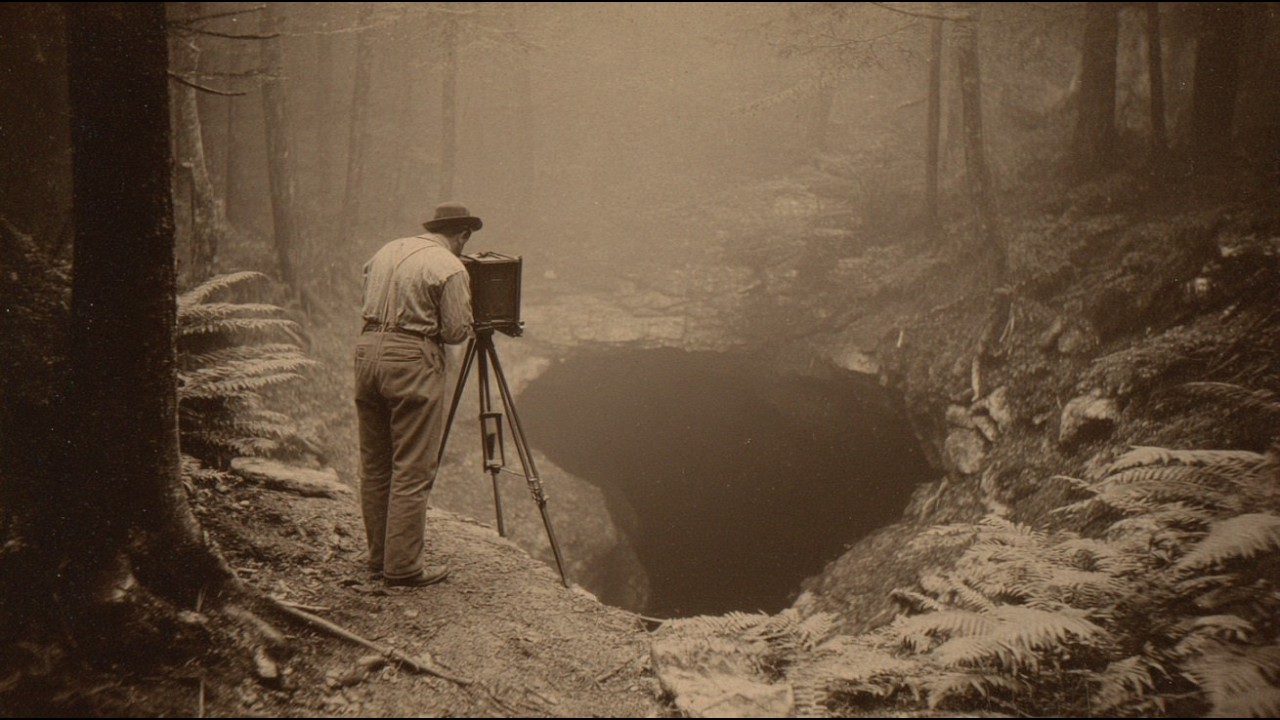
He drove on a road that became less of a road the further he went, until it was more of a suggestion, two tire tracks through tall grass bending around the base of a ridge. He camped at the edge of the property for three days before he found the main entrance. He had been told it was near a stand of dead oak on the eastern slope. What he found was a depression in the hillside, maybe eight feet across, ringed by a growth of pale fern that didn’t match anything else growing nearby.
He stood at the edge of it for a long time. The air coming up from below was cold, not cool, cold, and it smelled like something mineral, something deep, the kind of smell that has no equivalent above ground. He noted it in his field log: primary entrance located, unusual cold draft, temperature differential of approximately eighteen degrees Fahrenheit between ambient and exit air, fern growth suggesting persistent moisture, no evidence of previous survey or entry. That last part was true, technically.
But the stones along the rim of the entrance, arranged end to end in a rough circle following the edge of the depression, he noticed them, though he didn’t record them on that first day. Someone had been here before him. They just hadn’t left any paperwork. He went in the next morning.
He was equipped the way he always was: carbide lamp on his helmet, a backup electric torch strapped to his belt, two more in his pack, three days of food and water, rope, anchors, a hand-drawn grid for building his map as he went, and something new. In the spring of 1947, Aldine had acquired one of the early sixteen-millimeter film cameras being used by documentation crews on federal survey projects. He had signed it out from the Knoxville office on the last day of June, listing the purpose as geological documentation, standard. He’d used it twice before on easier systems.
He brought it because the Hollow Deep was expected to be significant. The entrance passage dropped sharply for the first thirty feet, then leveled into a low crawl for about twenty more. Then it opened. Aldine described the transition in his field notes as sudden and disorienting.
One moment he was crawling on his hands and knees with the ceiling brushing his back. The next, he was standing in a chamber his lamp couldn’t fully illuminate. He swept the beam around and estimated the space was at least sixty feet across and probably thirty feet high, though in the darkness it was difficult to be certain. He spent the first hour in that chamber doing nothing but standing still, listening, feeling the air move, getting a sense of the geometry before he made marks on paper.
There were at least four passages leading out of it. He labeled them north, south, east, and west on his grid, though underground compass readings are unreliable. The labels were relative. They gave him a reference point.
He started with the east passage because the airflow seemed strongest in that direction. Air movement in caves means one of two things: either there’s another entrance somewhere, or the system is very large. In this case, it was both. The east passage ran for several hundred feet, gradually descending before splitting into two branches.
Aldine took the wider branch and followed it for the better part of the morning. He found formations he hadn’t seen in sixteen years of underground work: columns of translucent mineral that caught his lamp and scattered the light in ways that reminded him of something he couldn’t name. He filmed them, setting the camera on a flat section of floor and angling it upward while he moved through the frame with his lamp. The footage, when eventually developed, showed the columns clearly, showed Aldine small against the scale of the formation, showed the light scattering.
And if you looked very carefully in the corner of the frame, in the passage beyond where Aldine was standing, there was something. But that would come later. He spent eleven days in the Hollow Deep. On the surface, he ate at camp, slept in his tent, and logged the day’s findings in his notebook.
Underground, he worked with the quiet, sustained focus Hewish had described. By the fifth day, he had covered approximately half a mile of passage. By the eighth day, he had found the lower chambers. The transition was marked by something Aldine had never encountered in sixteen years underground: a smell.
Not the mineral cold of the upper passages, but something organic. He noted it in his field log on the morning of the eighth day. Detected unfamiliar biological odor beginning approximately forty feet past pit three. Distinct from guano, checked formation for bat colony, none present.
Dissimilar to known fungal profiles, will continue to monitor. The smell wasn’t strong, but it didn’t go away. It was stronger on some days than others. The lower chambers were smaller than everything above, more intimate.
A series of interconnected rooms, most no bigger than a modest living space, connected by passages that were navigable but not easy. The formations here were different, too. No columns, no flowstone in the shapes he recognized. Instead, the walls were covered in a pale fibrous coating he couldn’t immediately identify.
It wasn’t calcite, it wasn’t typical cave coral. Under his lamp, it had a faint texture, almost like fabric, but it wasn’t. It was mineral. It grew in sheets and clusters.
He scraped a small sample into a glass vial and sealed it. Later testing would identify it as an unusual calcium silicate deposit, the kind typically associated with hydrothermal activity. There should not have been hydrothermal activity at that depth in that part of Kentucky. On the night of the ninth day, he had stayed later than usual, following a passage that kept opening into new rooms.
He was making his way back toward pit three when he heard something. He stopped. He turned off his lamp. Underground, when you turn off your light, there is no adjustment period.
The dark is complete, instantaneous, total. Aldine had been doing this for sixteen years. He stood in the dark and listened. The sound was faint.
It had a pattern, something rhythmic, something that started and stopped and started again. He stood in the dark for what he estimated was ten minutes. Then he switched his lamp back on and made his way out. That night he wrote three sentences, crossed them out, and started again.
What he finally settled on was this: Auditory phenomenon detected in lower chamber C during egress. Intermittent. Regular intervals suggests non-geological origin. Will attempt documentation tomorrow.
He went back the next day with the camera. He set it up in the passage outside lower chamber C, aimed inward, and waited four hours. Nothing happened. He picked up the camera and moved it into the chamber itself, set it on a flat section of floor near the north wall, pointed it into the deepest part of the room where the passage continued into darkness.
Then he sat down against the opposite wall with his lamp turned to its lowest setting and waited again. Four hours in a space not much bigger than a bedroom, in near darkness, in complete silence, alone, a hundred and fifty feet underground. Most people last about forty minutes before the claustrophobia becomes unmanageable. On the second hour, the sound came back.
He described it with his characteristic precision: rhythmic, occurring at intervals of approximately eight to twelve seconds, duration of each instance approximately three seconds, quality difficult to characterize. Not percussive, not vocal. Resonant. As if produced by something large moving against stone, but the movement itself was not audible.
Only the resonance. The camera was running. When the film was developed, two weeks later, back in Knoxville, the footage from that session ran for just over three minutes. Most of it showed the empty chamber, the passage entrance, the fibrous wall material catching the dim light.
And for eleven seconds near the end of the reel, something moved in the passage beyond the chamber. The image was not clear. Sixteen-millimeter film, low light, a stationary camera. What the footage showed was a change in the quality of the darkness at the passage entrance, a difference in depth.
Something that, if you followed the shape of it, appeared to be moving away from the camera. Not toward it. Away. As if it had been standing there for some time in the dark just beyond the edge of the light and had decided to leave.
Aldine did not leave the Hollow Deep when he found that footage. He went back on the eleventh day, with the camera, fresh film, a second lamp, and a length of cord tied to his belt and anchored at the entrance to lower chamber C. A fail-safe. He set up the camera.
He sat down. He waited. This time he didn’t have to wait four hours. After approximately forty minutes, the sound returned, closer.
It filled the chamber in a way that was difficult to describe, not loud but present in a way that felt physical. It made the fibrous material on the walls vibrate slightly. The temperature dropped during the sound and rose again after it stopped. He did not move.
For twenty-two minutes, the sound came and went. And then his cord went taut. He wrote about it afterward with the same precision. Tension was steady, not forceful.
I did not pull the cord. The tension released after approximately forty seconds. I remained stationary for a further fifteen minutes before exiting. No visual contact made.
He left the cave system that afternoon. He broke down his camp the next morning. He drove back to Knoxville. He filed a standard report: geological survey complete, system mapped to the extent required by the contract, formations noted and documented.
He sent the film to be developed. And then he went back to work. When the developed reels came back from the processing house six weeks later, Aldine went through them alone in the small projection room at the Knoxville office. He watched them twice.
He made notes. Then he locked the reels in his desk drawer and didn’t show them to anyone for eleven months. What changed in the summer of 1948 was that a colleague named Gervais Pollett, who worked in the cartography department and had a habit of going through other people’s files when they were out of the office, noticed something in the drawer and mentioned it to Hewish. Hewish mentioned it to Aldine in a Monday morning meeting, framing it as administrative housekeeping.
Were there any documentation materials from fieldwork that hadn’t been formally logged? Aldine said yes. He brought the reels in the next day. He sat in the projection room with Hewish and two other members of the survey team: Vera Salt, who handled mineralogy, and Orson Keith, the office’s most experienced field surveyor.
He let them watch the footage. He watched them watch it. Vera Salt asked halfway through the second reel what she was looking at. He said he didn’t know.
When the lights came up, Keith said the image quality was too poor to draw any conclusions. Hewish agreed. He suggested the movement visible in the passage could be a trick of the lamp, a reflection artifact, an issue with the film stock. Aldine said yes, that was possible.
He said he’d noted some unusual acoustics in the lower chambers that might warrant a follow-up survey. Hewish said he’d see if the budget allowed for it. Nobody mentioned the sound. Nobody mentioned the resonance.
Aldine hadn’t included that reel in what he showed them. He had kept the one with the sound, the one where, if you watched very carefully and turned the volume up, you could hear something that was not ambient cave noise, not air movement, not rock settling. Something that rose and fell, something that if you listened long enough began to resolve into something that had a shape. Not language, not anything recognizable as language, but shaped the way language is shaped.
With intent. He went back to the Hollow Deep in the spring of 1949. By then, he had spent eighteen months thinking about what he had found. He had also done something he had never done before in his career: he had gone looking for information that wasn’t geological.
He had driven twice to Harlan County and spoken to older people, people who had grown up in those hills. He had spent two long afternoons and one very long evening sitting in other people’s kitchens, drinking coffee. What he heard was not consistent. One woman, sixty-eight years old, whose family had farmed that valley for three generations, said the hollow was old, that it had always been known about, and that it was not a place people went.
He asked her why. She looked at him for a moment with the specific look people give when they are assessing whether you’ve earned the answer. She said, there is something down there that doesn’t move the same way things move. He asked what she meant.
She said she wasn’t explaining it. She was telling him what her grandmother had told her. He wrote in his notebook that night: Account consistent with acoustic phenomena observed in situ. Description of movement anomaly aligns with visual artifact in film documentation.
Appears to be long-standing local knowledge, not formal record. Then he wrote: They knew. They have always known. They just didn’t try to quantify it.
He returned to the Hollow Deep on the fourteenth of April, 1949. He was alone. He had not told Garrett Hewish he was going. He took a week of personal leave, loaded his car, and drove to Harlan County.
He parked at the edge of the property and walked to the entrance in the early morning light with everything he needed for five days underground, including a new camera, a better one. He had spent most of his savings on it: an early test model of a sixteen-millimeter camera designed for low-light scientific documentation, with a faster film stock and a wider aperture. He also brought a phonograph recorder, the kind used in radio production at the time, heavy and unwieldy, not designed for field work. He had modified the carrying case himself.
If the thing in the lower chambers made sounds again, he was going to record them. The first two days passed without incident. He moved through the upper chambers, verified his earlier maps, checked his markers. On the third day, he went down past pit three.
The smell was there, stronger than he remembered. Biological, yes, but not decay, not rot. Something alive. He continued to lower chamber C.
He set up the camera. He set up the recorder. He positioned himself against the north wall where he had sat before. And he waited.
Something came on the second night. Not the sound first. The temperature dropped first. He noted it precisely in his log: a reduction of approximately twelve degrees Fahrenheit occurring over three to four minutes beginning at approximately 11:20 in the evening.
Recorder running. Camera running. Then the sound. He wrote that the resonance was not simply audible this time.
It had a physical dimension. He could feel it in his chest, in his back against the wall. It seemed to originate from the passage at the far end of the chamber, but also from more than one direction simultaneously, as if the stone itself was conducting it from multiple sources. He kept writing.
He wrote, I can see movement in the passage. It is not the same as what appeared on the previous film. This is not a subtle shift in the quality of the dark. There is something there, and it is not moving away.
He wrote, It is not moving toward me. He wrote, It is stationary. It has been stationary for what I estimate is six minutes now. I have not moved.
My light is at its lowest setting. The camera is running. The recorder is running. He wrote, I am going to turn the light up.
There is a gap of approximately an hour in the notes. The next entry reads: I did not turn the light up. I am still against the north wall. The recorder has run out of blank disk and the camera has run out of film.
I cannot determine how long I have been here. Something has changed in my ability to track time. I believe it is between one and three in the morning. The sound stopped approximately thirty minutes ago.
The temperature has partially returned. I can no longer detect movement in the passage. I am going to leave now. I am going to leave and I am not going to return.
Then: In the hour following my last entry, while the sound was present and the movement in the passage was present, I heard distinctly and without ambiguity something that was not the resonance. It was different in character. It was specific. I do not want to write down what I believe I heard because I do not want to give it more weight than the evidence warrants.
But I heard my name. He left the next morning. He drove back to Knoxville and reported for work. He filed no paperwork related to the second visit.
It was officially leave, a personal absence, nothing to document. He developed the film and processed the recordings himself in the evenings, in the small darkroom he had converted from a storage closet in his apartment. He listened to the recordings alone. He watched the film alone.
Three weeks after his return, he wrote an entry: I have reviewed the documentation materials from the second survey. I will not reproduce what the film shows in writing. The recording contains material that I believe requires institutional review before any further steps are taken. Institutional review.
He was a cautious man, a precise man. He meant he needed help. He didn’t know who to ask. He wrote to four people in the autumn of 1949: a colleague at the University of Tennessee who specialized in acoustic phenomena, a geologist at the Kentucky State Survey Office, a researcher at the Smithsonian’s Natural History Division who had published work on cave biology, and someone whose name appears in the surviving correspondence only as a set of initials: RWH.
The first three received polite responses. The Tennessee colleague asked if he could review the acoustic recordings. The Kentucky geologist asked for the survey coordinates. The Smithsonian researcher didn’t respond.
RWH responded within a week. The letter, two paragraphs long, exists in photocopy. The first paragraph acknowledged Aldine’s letter and said, without any apparent surprise, that the location in question was known to RWH, his department, and had been for some time. The second paragraph said: you should not return.
Whatever documentation materials you have gathered should be submitted to this office before you discuss them further with anyone else. We are aware of the acoustic phenomena you have described. We are aware of the film. Please do not develop further copies.
Aldine had already made three copies. He kept one. He sent one to his colleague in Tennessee. He kept the third in a lockbox in a bank in Louisville.
He never responded to RWH. He never submitted anything. And he never found out how RWH had known about the film. The winter of 1949 was when things began to break apart.
Aldine began having difficulty sleeping. This is documented not in his own notes, but in a letter from his sister Cecile, who lived in Chattanooga and visited him in December. She wrote to their cousin afterward: Rupert looks like he hasn’t slept properly in weeks. He’s working constantly, papers everywhere, those awful photographs on the wall.
I asked him about work and he was evasive in a way that isn’t like him. He was always difficult, but this is different. He’s frightened of something. He won’t say what.
Those awful photographs on the wall. Cecile didn’t describe them further. We don’t know what was in them, except that they existed and that they were enough to disturb someone who knew Aldine well. He submitted a formal research proposal to his office in January of 1950.
A third survey of the Hollow Deep system. He wanted to go back. The proposal was returned in February with a note from Garrett Hewish. Survey contract for the above location has been closed by the contracting party.
Property has been transferred. No further survey work is required or authorized. Aldine went to Hewish directly and asked who had taken over the property. Hewish said he had been instructed not to share that information.
Aldine asked who had instructed him. Hewish was quiet for a moment. Then he said carefully that it had come from above the office level and that as far as he was concerned, the matter was closed. Aldine was not the kind of person to let things lie.
He wrote letters. He made telephone calls. He drove to the county recorder’s office in Harlan County and stood at the counter for forty minutes while a clerk looked up the property transfer on the Hollow Deep parcel. The clerk came back and said there was no record of a transfer.
The property was still held by the same land trust as before, had been since 1946, and there had been no transaction of any kind recorded. Aldine wrote in his notebook that evening. The property has not been transferred. Hewish was told to say it had.
Someone is managing access to that location. And they are doing it through channels that leave no paper trail. RWH. The Tennessee colleague returned the acoustic recordings in the spring of 1950.
He returned them without comment. No letter, no analysis. Just the recordings in their original case, placed on Aldine’s desk one morning. Aldine asked Hewish’s secretary if anyone had come by.
She said a man had dropped off a package, but she hadn’t gotten his name. She hadn’t needed to ask, she explained, because he was someone she’d assumed Mr. Aldine already knew. He had come through the front office and gone straight to the back without stopping.
She described him as of middling height, unremarkable in appearance, and that the only thing she’d noticed particularly was that he had seemed in a great hurry to be gone. Aldine wrote to the Tennessee colleague. He never received a response. When he telephoned the university two weeks later and asked to speak with him by name, the department secretary told him there was no one on faculty by that name.
He had published papers. He had a letterhead. He had visited Aldine’s office twice in previous years. He was apparently now someone who had never existed.
By the summer of 1950, Rupert Aldine had been told, in a variety of ways, to stop. He had not stopped. He had become more careful. He moved the lockbox in Louisville to a different bank.
He made additional copies of the film and the recordings and sent them to people he trusted with instructions not to open the packages unless something happened to him. And he began keeping a separate notebook, not the field journal he had always used, but a smaller one bound in dark cloth that he carried in his jacket pocket. That notebook surfaced in an estate sale in 1978 among the belongings of Cecile. The estate agent priced it with the other books at a quarter.
The person who bought it didn’t realize what they had for several years. When they did, they contacted an archivist at a university in Nashville. The archivist made a copy and kept it. That copy is the record of what follows.
The small notebook covers the period from late 1949 to early 1951. Most of it is technical notes, the kind of writing Aldine had always done, precise and spare. But there are sections written at night in a different kind of handwriting, faster, less controlled. One, dated the fourth of November 1950, reads: I have been thinking about what lives in places that have never seen light.
Not thinking about it the way I used to. Not as a geological question, as something else. Things that live in absolute dark adapt. They lose their eyes because eyes are useless.
They lose their pigment because pigment is a response to light. They keep what serves them and shed what doesn’t. But what about cognition? What does a mind become when it has never needed to interpret what it sees?
When every navigation, every interaction, every awareness has been built entirely on other senses? I have been listening to the recordings. I have been listening to the part I told no one about. The part near the end of the second night’s recording, after the main resonance stopped.
There is a sequence in that recording that I have now transcribed. It took me four months. It is fourteen seconds long. I do not know what it means.
But it has a grammar. Whatever produced it was not making random sounds. It was trying to communicate. I don’t know if it was talking to me or if it had been talking for a very long time to itself.
And simply for one night let me hear. He made two more attempts to gain access to the Hollow Deep system. The first, in the autumn of 1950, ended at the edge of the property. The road was blocked, not by a gate or a fence, but by two cars parked across it and by two men who got out when he arrived and stood beside the road without speaking.
He turned around and drove away. The second attempt, in the spring of 1951, was more involved. He drove in on a different road, one he had found on a county surveyor’s map that ran along the opposite ridge. He parked out of sight.
He hiked for three hours across rough country. He got within about a quarter mile of the entrance before he stopped. He stopped because something about the approach felt wrong. He stood on a hillside in the early morning light and tried to understand what was bothering him.
Then he wrote in the small dark notebook: The birds. There are no birds in the trees on this hill. There are birds on every other hill I’ve passed through. But not here.
They stopped about the same time I crossed the ridge. As if this place is known by every living thing in it not to be somewhere you do not make noise. He turned around. He never went back.
What happened to Rupert Aldine after that was not dramatic in the conventional sense. He did not disappear. He was not taken. He lived quietly, worked, and retired from the geological survey office in 1961, having spent thirty-two years in the field.
He died in Knoxville in 1973 at the age of sixty-four. He never published anything about the Hollow Deep. The film reels he sent to trusted contacts, most were never seen again. Two people he had sent copies to died before him without discussing the contents with anyone, as far as is known.
One copy went to a man in Nashville who moved in the early fifties and left no forwarding address. The copy in the Louisville lockbox was claimed by a woman who identified herself as Aldine’s legal representative six months after his death. She showed documentation that satisfied the bank’s requirements. The documentation was later found to be fraudulent.
No one was charged. The film was gone. What survived was the small dark notebook from the estate sale. The field journals from the original survey.
A partial set of photographs, not the underground ones, those are gone, but exterior shots: the hillside, the entrance, the pale fern ring at the edge of the depression. And the survey map Aldine drew over eleven days in the summer of 1947, penciled onto grid paper with the meticulous care of a man who believed documenting the shape of the world was important work. The upper chambers are all there. The passages, the formations, the four exits from the main room.
The lower chambers are there too: lower chamber A, lower chamber B, lower chamber C. And then, past the point where the passage continues beyond chamber C, the passage where he saw movement, where the cord went taut, where the sound came from. He didn’t map it. He stopped at the threshold.
He noted in small handwriting at the edge of the grid a single phrase: Passage continues, depth unknown. Do not follow. There is one more thing. In the small dark notebook, on one of the last pages with writing on it, in a hand that seems steadier than the late-night entries, Aldine wrote: I have spent twenty years thinking about whether I should have turned the light up.
In that chamber, on that second night, when it was stationary in the passage, when the sound had stopped, and I was against the wall, and the camera was running. I have decided that I should not. Not because I was afraid. I was afraid, that is true.
But that is not the reason. The reason is this. There are things that exist entirely outside of what we are able to understand, not because they are supernatural, not because they violate any law of nature, but because the category of understanding that would contain them has not been built yet. And the question is not whether we are ready to know.
The question is whether knowing, whether that particular act of illumination, changes something about the thing that is known. I believe it does. I believe that what was in that passage had existed undisturbed for longer than I am able to calculate. And I believe that turning the light up would have been an ending.
Not my ending. Its. I couldn’t do that. Even underground at three in the morning with something in the dark that knew my name.
I couldn’t be the thing that ended it. There is one account given to an oral historian at a Kentucky university in 1967 by an elderly farmer who had grown up in the valley below the ridge that holds the Hollow Deep. He was asked about the cave, not about Aldine. The interviewer didn’t know about Aldine.
The farmer talked about the cave for twenty minutes, about what his grandfather had told him and what his grandfather’s father had told him, stretching back through generations that had farmed that valley and known that hill the way you know the face of someone you’ve lived beside for a long time. At the end, the interviewer asked if he had ever gone into the cave himself. He said no. She asked if he’d wanted to.
He thought about that for a while. Then he said: When I was young, I thought it was something to be afraid of. But my grandfather said that wasn’t right. He said it wasn’t something to be afraid of.
It was something to be respectful of. The way you’d be respectful of something that was here before you and will be here after. Something that has its own purposes that have nothing to do with yours. He said the problem with people who went in there wasn’t that they were brave.
It was that they forgot they were guests. The Hollow Deep is still there. The land is held by a private entity that files paperwork sporadically and has no public presence. No one has formally surveyed it since Aldine.
No spelunking clubs have documented it. It doesn’t appear in any regional cave registry. For all practical purposes, it’s a place that doesn’t officially exist. Which doesn’t mean nothing lives there.
It just means nothing human has been back. Not as far as we know. Aldine’s last field journal entry, not from the Hollow Deep but from a routine survey project in western Virginia in 1960, contains one line that doesn’t relate to the work. He was mapping a small limestone system, unremarkable, a two-day job.
At the bottom of the day’s notes, below the last coordinate, he wrote: Sometimes in new caves, when I first turn the lamp off to listen, there is a moment before the silence settles, when everything feels possible, when the dark feels full. I don’t know if that is something I learned to feel or something I learned to remember. The difference matters less than it used to.






