In the spring of 1874, a railroad survey crew working the low hills of the Missouri Ozarks moved three stones from an old cemetery outside a village nobody now remembers. The stones had been set flush with the ground over three graves, and the crew set them aside without ceremony because a rail line was to run across that ground, and the graves would need to be relocated. The stones weighed something between four and five hundred pounds each and had been cut from a rock that was not local. The joints where they met the surrounding earth were tighter than a knife blade could enter.
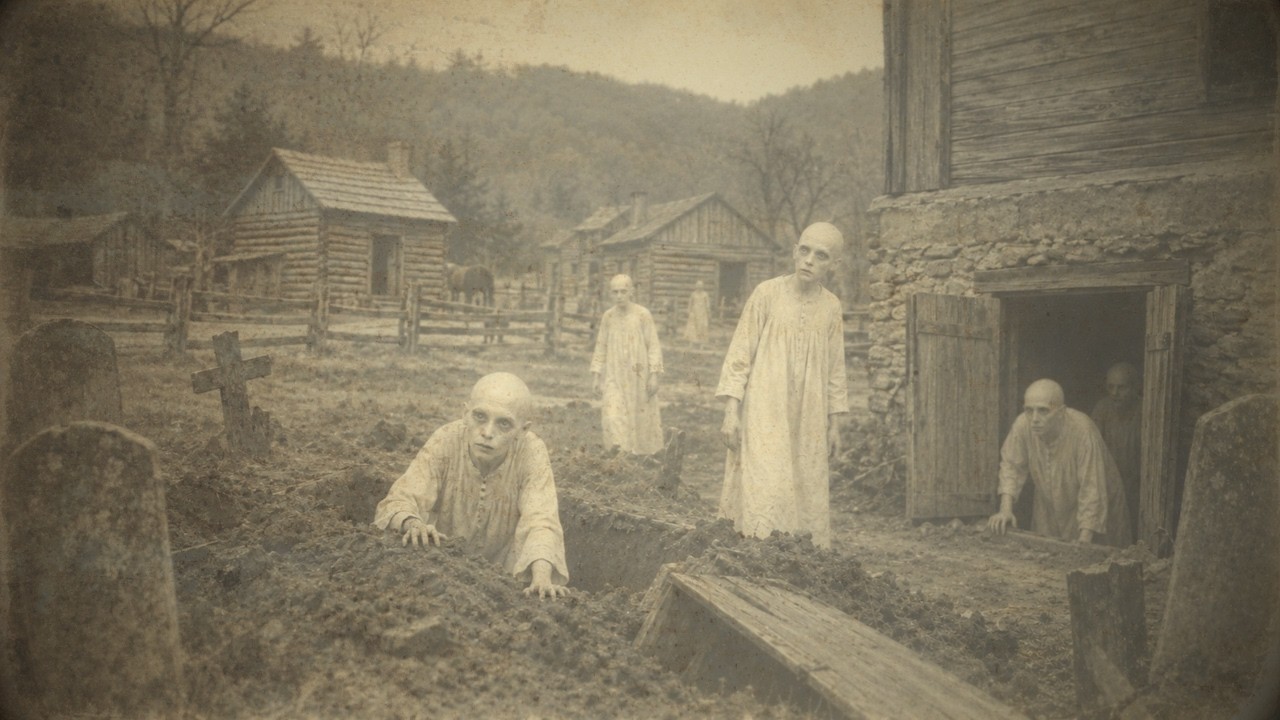
No one in the village knew who had cut them. No one in the village knew when they had been placed there. What the village knew was that the stones stayed where they had been put and had stayed there for as long as anyone had been living in the country, and that removing them was not something a person in Barrow Bend did. The crew were from Fort Smith and from Springfield, and they had not been told what the stones were for.
They set them aside on the morning of April 8th. Three days later, a village boy named Silas Prow walked out to the cemetery in the last light of the evening and stood for a long time looking at the three empty places. He walked back home and did not tell his father what he had seen. On the morning of April 14th, the first of the three men who had lifted the stones was found kneeling at the edge of the first grave.
His forehead was pressed to the raw earth. His hands were folded behind his back at the wrist in the manner of a man who has been bound, though there were no marks on the skin. His mouth and his nostrils were packed full of the graveyard dirt in a pattern that spread outward from his face in a shape the county doctor could not describe without drawing it. Barrow Bend sat in a shallow curve of the Piney Fork River in what was then called Galtry County, Missouri, and what is now not called anything at all.
The county was formally dissolved in 1911 and its territory absorbed into the two counties that had bordered it, and the record of its brief life was moved to Jefferson City in three wooden crates that were cataloged by a state clerk with no particular interest in what the crates contained. Galtry County had a seat at a settlement called Burnwater, which sat six miles down the river from Barrow Bend and which has also since been erased from the maps. What is left of Burnwater is a broken millstone in the woods and a section of foundation that a hunter can walk across without knowing what he is walking across. What is left of Barrow Bend is a cemetery in a stand of black oak on the north side of the river.
And the cemetery is what this story is about. Barrow Bend was founded by a man named Jedidiah Barrow in 1822. He was a Kentuckian by birth and a Virginian by education. He had come west with his wife and three children and two hired men across the Cumberland Gap and down through the middle of Tennessee, crossing the Mississippi at St.
Genevieve before riding into the Ozark Hills to find land. The land he found was a bend in a slow river at the base of two low ridges, with a spring rising from limestone on the north bank and a stand of oak and hickory on the higher ground above the spring. What Jedidiah Barrow also found on that higher ground when he began to clear it for his house was a small clearing that had been made before he arrived. The clearing was rectangular.
It was perhaps half an acre. At the northern end there was a line of stone set flush into the ground. The stones were dressed. They were pale gray.
They formed a grid and were spaced evenly. Jedidiah counted them and found that there were 47. He also found that when he tried to lift the first stone with an iron bar, the bar would not enter the joint between the stone and the surrounding earth. The joint was too tight.
He tried the other stones in the line and found the same thing. He tried a knife. He tried a folded piece of paper. Nothing would enter the joint.
The clearing above the spring had been there before him, and the stones in it had been there before him, and there was no way for him to know how long they had been there because there was no one within a hundred miles of that river bend who could tell him. The Osage had moved west by the time Jedidiah arrived. The Cherokee had not yet come. The trappers who worked the country did not stop long enough to notice a small clearing in the woods above a bend in a river too shallow to run flatboats.
Jedidiah Barrow made two decisions in the summer of 1822. The first was to build his house on the higher ground above the stones and to make his family’s home there and to raise his children in view of a small rectangular clearing whose purpose he did not understand. The second was to leave the stones exactly where he had found them, building no fence around them, planting no crop across them, allowing the clearing to stay as it was. He did not know why he made this second decision.
He would say later, in the one letter of his that survives, that he had made the decision the way a man makes any decision that comes to him complete before the reasoning has arrived. When he had stood on the clearing that first summer and looked down the length of the line of stones, he had understood without being told that the stones were where they were on purpose, that the purpose was not his purpose, and that moving them would be a kind of interference for which he had no authorization. He had written to his brother in Louisville that the stones felt of a piece with something that had put them there, that the something had not gone away, and that he did not intend to give it any reason to notice him. The village that grew up around Jedidiah Barrow’s house grew up around that clearing.
The clearing became the cemetery. Not because Jedidiah decided to make it the cemetery, but because his oldest child died of a fever in the winter of 1844, and the ground in the clearing was the ground that could be dug, and Jedidiah dug the grave himself between two of the stones. When the grave was covered, he found three days later that a new stone had been placed over the fresh earth. The new stone matched the other 47.
It was dressed. It was pale gray. It was set flush with the earth. Its joints, when Jedidiah tried them with a knife, were tighter than a folded paper.
He had not seen it placed. Neither had his wife. Neither had the two hired men who helped him dig the grave. The new stone was simply there on the morning of the third day, and there were no tracks around it.
The stones now numbered 48. Jedidiah told this story to his brother in a letter written in the winter of 1844. That letter is the earliest surviving document about what came to be called the Barrow Bend Cemetery. It was found in a family archive in Kentucky in 1957 by a Missouri historian named Bruno Kelp, and it is now in the Missouri State Historical Society in Columbia, cataloged under the papers of the Barrow family, and read in the seven decades since by perhaps twelve people.
By the spring of 1874, the cemetery was the resting place of 131 people. Of those, 47 had a stone plug set flush over their grave. The other 84 had a common headstone, a wooden marker, or nothing at all. The distinction was not one the village explained to outsiders, and it had nothing to do with wealth or standing.
Some of the plug graves belonged to people who had been paupers in their living years, and some of the marker graves belonged to Barrows themselves, the wealthiest family in the village for four generations. The distinction had to do with what the village called the crown, and the crown is the pivot on which the events of April 1874 turn. First, however, the stones. Every time a plug grave was made, a new stone appeared in the manner Jedidiah Barrow had described, on the morning of the third day after the burial.
No one in the village had ever seen a stone placed. No one had ever seen a stone brought. The stones simply were there on the third morning in the joints where they should have been, tighter than a knife blade could enter. Between 1844 and the spring of 1874, 127 stones had appeared in this fashion.
Some matched dead men. Some matched dead women. Some matched children carried out at three days old. The total number of stones in the cemetery in the spring of 1874 was 174.
The original 47 plus the 127 that had appeared over the years. They were all the same, dressed pale gray, set flush with the earth, joints too tight for a folded paper. When Bruno Kelp brought a geologist named Tobias Orca out to the cemetery in 1979, Orca took a chip from an unmarked stone at the eastern edge of the ground and drove it to the state geological survey office in Rolla, where it was sectioned and examined under a petrographic microscope. Orca’s finding, recorded in a three-page memorandum now in the Kelp papers, was that the stone was pale gray quartzite of a mineral composition and crystal structure that matched precisely the Baraboo range formation of south-central Wisconsin, 450 miles to the north.
Orca wrote that he could not account for the presence of Baraboo quartzite in the Missouri Ozarks. He wrote that the stones had been quarried and dressed with a precision that his own generation of geologists could not match with hand tools, that he could not imagine what tools had been used, and that the dressing matched no documented prehistoric stonework tradition of the middle Mississippi Valley. In the last paragraph he wrote that he had walked the entire length of the cemetery clearing before leaving, crouched at each stone, and tried to slide the blade of his geological hammer into the joint at the earth line, and failed at all 174 stones. He wrote that he had come away with the impression that the stones were doing something.
He struck the sentence through, then wrote it again below the strikethrough, leaving both versions, and in the margin of the second version wrote the words, as I understood the phrase while I was there. Orca retired from the state geological survey in 1984. He did not return to Barrow Bend. He did not respond to Kelp’s later letters.
He is listed in the alumni bulletin of the University of Missouri as having died in Springfield in 2006 of a cause not specified. What the village called the stones in its private language was the plugs. As a person plugs a barrel. As a person plugs a hole in a boat.
The word plug appears three times in the marshall’s report of 1874 without further explanation because Marshall Felim Stroud understood that the villagers were not going to explain it any further to him and that if he pressed them they would stop talking to him altogether. The marshall was from Burnwater. He was not a Barrow Bend man, but he had ridden the Galtry County roads for eleven years, and he knew when a village was going to answer his questions, and when a village was going to stop. When a Barrow Bend man called the stones the plugs in the marshall’s presence on the afternoon of April 14th, 1874, the marshall wrote the word down in his fieldbook, put a small asterisk beside it, and did not ask what it meant.
Marshall Felim Stroud was a competent man, and he was also a man who knew when to leave a question alone. The 47 original stones were arranged in a grid that was regular but not perfectly square, seven rows on the north-south axis and rows of unequal length on the east-west axis. The whole grid was oriented so that the long axis of the cemetery pointed toward the sun as it stood on the morning of the spring equinox. Four documents note the alignment, the marshall’s report, the Helmsing account, Orca’s geological memorandum, and the Vessey diary, and they all agree within a degree.
The grid was not laid out for the geography of the clearing. The clearing had been made to accommodate the grid. Whoever had cut the plugs, set them, and left them in the ground had chosen the site because of what the site pointed toward, and had cleared away the timber that would have obstructed the view. The stones were placed with intention.
The intention was not local, and the intention was old. Jedidiah Barrow lived until 1854, and he was buried in the cemetery he had not made, and a stone appeared over his grave on the morning of the third day after his burial, and the stone matched all the others. His son Ansley Barrow buried him. And Ansley Barrow was, at the time of his father’s death, wearing the bronze band under his hat.
This is where the crown enters the record. After Jedidiah buried his oldest child in 1844 and found a stone plug over the grave three days later, he did what any careful man in the country would have done. He tried to figure out what he was dealing with. He wrote letters.
He asked the two French trappers who came through his settlement in the autumn of 1845. He asked the itinerant Baptist preacher who worked the settlements along the White River. He got answers from nobody, because nobody had ever heard of a small clearing above a spring with a grid of 47 pale gray stones set flush in the earth, and no one could tell him what such a place was or what it was for. What Jedidiah eventually did was build a small structure over the eastern edge of the clearing, of oak, with a locking door, and in that structure he put the things he had found over the years that seemed to belong to the clearing and not to him.
There were four such things. The first was a bronze band roughly the width of two fingers, found in the woods a hundred yards north of the clearing in the spring of 1833. The band was closed. It was not a bracelet, being too small.
It was sized to fit around a human head roughly at the level of the temples, to sit under a hat so as not to be visible from the outside. When Bruno Kelp had the surviving band chemically analyzed in 1962, the report came back that the alloy contained copper and tin in a ratio consistent with pre-Roman Mediterranean bronze work, along with trace elements that matched no known bronze source and that the metallurgist listed simply as unidentified. The band was engraved on its inner surface, at the point where it would sit against the wearer’s forehead, with a small mark that was not any letter of any alphabet the metallurgist recognized. The second thing Jedidiah found was a small stone tablet roughly the size of a man’s palm, of the same pale gray quartzite as the plugs, with a similar but not identical mark carved into it.
It was found in the loose earth at the edge of the clearing in the summer of 1836 while Jedidiah was planting a hedge. The third thing was a wooden box about the size of a hatbox, its lid fastened by a bronze pin, found buried at the same spot at a depth of perhaps four feet. Inside were 13 more bronze bands of the same design, sized for human heads of varying sizes, some for adults, some for children, one for an infant. All were engraved on the interior surface at the position of the forehead with individual marks similar to but not the same as the mark on the first band.
The fourth thing was a rolled piece of parchment, or of something not quite parchment, folded inside the box under the bands, covered in writing in no alphabet Jedidiah recognized and in none the itinerant Baptist recognized when Jedidiah showed it to him in 1848. The parchment was translated to Jedidiah in a manner he described in the letter to his brother as follows. In the winter of 1857, on a night when he had been sitting alone at the kitchen table by the fire reading the parchment for the tenth or eleventh time by lamplight, the meaning of the writing had arrived in his head. He wrote that he had not translated the writing, that the writing had presented itself.
He understood, sitting at the table that night, four things, and he wrote them down in his letter in the order he understood them. First, the stones in the clearing were plugs, and they were set over graves, and the graves were not empty. Second, what the graves contained was not the body of a dead person but something that had been living in the ground under the graves before Jedidiah arrived, before any European arrived, before any human arrived, and that had been placed in the graves and held there by the plugs. Third, the something in the graves would come up if the plugs were removed.
Fourth, the bronze bands were for the living. Whoever wore a band was known to the something below, and would upon their death be given a plug of their own, and would in this way become part of the arrangement that kept the something below from coming up. Whoever did not wear a band would not be given a plug, would be buried in the ordinary way, and would not be part of the arrangement, and would not interfere with it either. Jedidiah understood these four things all at once, sitting at his kitchen table in the winter of 1857.
When he had understood them, he went out into the cold night air and walked to the clearing, stood at the northern end of the grid, counted the plugs, and counted them again. He walked home, lit a second candle at the kitchen table, put on his hat, and from the wooden box took the band sized to fit his own head, slipped it onto his forehead, settled his hat down over it, and went to bed. This is what the village called the crown: the bronze band worn under the hat from the age of twenty-one until death by every adult householder of Barrow Bend, by every married woman, and by every unmarried son or daughter who had reached majority and elected to stay in the village. Children under twenty-one did not wear the crown.
Visitors did not wear the crown. Hired men who came in from Springfield or Fort Smith for the harvest did not wear the crown. Bruno Kelp’s estimate, based on the marshall’s report, the Vessey diary, and the Prow cemetery roster, is that at any given time between 1850 and 1860 there were perhaps thirty to forty crown wearers in Barrow Bend at once. By the spring of 1874 there were 47.
The number was neither coincidence nor deliberate. It was arithmetic. The village had grown, and the number of adult householders had grown with it, and the village had reached 47, the same as the number of original plugs Jedidiah Barrow had found in 1822. The wooden box in Jedidiah’s oak building had contained fourteen bronze bands, one of which Jedidiah had put on, and the box had been added to as more were needed.
Where the added bands came from was the question Bruno Kelp spent the last decade of his working life trying to answer, and did not answer. Kelp’s notes contain a passage recording that whenever the village had needed a new crown, one had been found: sometimes in the woods, sometimes in the loose earth at the edge of the clearing, sometimes on the doorstep of the elder Barrow’s house on the morning the new crown was needed, and not before. Kelp wrote that between 1822 and 1874 the village had needed 165 new crowns and had received exactly 165, never once making one for itself and never once finding a crown surplus to the need. He wrote in the margin that he was aware of how the passage sounded, and that he was writing it down anyway because the historical record was clear on the point.
When a crown wearer died, the crown was taken off the corpse before burial. It was not buried with the wearer. It was returned to the wooden box, maintained by the elder Barrow of the generation, who kept a record of which crown had been worn by which villager and who placed the crown on the next wearer when that wearer reached twenty-one. The record was kept in a leather-bound ledger that the Prow family, cemetery caretakers from the 1830s onward, held on behalf of the elder Barrow.
The ledger is now in the special collections of the University of Missouri, donated by the last surviving Prow descendant in 1988 on the condition that it be cataloged under the general heading of local historical materials and not made searchable by name. It contains, in Jedidiah Barrow’s hand for the first twenty pages and in later hands after that, the name of every crown wearer of Barrow Bend from 1822 to 1891, when the village stopped keeping the ledger because there were no longer enough people to fill all 47 positions. Beside each name is the date the person put on the crown, the date the person died, and the date the plug appeared over the grave. In all 212 entries, the plug appears on the third day.
Not the second. Not the fourth. The third. This was the arrangement.
It had held from 1822 until April 1874, when the railroad company arrived. What broke the arrangement was not that the villagers stopped wearing the crowns. What broke the arrangement was that three of the plugs were removed by men who did not know what plugs were, who could not be told what plugs were in a way they would have understood, who were not wearing crowns and therefore were not known to the something below, and who removed the plugs at a moment when three of the crown wearers were coincidentally away in Springfield, and when the elder was in his sixty-ninth year and slower on his feet than he had been ten years before. The railroad crew arrived on the morning of Wednesday, April 1st, 1874.
They did not arrive at the cemetery that day. They arrived at the cemetery on the morning of Wednesday the 8th, a full week later, and by then the village had known they were coming, had made its request to the railroad company, and the railroad company had refused. Allen Barrow, the elder of the generation, had ridden to Rolla on the 3rd to plead the case in the county courthouse and had ridden back on the 7th, having failed, because the railroad company had a state charter and a right of way, and the courthouse was not in a position to intervene. At this point the Vessey diary becomes the most detailed source for the events of the spring.
Cornelia Vessey was the village schoolteacher, thirty-one years old, married to a crown-wearing farmer named Clint Vessey. She had begun the diary in 1868 and kept it every night of her life since. The railroad company was the Ozark and Fort Smith Railway, chartered by the Missouri legislature in 1869. By the winter of 1873 it had reached the vicinity of the Piney Fork River.
The company’s chief engineer, a Pennsylvania man named Halstead Brevard, had originally routed the spur line to cross the Piney Fork three miles south of Barrow Bend. The village heard about the routing in the fall of 1873 and voted unanimously to make no objection, because the crossing was three miles from the cemetery. Then, in the winter, the routing was changed. The original crossing point required a bridge span longer than the company’s Fort Smith investors were willing to authorize, and Halstead Brevard, riding the country himself in December, chose a new crossing point closer to Barrow Bend where the river was narrower and the bridge could be built in a single span at half the cost.
The new crossing point brought the spur line within three hundred yards of the cemetery. When the notice of the change was posted in the general store in the second week of January 1874, Allen Barrow read it, took it down off the wall, brought it to his own kitchen, and sent a boy to fetch Abel Prow. Abel Prow was the cemetery caretaker, fifty-three years old. The Prows had held the ledger and kept the records of the crown wearers and the plugs since 1841.
Abel walked into Allen’s kitchen at midday on the 11th of January and read the notice on the table. He read it twice. Then he said that the three hundred yards would not be a problem in itself, but that the survey crew would need to walk across the cemetery to lay their line, and that if they walked across the plugs, they would notice them, and if they noticed them, they would report them to the chief engineer, and the village would have to answer. Allen Barrow, in consultation with Abel Prow and Reverend Cade Helmsing, the Methodist circuit preacher who had served Barrow Bend for eleven years and knew about the crown and the plugs, decided to write to the railroad company and ask for the spur to be moved back to its original crossing point three miles south.
Allen wrote the letter on the 15th of January. He said the village had a small cemetery on the ground the spur would cross, that the cemetery was of religious and family significance, and that the village would prefer the spur be moved. He did not describe the plugs. He did not describe the crowns.
He did not describe the arrangement. Halstead Brevard replied on the 25th of January, courteous and firm. He said the company had already committed to the shorter crossing on financial grounds, that a country cemetery could be relocated at company expense to any acceptable ground within a reasonable distance, and that the company would take particular care with the removal of the flat gravestones which the surveyor had noted on his preliminary walk of the ground. Reverend Helmsing read that letter in Allen Barrow’s kitchen on the 27th of January and set it down on the table.
Cornelia Vessey’s diary for that evening records that Abel Prow said quietly that the surveyor had already walked the ground, that Halstead Brevard now knew about the plugs, and that this had changed the situation. If the village objected too strongly, Brevard would ask himself why, and if he asked himself why, he would send another man to look at them more closely. Allen Barrow’s letter to his nephew in Rolla, written on the 2nd of April, describes the decision the village made. The village had discussed the matter through February and March at three separate meetings in the general store and had arrived at a position by consensus.
The plugs could not be moved by the village because the village did not know how to move them. The plugs could not be removed by the railroad crew because if they were removed, the something below would come up. The village would go to the courthouse and ask for the spur line to be blocked on the ground that the cemetery was consecrated. If the railroad crew moved the plugs anyway, the village would have to prepare for what came next.
And what came next, Allen wrote, he did not know how to prepare for, but he would try. The Galtry County courthouse ruled against the village on the 6th of April 1874. The judge, Ellery Thornford, on the bench for nineteen years, wrote in his opinion that a state-chartered railway had a right of eminent domain over any ground within its authorized right of way, that a family cemetery was subject to relocation on adequate notice, that the railway had provided adequate notice, and that the village’s objection on religious grounds was noted but did not rise to the level required to block the charter. In an unusual final paragraph, quoted in full in the marshall’s report, Judge Thornford wrote that he had been asked by the village elder to consider that the cemetery contained material of an unusual nature which could not be relocated without unknown consequences, that he had considered this, and that he was unable to give it legal weight because the village elder had declined to describe the material further and had asked the judge to accept his word on the matter, and the law did not permit a judge to block a state-chartered railway on the unspecified word of a village elder.
Allen Barrow rode home on the 7th of April, arriving after dark. Cornelia Vessey’s diary for that night records that he sat on his own porch for two hours without saying anything, his wife Mercy sitting with him, and that at midnight he came inside and sent for Abel Prow. Allen said what the judge had said. Abel said that the survey crew was already at the crossing point downstream and had been for two days, and that they were expected at the cemetery within the week.
Mercy Barrow said that whatever came next would come, and that the village had done what it could. Allen is recorded as having said that there was one thing that had not been tried. The diary does not record what the one thing was, but the Prow ledger, in a page inserted at the back, contains a note in Abel Prow’s handwriting dated the 8th of April 1874 that reads simply: We tried. We tried to lift them.
The three of us, we could not. The plugs could not be lifted by the villagers. It had been tried at least once before, in Jedidiah Barrow’s own generation, and it had been tried again by Allen, Abel, and Mercy on the morning of the 8th of April 1874, and it had failed. What the plugs would move for, the village was about to find out.
The Ozark and Fort Smith survey crew arrived at the eastern edge of the cemetery clearing on the morning of Wednesday the 8th of April at approximately ten o’clock. The crew consisted of the surveyor Willard Furth, his brother Elias acting as chainman, a laborer named Jotham Coburn, and two teamsters whose names do not appear in any surviving record. They were accompanied by an assistant engineer from the railway named Yancy Dolan, who had ridden out from Fort Smith to supervise the removal. Willard Furth’s initial approach was cautious.
He had walked the ground in December and reported the presence of the flat gray stones to Halstead Brevard. He had not at that time tried to lift any of them. He tried on the morning of the 8th. He tried the northernmost stone in the westernmost row and found he could not.
He tried the second. He could not. He, Elias, and Jotham Coburn worked at the third stone for twenty minutes with a pry bar and could not get the bar into the joint. Willard sat down on the third stone at ten and took off his hat and wiped his forehead.
Then he sent Jotham back to the survey wagon for the horse team and the heavy chains. The horse team arrived at approximately noon. Willard wrapped the chains around the third stone as best he could, hitched the team, and drove them forward. The stone did not move.
On the second attempt, with the team pulling from a slightly different angle, the stone came free, coming up all at once. Something had released it from below. Willard Furth is recorded in the marshall’s report as having jumped back when the stone came free and having said at the moment the stone lifted that he had felt the ground shift beneath his feet, the way something turning over feels. Below the third stone, tipped aside, was a rectangular hole in the shape and size of a grave.
It went down perhaps six feet. It was empty. There was no coffin. There was no body.
There was no wood. There was nothing at the bottom but dark earth. Willard stared into the hole for a full minute. His brother Elias looked into it and said nothing.
Jotham Coburn crossed himself, though he was not a Catholic and had not been raised to cross himself and could not have said afterward why he had done so. Yancy Dolan wrote in his own field notes that evening, in a passage later transcribed by Bruno Kelp from the railway company archives, that the empty grave under the third stone had emitted no smell of any kind, which was the thing about it that struck him as unusual. A grave that had held a coffin, even for a very long time, should have retained some trace, and this one had not. It was the grave of something that had never held anything.
He also recorded that Willard Furth proposed at the site that the crew should replace the stone. Yancy Dolan refused. The stone was too heavy to lift back without cutting a new set of chain seats, and the schedule of the spur line did not permit that kind of delay. The stone would stay where it was, tipped aside, until the relocation of the graves was complete, at which point the whole cemetery ground would be leveled and the stones carted off.
The two additional plugs were removed on the 9th and 10th of April using the same method. The horse team lifted them at odd angles from below. Both graves under those plugs were empty. On the evening of the 10th, Willard Furth wrote a short letter to Halstead Brevard reporting that three of the flat stones had been moved, that the graves below them appeared to be empty and possibly older than had been supposed, and that he would begin work on the remainder of the cemetery the following week after a short break to allow his crew to rest, several of them having complained of being unable to sleep.
This letter survives in the Missouri State Historical Society in the Ozark and Fort Smith papers. It is the last document Willard Furth wrote. Elias Furth was found on the morning of Tuesday the 14th of April at the eastern edge of the cemetery at the first of the three empty graves. He was kneeling, his forehead pressed against the raw earth at the lip of the grave, his hands folded together behind his back at the wrist in the position a man’s hands take when he has been bound.
There was no rope, no ligature mark. His skin showed no bruising and no abrasion. His hands were simply folded there in the position of a man who had put them there himself. His mouth was open, his nostrils were flared, and both had been packed full of the dark earth of the grave, packed in tight enough that no air was moving through him.
He was cold. Dr. Woodrow Albright, the Galtry County physician, called from Burnwater, arrived at about two in the afternoon of the 14th. He wrote in his private notes that he had never seen a body in this position and could not offer an ordinary cause of death.
The mouth and nose packing would ordinarily suggest asphyxiation. The absence of bruising or struggle marks argued against restraint. The folded hands without ligature suggested cooperation. The kneeling position with the forehead pressed to the earth suggested prayer.
Albright wrote that in his professional judgment the man had died of no cause he could identify, had been in the position in which he was found at the moment of his death, and had not moved after. His notes contain one additional observation, underlined twice. The earth packed into the man’s mouth and nose was patterned. The packing was not uniform.
It radiated outward from the face in a distinct shape, so that if a person had lifted the head off the ground, there would have been a mark left in the earth where the mouth and nose had been, and the mark would have been a specific figure. Albright drew the figure. It was a small circle roughly the diameter of a silver dollar with six lines radiating outward from it in even spacing, each line about two inches long. It resembled a diagram of a wheel.
He wrote, or a sun. When he turned the body onto its back, the earth that had been packed into the mouth and nose came out in the radiating pattern intact and lay on the ground under the face in the shape of the small wheel. Albright squatted down and looked at the shape and felt the hair on the back of his neck rise, and without deciding to do so, brushed the earth flat with his hand, destroying the pattern before anyone else could look at it. He wrote in his notes that he understood, writing by lamplight in the small room he had been given in the Barrow house, that brushing the earth flat had been an act of interference with evidence.
He wrote that he could not explain why he had done it. He drew the pattern a second time on the next page. Elias Furth had been twenty-six, unmarried, come to Missouri from Pennsylvania two years earlier to join his brother on the survey crew because there was steady work in the railroad expansion. He had told Jotham Coburn on the evening of the 13th, over supper at the small camp the crew had made a hundred yards south of the cemetery, that he had been sleeping poorly since the 8th, that he had been dreaming of a specific patch of ground, and that in the dreams he was standing at the edge of the ground and looking down at it and knowing that something was going to come up out of it, but that in the dreams the thing had not yet come up.
Coburn said he had also been sleeping poorly. Willard Furth told the marshall on the 15th that through the six nights between the 8th and the 14th he had felt that something was in the vicinity of the survey camp that had not been there before. He thought his brother was simply overtired. He did not think anything was wrong until the morning of the 14th, when Elias did not come to breakfast, and Willard walked to his tent and found it empty, and walked to the cemetery because it was the closest place, and found his brother at the edge of the first grave in the position described.
Willard told the marshall that when he first saw his brother from a distance, he thought he was praying. He walked closer, spoke to him, received no answer, knelt down beside him, touched his shoulder, and found him cold. He understood at that moment that his brother had died in that position, that his brother had put himself there voluntarily without anyone else present, and that his brother had not been the person doing the deciding at the moment he had done it. The marshall wrote it down in his fieldbook.
When the village heard the news at about noon on the 14th, it did not respond with the alarm that might have been expected. Cornelia Vessey’s diary records that Allen Barrow, when he was told, closed his eyes for a moment, then opened them and said quietly that it had begun. Marshall Felim Stroud arrived at Barrow Bend at seven in the morning on the 15th, having ridden through the night from Burnwater with two deputies. He examined the body of Elias Furth, laid on a table with a sheet over it in a shed behind the general store.
He interviewed Willard. He interviewed Yancy Dolan, who had ridden back from the survey camp and was visibly shaken. He interviewed Allen Barrow, who was formal and short. He interviewed Abel Prow, who was formal and slightly longer but said nothing that could be used.
He interviewed Reverend Cade Helmsing, who had ridden in from a settlement twelve miles east after being sent for, and who told the marshall he could not comment on matters of village belief without the village’s permission. The marshall did not push. At about one in the afternoon, Helmsing rode with the marshall and the deputies out to the cemetery to view the site of the death. They were standing at the eastern edge of the cemetery at the first empty grave when Jotham Coburn walked up.
Jotham had spent the morning at the survey camp packing his belongings. He had told Willard he intended to leave on the afternoon coach from Burnwater and go back to Fort Smith. He had not been able to sleep since the 8th, and he had been dreaming, he told Willard, of the same patch of ground that Elias had described. He wanted to be well away from Barrow Bend before nightfall.
He walked to the cemetery on the afternoon of the 15th to say goodbye to Willard, who was there with the marshall. Jotham walked into the cemetery from the eastern side along the track that led up from the survey camp, carrying his pack over his shoulder, wearing his hat. He came to a stop about ten feet from where the group was standing, and Willard, who was facing east and saw him first, raised a hand in greeting. Jotham did not respond.
He was looking at the second empty grave, about twenty feet to the north of the first. The marshall later wrote that Jotham’s face at that moment was blank. Not frightened, not confused. Blank.
Willard called his name. Jotham did not respond. Willard called it again. Jotham took a step toward the second grave.
Willard began to move toward him. The marshall, who was closer, put out an arm to stop Willard because he wanted to see what was going to happen. This is a decision the marshall writes about in his report with a note of regret. He said he had wanted to observe, and that his desire to observe had cost the crew a second man.
Jotham walked to the edge of the second grave. He knelt down. He set his pack aside. He removed his hat and laid it beside the pack.
He folded his hands together behind his back at the wrist. He bent forward until his forehead touched the raw earth at the lip of the grave. And then he did nothing more. Marshall Stroud walked up, put a hand on his shoulder.
Jotham was warm. He was breathing. His eyes, when the marshall tilted his head slightly to look, were open and unfocused. The marshall said his name.
Jotham did not respond. The marshall tried to lift him. Jotham’s body was not stiff, but it was fixed. It could not be moved.
The marshall wrote that trying to lift Jotham had been the strangest physical experience of his life. Jotham had not resisted, had not been rigid, had not been braced, but his weight had somehow increased to a point at which the marshall, a strong man, could not shift him at all. He was fastened to the ground in the way a post is fastened, and the fastening was not on the surface but somewhere below. The marshall called for the deputies.
They put their arms under Jotham’s shoulders and tried to pull him up. They could not. Willard and Yancy Dolan also tried. They could not.
The five men were unable to lift a man they knew weighed at most 150 pounds. They eventually stopped trying because Jotham had begun to make a small sound. It was not a scream. It was not a moan.
It was, the marshall wrote, a hummed sound, coming from his throat without his lips moving, rising and falling in a pattern that had structure, the structure of a language, though he could not identify any word. The sound continued for perhaps a minute. Then it stopped. Jotham’s shoulders sagged a fraction of an inch, and the marshall knew without being told that he was gone.
When they went to lift him then, they were able to. His weight had returned to normal. His hands were still folded behind his back, and would not now be moved apart, no matter how hard they pulled. His forehead was still pressed to the earth.
Dr. Albright arrived later that afternoon, sent for a second time, and lifted the body onto a sheet spread on the ground beside the grave. He examined the mouth and nose. Both were packed full of the dark earth, the same as Elias, the same radiating pattern.
He drew the pattern in his notes for the second time and wrote beneath it the phrase, six lines from a central circle. He wrote that in the presence of the marshall he had brushed the earth flat again, that he had done so knowing that he was doing it, and had done it anyway, and that he could not entirely account for the compulsion but was noting it in the record. Reverend Helmsing wrote in his own account that when Jotham had knelt down at the edge of the grave and folded his hands behind his back, he had understood at a level he could not explain that Jotham had not been walking to that spot of his own volition, and that Jotham had not been walking to that spot against his volition either. He had been walking to that spot because the volition had been suspended.
Helmsing wrote that he had felt, at the moment Jotham’s forehead touched the ground, an answering movement somewhere below his feet, the movement of a door in the earth opening and then closing again very softly. He did not share this observation with the marshall. Silas Prow was seventeen. He was the son of Abel Prow, the cemetery caretaker.
He had not yet reached his majority and had not been given a crown, and he had not been part of the village discussions in the weeks leading up to the arrival of the survey crew. What Silas did do during the first two weeks of April was walk out to the cemetery in the evenings after supper and stand at the edge of the treeline and look at the plugs. He had been doing this for as long as he could remember. His mother, Ruth Anne Prow, wrote a short account of his behavior in the days between the 8th and the 17th of April, later added to the Prow family papers and now in the same collection at the University of Missouri as the ledger.
She wrote that after the 8th Silas had stopped eating properly, stopped speaking at meals, gone out each evening at dusk to the cemetery, stood at the edge of the clearing for perhaps half an hour, and walked home. When she asked what he was doing there, he told her he was watching. When she asked what he was watching, he told her he did not know yet. On the evening of the 14th, after Elias Furth’s body had been brought into the village, Silas came home from the cemetery earlier than usual, sat at the kitchen table, and said to his mother and father that he thought he understood what was happening.
Abel asked his son what he understood. Silas said that the something below had come up through the first grave and had gone back down and was waiting to see what would be done. If the plugs were replaced, the something below would settle. If the plugs were not replaced, the something below would come up again through the second grave, and then through the third, and after that it would come up through the ground that was not plugged, because it would have learned the way.
Abel asked his son how he knew this. Silas said that he had known it standing at the treeline that evening. He could not say more. Abel Prow went the next morning to Allen Barrow’s house and reported what his son had said, and Allen listened and told Abel to keep Silas home from the cemetery.
Abel went home to do so. On the morning of the 15th, Silas asked his father to be allowed to walk to the store, and his father said yes because the store was not the cemetery. Silas went to the store, came back, ate a small dinner, and went to bed early. On the morning of the 16th, a Thursday, Silas rose at his usual hour, ate breakfast, walked to the cemetery, stood at the edge of the treeline for perhaps twenty minutes, and walked home.
He said nothing to his father when he came in. Abel noted the visit but did not discipline his son, because Abel understood by then that whatever was happening was not something a father’s authority could correct. On the morning of the 17th of April, a Friday, Silas Prow was not in his bed when his mother went to wake him at six. His bed had been slept in.
His clothes were gone. His boots were gone. His hat was gone. Ruth Anne went to the kitchen and found the back door standing open.
She woke her husband. Abel dressed, walked out into the yard, walked out to the road, and looked toward the cemetery. From a distance he saw a small figure at the eastern edge of the clearing. He walked toward it, understanding as he walked what he was going to find.
He did not run. He walked at his ordinary pace all the way to the cemetery, and when he reached the treeline he stopped. Silas was at the third grave. He was kneeling.
His forehead was pressed to the raw earth at the lip of the grave. His hands were folded behind his back at the wrist. He was already cold when Abel got to him. Abel did not touch him.
He walked back into the village, walked to Allen Barrow’s house, knocked on the door, and when Allen opened it, Abel said, in the words Cornelia Vessey’s diary records, that his boy was gone. Marshall Stroud had stayed overnight in the village after the events of the 15th at the request of Reverend Helmsing, who had felt another death was likely. He walked out to the cemetery with Abel and Helmsing at about seven in the morning and confirmed that Silas Prow was in the same position as Elias Furth and Jotham Coburn, the same packing, the same radiating pattern, six lines from a central circle. He did not brush the pattern flat this time.
He asked Dr. Albright, who arrived a little after eight, to draw the pattern with the greatest care possible. Albright drew it three times from three different angles, measured the length of each line, and recorded the compass orientation. The lines pointed towards six compass positions later analyzed by Bruno Kelp and found to correspond within a degree to six of the seven north-south rows of the original grid of 47 plugs, minus the row directly under Silas’s face.
Kelp wrote in the margin of his notes that this correspondence had made him sit down. At the third grave on the morning of the 17th of April 1874, the marshall made a decision. He turned to Reverend Helmsing, Abel Prow, and Allen Barrow, who had walked out on hearing the news, and said that he did not understand what was happening and did not need to understand what was happening, and that the village was going to be given a free hand in doing whatever it needed to do to make the deaths stop. If the village needed the plugs replaced, he would see the plugs replaced.
If the village needed the railroad routing moved, he would ride to Rolla himself that afternoon and get it moved. Whatever the village needed it would have, and he would not require anyone to explain the reasoning because he did not want to know. He said he was aware he was making a promise he did not have the authority to make, and that he would make it good with his own credit, his own connections, and his own reputation. The village should tell him what it needed.
Allen Barrow told him. What the village needed was for the three plugs to be lifted back into their original positions. The plugs were replaced on the afternoon of the 17th of April 1874. Marshall Stroud, Willard Furth, Yancy Dolan, Abel Prow, and Allen Barrow worked together with the horse team.
They did not lift the plugs. The plugs went back into their positions the same way they had come out. They came off the earth beside the graves at odd angles, and they settled into the joints from below, pulled back into place by something under the ground. The horse team was used to guide them, not to move them.
Willard Furth, describing the replacement later in a letter to Brevard dated the 20th of April, wrote that the plugs had gone home the way a door closes when the wind takes it. When the third and last plug settled into its joint, he heard from below his feet a sound he could not describe except to say it had the quality of the closing of something very large at a distance. He did not stay at the cemetery any longer than was needed. The village held its breath through the night of the 17th.
No one died. No one dreamed. Cornelia Vessey’s diary records that she and her husband lay in bed listening for anything at all and heard only the ordinary sounds of the woods. On the morning of the 18th, Allen Barrow walked to the cemetery at sunrise alone, stood at the eastern edge, looked at the three plugs now back in their original positions, counted the plugs of the whole cemetery to make sure they were all present, and walked home.
He came into his kitchen and told Mercy that the arrangement had held. Halstead Brevard rerouted the spur line back to the original three-mile southern crossing on the 22nd of April at the request of Marshall Stroud, who wrote to Fort Smith personally to press the case. Brevard’s letter of concession, in the Ozark and Fort Smith papers, is short. He wrote that on the marshall’s assurance of the seriousness of the local situation, and in the absence of any wish on the company’s part to accumulate further difficulty at the site, the crossing would be moved.
The additional expense would be borne by the company and would not be recovered from any party. He would prefer not to be asked to explain the decision to the company’s investors, and would appreciate it if the matter did not become a matter of correspondence with anyone in Fort Smith. The marshall did not press him. The three graves that had been opened remained where they were.
Their plugs sat over them again. The village continued quietly for another 37 years, until the last of the crown-wearing generation died out one at a time in the ordinary way of country people, and no new children had been born to take up the crowns, and no ledger entries were being made after 1891. By 1911, when Galtry County was dissolved, Barrow Bend had a population of nine. By 1920, a population of two.
By 1925, the last of the Barrows had moved away, the house Jedidiah built stood empty, and the ledger was in the Prow family’s keeping, where it would remain until 1988. Marshall Felim Stroud filed his 41-page report in the Galtry County records on the 5th of May, 1874. It was cataloged under the general heading of incident investigations, moved to Jefferson City in the 1911 dissolution of the county, and sat in a box in the Missouri State Archives until Bruno Kelp found it in 1954 while researching the history of the Ozark and Fort Smith Railway. Kelp was at that time a 31-year-old doctoral student at the University of Missouri, looking for material on the railway’s early expansion.
He had ordered the Galtry County records because Galtry had been on the railway’s route. The Stroud report had been cataloged under the wrong heading, in a folder marked as agricultural correspondence. Kelp read it over the course of two days at a reading table in the state archive, made a photostatic copy at his own expense, and began the 18-year effort that would define the rest of his working life. He tracked down Reverend Cade Helmsing’s account, sent to the Methodist archive in Kansas City in 1882 and never requested by any researcher before him.
He tracked down Dr. Woodrow Albright’s private notes, found in 1961 in a Burnwater family attic slated for demolition, passed down through Albright’s granddaughter and forgotten. He tracked down the Prow cemetery ledger, allowed to examine it in 1955 in a Prow family kitchen in Rolla, but not allowed to photograph or transcribe it in full at that time. He tracked down Allen Barrow’s letter to his nephew, in the same Rolla family’s possession, permitted to read it once.
He tracked down the Ozark and Fort Smith company papers, donated to the state historical society by the last company president in the 1930s, containing Willard Furth’s letters and Yancy Dolan’s field notes. What Kelp did not find in 22 years of searching was the Cornelia Vessey diary. It was in a wooden box in the attic of a house in Cape Girardeau, carried there by Cornelia’s daughter after her mother’s death in 1897 and forgotten. The house passed through three families, and the box was moved from attic to attic without being opened.
In 2019, an estate lawyer named Cadence True, clearing the attic of a small property in Cape Girardeau for probate, opened the box and found the 94-page diary. She read enough of it that afternoon to understand she was looking at a document of historical importance. Cadence True was a Missouri native and had been an undergraduate history student at Truman State University before law school. She knew who to call.
She called the University of Missouri special collections office. The diary is now in the same folder as the Prow ledger. The Kelp papers, containing his 40-year accumulation of Barrow Bend research, were donated to the Missouri State Historical Society after Kelp’s death in 1993. He never published a book.
He published one article in 1979 in a small regional history journal summarizing the surveyor’s death and the marshall’s report without drawing any conclusion about the underlying event. Kelp had written a 240-page manuscript over the last decade of his life which he had not completed and had not submitted anywhere, and which sits in the Kelp papers under the title he had given it: Barrow Bend and what was held there. The last chapter, unfinished, contains a paragraph Kelp had written in 1991, two years before his death. Bruno Kelp had visited the cemetery seven times over the course of his research, always in daylight, always alone, always without disturbing anything.
On his seventh visit, in the autumn of 1990, he stood at the eastern edge of the clearing and counted the plugs. There were still 174. He walked along the eastern row and looked at each plug. At the first, the second, and the third, he noticed that the surface of the stone showed a very faint discoloration in the shape of a small circle with six lines radiating outward from it.
The discoloration was not on the other 171 plugs, only on the three that had been moved in 1874. He wrote that he had not gone back. Barrow Bend Cemetery is still there. It sits on the north bank of the Piney Fork River in what is now a conservation easement held by a small Missouri land trust.
The trust took the parcel in 1996 from a Kelp family descendant who had bought the ground in 1962 at Bruno Kelp’s request to prevent it from being logged. The trust does not publicize the cemetery. It is on no known Missouri or federal lists. It has no marker at the road.
The two-track that leads up to it from the county blacktop is gated, and the gate is padlocked, and the padlock is changed twice a year by a trust employee who walks the perimeter and does not go up to the clearing itself. What the trust knows about the clearing, it knows from the Kelp papers. What the trust does not know, it has not tried to find out. The 174 plugs are still where they were placed.
The three that were moved in April 1874 are still in the eastern row. And if you were to walk up to them and crouch down in the right morning light, you would see the faint discoloration Bruno Kelp described in 1990, in the shape of a small circle with six lines radiating outward from it. Cadence True has been to the cemetery once, in the spring of 2020. She stood at the eastern edge of the clearing, looked at the three eastern plugs, counted them, counted the rest, counted them a second time to be certain, walked back to her car.
She has not gone back. She does not intend to. The bronze bands, the crowns, are not accounted for in any surviving record after 1891. The wooden box that held them was in the oak building Jedidiah Barrow built in 1822.
The building was still standing in 1955, when Bruno Kelp visited the site, and it was collapsed by 1990, when he made his final visit, and the wooden box was gone. What the trust employee walks past twice a year is a low pile of oak boards on the eastern side of the clearing, tangled in ivy, where a building once stood. There is no box. There are no bands.
Whether they were carried away by one of the last Barrow Bend residents between 1891 and 1925, or removed by some other party at some other time, or taken by no one and still on the ground somewhere under the oak boards, no one now living knows. The 47 original plugs continue to hold, as they have held since before Jedidiah Barrow arrived. The 127 plugs that appeared over the graves of the crown wearers continue to hold, as they have held since they appeared. The three plugs that were removed and replaced in April 1874 hold so far as anyone has looked.
But no one has looked very closely, and no one has any plan to. Whether they hold as well as they did before they were moved, whether the something below has settled fully again, and whether the six-line wheel pattern on their surfaces is a mark of ordinary weathering or a mark of something else, are questions that Bruno Kelp did not answer, and that Cadence True has not tried to answer, and that no one currently working on the Barrow Bend material intends to try to answer.






