The teller behind the counter in a 1934 Midwestern bank wasn’t worried about a man with a note. He was worried about a man with a Thompson submachine gun, a bulletproof vest, and four friends standing out front carrying more of the same. And there was a real possibility he was about to spend the next twenty miles standing on the running board of a getaway car, the wind in his face, six outlaws between him and a police bullet. This was the public enemy era, and the men doing this were not amateurs.
Let’s start in Oklahoma. November 1st, 1932, in Tulsa. Pretty Boy Floyd—though his friends called him Chock, a nickname the newspapers slapped on him that he didn’t like—rolled into his own hometown with George Birdwell and Ollie Elliott. He walked into a bank where half the town knew him by sight.
He wasn’t wearing a mask. He said hello to people on the sidewalk on the way in. And when he came out with $2,530 in cash, nobody called the cops, because half the town was silently rooting for him. The locals had a name for him: the Robin Hood of Cookson Hills.
The rumor going around—and we don’t know if it was really true—was that Pretty Boy Floyd would tear up mortgage papers when he robbed a bank. So if you owed the bank $1,400 on your farm and Pretty Boy Floyd came through, your debt would go up in smoke, because he would set the papers on fire and burn them up. The Great Depression had banks foreclosing on farms faster than the courthouses could keep up with the paperwork. People watched their homes get auctioned off on the courthouse steps while the dust of their property was still on their boots.
So when a guy in a sharp suit walked in with a Tommy gun and put a match to a long ledger, he wasn’t a criminal in their eyes. He was a one-man court of appeals. Most modern historians say the mortgage thing was probably exaggerated. But the people of Oklahoma believed it hard enough that in 1931 and 1932, Floyd robbed so many banks across the state that bank insurance rates literally doubled.
And on December 12th, 1931, he pulled off what has to be the most efficient bank robbing day of the entire Depression. He robbed the bank in Paden, Oklahoma, and then drove down the road and robbed the bank in Castle, Oklahoma, all in the same day. Two banks, one afternoon. He used the same Tommy gun.
And he was so unbothered about being identified that he often introduced himself by name during the robbery. He’d walk in, walk up to the cashier, and say, “Hey, I’m Charles Floyd. Would you mind opening that drawer for me and handing me all that cash? ”
The FBI eventually tied Floyd to the Kansas City Massacre, the June 1933 ambush outside of Union Station that killed four lawmen and a federal prisoner in broad daylight.
Floyd denied it to the day he died, and historians are still arguing about it. But that event lit a fire under J. Edgar Hoover and gave the Bureau the political cover to come after men like Floyd with everything they had. It put a special agent named Melvin Purvis front and center on the hunt—a name we’re going to come back to, because he had a hand in ending nearly every story here.
Jump forward to March 6th, 1934, Sioux Falls, South Dakota. The Security National Bank and Trust. This one was so wild that the local newspaper that night had to stack six different headlines on top of each other on the front page just to fit the story in. The crew walking in was John Dillinger and a fistful of associates, including a 5’4″ fireplug of pure violence named Baby Face Nelson.
They came in armed with Thompson submachine guns. While they were cleaning out the cash drawers and yelling at the bank president to open the chest, the alarm got tripped. Now they had a problem, because the Sioux Falls cops were on the way. Outside, motorcycle officer Hale Keefe pulled up.
Baby Face Nelson, standing on a second-floor window of the bank, swung the machine gun out and cut Keefe down before the officer even got off his motorcycle. The newspaper the next day described Nelson as gloating while he did it. Keefe somehow lived, fortunately, which was his own little miracle. But at that moment he was laying on the ground bleeding.
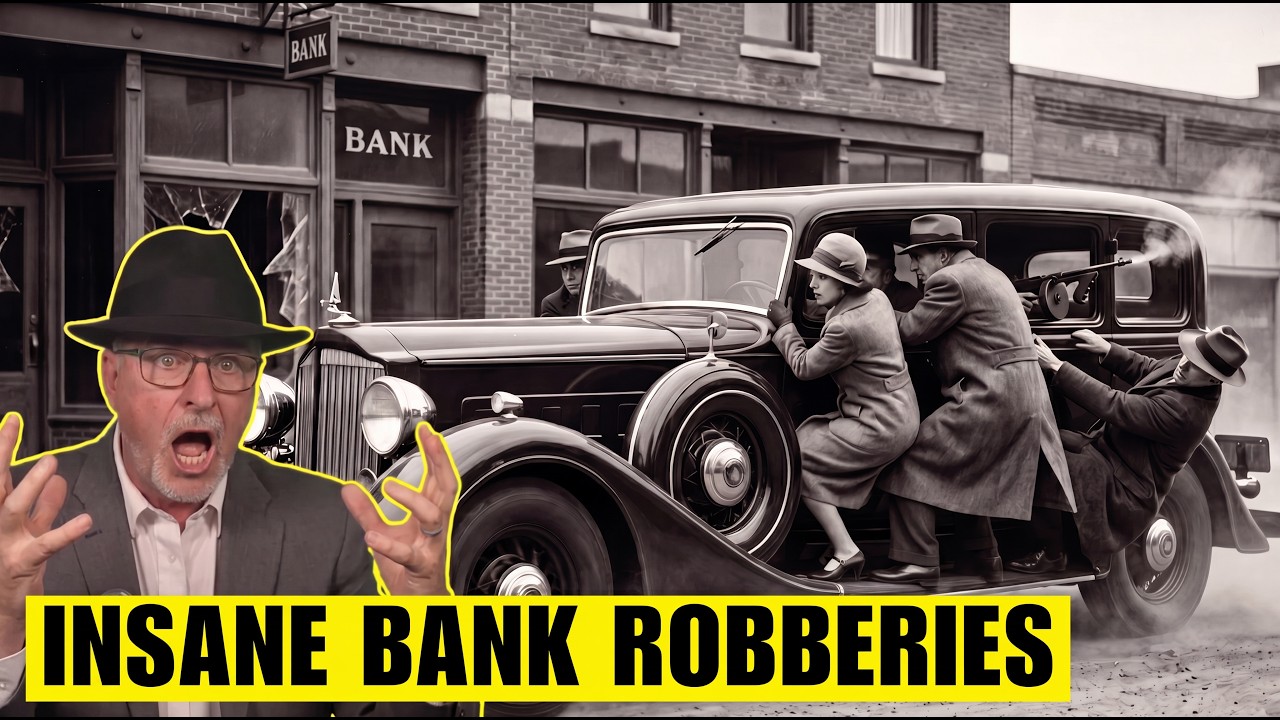
So now the bank was a fortress and the gang had to get out. There were four women inside. What did they do? They grabbed five employees on the way out—Mildred Bostic, Emma Kabatch, Mary Lucas, Alice Belgian, and Leo Olson.
All of them were made to stand on the running boards of the getaway Packard. A running board is a little strip of metal that runs along the underneath side of the doors, about as wide as a shoe. So you had five people clinging to the side of the getaway car, the wind hitting them in the face, and police shooting at the car they were physically attached to. They were, technically speaking, bullet stoppers.
A Packard, for the record, was a premier American luxury automobile brand that operated from 1899 to 1958. The Detroit-based company built cars favored by royalty, presidents, and celebrities, rivaling prestigious European brands like Rolls-Royce. And apparently it was the getaway car for this bank robbery. The gang got out with $46,000 in cash.
The hostages on the running boards eventually got dumped on the side of the road and walked back into town during the cold weather. About two weeks before Sioux Falls, the same core group had shot up a little resort in northern Wisconsin called the Little Bohemian Lodge, trying to dodge an FBI raid. Melvin Purvis and his men accidentally gunned down three innocent civilians in the dark while Dillinger and Nelson slipped out the back. The disaster embarrassed Hoover so badly that he made the manhunt personal.
By the time of Sioux Falls, these men had the full weight of the federal government pointed directly at them. A week later, March 13th, 1934, in Mason City, Iowa, the First National Bank. Same crew, more or less. Seven men, one Buick sedan, and they were expecting to walk out with $240,000.
That sounds pretty good for a few minutes of criminal activity. Things happened, and they walked away with $52,000. Why? Because one bank teller named Harry Fisher, who deserves his own statue, had the presence of mind to lock himself in the vault when the gang came in pouring through the doors, shooting their guns into the ceiling.
When they yelled at him to hand the money out, he did—he handed out stacks of one-dollar bills. The big bills stayed in the back. So there was Dillinger standing in the lobby with a Thompson machine gun, the place filling with smoke from gunfire and a tear gas grenade, and a bank teller in the vault behind bulletproof glass passing out dollar bills like he was making change at the county fair. Speaking of the tear gas: the bank had a guard named Tom Walters, sitting up in a little elevated booth made of bulletproof glass, fortunately enough for him.
When the gang came in, Walters fired a tear gas cartridge from his perch and hit one of the robbers square in the back. It was basically a small canister that fired out of a pistol grip launcher, and when it landed, it cooked off and dumped a cloud of irritating chemical smoke. So one of the gang members was now walking around the bank lobby trailing tear gas behind him like he was the lead car in a parade. The other gang members tried to shoot Walters, but they couldn’t get through the bulletproof glass protecting him.
That same bullet-pocked piece of glass is still sitting in the Mason City Public Library to this day. When the gang finally headed for the door, they did the same thing they did in Sioux Falls. They grabbed bystanders off the street, including a pharmacist named C. D.
McColloch, who was standing outside on the sidewalk in his work coat. They made him and the others ride on the sides of the Buick. Some accounts put the hostage count up to 24 people on that one car that day. McCaughey later said his thin pharmacist’s coat was the only thing between him and the freezing north Iowa wind that started spitting sleet on him about a mile out of town.
As they left town, the gang threw roofing tacks out the windows to flatten the tires of any cop dumb enough to give chase. The Mason City Public Library still has some of those tacks today. The whole thing went sideways the moment the gang counted the money on the side of the road. They were too excited to wait to get to a hideout—or maybe the tear gas was still on the one guy and they wanted fresh air.
Whatever the reason, they started counting the loot on the side of the road and only got up to $52,000, not the $240,000 they expected. Whoops. Harry Fisher, the teller responsible for that math, was back at the bank, probably needing a clean pair of pants. Now, Dillinger himself, the conductor of half the chaos we’ve been talking about—we have to talk about the wooden gun, because if you don’t know this story, you won’t believe it the first time you hear it.
Crown Point, Indiana, the Lake County Jail. January 30th, 1934. They had just dragged Dillinger off an airplane—the police literally had to fly him in, because they thought a train was too risky. They parked him in what the local authorities were bragging to anyone who would listen was an escape-proof jail, also known as the Crown Point Jail.
There’s a photo of Sheriff Lillian Holley with her arm around Dillinger like they’re at a barn dance. On March 3rd, 1934, Dillinger walked out the front door of that escape-proof jail with a piece of wood. He took a wooden block—accounts vary on whether it came from a washboard or a broom handle—and carved it into the shape of a pistol using a razor blade. Then he blackened it with shoe polish.
Then he stuck it in a guard’s ribs and said, “Hey, this is Dillinger. If you move a muscle, I’ll blow your head off. ” The guard believed him. Dillinger backed his way through the jail, grabbed two actual machine guns out of the armory, not wooden ones, locked the guards in a cell, and walked out the front door.
And then—this is the part that really gets me—he stole Sheriff Holley’s personal Ford V8 right out of the driveway and drove it away singing. Witnesses said he was singing “I’m heading for the last roundup” as he pulled out of the driveway. He drove that stolen car across the state line into Illinois. That was a whoops, because that was the move that finally made him a federal problem.
Driving a stolen vehicle across state lines was a federal crime under the Dyer Act, and that’s the moment J. Edgar Hoover and the FBI got a real legal hook into John Dillinger. So Melvin Purvis, already hunting Pretty Boy Floyd, now added Dillinger to his list. Dillinger’s lawyer later strongly implied, and historians have mostly come to agree, that the wooden gun story was a complete fabrication.
But Dillinger didn’t care if anybody believed it or not. He wanted the wooden gun story in the headlines, because the wooden gun made every lawman in America look like a fool. That was worth more to him than the truth. A couple months before the wooden gun, Dillinger and his crew had pulled off the East Chicago job.
They walked out with about $20,000 and killed a city patrolman named William O’Malley on the sidewalk. Here’s the detail to hold on to: Dillinger was wearing a bulletproof vest. O’Malley shot him four times in the chest with a service revolver, and the rounds didn’t penetrate. Dillinger then machine-gunned O’Malley dead.
The getaway car had armored steel plating and bulletproof glass. Imagine being a Depression-era cop on a city paycheck with a . 38 caliber revolver and a wool uniform, rolling up on guys wearing body armor and driving a tank. It wasn’t fair, and the gang knew it.
That gets us to why these robberies were insane in the first place. It wasn’t just about the loot—it was the showmanship on top of all of it. These men were operating in a country where one out of every four working adults had no job. The banks had foreclosed on everything that wasn’t nailed down, and the newspapers were the only entertainment most people could afford.
So when Pretty Boy Floyd told a teller his real name on the way out, and Baby Face Nelson cracked a joke through a machine gun, and John Dillinger sang a cowboy song while driving the sheriff’s car out of town, that wasn’t just crime. That was theater. It was a giant middle finger to the institutions that had let everybody else’s life burn down. The bankers and the lawmen wrote the official version of the 1930s, the one where these men were rabid animals that needed to be put down.
But the people who actually lived through it all, a lot of them weren’t so sure. That’s why a teller wouldn’t always sound the alarm, why a town like Solsberry never gave Pretty Boy up, and why 20,000 people showed up at his funeral when Melvin Purvis and the FBI finally shot him down in a cornfield in Ohio in October 1934. And three months after that, in July of 1934, Purvis was outside the Biograph Theater in Chicago when Dillinger walked out of the movies and into a trap. The public enemy era didn’t end with a dramatic last stand.
It ended on a sidewalk under a marquee’s light with a federal agent in the crowd. They were rooting for the wrong team, and they knew it.






