She never raised her voice. She never had to. In sixty years at the center of the British royal family, Queen Mary destroyed careers, severed relationships, and cast people out of her world—not with anger, not with confrontation, but with a silence so precise and so complete that those on the receiving end often said it felt worse than anything she could have shouted. The courtiers who served her called it being put on the outside.
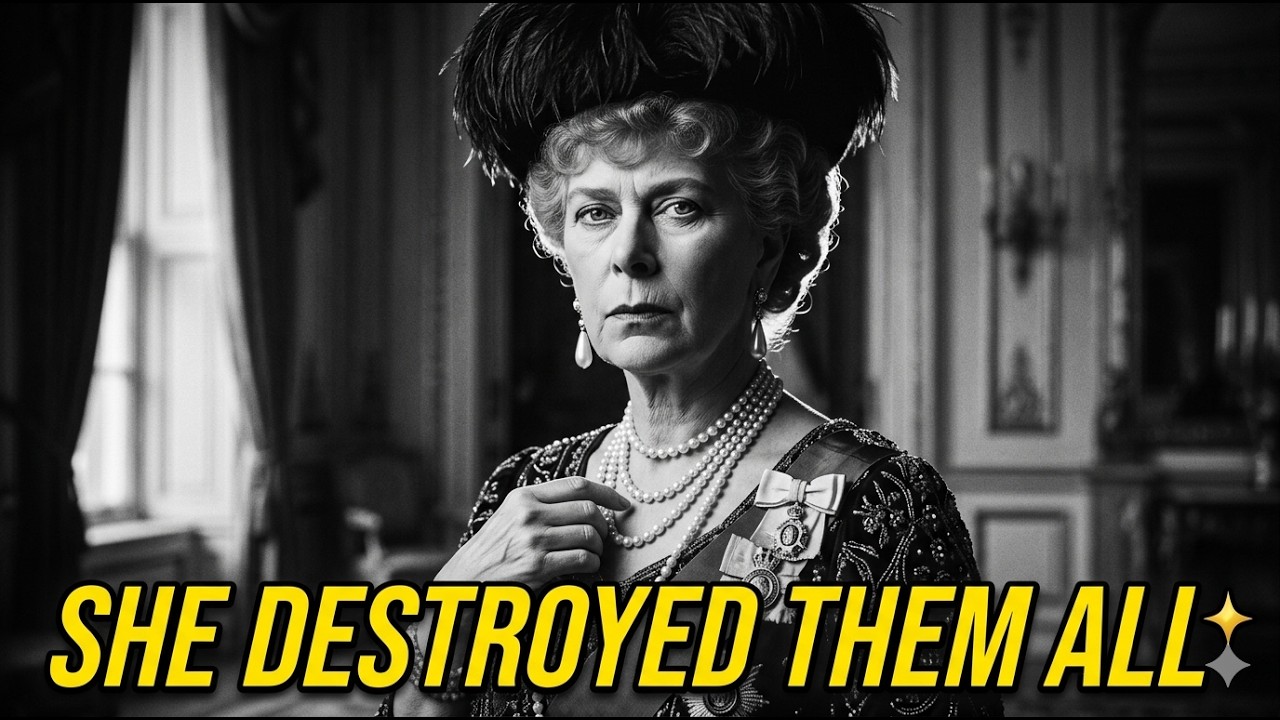
And once you were put on the outside of Queen Mary’s regard, you did not come back. To understand why Queen Mary became the woman she was, you have to begin not at the palace, but at the edges of it. Mary Victoria Mary of Teck was born on May 26th, 1867 at Kensington Palace in London. But despite that address, despite the grandeur of that birthplace, her early life was not one of security.
Her father, Francis, Duke of Teck, was a minor German royal with a significant title and almost no money. He was charming, warm, and almost entirely incapable of managing his finances. Her mother, Princess Mary Adelaide of Cambridge, was a granddaughter of King George III, which gave the family its connection to the British royal line, but she shared her husband’s cheerful inability to live within any kind of budget. The result was a childhood that looked respectable from the outside and was quietly chaotic on the inside.
The family moved constantly, and they spent extended periods living abroad in Florence, partly because life in Italy was cheaper and partly because their creditors in England were becoming difficult to ignore. Young Mary, called May by those close to her, grew up understanding something that many children of her background never had to confront. She understood that appearances and reality were two entirely different things. And she understood that what mattered in the world she was being prepared to enter was the appearance.
The reality could be managed. The appearance had to be maintained. This was not a cynical lesson, or at least it did not begin as one. It was simply the truth of her situation, absorbed gradually over years of watching her parents smile at people who were quietly deciding whether to extend them credit.
It was the truth of being a young woman with royal blood and no money, being prepared for a life in royal circles while wearing dresses that had been carefully mended so that the worn parts didn’t show. What this produced in Mary was not bitterness. It produced something more durable than bitterness. It produced discipline.
She decided somewhere in those years between childhood and adulthood that she would never be caught unprepared. That she would never be caught without the right answer, the right posture, the right expression. That she would master whatever was required of her completely and without complaint, and that she would expect others to do the same. The story of how Mary entered the royal family contains the first real glimpse of the iron that ran through her.
In 1891, she became engaged to Prince Albert Victor, Duke of Clarence, the eldest son of the then Prince of Wales. The engagement was, by all accounts, not a love match. It was an arrangement—practical, dynastic, appropriate. Mary understood this, and she accepted it with the same composed efficiency she brought to everything else.
But then, in January of 1892, Prince Albert Victor died. He was 28 years old. Influenza progressed rapidly, and within weeks he was gone. Mary was 24.
She was suddenly an ex-fiancée of a dead prince, placed in an awkward position that had almost no precedent. Most women of her background and era would have retreated, would have returned to a quieter life and faded from the center of royal attention. Mary did not retreat. What happened instead was both remarkable and revealing.
The royal family, specifically Queen Victoria, decided that Mary of Teck was too suitable, too well-prepared, too perfectly formed for the role of royal consort to simply be released back into ordinary life. And so with a pragmatism that was almost startling in its directness, the question was raised of whether Mary might instead marry the new heir, Prince George, Duke of York, the second son, the one who was now unexpectedly next in line. They became engaged in May of 1893 and married in July of the same year. What this episode revealed about Mary was not simply her resilience.
It revealed her fundamental orientation toward duty. She had experienced something genuinely painful—the loss of a fiancé, the uncertainty of her position, the strange social limbo of being a princess in waiting who suddenly had nothing to wait for—and she had moved through it and out of it with her composure entirely intact. She did not perform grief. She did not perform recovery.
She simply continued. And those who were watching took note, because what they were seeing even then was the outline of a woman who would not be moved by the kind of thing that moved ordinary people. This was not coldness exactly. Those who knew her well would insist on that distinction.
It was control—complete, deliberate, unwavering control—and it extended outward from herself to everyone around her. To work for Queen Mary was to enter a world of very specific requirements. She was by every account extraordinarily knowledgeable. She had educated herself with a thoroughness that went well beyond what was expected of women of her generation and class.
She knew art history with the precision of a curator. She knew genealogy with the detail of an archivist. She knew the history of the royal family—every branch, every connection, every piece of silver or furniture or jewelry that had passed through its various houses—with an intimacy that could be quietly terrifying for those who hadn’t done their own reading. Because Mary expected you to know things too.
Not everything she knew—she understood the difference between an impossible standard and merely a very high one—but she expected you to know the things that were relevant to your position. She expected you to have prepared. She expected you to have thought in advance about what might be asked of you and to have equipped yourself accordingly. A lady in waiting who stumbled over a basic question of protocol was not someone Mary would visibly embarrass in the moment.
That was not her style. She would note it. She would file it. And the next time there was an opportunity to determine whether that person was suited to their role, the stumble would be remembered.
This was what made serving her so particular. It was not that she punished mistakes immediately and visibly in the way of someone with a short temper. It was that she punished them slowly and invisibly and completely. The mistake you made in March might be what cost you your position in September.
And you might never connect the two moments. You might spend years wondering what you had done wrong, while she had known since spring. Her memory in this regard was both her greatest gift and her most formidable weapon. She remembered everything—what you had said at a dinner years ago, the expression on your face when you delivered a piece of news she had found unpleasant, the dress you had worn to an event where she had expected something different.
And she remembered that she had looked at it and looked at you and said nothing, which was, in the language of her silences, a very loud thing indeed. The courtiers who served her over the decades developed among themselves a fluency in a very particular language: the language of her disapproval. Because Queen Mary did not express disappointment the way most people do. She did not sigh or complain or take someone aside for a gentle word.
She expressed disapproval through signals so subtle that an outsider might miss them entirely. But to those who had spent time in her orbit, those signals were as clear as a shout. There was first the look—a particular angle, a particular stillness of expression that communicated with extraordinary precision exactly how far below her expectations you had fallen. It was not a glare.
It was not a frown. It was more like the expression of someone who has just encountered an unexpected object in their path and is deciding calmly and without particular urgency what to do about it. The look contained no heat. That was what made it so effective.
Anger you could argue with. This look was beyond argument. It was simply an assessment. Then there was the silence.
Mary used silence the way a conductor uses a pause in music—not as an absence of communication, but as communication itself. If you had said something that disappointed her, she would not respond immediately. She would let the silence extend. She would let it grow into the room, filling the space where your words had been, until you became entirely aware of how inadequate those words had been.
And then when she did speak, she might say something entirely unrelated, and you would understand that the subject you had raised was, as far as she was concerned, closed. Not resolved. Closed. The distinction mattered enormously.
Resolved would have meant there had been a conversation, that your position had been heard, that the matter had been processed between two people. Closed meant she had decided unilaterally, without appeal, and without any particular interest in your perspective on the matter. And finally, there was the withdrawal. If someone had truly significantly disappointed her—not stumbled in a small way, but failed in a way that touched on character or loyalty—she withdrew from them.
Not dramatically, not publicly. Simply quietly, and completely. The invitations that had previously come began not to come. The warm acknowledgement that had marked her dealings with them became merely correct, polite, appropriate, and entirely emptied of anything personal.
They were still in the room, but they had been, in every way that mattered, removed from it. At the heart of her demands was something she would not have described as perfectionism, because she would not have considered it a personality trait at all. She would have described it simply as the minimum required standard—the floor, not the ceiling. She expected punctuality with an absoluteness that left no room for context or excuse.
She expected appearance to be considered and appropriate at all times. She expected discretion so complete it was almost invisible. But above all else, she expected loyalty. Not the simple loyalty of doing your job well, but a loyalty that was more total.
The understanding that your primary allegiance was to the institution of the monarchy and to the family that embodied it—not to your own comfort, not to your own convenience, not to your own emotional needs. The people who disappointed her most profoundly were always those who had placed something personal above something institutional, who had let their own feelings intrude on their responsibilities, who had made a decision based on what they wanted rather than on what was required. This was for Mary the most fundamental failure, and it was one she found almost impossible to forgive. Nowhere was this clearer than in the raising of her own children.
There is a particular cruelty that exists in the gap between what a parent intends and what a child receives. Most parents, even the most demanding ones, believe that what they are giving their children is preparation—that the strictness, the high standards, the refusal to accept less than the best, is a form of love. A practical love, perhaps, an unsentimental love, but love nonetheless. Queen Mary believed this completely.
She had been formed by difficulty, by precariousness, by the constant pressure of expectation without sufficient resources to meet it. And she had survived. She had more than survived. She had become one of the most admired and formidable women in the world.
Surely the methods that had produced that result were worth passing on. Her children did not see it that way. The six children of Queen Mary and King George V felt the weight of her expectations for most of their lives. And three of them, in particular, would go on to disappoint their mother in ways that she found not just frustrating, but in some cases unforgivable.
To understand what her children experienced, you have to understand first what childhood meant in the context of the early 20th century British royal family. It meant preparation. Royal children were being prepared for roles that had existed for centuries. The role was primary; the individual was secondary.
And the job of royal parents was to produce children who understood this hierarchy and had internalized it so completely that it no longer felt like a constraint. It felt like a vocation. Mary brought to this already formal arrangement her own particular intensity. She monitored her children’s progress with the same thoroughness she brought to everything else.
She was looking always for the gap between what they were and what they needed to become. And she communicated that gap to them regularly and clearly, in the quiet, precise way that was her characteristic mode. The eldest was Edward, called David by his family—the Prince of Wales, who would briefly become King Edward VIII before abdicating in 1936. He was in many ways the one who hurt her most, because he was the heir.
Everything—the entire structure of her life’s work, the entire purpose of the standards she had maintained and enforced—was oriented toward producing a king. And David was going to be that king. And he was almost from the beginning exactly the wrong shape for it. He was charming in a way that was too personal, too individual.
Royalty was supposed to be charming in a way that belonged to the institution—warmth that felt general, that could be distributed evenly across crowds and occasions without giving too much of itself to any one person or moment. David’s charm was specific. It attached. It sought connection in a way that made people feel genuinely seen, which was wonderful for those people and quietly alarming for his mother.
Because genuine connection requires giving something of yourself. And a king, in Mary’s understanding, could not afford to give himself away. He had to be preserved, maintained, held in reserve so that the institution he embodied could function with the dignity and distance it required. David did not want to be preserved.
He wanted to live. As a young man, he chafed against the formality, the schedule, the endless ceremonies that constituted royal life. He found the distances his mother maintained—the emotional distances, the social distances—not dignified but suffocating. He wanted warmth.
He wanted informality. He wanted to be known as a person, not performed as a prince. Mary saw this wanting as a kind of weakness. She had applied the logic of duty to herself.
She had wanted things—comfort, security, the kind of easy warmth that her position never quite permitted—and she had set those wants aside, because setting them aside was what duty demanded. Why could her son not do the same? Then, in 1936, David met Wallis Simpson, and everything that had been building for decades finally arrived at its conclusion. Queen Mary told the story of the abdication to herself as a betrayal.
What she could not accept was that David had chosen. He had looked at his duty and he had looked at his desire, and he had chosen his desire. This was for Mary not simply a personal failing. It was a philosophical failure.
It was a repudiation of the entire framework she had spent her life building and defending. She wrote him a letter after the abdication. It was not a tender letter. It was in its way a document of prosecution—carefully, coolly written, setting out the nature of his failure in terms that left no room for alternative interpretation.
She told him that he had caused immeasurable damage, that he had failed his duty to the crown, to the family, to the country. What was notable to those who read it was what it did not contain. It did not contain an expression of grief. It did not contain the acknowledgement that she had lost something, that her eldest son was gone from her in a way that went beyond geography.
It simply stated what he had done and what it meant. Then she moved on. She remained for the rest of her life largely unwilling to engage with the question of David in any meaningful emotional way. The second son was Albert, called Bertie, who would become King George VI after his brother’s abdication.
Bertie was in many ways the child who tried hardest to meet his mother’s standards. He was earnest in a way that David was not. He wanted genuinely to do the right thing. But Bertie was also frightened.
He had been a frightened child—sensitive, anxious, prone to the kind of inner difficulty that does not show well in the context of royal expectation. The stammer was perhaps the most visible manifestation of this, but it was not the only one. Queen Mary’s response to this anxiety was consistent with her response to everything else that fell below her standards. She did not pathologize it.
She simply maintained her expectations and trusted that the gap between his current performance and the required standard would motivate him to close it. This is not an approach that works well with anxious people. What anxious people need is typically a reduction in the pressure of expectation—a sense that they are acceptable as they are. What they get when the pressure is maintained is more anxiety, which produces more stumbling, which produces more pressure, in a cycle that is very difficult to break.
Bertie broke it eventually through his relationship with his wife Elizabeth and through his work with his speech therapist, Lionel Logue. He found, outside the immediate orbit of his mother’s expectations, people who related to him differently, people who saw the anxiety not as a failure of character but as a feature of a particular kind of person. And he was able, gradually and with significant effort, to build himself into a king. But the cost was real, and the courtiers who watched both mother and son understood something that neither of them would have said aloud: Bertie had become the king he became partly in spite of his mother’s methods, not because of them.
Of all the children of Queen Mary and King George V, the one whose story is most painful, and perhaps most revealing of the limits of Mary’s approach, is the youngest, Prince John. John was born in 1905, the fifth son and sixth child. From early in his childhood, it became apparent that he was different from his siblings in ways that went beyond personality or temperament. He had epilepsy, which in the early 20th century was poorly understood and carried a significant social stigma.
He also had what would now be recognized as some form of developmental difference. He learned differently, communicated differently, experienced the world differently from those around him. In the royal household of the early 20th century, there was no framework for this. There was no vocabulary for neurodevelopmental difference.
There was only the standard and the gap between the standard and the individual. John could not meet the standard—not because he lacked effort or will, but because the standard had not been designed with someone like him in mind. The decision was made to remove John from the main family household. He was established with his own small household at Wood Farm on the Sandringham estate, in the care of his nurse, Mrs.
Bill, who was genuinely devoted to him. He was not imprisoned. He was not mistreated in any crude sense. But he was separated.
He did not appear at family events. He was not included in the family photographs released to the public. He existed to the outside world as a kind of absence. Queen Mary visited him.
She maintained contact. She was not indifferent to his existence. But she could not accommodate him in the life she was living, and she did not attempt to restructure that life in a way that would have made accommodation possible. John died in January 1919 at the age of 13, following a severe seizure.
Mary’s response to his death was characteristically controlled. She wrote in a letter to a friend that it was a great release for him and for them. Those words have been quoted many times since, almost always as evidence of coldness. But those who have tried to understand her more completely suggest that what she was expressing was not indifference, but a particular kind of grief translated into the only language she had.
The courtiers who served her directly, who watched her manage her household with that precise, relentless control, carried specific memories of specific moments for the rest of their lives. There is a particular skill that develops in people who spend long periods of time in the presence of someone genuinely formidable. It is the skill of invisibility. The courtiers who served Queen Mary were present visibly, physically, functionally present at every event, every engagement, every private dinner and public ceremony.
They stood at the correct distance. They moved at the correct pace. They anticipated needs before those needs were expressed. They had learned to occupy space without disturbing it, to be useful without being noticeable, to exist within the world Queen Mary had created in a way that generated no friction whatsoever.
What made this particularly demanding was the comprehensiveness of her attention. She noticed everything. She noticed the placement of objects in a room. She noticed when something had been moved, even slightly, from where she had last seen it.
She noticed when a member of her household was wearing something she had not seen before, and she formed a view about whether that something was appropriate. One of her ladies in waiting, recalling her years of service much later in life, described the experience of entering a room where Queen Mary was already seated. The lady had learned over time to conduct a kind of rapid internal inventory before stepping through the door. Was her dress correct for the occasion?
Was her hair properly arranged? The inventory became automatic. It had become, over years of service, simply part of how she moved through the world. The courtiers who lasted, who built careers of genuine length and substance within her household, were almost without exception people of a particular temperament.
They found something satisfying in the extreme precision of the environment. The rules were demanding, but they were clear. If you met them, you were safe. But not everyone who entered Queen Mary’s service was of this temperament.
Some came to it with genuine enthusiasm and a perhaps slightly idealized sense of what royal service involved, and encountered the reality with a shock that took time to absorb. One account preserved in the memoirs of a former member of the household describes an incident that was small in its particulars and large in its effect. A junior member of the staff had been responsible for arranging a particular set of items in readiness for an engagement. He had done so carefully.
He had arrived early to ensure everything was in order. Queen Mary had entered the room, moved through it, and stopped. She had looked at one item, placed a matter of inches from where she expected it to be. She had not said anything.
She had simply looked at it, and then looked at the young man responsible for it, and then continued moving through the room as though nothing had happened. But something had happened. The consequence, when it came, was not dramatic. The next time a task of similar responsibility was being allocated, he was not the person it was given to.
No explanation was offered. None was needed for those who understood the language. The women of the household had a particularly intimate experience of Queen Mary’s standards. They accompanied her.
They traveled with her. They sat with her during the long hours of state events and attended her during private moments. She was warm in her way. Those who served her longest were often at pains to say this.
She had a dry, precise humor that she deployed occasionally and to considerable effect. She remembered personal details about the people around her—birthdays, family situations, small difficulties that had been mentioned in passing. But warmth was not the same as equality. Several women made the mistake over the years of allowing the familiarity of daily proximity to erode the professional distance that Mary required—beginning to offer opinions when opinions had not been invited, beginning to speak about their own lives with a frequency that tipped from appropriate disclosure into something that felt to Mary like imposition.
Mary’s response to this erosion was always the same. She did not address it directly. She simply began, almost imperceptibly, to create more distance herself. The conversations became slightly shorter.
The moments of personal warmth became slightly rarer. What none of them could do was ask. To ask would have been to acknowledge that you had noticed the shift, which would have been to acknowledge that you had been measuring the warmth she extended to you. The only available response was to adjust silently and completely, and to hope that the adjustment was enough.
There is a difference between being corrected and being cast out. Correction implies a future. Being cast out implies none of this. Being cast out is the determination, made quietly and finally and without appeal, that the gap is not closable—that the person in question has revealed something about themselves that cannot be corrected, because it is not a behavior.
It is a character. And character, in Queen Mary’s understanding, was not something that changed. It was something that was revealed. Once revealed, it was known.
Once known, it could not be unknown. The people Queen Mary cast out of her world were not always people who had done dramatic things. Some of them had done something that appeared on its surface relatively minor—a careless word, a misplaced confidence, a moment of judgment that revealed to Mary’s precise and unsparing eye that the person exercising it did not quite have the quality of character she required. Mary was not measuring the size of the action.
She was measuring what the action revealed. The case of a particular courtier illustrates this pattern with unusual clarity. He had served the household for several years with what appeared to all external observation to be considerable competence. He had risen steadily through the ranks, accumulating responsibility and the kind of quiet trust that came with demonstrated reliability.
Then he made a mistake that was not, in the conventional sense, a professional mistake at all. He had been present at a private gathering where something had been said that touched on matters considered private to the family. Several weeks later, Mary became aware that an account of that conversation had found its way into a social setting outside the household. She investigated with methodical precision.
The echo had originated with the courtier. He had not set out to breach a confidence. He had simply spoken, in what he believed was a safe social context, about something he had witnessed. This, in Mary’s framework, was precisely the problem.
The standard she required was not the standard of someone who was careful when they believed they were being observed, or discreet when they actively remembered to be discreet. The standard she required was the standard of someone for whom discretion was not a conscious practice but a fundamental orientation. He was not confronted. He was not summoned and told what had been discovered.
There was no formal accusation, no opportunity for defense or explanation. What happened instead was the withdrawal. The assignments that had previously come to him began to go elsewhere. The access he had accumulated began quietly to contract.
He served out the remainder of his time in the household in this diminished state, never quite understanding what had happened. This was in some ways the most cruel aspect of Queen Mary’s method. Not that she punished, but that she punished without explaining. The people she cast out were left to construct their own understanding of what they had done, working from the evidence of her response without the clarity of her reasoning.
The uncertainty itself became part of the consequence. What is striking in looking at these cases across the span of Mary’s long prominence is how consistent the pattern was. She did not vary her method based on who the person was or how long they had served. The same quiet final withdrawal was applied to the junior member of staff who had misplaced a single object as to the long-serving courtier who had breached a confidence.
This consistency was itself a message. It told everyone who observed it—and everyone in the household observed it—that the standards applied universally. That no one was exempt. That length of service, personal warmth, family connection, previous accomplishment—none of these things provided protection against the consequences of falling short.
There was a particular occasion, documented in the recollections of several people who were present, during a state visit in the years before the First World War. A formal dinner of the kind that required the precise coordination of dozens of people. Something went wrong with the timing. A course arrived slightly early, a matter of minutes perhaps, at a moment when the conversation at the head of the table had not yet reached its natural pause.
Most of the guests either did not notice it or attached no particular significance to it. But Mary had noticed. She had noticed the timing, and she had identified where the failure of judgment had occurred. The member of staff responsible had made a judgment call in the moment, had looked at the situation and decided based on his own assessment that the timing was acceptable, and his judgment had been wrong.
This was the error—not the timing itself, but the decision-making that had produced it. The assumption that his in-the-moment judgment was a reliable substitute for the careful prior planning that existed precisely so that in-the-moment judgment would not be required. He had trusted himself when he should have trusted the procedure. In the days that followed, the adjustment was made quietly, without explanation.
The member of staff found gradually that his access to the planning of significant occasions was reduced. He understood what had happened. He had been in the household long enough to recognize the shape of the withdrawal. The public occasions that were most revealing of Mary’s standards were not always the ones where something went wrong.
Sometimes the most instructive occasions were the ones that went entirely right. On those occasions you could see in Mary’s bearing something that was the closest she came to satisfaction—not pleasure exactly, but a kind of settled quality, a sense of rightness. Those who served her longest said that this was in its way more motivating than any explicit praise could have been, because explicit praise was, in her household, essentially unavailable. But the settled quality, the sense of rightness that she occasionally allowed to show—that was different.
That was real. The failures that Mary found most difficult to manage were the ones that involved the behavior of members of the family itself. Because when a member of the family failed in public, the failure was not simply a professional lapse. It was an institutional one.
It reflected not just on the individual, but on the crown. And the crown was the thing Mary had organized her entire life around protecting. In those moments, Queen Mary was left with only her bearing—only the absolute, unwavering composure that she had built over decades, and that she maintained publicly with a consistency that those who watched her found either admirable or heartbreaking. She gave the world nothing to work with.
No visible distress. No public acknowledgement of difficulty. No crack in the surface. There is a particular assumption that people make about powerful figures and their families: that family by its nature exists in a different category from everything else, that love or at least the biological fact of kinship creates a kind of exemption.
Queen Mary did not share this assumption. For her, the extended family was not a refuge from expectations. It was simply another arena in which expectations operated. If anything, the expectations she held for family were higher than the expectations she held for staff.
Because staff could be forgiven to some degree for not fully understanding what was required. Family had no such excuse. Family had been born into the world she inhabited, or had chosen to marry into it, which amounted to the same thing. If they failed to meet its requirements, the failure could not be attributed to ignorance.
It could only be attributed to choice. And choice, for Queen Mary, was the most revealing thing of all. The most significant of these relationships, in terms of what it revealed about Mary’s method, was her relationship with Wallis Simpson—or rather, the relationship that never existed. The absolute, complete, and permanent refusal to acknowledge Wallis Simpson as a person with any legitimate claim on her regard.
Wallis Simpson had, in Mary’s understanding, done two things that placed her permanently outside the category of people Mary could recognize. She had pursued a relationship with a married man, which was in itself a failure of the character standards Mary applied universally. And she had, through that relationship, contributed to the abdication of a king. She had been the mechanism through which David had made the choice that Mary found unforgivable.
Mary never met Wallis Simpson. This was in one sense simply a geographical fact. But it was not merely geographical. It was intentional.
Mary made no effort to create the conditions for a meeting, and she ensured through the management of the situation she controlled that no meeting was imposed on her. The silence around the whole arrangement was its own kind of statement. What was more complex and in some ways more revealing was Mary’s relationship with the women who married into the family in ways she considered appropriate. The most prominent of these was Elizabeth Bowes-Lyon, who married Mary’s son Bertie in 1923 and would eventually become Queen Elizabeth, and then Queen Elizabeth the Queen Mother.
Elizabeth was by most accounts a woman of considerable social intelligence. She was warm in a way that was natural rather than performed, genuinely charming, able to put people at ease in circumstances that might otherwise have been stiff and formal. That was in some ways the emotional opposite of Mary’s more architectural approach to human interaction. Mary recognized Elizabeth’s gifts.
But she also watched her with the same attention she brought to everyone who operated within her orbit. Elizabeth understood that the way to manage her relationship with her mother-in-law was not to challenge Mary’s authority or compete with her framework, but to exist within it gracefully—to meet the formal requirements with genuine competence while building, in the margins of her life, something warmer and more personally sustaining. Mary respected this. She did not warm to Elizabeth in the way that people with more available emotional vocabularies might have warmed to someone so genuinely charming.
But she assessed her accurately, and her assessment was largely positive. Elizabeth was not subjected to the withdrawal. She was treated across the decades of their shared family life with a consistency of respect that communicated, in Mary’s language, genuine approval. The other daughters-in-law had more complicated experiences.
The Duchess of Gloucester, Alice, was a quiet and serious woman who approached her role with a genuine sense of duty that Mary could appreciate. But she was also somewhat reserved in a way that was different from Mary’s reserve—less a controlled composure than a natural shyness that made the social demands of royal life genuinely effortful for her. Mary observed this and formed her assessment. Alice was adequate.
She was appropriate. She met the requirements, but she did not exceed them. The Duchess of Kent, Marina, was a different case entirely. She was a Greek princess, beautiful and stylish and socially brilliant.
Mary appreciated elegance. But Marina also had an independence of taste and style that occasionally sat in slight tension with what Mary considered appropriate. She dressed in ways that drew attention to her as an individual rather than simply as a member of the collective presentation of the royal family. Marina was never cast out.
But she was watched. And the watching was itself a form of pressure. The diplomatic world also brought Mary into contact with people over whom she had no formal authority. Foreign royals, heads of state, diplomatic representatives.
These people could not be managed through the household’s internal mechanisms. With these people she had only her presence—only the cumulative weight of what she was and how she carried herself, and the particular quality of attention she either extended or withheld. Before a state visit, Mary would acquire and absorb information about the people she was going to encounter with a depth that went well beyond what was strictly required. She wanted to know not just the formal biographical facts, but the texture of the people—their interests, their sensitivities, the things that mattered to them personally.
There was an account preserved in the diplomatic correspondence of a foreign minister who attended a state dinner at which Mary was present, of a conversation she initiated with him about a particular aspect of his country’s cultural history—a relatively obscure aspect, not something that a person simply making conversation would have been expected to know. He had been surprised and had said so. The effect of the exchange had been exactly what she had intended. The foreign minister left the dinner with the clear impression that the British royal family had thought carefully about him as an individual.
This was diplomacy at its most refined. The same attention that she brought to preparation also meant that she noticed with uncomfortable precision when the people around her had not prepared with equivalent thoroughness. These moments were, for Mary, among the most difficult to absorb, because they happened in public. She managed them through the steady maintenance of her own bearing, through the subtle redirection of attention.
But containing the damage in the moment did not mean absorbing it without consequence. The consequences came later, in the usual way. There was within the diplomatic world a particular category of encounter that revealed something specific about how Mary’s approach functioned at an international level. These were the occasions when the foreign party was itself of the highest caliber—when the person she was engaging with brought to the encounter the same level of careful thought and genuine depth that she brought to everything.
In these encounters, something happened that those who witnessed them found genuinely remarkable. Mary relaxed. Not visibly. But those who had spent years inside the orbit of her attention could see it.
A slightly greater willingness to extend the conversation past its formally necessary duration. A quality of engagement that went beyond the performing of the relationship. She liked meeting people who were as prepared as she was. There is a particular test that history applies to people of fixed principle.
It is the test of catastrophe—of the kind of event so large and so total that it does not simply challenge the framework a person has built, but dismantles the world in which that framework existed. The First World War was that kind of event, and the Second World War, twenty years later, was that kind of event again. Between them, the two wars dismantled the world of the European aristocracy as thoroughly as any historical force has ever dismantled a social order. The royal houses that had defined the political and social landscape of the continent—the Romanovs, the Habsburgs, the Hohenzollerns—were swept away.
The cousins and second cousins and relatives by marriage who had constituted the international community of royalty in which Mary had been raised disappeared one by one into exile or obscurity or worse. The world that had produced Queen Mary ceased to exist. And Queen Mary continued. The First World War began in August of 1914, when Mary was 47 years old.
She had been queen consort for four years. The war created for the British royal family a set of complications that went far beyond the ordinary difficulties of wartime. The family had German roots that were, in the context of a war against Germany, deeply uncomfortable. The king’s own name—Saxe-Coburg and Gotha—was a German dynastic name that, as anti-German sentiment intensified in Britain, became an increasing liability.
The Kaiser, against whom Britain was now at war, was King George’s first cousin. Mary managed this with the same methodical precision she brought to every problem. In 1917, the family name itself was changed from Saxe-Coburg and Gotha to Windsor, a name chosen for its quintessentially English associations. Mary did not resist any of this.
She understood it as a necessity, processed it as she processed all necessities, and implemented it with the same absence of visible distress that characterized her response to every difficult decision. The war also brought losses that were more personal. The young men who had been part of the world she knew—the sons of aristocratic families, the junior members of the household—were dying in France and Belgium in numbers so large that the loss became over the four years of the war a kind of permanent background condition. Mary responded to this in the way she responded to everything: by doing what was required.
She visited hospitals. She engaged with the mechanics of wartime charitable organization with the same thoroughness she brought to every other undertaking. What was needed in the context of a country sustaining losses on that scale was not a sovereign who was visibly distressed. What was needed was a sovereign who was steady.
The courtiers who served her during the war years described an atmosphere in the household that was altered but not destabilized. If anything, the wartime context had heightened rather than relaxed the demands she made, because the stakes of everything had been heightened. But the war also created something else—something that Mary had not entirely anticipated. It created dependency.
Not her dependency on others, but the dependency of others on her. As the familiar structures of the social world dissolved and the losses accumulated, the people around her turned toward the one thing in their environment that had not changed: her. She became during the war years a kind of fixed point for the people in her orbit. Not a warm fixed point, but a fixed point nonetheless.
The ladies who served her, who had their own losses and their own anxieties, found in the continued operation of Mary’s standards something that was not comfort exactly, but was adjacent to it. The Second World War, which began in September of 1939, found Mary at 72. She had been a widow for three years. King George V had died in January of 1936, the same year as the abdication.
She had left Sandringham, which was considered vulnerable to German air attack, and moved to Badminton House in Gloucestershire, the home of her niece, the Duchess of Beaufort. She remained there for the duration of the war—nearly six years in someone else’s house, adapting to a context that was not her own, and doing so with a thoroughness and a practicality that impressed even those who had been watching her manage difficult circumstances for decades. At Badminton, Mary worked. She organized with her characteristic energy a program of activity that engaged both herself and the members of her household in the practical work of wartime.
Ivy and undergrowth were cleared from the estate. Timber was managed. She was in her seventies. The staff at Badminton who had not previously been subject to her orbit encountered her standards for the first time and found the encounter somewhat startling.
Her requirements did not relax because the context had changed. But there was also something at Badminton that was different from what had come before—a slightly greater visibility of what lay beneath the standards. She was moved by things during the war in ways that she was not always able to entirely contain. The news of losses registered in her in ways that sometimes showed—not dramatically, but in small, momentary alterations of expression that those who knew her well recognized as significant precisely because they were so rare.
The courtiers who were with her at Badminton described these moments with a particular kind of care. They responded to what they saw with the same discretion that she had always required, by not acknowledging it, by allowing it to pass as though it had not occurred. This was, in its way, one of the most genuine acts of loyalty that her household ever performed for her. There is something particular about the relationship between a grandparent and a grandchild that is different from every other familial relationship.
It skips the generation of direct obligation—the mutual weight of expectation and disappointment, the long complicated history of having been responsible for each other. Grandparents and grandchildren meet each other on cleaner ground. Among Mary’s numerous grandchildren, one relationship stood apart. That grandchild was Elizabeth, the elder daughter of Bertie and his wife, born in April of 1926, who became heir presumptive after the abdication of her uncle David in 1936, and who would become Queen Elizabeth II on the death of her father in February of 1952.
The relationship between Queen Mary and the young woman who would become Elizabeth II was one of the most significant and least fully understood relationships in the modern history of the British monarchy. Elizabeth had been observing her grandmother since early childhood. But she observed her differently—with the particular quality of attention that Mary herself brought to everything. Comprehensive, patient, retaining.
She was not simply watching her grandmother in the way that a child watches an impressive adult. She was studying her, absorbing something from the observation that went deeper than impression. What she was absorbing was an understanding of what the role required—not the formal requirements, which could be taught, but the deeper requirements. The understanding of what it actually meant, in the lived reality of daily existence, to be the person at the center of the institution.
Mary communicated this understanding not through instruction, but through example—through the simple, sustained demonstration of what it looked like to inhabit the role completely. Elizabeth watched this demonstration for decades before she was required to perform it herself. And when she was required—when her father died unexpectedly in February of 1952, and the weight of the crown descended onto her at 25—what those who knew both women observed was a quality in the new queen’s bearing that reminded them with sometimes startling precision of her grandmother. In the years of Mary’s widowhood, the seventeen years between the death of King George V in 1936 and her own death in 1953, the relationship with Elizabeth had deepened.
Mary spoke to Elizabeth about the history of the family in ways that went beyond the formal biographical facts. She talked about the objects—the jewelry, the furniture, the works of art that had passed through the family across generations—not simply as things of value, but as carriers of history, as connections to the people and the moments they had belonged to. Elizabeth received this inheritance with the same quality of attention she had always brought to her observations of her grandmother. She was not performing interest.
She was genuinely interested. The conversations they had in the final years at Marlborough House, where Mary had established herself after leaving Buckingham Palace at the beginning of the war, were different in quality from most of the conversations in Mary’s life. Less performed, less managing, more real. Those who observed the relationship from the outside noticed the difference.
Noticed that in Elizabeth’s company, Mary was slightly more accessible than she was elsewhere. The final years were also the years in which the full cost of her life became, for those who watched her closely, most visible. Not in any dramatic collapse of her composure or her standards. Those remained.
But in the accumulation of loss that had marked her widowhood. She had outlived her husband. She had outlived two of her sons—George, Duke of Kent, killed in an air crash in 1942 during the war, and the former King Edward VIII, who was still alive but who had, in the most meaningful sense, been lost to her at the abdication. She had outlived most of the generation she had been formed in.
And she continued with full weight, full attention, full precision. King George VI died on February 6th, 1952. He was 56 years old. Mary received the news of his death and was, by all accounts, devastated.
This was perhaps the loss that cost her more than any other, because Bertie had been, of all her children, the one she felt she best understood. The one whose earnestness and dedication had most closely reflected the values she had tried to transmit. The one who had become, against considerable difficulty and with considerable courage, exactly what the institution required. He was gone, and with him went something that nothing else could replace.
She survived him by seven weeks. She died on March 24th, 1953, at Marlborough House, at the age of 85. Her granddaughter Elizabeth had been queen for seven weeks. Mary had made it known in the final weeks that whatever happened to her, the preparations for Elizabeth’s coronation, scheduled for June of that year, should not be interrupted.
That the death of a queen mother, however significant, should not alter the course of the institution’s work. This was, in its way, the final statement of everything she had ever believed. The institution first. Always the institution first.
The coronation took place on June 2nd, 1953, as scheduled. She was not there to see it. But in another sense, she was entirely there—in the bearing of the young queen who had learned from her what bearing meant, in the standards maintained by the household that she had shaped across decades, in the institutional memory of what the monarchy was and what it required. There is a particular kind of love that expresses itself not through people but through things.
Not because the person who feels it is incapable of loving people, but because things offer something that people, in their fundamental and irreducible complexity, cannot quite provide. Things do not disappoint. Things do not make choices that contradict your expectations of them. Queen Mary loved things with a passion that was by any measure one of the most intense and least complicated relationships of her life.
She loved antiques and jewelry and works of art and the historical objects that had passed through the hands of the royal family across centuries. She loved them because they offered her something that almost nothing else in her world could offer. They offered her certainty. She had been collecting, cataloging, and researching the royal family’s possessions since early in her marriage.
What she found in those early years of exploration was that the collection was remarkable but also somewhat chaotic. Mary set about correcting this with characteristic thoroughness. She researched, she documented, she traced provenance through historical records and correspondence. She created over decades of dedicated effort a systematic understanding of the royal collection that had not previously existed in any comparable form.
The royal collection that exists today, curated, documented, understood with the depth and the historical precision that makes it genuinely significant rather than merely impressive, owes a substantial part of its current state to the work that Mary undertook across six decades of obsessive, meticulous attention. But the love she bore for objects also expressed itself in ways that were, to put it carefully, somewhat more complicated than simple curatorial devotion. Queen Mary wanted things. When Queen Mary came to visit, you checked your collection before she arrived, and you checked it again after she left.
Not because she stole—that was not what happened—but because Queen Mary had a way of expressing admiration for objects that created in the people who owned them a very strong sense that the admiration was expected to have consequences. She would pause before something—a piece of porcelain, perhaps, or a small painting, or a piece of furniture with an interesting history. She would look at it with the focused expert attention that she brought to everything she found genuinely interesting, and she would say something—a comment on its quality, an observation about its provenance—and then she would wait. Most of them offered.
And Mary accepted. There were people who did not offer. These people were noted. Not always immediately, and not always in ways they could directly connect to the moment of the refusal, but noted.
Filed. Added to the comprehensive archive of Mary’s assessments of the people she encountered. There was a particular incident recounted in the private correspondence of a member of one of the great aristocratic families that illustrates the dynamic with unusual clarity. Mary had visited the family’s house for a weekend and had, during a tour of the house’s collection, paused before a small piece of decorative art—a snuff box of considerable age and historical interest, connected to a figure from the eighteenth-century court.
She had examined it, commented on it with precision, and waited. The family had not offered it. The piece was of particular sentimental significance to them. Mary had moved on.
She had said nothing more about the snuff box. But the family noticed, in the years that followed, a very slight cooling in the quality of their relationship with the palace. Invitations that had previously come with a certain regularity became slightly less regular. They connected it eventually to the snuff box.
They could not be certain. But they felt it. The jewelry was perhaps the most intense expression of this love. Mary’s collection of jewelry was extraordinary.
She knew every piece with the intimacy of someone who has studied a subject until the study has become something closer to devotion. She knew the history of each stone, the provenance of each setting. She wore her jewelry with the same deliberateness that she brought to every other aspect of her presentation. Wearing a particular tiara for a state occasion was not decoration.
It was a statement about continuity. The courtiers who served her longest understood this about her, and they understood it with a compassion that they did not always feel able to extend to other dimensions of her character. Because what the objects represented, in the end, was not simply an eccentric passion. They represented the place where Queen Mary was most fully herself.
Where the armor of expectation and standard could be briefly and genuinely laid aside. Where she was not the queen, not the arbiter of standards, but simply someone who loved something completely and without complication. Those who had the privilege of watching her in those moments, absorbed in the examination of a new acquisition, said that she was in those moments more visibly human than at almost any other time. That something in her face, usually so composed and so controlled, opened slightly.
It was, they said, the closest she ever came to being at peace. The objects remained long after the people who had failed her and the people she had failed. Long after the courtiers who had navigated her requirements, and the children who had struggled beneath the weight of her expectations. Long after the diplomatic occasions and the wartime years and the quiet final weeks at Marlborough House.
The objects remained exactly what they had always been—precisely, completely, and without disappointment. Just as she had always required.






