The soldier stood correctly in the processing line, hands at his sides, chin level, waiting his turn like every other man around him. Hundreds of German prisoners moved through the same routine that morning: weapons surrendered, names recorded, personal effects logged. The SS man blended in the way any prisoner blends into a line, by being one of many. Captain Daniel Marsh was walking the row when the light caught it.
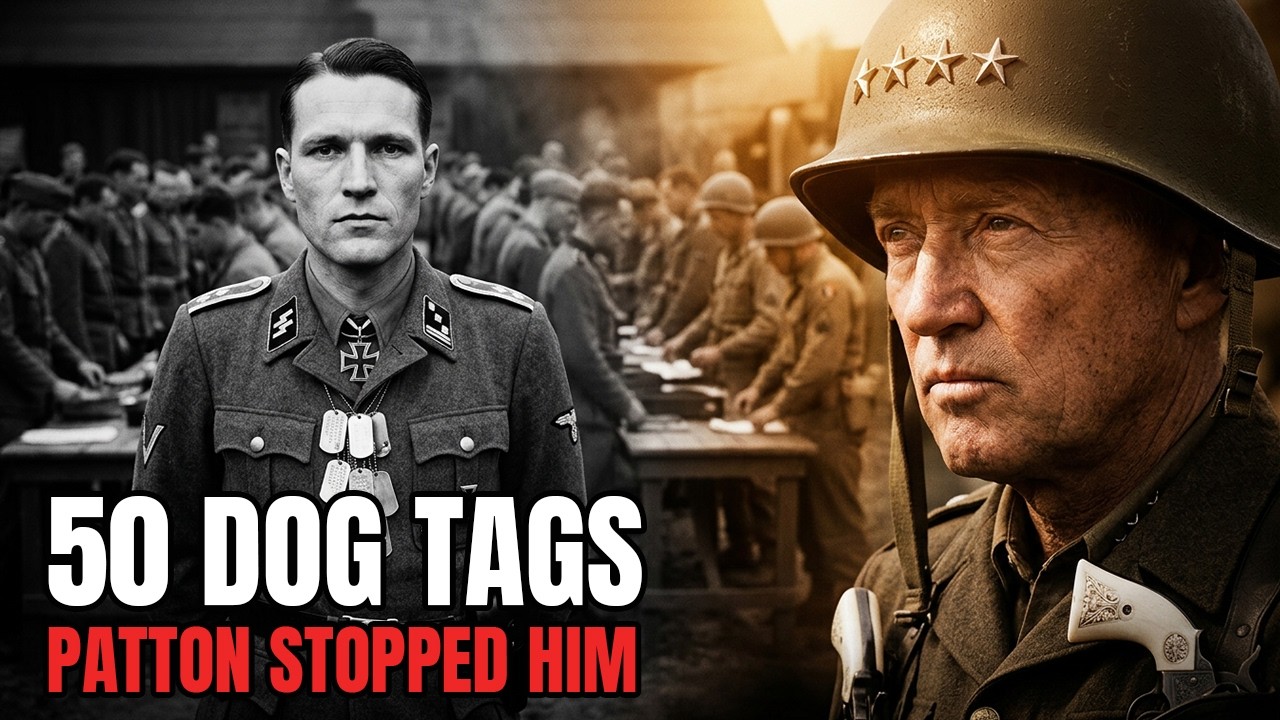
Metal, around the man’s neck. Not one piece. Many. Marsh stopped.
He looked closer. Not decorations, not a chain. A necklace made entirely of American military identification tags, strung together one after another, catching the April 1945 light above the processing tables. He counted.
He lost count. He started again. Fifty. Marsh was thirty-one years old, from Cleveland, Ohio.
Before the war he had worked as a claims investigator for an insurance company on Euclid Avenue, a job that had taught him one specific skill above all others: reading the difference between what a document said and what had actually happened. He had developed an instinct for the moment when a story stopped being a story and became evidence. He had been running the POW processing center outside Frankfurt for eleven weeks. He had processed thousands of German soldiers: Wehrmacht infantry, Luftwaffe ground crew, Volksturm men who should never have been in uniform.
He had developed procedures, checklists, a rhythm. Check the face, check the hands, check the collar insignia, take the weapons, record the name, move them through. In eleven weeks, he had never once checked what was around someone’s neck. He would not make that mistake again.
The prisoner was SS-Obersturmführer Ernst Brandt, thirty-four years old, from Munich. He had joined the Waffen-SS in 1938 at twenty-seven, older than most recruits, old enough to choose deliberately. He had served with the 1st SS Panzer Division, the Leibstandarte, through Poland, France, Greece, the Eastern Front, Normandy, and the Bulge. By any technical measure, he was an experienced combat soldier.
He was also a man who had kept score. The necklace had begun in Normandy in the summer of 1944, after a firefight outside Saint-Lô. He had taken the first tag not as a trophy but as a marker, a way of counting that felt more honest to him than a kill record in a logbook. The logbook was a document.
The tags were proof. Each one had a name stamped into it, a service number, a blood type, a religion. Each one had been worn by a specific man. Brandt kept them.
He added to them through France, through Belgium, into Germany. He wore them against his chest under his uniform, where no one could see. Only in the last days, when the front collapsed and surrender became inevitable, had he stopped hiding them. He had worn them openly into the processing line.
He had done something that perhaps no man in that line had done: decided, before he walked through the gate, that he was not ashamed. By April 1945, the Third Army’s prisoner processing network was handling volumes its original design had not anticipated. Tens of thousands of German soldiers were surrendering weekly. The processing centers ran around the clock.
Intake, documentation, segregation, transfer. The staff was undermanned and overworked. The system was designed for weapons: rifles, pistols, grenades, edged weapons. It checked collars for SS runes, which triggered additional screening.
It recorded names and ranks. What it did not systematically do was inspect what prisoners wore around their necks, inside their collars, beneath their uniforms. The gap had existed for eleven weeks at the Frankfurt center. Senior officers knew the system was imperfect.
They were processing a defeated army, not investigating it. That understanding changed that morning. Marsh stopped walking. He called his senior sergeant over first: Garver from Akron, who had been processing prisoners since Normandy and had stopped being surprised by most things.
Garver looked at the necklace. He was surprised. Marsh asked Garver to get a German speaker and keep the prisoner where he was. Private First Class Stephen Kovacs arrived two minutes later.
He was Hungarian-American, twenty-two years old, had grown up speaking German at home. He looked at the necklace and went slightly pale. Marsh told him to ask the prisoner his name and unit. Kovacs translated.
The prisoner answered without hesitation. Name, rank, division, service number. The answer of a man who had memorized his rights under the Geneva Convention and was reciting them correctly. Marsh told Kovacs to ask about the necklace.
The prisoner looked at the necklace, then at Marsh. He answered in two sentences. Kovacs translated. He says he collected them from American soldiers he killed in combat.
He says they are proof of his service record. Marsh looked at the necklace. He could read some of the names from where he stood. Stamped metal, American names, American service numbers.
Someone had worn each of these. Someone had stopped wearing them. He said, “How many? ”
Kovacs counted, moving his lips slightly.
He said, “Fifty, sir. ”
Marsh said, “Get on the radio. ”
The call reached Patton at his forward headquarters within the hour. His operations officer gave him the summary in ninety seconds.
Patton asked one question. He asked, “Are the tags intact? ” The operations officer confirmed they were. Patton said, “Nobody touches them until I get there.
”
The jeep came through the processing center gate twenty minutes later. Patton was out before it fully stopped. He walked directly to where Brandt stood in the processing line. Staff and guards had kept the prisoner in place, the line around him stopped, a cleared space forming.
Patton stopped in front of Brandt and looked at the necklace for a long moment. He did not speak. He looked at each tag he could see, reading the names that faced outward. Then he looked at Brandt’s face.
Brandt looked back. He was afraid. He was not defiant in the way that tries to hide something. He was simply present, the expression of a man who has decided what he is and is waiting for the world to respond.
Patton turned to Kovacs. He said, “Ask him if he knows what those are. ”
Kovacs translated. Brandt answered briefly.
Kovacs said, “He says yes. He says they are identification tags belonging to American soldiers he killed. ”
Patton said, “Ask him what he thought would happen when he walked through that gate wearing them. ”
Kovacs translated.
Brandt answered this time at greater length. Kovacs said, “He says he thought nothing would happen, sir. He says they are his property. He earned them.
”
The processing center had gone quiet. Soldiers at nearby tables had stopped working. Every American within sight had oriented toward the same point. Patton looked at the necklace again.
Then he spoke, quiet enough that the men nearby had to stop breathing to hear it. He told Brandt that he had looked at the names on those tags. Some of them he could read, some he couldn’t, but each one was a man’s complete identity reduced to a piece of metal: name, number, blood type, the religion that told a graves registration officer how to bury him if they found a body. These weren’t decorations.
They weren’t trophies in the sense Brandt seemed to understand the word. They were the last official record that fifty human beings had existed. He said, “You wore the last proof of fifty men’s lives around your neck, not hidden, not private, displayed. You walked into this facility wearing the remains of the men we sent to stop you, and you called it a service record.
”
He paused. He said, “I’m going to tell you what they actually are. They are evidence, every single one of them, evidence of where you were, when you were there, and what happened to the American soldier whose name is on each one. Some of those men may have died in combat, some of them may not have.
We are going to find out. Every tag is going to be investigated. Every name is going to be traced. Every family is going to be told what we found.
And you are going to answer specifically and individually for each one. They are also going to be proof at a war crimes tribunal and you carried them here and handed them to us. ”
He turned to Marsh. He said, “Every tag comes off that chain right now.
Each one is cataloged separately. Name, condition, any marks or damage. They are not evidence bags. They are remains.
Treat them the way you would treat remains. ”
He turned back to Brandt. He said, “You have five seconds to take off the necklace yourself. ”
Brandt did not move.
On four, Patton nodded to Garver. Two MPs stepped forward. Brandt resisted. Not from panic, from principle.
The resistance of a man who had decided this was the moment to hold on to something. The chain broke. Fifty tags hit the concrete processing floor. Metal on stone.
Each impact a separate sound. The Americans went to their knees to pick them up carefully, one by one. Every soldier who retrieved a tag held it for a moment before placing it in the catalog tray. Before Patton left the processing center that afternoon, he issued a standing order for every Third Army intake facility.
Incoming prisoners were to be inspected for items taken from Allied soldiers, including identification tags, personal effects, and any materials bearing Allied military markings. The inspection was mandatory, not discretionary. The order went to every center commander in writing before evening. Brandt was segregated from the general prisoner population and transferred to a facility for war crimes investigation.
The investigation took four months. Out of the fifty tags, investigators traced forty-three soldiers. Of those forty-three, nine had been killed in circumstances consistent with lawful combat. Eleven had been killed while attempting to surrender.
Eight had been executed as prisoners. The remaining fifteen could not be conclusively determined. Brandt was tried in 1946. The fifty tags were laid out on a table in the courtroom, each one labeled with the name of the soldier it had identified.
He was convicted on thirty-one counts, sentenced to death, and executed in 1948. His last statement, according to the court record, was a single sentence. He had done his duty. Daniel Marsh returned to Cleveland in late 1945.
He went back to the insurance company on Euclid Avenue and resumed his work as a claims investigator. He was promoted to senior investigator within two years. His colleagues noted that he had developed an exceptionally precise attention to what people carried on their person and what that carrying revealed about them. He worked the job for twenty-six years.
He retired in 1971 and died in 1983. In his desk at home, his family found a single sheet of paper. A carbon copy of the processing log entry from the Frankfurt center, the page on which he had recorded the initial intake of SS-Obersturmführer Ernst Brandt. The entry was standard in every respect except one.
In the column labeled personal effects, Marsh had written in his careful claims investigator’s hand: “50 identification tags, American, cataloged separately per standing order. ”
The carbon copy was the only thing from his service he had kept. Patton did not include the Frankfurt processing center incident in his memoirs. A notation in his personal records, dated April 1945, read: “The tags went home.
That is sufficient. ”
Some historians argue that Patton’s insistence on treating the dog tags as remains, rather than evidence, was itself a legally significant act. By framing them as the property of the dead rather than as crime scene material, he influenced how the subsequent war crimes prosecution was structured. They note that the prosecution’s decision to display each tag individually, rather than as a collective exhibit, reflected this framing and may have strengthened the tribunal’s understanding of the scale of individual harm.
Others argue that Patton’s intervention created procedural complications, that evidence handled as remains occupies a legally ambiguous category, and that the prosecution had to navigate those complications carefully. They contend that a cleaner evidentiary chain would have been established if the tags had been treated as material evidence from the outset. What is certain is that following Patton’s standing order, three additional sets of Allied identification tags were recovered from incoming prisoners at Third Army processing centers within the following two weeks.
All three became the basis of war crimes investigations.






