On the third night of January 1919, the boy lay in his room at the Sandringham estate, and the seizure took him. He was thirteen years old, John was his name, the youngest son of the King of England. The convulsions had tormented him since he was four, and when this one came, his nurse and his family watched helplessly. The boy died before morning.
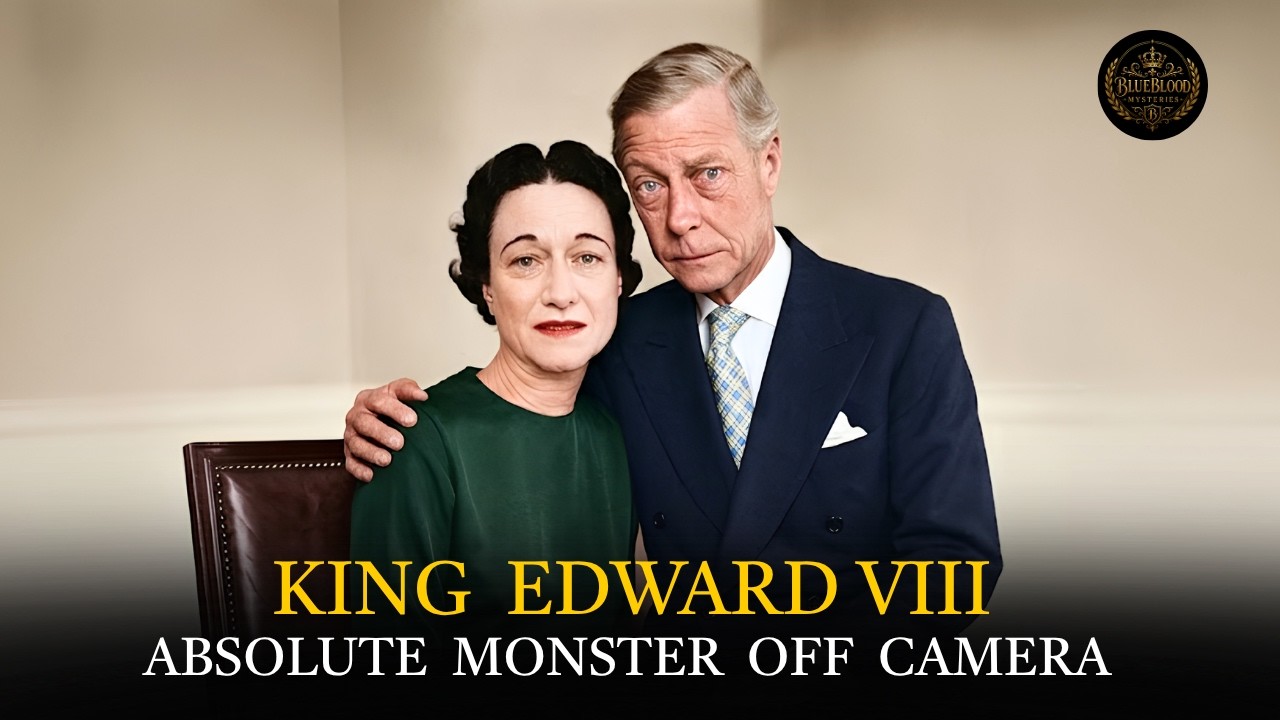
Two days later, his older brother, the Prince of Wales, wrote to his mistress. He did not write of grief. He wrote that the poor boy had become, by his own words, more like an animal than anything else. He added that John had been practically locked up for the past two years anyway.
That letter surfaced publicly in 2015 at auction, and since then it has stuck to the story of Edward VIII like a stain. The world remembers this man as a romantic who gave up a throne for love. Photographs show a charming, impeccably dressed prince. The archives show something colder.
Who was Edward VIII when the cameras were off? The word “monster” in the title of this piece is there to catch attention, not to settle the question once and for all. Some of what follows is confirmed fact, drawn from his private letters and declassified files. Some of it remains contested, and the difference matters.
It begins with the boy, because every strange man had a strange childhood, and Edward’s was stranger than most. Born on 23 June 1894 at White Lodge in Richmond Park, he was the eldest son of the future George V and Mary of Teck. His full name was Edward Albert Christian George Andrew Patrick David, and the family called him David. His great-grandmother, Queen Victoria, was still on the throne when he arrived.
He belonged to a family that expected children to be seen rarely and heard never, and he was raised mostly by nannies and tutors, not by his parents. There is a story from his early years that biographers have repeated for generations, and it is as disturbing as anything in the Windsor archives. According to accounts from people close to the family, one of his first nannies disliked the daily moment when the infant prince was brought down to see his parents. So, the story goes, she pinched him before presenting him, and the child arrived crying.
His parents, seeing a crying baby, sent him back upstairs, and the nanny remained indispensable. The pattern reportedly lasted for months, perhaps longer, before it was discovered and she was dismissed. A word of caution is needed. This story comes from handed-down accounts, not from a documented confession, and the precise details vary from book to book.
But it has been told so consistently by family insiders that many historians accept its broad outline. And it matters, because a child who learns that closeness brings pain may grow into a man who never quite understands what real love is. His father, George V, was a strict man who believed in discipline and had no patience for sensitivity. He is quoted as saying about his sons that he had feared his father and was determined that his sons would fear him.
Whether or not those exact words were spoken, the household was indeed cold and austere. Edward was sent away to the naval colleges at Osborne and Dartmouth in his early teens, then to Magdalen College, Oxford, where by most accounts he left no distinctive mark. He was short, slight, boyish in the face, with fair hair and a smile photographers adored. He was also, even then, carrying a deep insecurity, eager for applause and quick to anger at anyone who made him feel small.
In 1911, he was invested as Prince of Wales at Caernarvon Castle in a ceremony designed by David Lloyd George, who saw it as a chance to win the affection of the Welsh people for the monarchy. Edward hated the costume, which he found absurd, and later wrote that he felt like a show creature displayed before the public. That phrase reveals a great deal. Even as a teenager, he resented the role he was born to play, and the cameras that made him famous.
Then came the First World War. Edward wanted to fight. He was appointed to the Grenadier Guards, but Lord Kitchener refused to let him near the front lines, famously asking what would happen if the heir to the throne were captured or killed. So Edward served on the staff in France and Italy.
He visited the trenches, wore the uniform, and later said the experience left him feeling inferior and ashamed. That frustration is worth remembering. Edward never escaped the feeling that the world valued his public image far more than his actual abilities. After the war, he became a global celebrity.
He toured Canada, the United States, Australia, New Zealand, India, South Africa, and South America, charming enormous crowds wherever he went. The press called him the most eligible bachelor in the world. He danced, shook hands, drove tractors, dressed in the latest fashions, and gave the monarchy a youthful glamour it had never known. Ministers and diplomats described him as the empire’s greatest asset.
But beneath that brightness, the same biographers who admired his skills noticed something troubling. He tired of details, chafed at duties, and craved attention. The letter about his brother John fits into this pattern. Born in 1905, John began having seizures around age four.
As his condition worsened, he was moved to Wood Farm on the Sandringham estate, cared for by a nurse named Charlotte Bill, whom he called “Lalla. ” In the early twentieth century, epilepsy carried a terrible stigma. Families hid it. Many regarded it as a moral deficiency or a hereditary shame.
The royal family, anxious about its image, kept John largely out of public life. Queen Mary wrote of him with real tenderness and described his death as a relief for him and for the family. Edward’s letter shows no such warmth. He was twenty-four, barely knew his sick brother, and had spent years away at school and war.
Some historians caution that people often write coldly when grieving, and that upper-class British men of that era were trained to hide emotion behind dry language. That interpretation is possible. But the letter also shows no curiosity about John as a person, no regret for his hidden life, and no sign that losing him mattered. As the record shows again and again, this absence of empathy was not an isolated moment.
The second thread is Edward’s relationship with his younger brother Albert, known in the family as Bertie, the future George VI. Bertie suffered a severe stammer from childhood. He was a shy, anxious boy, forced to write with his right hand though he was naturally left-handed, and he struggled with stomach problems and a crushing sense of inadequacy. When he opened the British Empire Exhibition at Wembley in 1925, his stammering was painful for everyone present, and he felt devastated.
Shortly afterward, he began working with an Australian speech therapist named Lionel Logue, the partnership later dramatized in the film The King’s Speech. According to family accounts, Edward mocked Bertie’s stammer when they were younger. Some biographers say he mimicked the stutter in private, part of a broader pattern of the older brother treating the younger as a joke. The evidence here is anecdotal, not documented.
Some defenders of Edward argue that sibling teasing is common and that the story was exaggerated later when the contrast between the brothers became dramatic. But the story appears in so many biographies that it is difficult to dismiss entirely, and what happened during the abdication crisis made that old mockery look far worse. Then there were the relationships that cemented Edward’s reputation as a man who could never be satisfied. For years, he pursued married women, many of them older, some of them the wives of his friends.
Freda Dudley Ward was the great love of his early adulthood, and he wrote her hundreds of letters, many of them sentimental and childish. Then came Thelma, Viscountess Furness, an American who became his companion in the late 1920s. Edward seemed to need constant reassurance from these women, and he could be demanding, jealous, and attention-hungry. His private secretary and his father’s advisers noticed that the Prince of Wales seemed to prefer relationships that could never become stable marriages, as if stability itself frightened him.
In 1931, Thelma Furness introduced him to Wallis Simpson, an American divorcée married to her second husband, Ernest. Wallis was not beautiful by conventional standards, but she was intelligent, witty, and unafraid of him. Edward, accustomed to praise, found her teasing exciting. Over the next few years, he became obsessed.
By 1934, she had effectively replaced Thelma as the center of his life. He showered her with jewels, took her to Fort Belvedere, his private retreat in Windsor Great Park, and rearranged his entire schedule around her. Historians who have studied this relationship raise serious questions about its nature. The royal historian Tracy Borman described Edward’s behavior toward Wallis as obsessive and possessive.
Others have used words like “clingy” and “smothering. ” Wallis’s own letters, preserved in the archives, suggest she sometimes felt overwhelmed. Many biographers argue she never wanted the abdication and tried to discourage him once the crisis began. Her friend Constance Coolidge is often quoted as saying Wallis was obliged to maintain publicly a myth of love she did not truly feel.
Caution is required here, because Wallis left her own account, and it was entirely different. In her memoirs, she described a love that grew over time. The biographers disagree, and anyone who claims to know exactly what was in Wallis’s heart is overinterpreting the evidence. George V died on 20 January 1936, and Edward became king.
It was said that the old king, shortly before his death, remarked that after he was gone, the boy would destroy himself within twelve months. The remark is recorded in the diary of Prime Minister Stanley Baldwin and has become one of the most quoted lines in royal history. Whether those exact words were spoken or not, they captured a fear widely shared among people who knew Edward well. Within days of the new king’s accession, signs of trouble appeared.
The official biography by Philip Ziegler, written with access to the royal archives, describes a king uninterested in routine and bored by the paperwork the constitution required him to review. The Foreign Office and other departments sent him secret documents in the famous red boxes. According to Ziegler and other writers, the government became increasingly anxious about what happened to those documents. Papers came back late, sometimes showing signs of careless handling.
At Fort Belvedere, where a changing circle of Edward’s friends, including Wallis and her entourage, came and went, there were worries that sensitive material was not secure. Ministers reportedly began withholding or altering what they sent him. Some of the more colorful accounts, of papers left on tables before guests, come from dramatic retellings rather than surviving records. But the underlying concern, that the king could not be trusted with state secrets, is well documented.
In November 1936, Edward visited the grim coal-mining valleys of South Wales. He saw the closed pits and the unemployed men, and he said, in words widely reported, that something must be done. It was a moment that made him look like a king with a conscience, and people in Wales remembered it for decades. Yet when historians looked for follow-up action, they found very little.
The government did not change its policy. There is no significant evidence that Edward pressed his ministers to do so. The phrase became a headline and nothing more. Critics have since used it as an example of his talent for performing concern.
That criticism is fair, though some historians argue his sympathy during those visits was genuine, and that a constitutional monarch had little power to change policy. The Baldwin government was cautious and conservative, and the king could not simply order a relief program. But the question critics raise is different: whether Edward had the discipline to turn sympathy into action. The surviving documents suggest that most of the time, he did not.
That leads to the crisis that made him famous. Through the summer and autumn of 1936, Wallis was in the process of divorcing her second husband, Ernest Simpson. Edward made clear he intended to marry her. Baldwin, the Archbishop of Canterbury, the Dominions, and most of the establishment were alarmed.
The Church of England did not permit remarriage after divorce while a former spouse was still alive, and the king was the Supreme Governor of the Church. Edward offered several solutions, including a morganatic marriage in which Wallis would be his wife but not queen. All were rejected. By early December, the hard choice was unavoidable.
He had to give up Wallis or give up the throne. During those final days, the government did something that remained secret for almost eighty years. In 2013, documents at the National Archives revealed that on 5 December 1936, five days before the abdication was signed, an order was issued to intercept telephone calls between Fort Belvedere, Buckingham Palace, and the continent of Europe. The written order was classified as most secret and confirmed earlier instructions given orally.
In other words, the king’s telephone calls were being wiretapped by his own government. Officials feared that Edward and Wallis might try to arrange some alternative, perhaps escape abroad or appeal to the public, and they wanted to know in advance. It is a staggering detail that shows how completely trust had collapsed. On 10 December 1936, at Fort Belvedere, Edward signed the instrument of abdication.
The next day, 11 December, he gave a radio broadcast from Windsor Castle, explaining that he could not carry out his duties as king without the help and support of the woman he loved. It was a masterpiece of public relations. Millions across the empire listened, and many wept. The broadcast created the myth that still endures: a king who chose love over duty.
He had reigned for only 326 days. What the broadcast did not mention was what it did to his brother. Bertie, who never expected to be king, was pushed onto the throne. He was thirty-nine, a nervous, stammering man who had spent his life in the shadow of a dazzling older brother.
He reportedly broke down and wept when he realized what had happened. He took the name George VI, partly to signal continuity with his father. His wife Elizabeth, who never wanted this role, was said to blame Wallis and Edward for the burden placed on her husband. The rift between the two sides of the family never healed.
After the abdication, Edward was given the title Duke of Windsor and went into exile. He married Wallis on 3 June 1937 at the Château de Candé in France, but the new king refused to grant Wallis the title of Her Royal Highness, a decision that infuriated Edward and haunted the family for decades. According to Ziegler and others, Edward spent the next several years inundating his brother and the royal court with demands. He wanted money.
He wanted his financial allowance secured. He wanted the title for Wallis. He wanted an official role. Reports suggest he telephoned George VI so persistently that the king eventually ordered that his calls not be put through.
The precise number of calls is hard to confirm, and some of the more dramatic details come from memoirs written years later. But the general picture of a former king treating his brother as a personal bank and a source of personal grievance is well documented. Consider the irony. Edward had mocked Bertie’s stammer when they were boys.
Then he left Bertie to carry the crown. And now he kept calling to complain about how he had been treated. If one wanted to design a situation to make the younger brother’s life harder, it would be hard to do better. George VI, who needed all his strength to face the coming war, was being harassed by the man who had caused his burdens.
This is the point where scholars of the Windsor papers begin using stronger words than “selfish. ” In October 1937, the newly married Duke and Duchess visited Germany. Edward claimed he was studying housing and working conditions, but the trip was a propaganda gift to the Nazi regime. They were received by Hermann Göring, toured factories, and on 22 October met Adolf Hitler at his mountain retreat, the Berghof.
Photographs from that occasion show the Duke appearing to perform what looks like a Nazi salute. His defenders say he was merely being polite, and that the salute was a common courtesy gesture at the time. Perhaps. But the British government was sufficiently worried that it distanced itself from the tour, and the visit was widely regarded as a sign that the Duke was blind to the dangers of the regime he was visiting.
By the time war broke out in 1939, the Duke was already known for his sympathy with appeasement. In May of that year, from the battlefield at Verdun, he broadcast a message over American radio urging peace and expressing his horror at another war. This is documented and is often cited as evidence of his political leanings. His defenders say he was genuinely frightened of another bloodbath, a justified fear for a man who had seen the trenches.
Critics say it was naivety at best, and at worst a gift to those who wanted Britain to retreat. When war was declared, Edward was sent to France as a liaison officer attached to the British military mission. He toured the Maginot Line and wrote reports on French defenses. According to later research, some of what he saw and said did not remain secret.
A story repeated in many books claims his remarks about weaknesses in the Allied position reached the Germans. The evidence is murky. No court ever convicted him of treason, and some of the claims in popular books rest on a single source. But the suspicions were serious enough that Winston Churchill, back in government, kept a close eye on him.
Then came the fall of France in the summer of 1940. The Duke and Duchess fled south, crossing into neutral Spain and then Portugal. This is where the most controversial chapter of his life begins. The German Foreign Office, which had been tracking the couple, saw an opportunity.
Germany’s foreign minister, Joachim von Ribbentrop, believed that if the Duke could be persuaded to side with Germany, or at least stay neutral, he could be used as leverage to push Britain toward a negotiated peace. The plan was later called Operation Willi. According to German documents and historians’ research, the scheme had several elements. One was to keep the Duke in Spain or Portugal and prevent him from taking the post Churchill had arranged for him as Governor of the Bahamas.
Another was to manipulate his fears, telling him that the British government or intelligence services wanted to harm him. A third and most dramatic element was the idea that if Germany won the war, the Duke might be restored to the throne with Wallis as queen. These are not speculations. They come from captured German files.
What historians still argue about fiercely is how much the Duke himself knew, how seriously he took these overtures, and whether he ever encouraged them. One document sits at the center of the debate: a German telegram dated 11 July 1940, conveying remarks the Duke was said to have made in Lisbon. According to that report, he told an intermediary that continued heavy bombing of England would make the country ready for peace, and that he considered himself a strong supporter of a peaceful settlement with Germany. Think about the weight of those words.
At a time when British civilians were being killed in the bombing, and the Battle of Britain was about to begin, the former king reportedly said the bombing would do some good. Caution is essential here. The telegram is a German document. It records what a German official said he heard from someone else, written by people with an interest in exaggerating the Duke’s usefulness.
The Duke and Duchess denied any Nazi sympathies, and the Duke later said he had been misunderstood. Summaries of the so-called Marburg Files show no evidence that he accepted the Nazi terms, and historians believe he was at first more influenced by the British offer of the Bahamian governorship. So when people say Edward was a traitor, understand that this is a conclusion, not a proven fact. What the evidence shows is that he was careless, indiscreet, and willing to talk in ways that gave comfort to the enemy.
Churchill allowed no risk. He sent a blunt message to the Duke: if he did not go to the Bahamas, he would face court-martial as an officer in service. Churchill also sent the Duke’s friend and lawyer, Sir Walter Monckton, to Lisbon to help persuade him. On 1 August 1940, the Duke and Duchess sailed to Nassau aboard the ship Excalibur.
The governorship was, in Churchill’s mind, a way to keep a dangerous symbol out of the way. Churchill later admitted he wanted to keep the Duke as far from Europe as possible. The Bahamas years were not as humiliating as some imagined. The Duke and Duchess lived in the governor’s residence with servants, parties, and a comfortable routine.
But the appointment was a symbol of how the government regarded him. He was given little real power and kept under close observation. He complained about the climate. He complained that his wife was not treated with enough respect.
He remained a source of annoyance to both the royal family and the Foreign Office. When the war ended in 1945, he resigned and the couple returned to France. In the spring of 1945, as Allied troops swept through Germany, American soldiers discovered the German Foreign Office archives hidden in the Harz Mountains, later gathered at Marburg Castle. The collection was enormous, about 400 tons of papers, and it included dozens of documents referring to the Duke of Windsor.
These became known as the Marburg Files or the Windsor Files. The documents recorded the Nazis’ attempts to cultivate the Duke and included letters that made him look dangerously friendly. What happened next is a story of institutional fear. The British government was anxious that these papers never become public.
According to accounts based on later declassified material, Churchill and, after him, the Palace wanted to suppress the documents. Reports indicate that Churchill appealed to the American side, including Dwight Eisenhower, to prevent publication, arguing that the papers would damage the British crown at a delicate moment. Whether the details of that conversation are exact or not, the broad outline shows British authorities working to keep the material quiet. In 1948, the collection was moved to Britain and stored at Waddesdon Hall in Buckinghamshire.
A small batch of papers was released in 1954, and in 1957 the full volume was finally published after American pressure made further delay impossible. Even then, the story did not disappear, because the royal archives remain partly closed to researchers. In 2021, the historian Andrew Lownie published a book titled Traitor King, based on research in dozens of archives across several countries. Lownie argues that the Duke was far more sympathetic to the Nazis than the official account admitted, and that the establishment spent decades downplaying the evidence.
The book earned praise for its careful research, while some reviewers criticized it for going too far. Other historians, including those who have worked on the Windsor documents for years, maintain that sympathy is not the same as betrayal, and that the Duke’s behavior can be explained by vanity, resentment, and naivety. That brings us to the question of the title: was he a monster? To answer, it is necessary to separate two different things.
The first is the documented pattern of his character. The second is the harsher accusation that he was a traitor. On the first point, the evidence is substantial. Ziegler, who wrote the official biography with access to the royal archives, was not a hostile writer at all.
Yet he depicted a man who was superficial, self-absorbed, and strikingly uninterested in the world around him. Edward’s letters, full of talk about golf, clothes, and parties, rarely show any sign of deep thought. His memoirs, A King’s Story, devote a surprising amount of space to uniforms, fashions, and matters of dress. Contemporary descriptions of his tailoring, with its unusual cuts and insistence on perfect fit, show a man whose appearance bordered on obsession.
Some very precise wardrobe statistics circulate online, exact numbers of shoes and suits, but they are repeated without clear sources, so they are not worth repeating here. The general picture of a man intensely concerned with his appearance is undisputed. This obsession with image fits a deeper pattern. Edward could be generous, warm, and amusing.
Many people who met him left enchanted. But those who lived with him, worked for him, or depended on him often saw a different side. He could be quick to anger when things did not go his way, quick to take offense, and capable of turning on friends who displeased him. The same man who charmed crowds in the coal valleys could be cold and dismissive toward servants and advisers.
Many courtiers and former friends, including some who remained publicly loyal, wrote private diaries recording their shock at how he treated people when angry. The picture that emerges is of a person who needed admiration and treated criticism as betrayal. Psychologists and historians have offered different explanations. Some point to the cold upbringing, the alleged abuse by the nanny, and the early pressures of being heir.
Others point to a personality that craved a mother figure and an escape from duty. Since a long-dead man cannot be psychoanalyzed, these theories should be treated as interpretations, not facts. They do help explain why he was drawn to strong, older, unavailable women, and why he reacted so badly when the people around him opposed him. What about his treatment of Wallis?
Here too the evidence is mixed. The letters exchanged between the couple show genuine affection. They stayed together for thirty-five years. Edward remained loyal to her until his death.
Even in the final years, visitors to their Paris home noticed how the Duke’s days still revolved around Wallis’s mood and approval, and how very little else seemed to fill his life. A man who once held the greatest empire on earth came to measure his life by dinner parties, golf, and her positive opinion. But many of Wallis’s friends said she felt trapped in a life she had not chosen. Some biographies suggest Edward’s possessiveness made her unhappy.
Her own writings sometimes complain of the boredom of exile, the endless parties, and the sense that she was expected to play the role of a great love story. This was not a monstrous relationship. It was a sad one. And it was unequal: the person who sacrificed the most was also the one who demanded the most.
On the second point, the charge of treason, extreme caution is required. The evidence that the Duke made indiscreet statements, admired aspects of Germany, and urged appeasement is strong. The evidence that he actively conspired to betray Britain is much weaker. The Marburg Files show what the Germans hoped to do with him, not what he agreed to.
The British government’s response, sending him to the Bahamas and placing him under observation, suggests that Churchill and his colleagues saw him as a risk, not a confirmed enemy. If they believed he was a traitor, they would not have given him a governorship. When a video claims that Edward worked for the Nazis, treat it with suspicion. The more accurate statement is that he was a vain and resentful man whose views made him dangerously susceptible to flattery, and whose leaders had reason to worry.
One more point is often overlooked. Whatever his faults, the abdication changed history in ways Edward never intended. His brother Bertie, the stammering man, grew into the role in a way few expected. During the Second World War, George VI and Queen Elizabeth refused to leave London during the Blitz, visited bomb sites, and became symbols of resistance.
His radio broadcast, delivered with deliberate effort, reassured a nation under attack. Had Edward remained king, the war might have looked very different. Britain might have had a monarch out of step with his government and admiring of the regime it was fighting. Many historians have argued that the abdication, though painful at the time, may have been a stroke of luck.
Edward spent the last decades of his life mostly in France. He and Wallis lived in a house in the Bois de Boulogne in Paris, and later in a country home outside the city. They entertained. They traveled.
They were photographed in nightclubs and fashion shows. The press loved them. The Duke returned to Britain only for funerals and a few other occasions. In 1967, he and Wallis attended the unveiling of a memorial plaque to Queen Mary.
In 1972, a few weeks before his death, Queen Elizabeth II visited him in Paris. He had cancer of the throat and died on 28 May 1972 at the age of seventy-seven. His body was flown home and buried at Frogmore, near Windsor Castle. Wallis, who attended the funeral, stayed at Buckingham Palace for the first time.
She died in 1986 and was buried beside him. It is tempting to end the story there, with the tragic lovers reunited in a Windsor cemetery. But the more honest ending is to ask why the romantic version has persisted for so long. Part of the answer is that it was a good story, and the press and the public wanted to believe it.
Part is that the people who knew the less flattering truth had their own reasons for silence. The royal family did not want to damage the monarchy by exposing a scandal. Churchill did not want to embarrass the crown at a time of national crisis. And the Duke himself spent decades burnishing his image, giving interviews and publishing memoirs that presented him as a victim of circumstance.
At the same time, the opposite temptation must be resisted: turning him into a cartoon villain. The real Edward was not a mastermind. He was a spoiled, anxious, insecure man, raised to be admired and never taught to be useful. He lacked the discipline for the job he was born to do, and he seems to have known it.
When he abdicated, perhaps part of him felt relief, even if he never admitted it. The tragedy is that he gave up his role without finding another purpose, and that he dragged the people around him down with him. So where does that leave us on the question of the title? If by “monster” one means a man who committed murder or atrocities, the answer is no.
Edward never did anything of the kind. If one means a man who treated people carelessly, was cold toward the sick, cruel to a brother who needed his support, and demanding to the point of harassment toward those who loved him, the evidence is stronger than his admirers would like. If one means a man whose arrogance and resentment led him to say things that gave comfort to an enemy at war with his country, there is enough in the files to justify the concern his government officials felt. What does not exist, at least not yet, is evidence that he was a deliberate traitor.
Perhaps that is the most disturbing part of the story. The Duke of Windsor was not a movie villain. He was ordinary human weakness magnified by a crown. He was a man who wanted to be loved, believed his personal comfort was the most important thing in the world, and had the power to hurt a great many people.
The private photographs show him smiling. The archives show what that smile cost.






