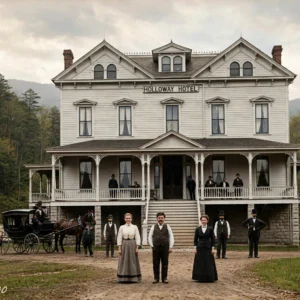
Before she became a Vanderbilt and ruled the Gilded Age, she was simply Alva Smith. Born in Mobile, Alabama, on January 17, 1853, she entered a world thick with jasmine and judgment, a Southern family on the edge of ruin. Her mother Phoebe had been cast out of society, and the family fortune was dissolving. But Alva Smith wanted control, and she got it.
She clawed her way up New York’s marble staircases, married into America’s richest family, and built limestone and gold palaces. She forced Caroline Astor to bow to her, not merely entering high society but overthrowing it. Her greatest empire was not marble but her daughter, raised to marry the Duke of Marlborough, a cousin of Winston Churchill. When that daughter begged to follow her heart, Alva replied, “I do not ask you to think.
I demand that you obey. ” She engineered a royal wedding and broke her daughter’s will to achieve it. Then, when her husband took mistresses, she did the unthinkable and divorced him, shocking society and leaving the world she had conquered. But Alva did not disappear.
She directed her money, her anger, and her will toward something greater: women’s suffrage. She paid for pickets, printing presses, and bail. She stood at the back of marches she funded, silent, among the banners and bruises, a quiet force of a woman trying to reclaim what had once been taken from her. This is not fiction.
This is not a story of redemption. This is the story of Alva Vanderbilt, cruel, compelling, and deeply human. Her childhood home was a fortress of hierarchy, a white-columned mansion at the corner of Government and Conti streets. Her mother Phoebe, from Kentucky landed aristocracy, ruled with commands and demands.
When a satirical pamphlet mocked Phoebe’s failed dinner parties and ignored lineage, she retreated, deciding the city was not worth conquering and raising her daughter to conquer something greater instead. The Smith family’s money had been made on the backs of the enslaved. Alva’s mother received enslaved people as wedding gifts, and when the family fled north, they took them along, renaming them servants. One of those servants, Monroe Crawford, was assigned to Alva.
She adored him and ruled him absolutely. “I tyrannized over him,” she later said. “It was absolute control on my part. ” He cleaned her shoes, carried her umbrella, and endured her silence.
He never questioned her. As a child, she discovered the pleasure of command. Her favorite toys were dolls, not playthings but subjects. She dressed them in French lace, arranged them in narrow beds, declared them hungry, tired, or cold.
She walked at night to cover them again, insisting they must sleep flat. “They have nightmares when they don’t,” she told her sisters. She was not playing. She was training.
Beneath her fury lived a quieter grief. In 1857, when Alva was four, her older brother Murray Jr. died at thirteen. He carried his father’s name, the heir, the favorite child.
Alva watched the house fill with silence. The dead son was worth more than the living daughter. From that day forward, she stopped asking for affection and began demanding recognition. She had seen what it meant to be overlooked, and she decided silence would never again be part of her life.
When the Civil War broke out, the Smiths fled north. Phoebe insisted on bringing her daughters, two maids, a small dog, and a sick mockingbird in a copper cage. In New York, their Southern accent was met with cold stares, and at church, the rector preached against slavery from the pulpit. They left and never returned.
When Lincoln was assassinated, they covered their windows with black cloth, not in mourning but to protect the glass from Northern stones. Eventually they sold their Fifth Avenue home. Alva watched the shutters close and thought, “Nothing lasts, not even marble. ”
They sailed for Europe.
In Paris, the court of Napoleon III and Empress Eugénie was at its peak. American Southerners were not condemned but curiosity. At a costume ball hosted by the minister, Alva, too young to enter the dance floor, watched from behind velvet curtains. She studied the court as a general studies terrain.
Paris taught her what Mobile had already begun: control was possible if she understood the rules. She fell in love with France, its symmetry, its discipline, its deliberate extravagance. She read French history, memorized the dynasties, and sketched palaces in the margins of her schoolbooks. She did not want to visit beauty.
She wanted to own it. In 1869, the family returned to New York. Alva was sixteen, freshly separated from the place she loved. New York had changed, become louder and rougher.
The Smiths moved to smaller homes, servants disappeared, and Phoebe unpacked boxes herself. In 1871, Phoebe died of inflammatory rheumatism at forty-eight. Alva was eighteen. At her mother’s coffin, she made a silent vow to become the woman her mother had imagined.
She observed her father’s trembling hands over an unpaid butcher’s bill. She would save them, not with tears but with strategy. In a world where women had only beauty and marriage as tools, she would master both. She entered society through the side door, with friends like Consuelo Yznaga, through whom she met William Kissam Vanderbilt.
He was quiet, confident, and elegant, educated in Europe like Alva, preferring horses to crowds. But unlike her, he carried a name that rang with new money. The Vanderbilts were richer than kings, but to Caroline Astor, they were mere railroad men. Alva saw in that name a lifeline.
She knew that kindness alone would not secure a marriage, not with her family’s circumstances deteriorating hour by hour. In the summer of 1874, she traveled to White Sulphur Springs with a plan. She bought yards of cheap black tarlatan, rough and transparent cloth, and with her old nurse’s help, sewed small clusters of golden flowers on the bodice. That evening, while guests wore silk, Alva slipped into the fields and gathered fresh golden flowers by hand.
She entered the ballroom in black and gold, her hair up, the fabric rustling like a solidified strategy. The room turned toward her, and William Kissam Vanderbilt saw her differently. By autumn, the engagement was officially announced. On her wedding morning in April 1875, her father, too ill to walk her down the aisle, kissed her hand and said, “You have taken a heavy burden from my shoulders.
I know now that you will take care of the rest. ” She married not for love but for survival. Two weeks later, her father died. Alva ordered mourning ribbons sewn into her new sleeves, but her eyes stayed forward.
Grief had no place in her strategy. She moved into a brownstone on West 44th Street, a gift from William’s father. She studied the Vanderbilt family as a system. They had money but no style, wealth without pedigree.
At the top of society sat Caroline Astor. Her salon on Fifth Avenue was a throne room, her guest list a register of legitimacy. She never visited the Vanderbilts. They were not on her list.
While New York’s salons remained closed to her, Alva turned to a realm she could rule alone: motherhood. On March 2, 1877, she gave birth to her first child, a daughter, named Consuelo after her friend Consuelo Yznaga. The name was strategic, a signal that this child would not wait for acceptance but would ascend to a higher world. From the cradle, Consuelo was designated to carry everything Alva had been denied.
Motherhood for Alva was not instinct but architecture. She organized feedings like measurements, lessons like renovations. Every governess, every tutor, every hour dedicated to deportment and French was a brick in the construction of a future duchess. The dolls she once arranged as a child had become flesh and blood under her control.
That same year, the Commodore died. William inherited three million dollars. For Alva, that meant building materials: stone, light, and legacy. She hired Richard Morris Hunt, the most famous architect in America, and argued with him constantly.
When he shouted, “Damn it, Mrs. Vanderbilt, who is building this house? ” she replied without blinking, “Damn it, Mr. Hunt, who is going to live in it?
”
Her true canvas was New York. She commissioned 660 Fifth Avenue, a limestone chateau with turrets and grotesques inspired by the Château de Blois. The interior was theatrical, a staircase built to be watched, a dining hall like a cathedral. Stained glass cast light on symbolic ceilings.
Every piece was chosen for control, not wealth. It was not a house but a palace of will. By 1882 it was nearing completion. The invitations had not been sent, but the guest list was written carefully and cruelly.
Caroline Astor had not called. Alva waited, then planned a costume ball, not merely a party but a coronation of brocade, a thousand guests, powdered servants, and marble staircases lit by gas. The Astors were not on the list. But Caroline Astor’s daughter Carrie was among the hopeful, possessing dresses, youth, and desire but lacking an invitation because her mother had never paid a call.
Alva waited, confident. Finally, a carriage arrived, a card was presented, a visit was paid, and the invitation was sent. With one move, the great gatekeeper of New York surrendered the key to acceptance. On the night of March 26, 1883, the ball took place.
Sixteen hundred guests attended, with five orchestras and rivers of champagne. Chandeliers glowed until dawn. The invitation read, “Come as myths, or memories, or marvels. ” Reporters waited outside.
Thousands lined the streets. The New York Times covered the costumes, jewels, and symbols across multiple columns. Alva stood in Venetian silver, attended by servants in powdered wigs. She had once arranged dolls as a court.
Now they bowed to her. After the ball, nothing was the same. Her rooms were imitated, her guest list treated as sacred text, her taste became law. But when the music faded, silence crept in.
Her marriage, distant by nature, began to collapse. William withdrew to clubs, yachts, races, and quiet affairs. They did not argue. They simply lived beside each other, elegant strangers in a stone cathedral.
In 1892, she began Marble House, her second Versailles, built on a cliff above the Atlantic with five hundred thousand cubic feet of imported stone, Corinthian columns, and a gilded ballroom. It was the most lavish summer home in America and the coldest. She walked its halls alone. In 1894, the family sailed for Europe.
William disappeared into Paris clubs; Alva stayed on the ship, sipping tea and correcting architectural plans. Consuelo, seventeen, carried messages between them. By the winter of 1894, preparations had begun. In March 1895, New York society opened its newspapers in shock.
Alva Vanderbilt was divorcing her husband. No woman of her standing, with her money, power, and marble palaces, had ever done such a thing. She provided no explanation. She hired the best lawyers and arranged the terms like a ledger: ten million dollars in cash, Marble House remained hers, custody of the children without discussion.
The marriage ended as it began, planned by Alva. With the marriage gone, she turned to her daughter. Consuelo had fallen in love with Winthrop Rutherford, a man of good family but no title. He was everything Consuelo wanted: kind, intelligent, American.
He was everything Alva did not want. Alva called Consuelo ungrateful, a disappointment, a fool. She told her, “I did not raise you to think. I raised you to obey.
” When Consuelo refused to leave New York, Alva claimed illness. She wept, took to her bed, and told the girl she was dying, that her disobedience was killing her. Curtains were drawn, clergy summoned, servants dismissed. Every day Consuelo came to her bedside, and every day Alva said, “You are breaking my heart.
” Consuelo resisted, but the house was closed to Winthrop. She became a prisoner in her own home. When Alva’s health declined, Consuelo wept and surrendered. She wrote to Winthrop, “I cannot see you again.
I obey. ”
Alva negotiated with the Duke of Marlborough, a distant relative of Winston Churchill. He had a title, a debt-ridden estate, and a desire for a dowry. Alva had a daughter with a fine figure and porcelain skin.
They discussed bloodlines and exchanged financial arrangements. The wedding was planned for perfection. Alva made Consuelo walk the aisle again and again, adjusting the veil, telling her when to smile, when to cry, when to stop. The night before the wedding, Consuelo wrote, “I feel like I am a prisoner in a play I cannot stop.
” On the wedding day, she wept behind the veil. It was so long that three bridesmaids carried it. More than 1500 guests attended. She had to be supported to stand before the ceremony.
Alva had presented a duchess to the world but lost her daughter. Months later, in January 1896, Alva remarried, to Oliver Hazard Perry Belmont, on a cold day. The press called it a love match. It was not, but it was, in every way that mattered, the right match.
He was a wealthy widower from an established family who liked horses and newspapers and never interrupted a woman speaking with authority. He admired her without needing to control her. For Alva, whose first marriage had been a long war for legitimacy, this was peace. They moved into Belcourt, his unfinished Gothic fantasy in Newport.
It had horses stabled on the ground floor. Alva took one look and started over, removing the horses, replacing dark wood with cream paneling, adding mirrors to the ballroom ceiling, turning the armory into a reception room. She did not make it beautiful; she made it hers. She began to withdraw from social life.
No more grand Vanderbilt parties. No more headlines. Belcourt was not a stage but a kingdom of silence. She kept a small staff, held dinners instead of festivals, and invited different kinds of people: a journalist, a widow interested in suffrage, an artist, a teacher.
In 1903, she sold her last Vanderbilt properties. In 1908, Oliver died suddenly of appendicitis. Alva arranged the funeral and returned to Belcourt. She wore black but did not stop hosting.
She did not remarry. For the first time, Alva lived without collision, with space and quiet and a voice that was entirely her own. By 1908, the suffrage movement was gaining strength. Women marched in long coats and worn shoes, their signs handstitched.
The press published grainy images of arrests on Fifth Avenue, bruises from clubs, women in corsets and feathered hats standing shoulder to shoulder with police. Alva noticed. She began ordering volumes from England, circling sentences, writing in margins, pacing her sitting rooms. She attended meetings, not speaking, but listening, writing checks quietly, and allowing Marble House to be used for lectures.
Rooms that once glittered with diamonds and dukes now held folding chairs and sharp voices. In 1913, she funded a full print run of suffrage materials, not as Mrs. Belmont but as Alva. Her name, once engraved on gilded place cards, now appeared on pamphlets, press releases, and meeting notes.
In July 1914, Marble House no longer echoed with music but with the voices of people. It was not a ball but a political gathering. Alva stood where she had once received the Prince of Wales and told the women before her, “I have always been gratified to know that I was never a doll in anyone’s hands. And I intend to be useful now that I know the meaning of my life.
” That summer, she was elected president of the New York Equal Suffrage League. She allied with Alice Paul, thirty years her junior, trained by British radicals. Alva gave not just her name but money and energy. She paid for ink, bail, and banners reading “A Vote for Women Now.
” Her speeches grew sharper. She said, “American women have been trained to obey. We are now training them to think. ”
Across the Atlantic, Consuelo watched from London.
Her marriage had become hollow, the duke had mistresses, and the title was cold. She separated quietly and joined the suffrage movement in England, working as a volunteer. Their silence changed between them, no longer punishment but waiting. In January 1917, women in long coats stood outside the White House gates, the Silent Sentinels, the first women ever to protest an American president in office.
Their signs read, “Mr. President, how long must women wait for liberty? ” They stood for hours in frost and rain. Alva paid for the signs, the badges, the printing, the wagons, the scarves, the charcoal stoves.
When arrests began, she paid bail, lawyers, ink, and telegrams. In November 1917, forty women were beaten and kicked at the Occoquan workhouse in what became known as the Night of Terror. Alva did not hesitate. She paid the legal fees, the court reporters, and funded a special issue of The Suffragist documenting the brutality.
In 1918, she bought a house on Lafayette Square, directly across from the White House, as the official headquarters of the National Woman’s Party. Three stories, printing rooms, meeting halls. It was known as “the house that Alva built. ” She donated $120,000 over four years.
Alice Paul once said, “Mrs. Belmont does not knock on doors. She builds her own. ” On August 18, 1920, the Nineteenth Amendment was ratified, and on August 26, it was signed into law.
Women could vote. It had taken seventy-two years. Alva gave a brief statement to the press: “Let us not forget those who tried to stop us. ” Then she returned to Belcourt.
In 1921, a letter arrived, handwritten, folded once, signed only “Consuelo. ” It read, “I heard you were in Paris. I would like to see you. ” Alva stared at it for nearly an hour.
Then she replied, “There is a room. It is open. ” By 1923, she had moved to a small house in Saint Brice-sous-Forêt, not far from where Consuelo lived with her second husband. “I lived in a house that was a fortress,” Alva told a visitor.
“Now I want to live in a place where I can leave the windows open. ” Consuelo visited, then returned. They sat in silence, walked in the garden, read aloud, argued, and made tea. They never forgave each other outright, but they came close.
Consuelo once said, “You used to write in the margins. ” Alva replied, “I still do. Only now, there is someone reading them. ”
In 1925, Alva sold Marble House.
She kept some pieces: a mirror partition, one chair, a painting of Consuelo at eighteen. The rest went. In the final years of her life, she funded a school for girls in Paris, paid travel costs for three Latin American women to attend a women’s rights conference in Geneva, supported a series of feminist essays translated into Spanish, and sent anonymous donations to suffrage initiatives in Egypt, Uruguay, and Haiti. She kept a drawer of small things: a suffrage ribbon, a campaign pin reading “Votes for Women,” a newspaper clipping about the 1917 protests, a folded note that simply said, “Thank you.
”
On January 26, 1933, Alva Belmont died in her sleep at eighty years old. The American press called her a society woman, a divorcée, a builder of ballrooms. Few mentioned the women or causes she funded or the laws she helped change. Her funeral was small, no speeches, no crowds, only a few women.
And Consuelo. She left her fortune not to institutions but to women’s colleges, legal aid societies, three international press funds, and her daughter. She built palaces, tore down gates, and died with a door left open. Alva was not gentle.
She was not kind. She was, by all accounts, difficult, domineering, demanding, and impossible. She raised her daughter for obedience and then fought for a world in which no daughter would have to obey. She married for status and divorced for freedom.
She was resented by those she helped and feared by those she challenged. But she opened doors, with money, with marble, with marches, with banners, and with bruises she never wore herself but paid for. When victory came, she did not step forward for applause. She stood at the back in black clothes, watching others cross through.
She never begged to be loved. She demanded to be heard, and then she made sure others could speak.