The shadow stretched over the frost like a shape cut from the moonlight, long and thin, the outline of a person. Nothing cast it. Above the clearing the sky was cloudless, the moon round and pale and utterly still, yet the shadow crept across the grass from the tree line toward the cabin, sliding forward with an intent that required no body to drive it. It came to the woodshed and halted.
The singing ceased with it, and the quiet that followed pushed against Apprentice Callaway’s face as he stood at the window, his heart pounding at his ribs. The shadow held still. It rested there, black and crisp-edged, arms at its sides, head cocked as though peering up at him through the frost, the grass, and the cabin wall with something akin to curiosity. He drew back a step.
His hands trembled. The singing rose again, a single note, then stillness, then nothing. The place where all this occurred lay in the autumn of 1897 in a stretch of the southern Appalachian Mountains that most maps of the day never bothered to label. It rested between two ridges running roughly north to south, shaping a long, narrow valley the locals called the Trough—a name that appeared on no official survey.
The closest settlement of any real size sat some forty miles to the east, a town called Coulter’s Mill, joined to the valley by a lone wagon trail that flooded out each spring and froze hard each winter. Between Coulter’s Mill and the Trough lay only forest—miles of old-growth hemlock, white oak, and tulip poplar, so tall and dense that even at noon the forest floor stayed in perpetual dusk. The canopy shut overhead like a cathedral roof, and beneath it the silence carried weight, the sort you could feel pressing on your eardrums. The folk who lived in the hollows and along the ridges between those mountains were not the sort to ask for help, and not the sort to leave.
They were born in those hills and buried in those hills, and in between they lived quiet lives shaped by the turning of seasons, the health of their livestock, and unwritten rules every family knew but no one had ever set down. Rules about which springs were safe to drink from. Rules about which trails you could walk at night and which you steered clear of. Rules about when to plant and when to harvest and when to stay inside with the shutters barred and the fire built high.
One rule outweighed all the rest. You did not cross past Sorrow Ridge after dark. You did not take the trail that dropped into the valley on the far side. And if you heard singing drifting up from below the fog line on a still night, you shut your windows, barred your door, and did not listen.
No one recalled who had made the rule or how far back it reached. It was simply there, woven into mountain life the way cold is woven into winter. The old women shelling beans on their porches through the long afternoons would sometimes speak of it in hushed voices, the way people speak of sickness or debt, acknowledging it without beckoning it nearer. They said the valley beyond Sorrow Ridge was older than the mountains themselves.
They said things dwelt there that had no name in any language human tongues had spoken. They said the singing was not music. It was a mouth, and what it hungered for was not applause. It hungered for company.
Apprentice Callaway was forty-four years old the year everything changed. He was a timberman by trade and by blood, the third generation of Callaways to earn a living hauling logs off the slopes of the southern Appalachians. He was broad across the shoulders, thick through the chest, with arms that seemed carved from the same hardwood he cut. His face was deeply weathered, lined and browned by decades of wind and sun, and his jaw sat heavy and square beneath a beard gone more silver than brown.
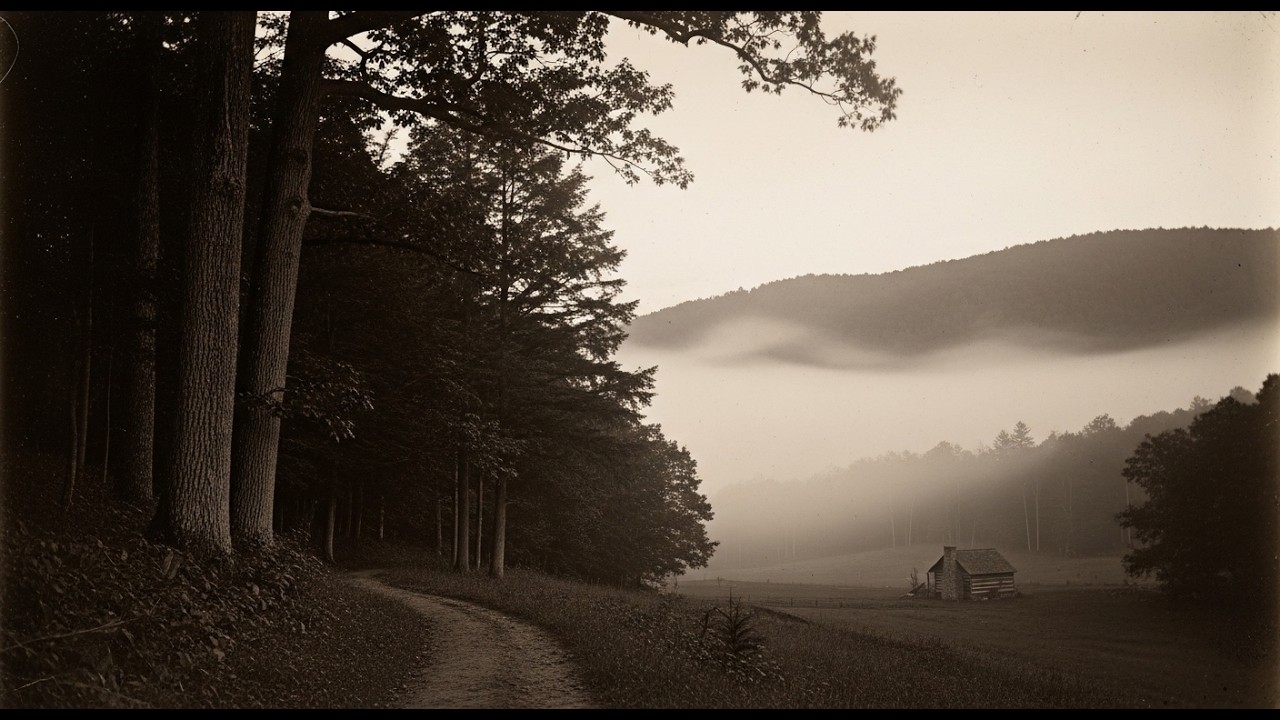
His hands were enormous, scarred at every knuckle, fingers as thick as axe handles, forever stained with sap and soil. His eyes were deep-set and the color of wet slate, and when he spoke, which was seldom, his voice came out low and unhurried, like a man who had long ago learned the mountains didn’t care how fast you talked. He had spent his whole life on a homestead at the foot of Sorrow Ridge, in a cabin his grandfather Abner Callaway had raised from hand-hewn logs back in 1831. The cabin was sturdy and low, with a stone chimney at one end and a covered porch at the other, set in a clearing of about three acres ringed on every side by forest.
There was a woodshed to the east, a small barn to the west, and a root cellar dug into the hillside behind the cabin that stayed cool even in the hottest stretch of summer. His wife, Dorotha, had died of fever six years before. She had been thirty-seven, a tall woman with auburn hair she wore braided down her back and a laugh that seemed to fill whatever room she entered. They had been married fourteen years.
She fell ill in late February, a cough that worsened into something more, and by the first week of March she was gone. Apprentice dug her grave himself in the little family plot on the hillside above the cabin, breaking the frozen ground with a pickaxe for two days because the earth was hard as iron and he would not let another soul do it. Since then he had lived alone with his hound, a graying blue tick named Kettle, and a silence that filled every room like smoke. He was not a superstitious man.
He did not sit through the circuit preacher’s sermons when the man rode through every other month on his mule. He did not hang iron horseshoes above his doorframe the way some neighbors did to ward off evil spirits. He did not believe in hexes or witchery or the old tales the ridge women told around their autumn fires about lights in the hollows and voices in the wind. But he honored the rule about Sorrow Ridge—not because he believed something was out there, but because his grandfather had believed it, and his father had believed it, and Dorotha had believed it, and that was enough.
The trouble began on the ninth of October, a Thursday, when Apprentice found his axe buried in the stump behind his woodshed. That alone was nothing strange—he split wood at that stump every day and always left the axe embedded when he finished. But he always set the blade flat against the grain, angled to the left, handle leaning against the side of the stump. Always.
It was a habit so ingrained it had become nearly automatic. But that morning the axe stood straight up, sunk deep into the middle of the stump with such force that the wood had split almost clean through. The handle rose toward the sky like the needle of a compass. Apprentice stood there a long while, just staring at it.
The morning was quiet and cold, his breath forming little clouds that floated off like spirits. Kettle sat beside him, motionless, not nosing at the ground as he normally did, only watching the tree line with his ears pinned flat to his skull. Apprentice worked the axe loose, ran his eyes over the handle for marks, scanned the ground around the stump for boot prints, animal tracks, any trace at all that someone had been there in the night. He found nothing.
The frost lay untouched. No prints except his own, leading from the cabin to the woodshed. He told himself the wind had managed it somehow, that a gust had caught the handle and tipped the axe upright and forced the head down. He told himself he must have left it that way and simply forgotten.
But he hadn’t, and he knew it, and Kettle knew it too. The dog sat and stared at the trees and did not move for a long while after Apprentice went back inside. Three nights later something woke him at what he judged to be around two in the morning. He had no clock—time in the mountains was told by the sun, the shadows, the habits of animals—but he knew it was the deep middle of the night, that hollow stretch when the world seems paused, suspended, holding its breath.
It wasn’t a sound that woke him. It was the sudden absence of sound. The crickets had gone quiet. The frogs along the creek, which sang every night from April through November in an endless chorus, had fallen silent.
Even the wind, which usually pressed against the cabin walls with a low, steady moan he no longer consciously noticed, had died away entirely. The silence was so complete and so sudden it felt physical, like a hand clamped over his ears. Kettle lay on the floor beside the bed, trembling—not whimpering, not growling, just shaking, a fine continuous vibration Apprentice could feel through the floorboards. The kind of trembling an animal does when it has already decided that whatever is outside is something it cannot fight and cannot flee from, and the only option left is to be still and small and hope it passes by.
Apprentice reached down and laid his hand on the dog’s ribs, felt the heartbeat beneath the fur, fast and shallow like a bird caught in a closed fist. Then he heard it. A single note, high and clear, like a woman’s voice carrying across still water. It came from the direction of Sorrow Ridge, from up the slope past the tree line, past the first crest of the mountain.
It hung in the air for perhaps three seconds, pure and sustained, without vibrato, without wavering. Then it faded, and the crickets came back, and the frogs resumed, and the wind returned, and Kettle stopped trembling. Apprentice did not sleep again that night. He lay in the dark and listened to the ordinary sounds of the mountain night and tried to convince himself it had been a screech owl, a vixen calling for a mate, an echo distorted by distance into something that only resembled a human voice.
But his hands were cold and his heart was beating too fast, and somewhere behind the rational part of his mind, in the ancient wordless place where instinct lives, something had woken up and was paying very close attention. The next morning he walked down the slope to the nearest homestead, which belonged to a man named Rosco Leatherwood. Rosco was sixty-one, thin as a fence rail, with a white beard that reached past his collarbone and a full head of hair the color of old snow. His hands never stopped moving—whittling a piece of cedar, rolling a cigarette, adjusting the brim of his battered felt hat.
He had pale blue eyes, still sharp despite his age, and he had lived in these mountains his whole life, same as his father before him and his father before that. Apprentice found him on the porch whittling a piece of sourwood into a shape that might have been a spoon or might have been nothing at all. Rosco looked up but didn’t speak. Mountain etiquette.
You let a man get settled before you ask his business. Apprentice sat on the porch step, accepted the cup of chicory coffee Rosco poured, drank half of it, and told him about the singing. He expected Rosco to laugh or wave it off. Rosco did neither.
He stopped whittling, set down his knife, set down the sourwood, and looked at Apprentice with an expression Apprentice would later describe as the look of a man who has just been told the thing he feared most has finally arrived. Not shocked, not panicked. Resigned. The way a man looks when he hears the first rumble of a storm he’s been watching build all day.
Rosco asked one question. Was the singing coming from below the fog line? Apprentice said he couldn’t be sure. It had been dark.
He couldn’t see the ridge, couldn’t judge the elevation of the sound. He just knew it had come from up the mountain, from the general direction of Sorrow Ridge. Rosco nodded slowly, then told him a story. His grandmother, a woman named Parthnia Leatherwood, had heard the singing once back in 1852, on a November night cold enough to freeze the creek solid.
Parthnia had been alone in the cabin, her husband away on a timber run down to the lowlands, and she had woken in the middle of the night to that same sound, a single voice high and clear coming from the direction of the ridge. She made the mistake of stepping onto the porch to listen. She stood there for what she later estimated was about twenty minutes, wrapped in a quilt, her breath making clouds in the moonlight, listening to the most beautiful sound she had ever heard. It wasn’t just singing, she said.
It was longing made audible, the sound of something that missed something else so desperately that the missing had become its own kind of language. She came back inside, closed the door, went back to bed. But she was never the same. She stopped speaking for three months.
When she finally talked again in late February of 1853, the only thing she would say about that night was that the voice had not been outside. It had been right beside her, standing next to her on the porch, close enough to feel the breath on her neck, warm and slow and rhythmic. When she turned, there was nothing there—just the empty porch, the moonlight, the mountains, silent now, the singing having stopped the moment she turned to look. Rosco said his grandmother lived another thirty years, dying in 1882 at the age of seventy-nine, but she never once went outside after dark again.
She kept a candle lit in every room while she slept. And on November evenings she would settle by the hearth and rock and hum to herself—not really a melody, more a single tone held and wavering, as though she were attempting to recreate something she had once heard and could never quite reproduce. Apprentice walked home that afternoon carrying a weight in his chest that hadn’t been there before. Not fear exactly—fear was something he knew, something with boundaries and edges, something a man could confront or run from.
This was something else. It was the sensation of a door swinging open somewhere behind him, a door he couldn’t see and couldn’t shut. That night he secured his door with the heavy timber crossbar his grandfather had fitted and that Apprentice had never once in all his years had cause to use. He lit a lantern, inspected the shutters on every window, and sat in his chair with his rifle—a .
44 caliber Winchester lever action that had belonged to his father—resting across his knees, and he waited. Kettle lay beneath the table pressed against his boots. Nothing happened that night, nor the next, nor the one after. By the fourth night he had started to loosen up.
He told himself Rosco was just an old man full of old tales. He put the rifle away. He stopped barring the door. On the fifth night, the singing returned.
This time it was nearer—not up on the ridge, but somewhere in the woods behind his cabin, perhaps two hundred yards off, perhaps less. The same single note, high and sustained, clean as spring water. But now he could detect a layering beneath it, as though more than one voice were making the sound without quite harmonizing, the notes close together and nearly identical yet not quite matched, producing a dissonance more felt than heard, a quiver in the chest rather than a sound in the ears. It was beautiful.
That was what disturbed him most. It was truly, achingly, heartbreakingly beautiful—the way grief is beautiful when you hear it from a distance, the way a hymn sung in an empty church is beautiful, the way the last light of day on a winter mountain is beautiful. It bore a weight of feeling that seemed impossible for a mere sound to hold, as if whatever made it had distilled an entire lifetime of loneliness into one unwavering note. Kettle did not tremble this time.
Kettle let out one long mournful howl that climbed up from the floor and filled every corner and rang in the rafters, then ceased as abruptly as it had begun, cut off mid-note as though the dog had been struck dumb. Then the animal crawled under the bed and refused to come out no matter how many times Apprentice called his name. Apprentice stood at the window. He knew he shouldn’t.
Rosco’s words were plain as scripture in his mind: do not go to the window, do not open the door, do not try to find where it’s coming from. But something had shifted across those five quiet days. The not knowing had grown worse than the knowing. He pressed his face to the glass and peered out toward the tree line.
The moon was nearly full, and it washed the clearing in a pale blue-white light that left everything looking faded, ghostly. The woodshed cast a long shadow across the frosted grass. The stump was a dark lump beside it. Past the fence, the first row of hemlocks climbed like columns into a canopy that shut out the sky.
Everything was motionless, the kind of stillness that feels intentional, like a breath held. Then he caught movement—not in the trees, on the ground. A shadow, long and narrow, gliding across the frosted grass like something being dragged by an unseen hand, with nothing casting it. He glanced up expecting a cloud passing over the moon, a bird flying overhead.
There was nothing. The sky was clear. He followed the shadow with his eyes. It moved steadily, without hurry, from the tree line toward the cabin.
It had direction and intent. It wasn’t drifting or wavering. It was advancing deliberately, as though it had all the time in the world. The shadow reached the woodshed and halted.
The singing ceased at the same instant. The silence that followed was total. Apprentice stood at the window, face pressed to the cold glass, and stared. The shadow lay there on the frost, black and sharply outlined, and it was shaped—with a slow, crawling horror that began in his stomach and climbed his spine—like a person.
Long and thin, arms at its sides, head tilted a little, as if it were gazing up at him with something that might have been curiosity. He stepped back. His hands were trembling. The singing began again.
One note, then silence, then gone. He did not sleep that night. He sat in his chair with the lantern burning and the rifle across his knees and watched the door until dawn. In the morning he went out to the woodshed.
The axe was in the stump once more, upright, driven deep, and this time something else had been scratched into the surface around the base of the blade. Marks. Not letters, not symbols he recognized. Just lines, dozens of them, thin and deliberate, cut into the wood with something harder and sharper than any tool Apprentice owned.
They formed a pattern that resembled the rings of a tree, yet wrong somehow, spiraling inward instead of outward, drawing tight toward the center where the blade was buried. He told Rosco. The old man came up the trail that afternoon, stood over the stump for a long while without a word, then spat tobacco juice into the dirt and said something Apprentice would carry with him for the rest of his life. “It’s not coming from the ridge anymore, Apprentice.
It’s already here. It’s in your clearing, and once it’s in your clearing, it don’t leave. It waits. ”
Apprentice asked what it was waiting for.
Rosco fixed him with those old, tired, pale blue eyes and said, “For you to answer. ”
In the days that followed, something began to shift in Apprentice. Something quiet and slow and impossible to halt, like water seeping through a crack in a foundation. The singing came every night now, always between two and three in the morning, always from just past the tree line, always nearer.
Not by much, not in any way he could measure exactly, but he could sense it the way you can sense someone standing behind you in an empty room. The marks on the stump multiplied. Each morning fresh lines, the spiral growing tighter, more intricate, more deliberate. He tried scouring them off with sand and water.
They returned the next night, deeper than before. He tried turning the stump over so the marked surface faced the earth. By morning the marks had appeared on the new surface, identical in pattern, as though they had seeped through the wood like ink through paper. He tried burning the stump entirely, soaking it with kerosene and setting it alight on a clear, dry evening.
The kerosene had dried up before the match could take. The matches died, all three, one after the other, sputtering and going out between his fingers, as though the air around the stump had lost its oxygen. The stump just sat there, cold and wet and scrawled with those impossible spiraling lines, and it would not burn. Kettle quit eating.
The dog stayed under the bed through the day and through the night, his ribs showing through graying fur, his eyes open but vacant, fixed on some distant thing only he could perceive. Apprentice’s chickens quit laying. His cow, a dependable old Jersey he’d kept for twelve years, broke through her fence one night and bolted. He found her the next morning two miles down the trail, planted in the center of the road and shaking so violently her legs almost gave out, her eyes rolled back until only the whites showed.
She would not budge. He had to blindfold her and lead her home by the halter, and even so she fought him at every step, as though she knew precisely where they were headed and would sooner die on that road than go back to the clearing at the foot of Sorrow Ridge. That was when the dreams began. Whenever he shut his eyes, he was somewhere else—below ground, in a tunnel narrow and damp, its walls of packed earth warm against his touch, warm with an organic heat like the flank of a living animal.
The tunnel ran a single way, sloping gently downward. The air hung heavy, carrying the smell of rain and disturbed soil and something sweet with a faint metallic edge. He would walk on, always on, and somewhere ahead, forever just past the next bend, he could hear the singing—no longer one voice but many, braided into harmonies that moved like light across water. He would wake up choking for breath, soaked in sweat, his heart pounding.
And each time, with no exception, he found dirt beneath his fingernails. Actual dirt, dark, rich, loamy soil wedged under his nails as though he had been digging while he slept. He inspected his hands every morning. The dirt was always there.
He searched the cabin floor for loose boards, for any sign of sleepwalking, of clawing at the ground. Nothing. The floor was solid pine, tightly joined. The door was still barred, the shutters still latched.
There was no way he had been outside. Yet the dirt was real. By the third week of October, Apprentice had all but stopped sleeping. He sat up through the nights, lantern burning, listening to the singing draw nearer.
It was inside the clearing now, he felt sure of it. Some nights it seemed to come from just beyond the wall, with nothing between him and it but two inches of hand-hewn oak. He could hear the voice, and under it that layered harmonic, and under even that, something more—a rhythm, not musical but organic, like breathing, slow and deep and even, as if something enormous were pressed against the outer wall of his cabin, its mouth close to the logs, breathing in time with the singing. The warmth of its breath seeped through the wood, and he realized he was sweating in the middle of an October night.
He began visiting Rosco every day. The old man had become his only link to anything that felt normal. One afternoon near the end of the third week, Rosco told him about the valley on the far side of Sorrow Ridge. Before the first settlers came to these mountains, the native people who lived here had a name for that valley.
Rosco couldn’t pronounce it—his grandmother had told him once, but the sounds did not sit easily in an English-speaking mouth. The nearest translation was something like “the place where the ground listens” or perhaps “the place where the ground remembers.” The two meanings were apparently very close in the original language, listening and remembering being understood as aspects of the same thing. They believed the valley was not merely a geographic feature.
It was alive—not alive the way a forest is alive with trees and animals and seasons, but alive the way a person is alive, with awareness, with memory, with intention, with something that in a human being you might call loneliness. Every few decades something in that valley would reach out, not physically, but the way loneliness reaches out, the way grief reaches out, by making itself known, by singing, by calling. Whoever heard the singing would feel a pull, gentle at first like a current in a stream, then stronger, then irresistible. And eventually, inevitably, they would walk over Sorrow Ridge and down into the valley and into the fog, and they would not come back.
Apprentice asked how many people had gone over the years. Rosco said he didn’t know for certain. His grandmother had told him about four or five spread across the decades—always people who lived alone, always people who had lost someone, a spouse, a parent, a companion, always in autumn when the fog was thickest and the nights were longest. The last one he knew of had been a woman named Varity Ashgrove, a widow of about fifty-three who had lived alone on the eastern slope since her husband died in a logging accident in 1868.
She walked into the valley on a November night in 1871 and was never seen again. Her cabin was found with the door wide open, the fire still burning, a pot of stew still warm on the stove. Her boots were by the door, lined up neatly the way she always left them. She had walked into the mountains barefoot.
Something cold settled deep in Apprentice’s stomach when he heard that—cold and heavy and permanent, like a stone dropped into still water. Because three nights earlier he had woken up standing on his porch barefoot, facing the direction of Sorrow Ridge. The door behind him was open, the crossbar lifted and set aside as carefully as if he had done it deliberately, though he had no memory of it. No memory of getting out of bed, crossing the cabin, lifting that heavy timber bar.
But there he was, standing in the frost with his bare feet on the frozen boards, nightshirt plastered to his body with sweat, and the singing everywhere, all around him, inside him, resonating in his rib cage like a second heartbeat. He told Rosco this. The old man set down his knife, looked at Apprentice for a long, long time, then said very quietly, “You need to leave, Apprentice. Today.
Right now. Take your dog. Take what you can carry. Walk down to Coulter’s Mill and get on the next wagon heading east.
Don’t stop until you can’t see these mountains anymore. Don’t come back until spring. Maybe not even then.”
Apprentice said he couldn’t leave.
This was his home, his grandfather’s cabin, his father’s land. Dorotha was buried on the hillside above the clearing. He couldn’t leave her. Rosco looked at him and said, “Everything you had—what’s here now ain’t yours anymore.
And Dorotha, God rest her, she’s not in that grave, Apprentice. What’s in that grave is just what she left behind. Don’t confuse the two.”
Apprentice didn’t leave.
He convinced himself it was pure stubbornness, that Callaway men never backed down from anything, that some rational answer had to exist. Yet another reason lurked beneath, one he refused to acknowledge until years afterward, when he was far removed from the mountains, the fog, and the singing, when he could finally look back with a measure of clarity. The singing was lovely, and in the deepest, most hidden corner of his grief-emptied heart, it called Dorotha to mind. Not her voice precisely—Dorotha had possessed a warm, low singing voice, a contralto she used while hanging laundry or kneading dough, gentle and unguarded, the way people sing when they believe no one is listening.
This was something else, higher, more otherworldly, more remote. Yet something within the melody, in the way it shifted, in the sorrow it bore, felt like her. As though whatever waited out there in the dark had reached into his memory and located the single sound, the single pitch of longing that would make him pay attention. And pay attention he did.
In spite of everything—the dread, the sleepless nights, the dirt caked beneath his fingernails, the impossible marks on the stump—he was listening, and some part of him, a part he was profoundly ashamed of yet could not quiet, wanted to respond. The final week of October brought the fog. It descended from Sorrow Ridge as though poured from some great vessel, sluggish and thick and deliberate—not the scattered ground fog of ordinary autumn mornings, but dense and white and total, a barrier of moisture that slid down the slope, flooded the clearing, encircled the cabin, and shrank the world to the size of the yard. Apprentice could not make out the tree line, could not see the trail, could hardly spot the woodshed from the porch.
The fog devoured everything—sound, light, distance, direction. It did not burn off during the day the way mountain fog typically does once the sun warms the air. It lingered morning, noon, and night, unvarying, thick, and it carried a quality Apprentice found hard to put into words. It gave off a faint glow, nearly imperceptible, a soft luminescence most apparent at night, when the lack of moonlight should have left the world in total darkness.
The fog emitted a pale, diffuse radiance like the inside of a lantern turned down to its dimmest setting, as though something deep within the mist were generating light, something distant and immense and endlessly patient. And within the fog, things stirred. Not shapes he could name—only variations in thickness, patterns that surfaced and faded, like something pacing around the cabin slowly, methodically. The singing was unbroken now, not merely at night but through every day and every night, woven into the fog itself.
He heard it when he covered his ears, when he buried his face in his pillow, heard it in his very bones. The singing was not traveling through the air. It came through the ground, the timber of the cabin walls, the water in the creek. It was everywhere and nowhere, and there was no escaping it.
Kettle ceased moving altogether. The dog lay on his side beneath the bed, drawing shallow, gasping breaths, eyes open but utterly blank, as though his mind had withdrawn to some far, unreachable place where the singing could not follow, leaving the body behind like an empty house with the lights out and the doors locked. Rosco arrived on the twenty-eighth of October. He had to feel his way up the trail through the fog, and when he reached the cabin his face was ashen and haggard, his hands shaking.
He told Apprentice the fog had reached his homestead as well. His horses were gone, having broken loose from the corral and fled down the mountain. The spiraling marks had shown up on his own porch railing overnight. He said he was leaving, and pleaded one final time for Apprentice to come along.
Apprentice nearly agreed. Nearly. But that night, while Rosco dozed uneasily in the chair beside the dying fire, Apprentice detected something new within the singing. A word.
Only one, spoken rather than sung, woven into the melody so smoothly that at first he believed he had imagined it. But it returned again and again, a single word repeated at intervals in a voice that was unmistakably, impossibly, achingly Dorotha’s. His name. Clear and tender and impossibly real, the way she used to say it when she roused him in the morning, her hand on his shoulder, her face near his, with that particular gentleness that held a whole lifetime of knowing someone, of having charted every corner of another person’s soul.
“Apprentice.” Just like that. With love, with familiarity, with the quiet certainty of a woman summoning her husband home. Apprentice sat bolt upright in bed.
His heart was pounding. His eyes were stinging. For one terrible, beautiful, shattering moment he forgot everything—the fear, the warnings, Rosco asleep in the chair, the marks, the fog, the dog lying limp beneath the bed. All of it dissolved, and there was only her voice calling him, and the overwhelming, ruinous need to go to her.
He was on the porch before he realized he had moved. Barefoot once more, the fog pressing against him like wet cloth, warm and damp and alive with that faint pulsing glow, the singing rising around him, and inside it Dorotha’s voice repeating his name over and over, each time a little farther off, a little deeper into the white, leading him, drawing him onward the way a lantern draws a moth. He took one step off the porch, then another. The frost stung his bare feet, but he scarcely felt it.
The world had shrunk to two things: her voice and the need to follow it. The third step carried him past the woodshed. The fourth brought him to the edge of the clearing. One more step and he would be among the trees, on the trail that climbed to Sorrow Ridge, and from there down into the valley from which those who entered did not come back.
He took that step. And then something seized him. Not the fog, not whatever dwelt in the valley. Something real, something human.
Two hands, bony and startlingly strong, caught the back of his nightshirt and wrenched him backward with a force that seemed impossible for a sixty-one-year-old man. Rosco had awakened, seen the empty bed and the open door, followed the bare footprints in the frost, and now he was hauling Apprentice backward, away from the tree line, back toward the cabin, shouting words Apprentice could not hear over the singing, could not hear over Dorotha’s voice calling his name with growing urgency, growing desperation, as though she knew he was being torn away from her. Apprentice fought him. He was ashamed of it afterward, deeply and permanently ashamed.
Yet in that instant, with her voice filling his ears and her nearness so tangible he could almost catch her scent—lavender, wood smoke, and bread dough, the fragrance of their cabin on a winter night, the fragrance of home and love and all he had lost—he battled the old man like a trapped beast. He writhed and scratched and nearly tore himself loose. But Rosco would not let go. Rosco clung with all his strength, boots skidding on the frost, breath rasping in ragged pulls, and he dragged Apprentice back onto the porch, through the doorway, and shut the door hard and barred it.
The singing ceased. Not little by little, not dying away. It ceased the way a flame is snuffed out. One second it was there, filling every crevice, every fiber, every thought.
The next second it was gone. And the silence that followed was the emptiest, most bleak silence Apprentice had ever known. It was the silence of something retreating, of something thwarted, of something that had come very near to claiming what it wanted and had been refused. Apprentice crumpled onto the cabin floor.
His feet were cut and bleeding from the frost and stones. His hands trembled uncontrollably, his cheeks wet with tears. Not from fear, not from relief—from sorrow. Because at that moment, as Rosco hauled him back from the tree line and slammed the door against the singing and the fog and whatever waited out there wearing Dorotha’s voice, it felt exactly, utterly, agonizingly like losing her all over again.
They departed at daybreak. Rosco half carried Apprentice along the trail, pressing forward as fast as the fog permitted. Kettle would not come. The dog was breathing, but he would not rise, would not stir, would not respond to their presence.
Rosco said the dog was already lost. Whatever the thing in the valley had done to Apprentice’s mind, it had done to the dog as well, only deeper, more thoroughly, because animals lack the defenses humans build between themselves and what they cannot explain. Kettle’s mind had followed the singing wherever it led, and his body was merely what remained. Apprentice never laid eyes on the dog again.
They reached Coulter’s Mill by early afternoon. The fog had not pursued them beyond the foot of the ridge. It stopped sharply, a wall of white on one side and clear air on the other. Apprentice glanced back once, and afterward he told Rosco that for a split second he believed he saw something standing at the fog’s edge—a figure, tall and pale and impossibly slender, motionless at the exact place where the mist met the clear air.
Its head was cocked slightly. It was there for a single heartbeat. Then the fog shifted and it vanished. Apprentice spent three days in bed at Rosco’s nephew’s house.
Not ill precisely, but drained. He stared at the ceiling and listened for a singing that was not there, and felt its absence like an open wound. On the fourth day, a trapper named Peton Qualls came down from up the mountain—thirty-six years old, lean and hard-eyed, with a scar across his chin. He reported that the fog had spread over the entire northern face of the ridge and down into three separate hollows.
At least two other homesteads stood abandoned, the families having fled in the night without packing. He said he had discovered tracks on the trail leading up to Sorrow Ridge. Bare feet, several sets, all going up, none coming back down. Qualls said he followed the tracks to the ridge line, where the fog was so dense he could not see his own outstretched hand.
The singing began the moment he reached the top. It was the most beautiful sound he had ever heard, he said, and it required every ounce of will he had to turn around. As he retreated, the singing changed. It turned angry.
Not louder—just angry, the way anger can fill a room even when no one speaks. And the fog rushed after him like a wave, and he ran until he reached clear air. A party of seven men from Coulter’s Mill went up to investigate, armed with rifles and axes, all experienced woodsmen. Four returned.
They came back at dusk, walking fast, silent, their faces ashen. They said they had roped themselves together and entered the fog. It was warm. It moved against the wind.
It had texture, like walking through something woven. The singing started at once, and two of the men, Hartwell Creedmore and Anel Picket, began weeping without knowing why. About two hundred yards into the valley they found a cabin. Not any cabin they recognized.
Logs so ancient they had turned black. No door, only a dark rectangular opening. The fog was pouring out of it in slow, steady exhalations, like the breath of something sleeping. Around the cabin, in the frozen mud, were bare footprints—dozens of them, circling the structure in the same spiraling pattern as the marks on Apprentice’s stump, walking around and around, tightening with each revolution, converging on the doorway.
The singing was coming from inside. Four of the men approached. The singing grew louder with each step. The fog inside the cabin was not white but faintly golden, like lantern light diffused through gauze.
When they reached the threshold and peered inside, they saw nothing. An empty room—dirt floor, no furniture. But the room was larger than the cabin. The cabin was perhaps fifteen feet across.
The room within was vast. They could not see the far wall. And the room did not go back. It went down.
The dirt floor sloped gently, descending into the earth itself. And from somewhere deep in that impossible depth, the singing rose—layer upon layer of voices that were almost words but not quite, almost familiar but not quite, almost human but not quite. One of the men, Anel Picket, stepped inside. He did not hesitate, did not explain himself.
He walked forward into the golden fog, down the gentle slope, and within three steps the fog had closed around him. Within five, they could not see him. They called his name. The singing swallowed the sound.
They waited. Anel did not return, and gradually the golden fog began to drift outward through the doorway, toward them, reaching for them, extending tendrils of warm, luminous mist that curled around their boots and pressed against their chests with a gentle, insistent pressure—not pushing them away. Pulling them in. They ran.
They found the rope, followed it back up the slope, reached the ridge line and the clear air, and ran down the other side without stopping. Three of the seven did not return. Anel Picket was one. The other two, Clement Shadex and Virgil Boatright, had untied themselves from the rope at some point during the retreat.
Nobody witnessed their departure. The rope sections assigned to them were discovered lying in tidy coils, the knots carefully worked loose. They had freed themselves on purpose, in deliberate fashion, and then walked off into the fog, into the singing. The following day a full search party of twenty men headed up, under the leadership of Whitfield Gantry, a onetime schoolteacher and military veteran.
They came up empty. No fog, no cabin, no tracks. The valley lay empty and unremarkable—bare trees, dead grass, thin November sunlight, as though nothing had ever been there at all. Yet the three men remained missing.
And when Apprentice Callaway’s homestead was checked a week afterward, it too was empty. The cabin stood intact. The door was open. The lantern sat on the table, burned down to a stub.
And the stump behind the woodshed was wrapped in spiraling marks so thick and crowded that the whole surface had been swallowed by them. Whitfield Gantry studied them through a magnifying glass and declared they resembled writing, resembled a language, resembled something that had been striving to communicate—and whatever it was saying, it had at last said its piece. Kettle was beneath the bed, dead. Not from any wound, not from hunger.
His heart had merely stopped, as though it had concluded, or something had concluded on its behalf, that there was no longer any cause to keep beating. Apprentice Callaway was never again seen in those mountains. Some claimed he reached the east and kept on going, putting as many miles as he could between himself and Sorrow Ridge. Some claimed he went back—that on one of those endless November nights, alone in a spare room, he heard Dorotha’s voice once more, and this time no Rosco was there to seize his shirt and drag him back.
Some claimed he was still there, in the valley, in the cabin that ought not to exist, in the room that descended instead of receding, walking the gentle slope into the golden fog, trailing a voice that sounded like everything he had ever cherished and lost, sinking forever into a warmth that was not warmth, a beauty that was not beauty, a welcome that was not welcome—but hunger, ancient and immense and patient past all human measuring. Rosco Leatherwood lived eleven years more, passing quietly in the winter of 1908. He never went back to his homestead. He never discussed what happened on Sorrow Ridge unless someone asked him straight out.
And when they did, he would sit perfectly still and gaze at something distant that only he could perceive. Then he would say, “There are old things in these mountains, older than the trees, older than the rock. They sleep a long while, and when they wake, they’re hungry. Not for flesh, not for blood—for company.
They’ve been alone so long they’ve forgotten what company means, what it feels like, how to ask for it. So they call for it the only way they know. They sing. And the song is beautiful, because loneliness is the most honest thing there is, and honest things are always beautiful, even when they’re terrible.
“
The cabin on Sorrow Ridge was never found again. The valley went back to its ordinary emptiness. The mountains settled once more into their ancient, uncaring silence—the silence of things that have existed so long that human lives are not even footnotes in their story, but punctuation marks. Yet the people living in those hollows today, the descendants of the families who were there in 1897, still keep the rule.
They still shut their windows after dark in October. They still bar their doors when the fog comes down off the ridge. They still won’t speak of Sorrow Ridge unless you ask. And when you do, they take on that look—that far-off, guarded look that says, “I know more than I’m going to tell you.
” And now and then on very still autumn nights, when the air is cold and sharp and the moon hangs full above the mountains, and the trees are bare and the world is wrapped in that particular silence that feels less like an absence of sound and more like something listening—they hear it. Faint, far off, rising from the valley beneath the fog line like smoke from a chimney that shouldn’t be there. A single note, high and clear, beautiful. And they close their windows, and they bar their doors, and they do not listen.
At least most of them don’t.
