On August 8, 1944, in a wheat field near Saint-Aignan-de-Cramesnil in Normandy, Michael Wittmann stood in the commander’s cupola of his Tiger tank. He was thirty years old, an SS captain credited with destroying 138 enemy tanks, decorated by Adolf Hitler personally, celebrated on the radio, and featured in magazines. In Germany, schoolchildren knew his name. In England, tank crews whispered it like a curse.
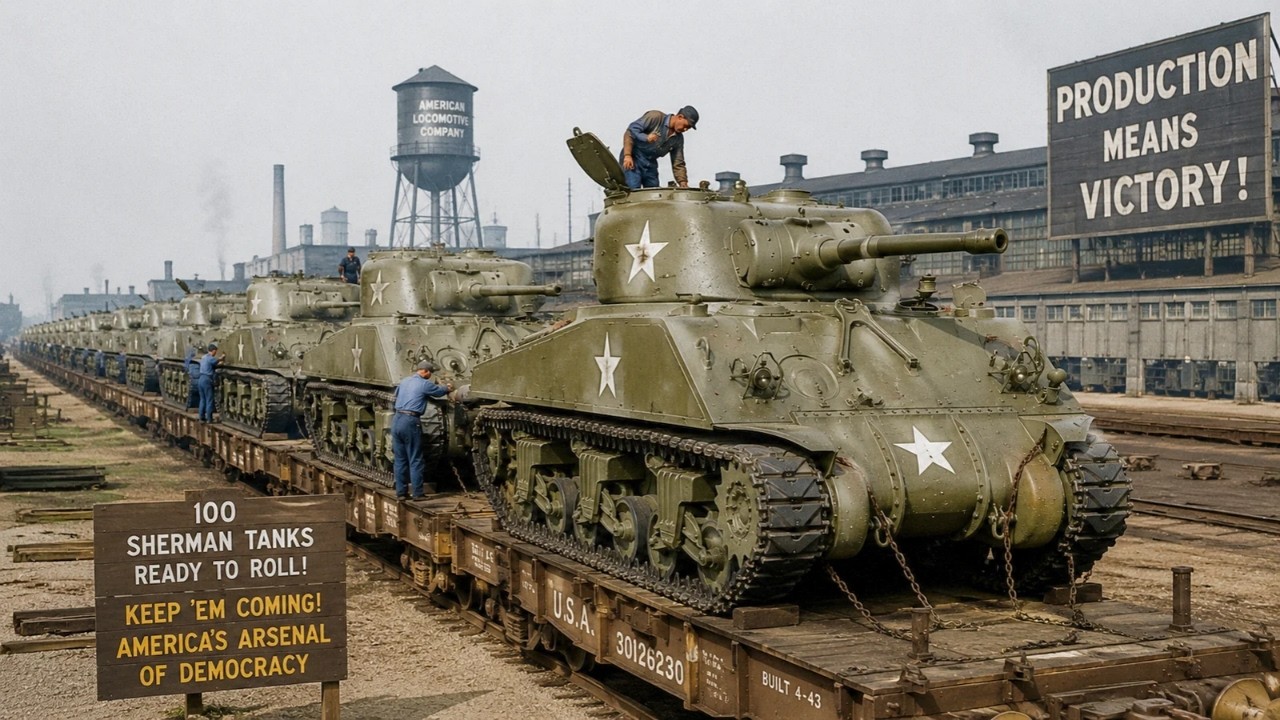
In a small town in Ohio, a mother packed her son’s lunch before his shift at the Detroit Arsenal. She had never heard of Michael Wittmann, and she never would. But her welding torch was about to kill him. He had less than an hour to live.
To understand how a shoemaker’s apprentice from an English village killed the most famous tank commander of World War II, the story does not begin with tanks. It begins with a birthday party on April 20, 1942, deep in the pine forests of East Prussia, at Hitler’s forward headquarters, the Wolf’s Lair. The Führer was celebrating his fifty-third birthday. There was no cake, only a demonstration.
Two massive prototypes stood side by side in a forest clearing, their exhaust curling into the cold Prussian air. On Hitler’s left stood Erwin Aders, sixty-one, chief engineer of Henschel and Son, a company that had built locomotives since the age of steam. On his right stood Ferdinand Porsche, sixty-six, already a legend, designer of the Volkswagen, Hitler’s favorite engineer. Between them were the competing prototypes for the tank that would decide the war.
Aders had built a machine of iron and steel, conventional, gasoline-powered, brutal in its simplicity. Porsche had built something extraordinary: a hybrid gasoline-electric drive wrapped in fifty tons of Krupp steel. Everyone expected Porsche to win. Porsche was Hitler’s friend, and his company had already built one hundred hulls in anticipation of the contract.
Behind the two prototypes, in a small notebook, a Wehrmacht procurement officer had written six words that would change history: Germany does not have enough copper. Porsche’s electric transmission required vast amounts of copper, a metal Germany could no longer import under blockade. Aders’s design used almost none. Hitler paced, listened to the logistics officers in gray uniforms, and made a decision that had nothing to do with battlefield performance.
He chose the Henschel design. Then he turned to his generals and declared that one Tiger tank would destroy a battalion of enemy tanks. Quality was the German way. None of them mentioned that Germany had chosen its wonder weapon not because it was better, but because there was not enough copper for the alternative.
The Tiger was born of scarcity dressed in the uniform of strength. Six thousand kilometers away, in a world that could not have been more different, a fifty-eight-year-old man in a wheelchair made the telephone call that would end the German Reich. May 30, 1940. The White House, Washington, D.
C. France was collapsing. Norway had fallen. The greatest army in Europe had been shattered by German panzer divisions, and America possessed fewer than five hundred modern tanks.
Roosevelt did not call a general. He called William Sigismund Knudsen, sixty-one, president of General Motors, a Danish immigrant who had arrived at Ellis Island in 1900 with thirty dollars, a Republican who had denounced the New Deal from every platform he could reach. The phone rang on the seventy-first floor of the GM Building in Detroit. Roosevelt said he needed Knudsen in Washington to run war production.
Knudsen accepted a government salary of one dollar a year. His wife thought he had lost his mind. His colleagues thought Roosevelt would destroy him. Knudsen understood something Hitler never would: modern war was not won by warriors, but by assembly lines.
Knudsen arrived in Washington within a week. His first call went to K. T. Keller, president of Chrysler.
Knudsen asked if Keller could build tanks. Keller said he had never seen one. Knudsen told him to go look. Two days later, Keller and his chief engineer climbed into an old medium tank at the Rock Island Arsenal, spent six hours examining it, and called back with the answer: yes, they could build tanks.
How many did he need? Knudsen gave a number no American had ever spoken about tanks before: thousands. Within eight weeks, the government purchased 113 acres of farmland in Warren, Michigan. Construction began in the fall of 1940.
On April 24, 1941, the Detroit Arsenal opened. It was the first factory in history designed from empty ground for mass production of armored vehicles, covering 1. 25 million square feet, larger than all of Germany’s tank factories combined. In Kassel, Germany, the Henschel plant was preparing to build the first Tiger.
The scene inside the workshop seemed to belong to another era. Nine thousand skilled workers moved slowly around a single tank hull. Each Tiger was built in place; the workers moved around it, not the other way around. There were nine assembly stages, each taking days, some weeks.
Welders spent entire afternoons on one weld. When the first Tiger was finished, it had consumed three hundred thousand hours of labor, contained twenty-six thousand separate parts, and cost a quarter million Reichsmarks. Colonel Wolfgang Thomale wrote that the machine represented the pinnacle of German engineering. If Germany could build one hundred a month, the war would be won.
Germany never built one hundred Tigers in any month of 1942 or 1943. Production peaked only in April 1944, at 104. By then, Chrysler in Detroit was producing 896 Sherman tanks a month. The Tiger’s first humiliating defeat did not come on an assembly line, but in a swamp on September 22, 1942, near the town of Mga, southeast of Leningrad.
Four Tigers, the first four committed to combat, advanced in single file along a narrow forest track. Hitler had sent them to the front in haste, demanding a demonstration. The terrain was unsuitable; the unit commander begged for time to test the tanks. Hitler refused.
Within the first hour, the first Tiger’s engine overheated. The second Tiger’s transmission failed. The third Tiger threw a track. Only one Tiger reached the battlefield, fired a few shots, and withdrew.
Three of the first four Tigers built were disabled not by the Red Army, but by Russian mud and German engineering. The Soviets recovered a bogged Tiger, shipped it to Kubinka, photographed every bolt, measured every plate, and began designing weapons to destroy it. In December 1942, Mary Krichevsky, a Polish immigrant welder on the third shift at the Detroit Arsenal, stood under a sign reading: Every tank we build is a life we save. Every four hours, a completed Sherman rolled off the line.
In December alone, the Detroit plant produced 907 Shermans. Henschel produced 38 Tigers that month. In January 1943, General Heinz Guderian, the inspector general of panzer troops, read an intelligence report with American production figures. He read it twice.
Then he wrote a single sentence in his diary: If these numbers are even half right, we have already lost the war. He closed the diary. He did not tell Hitler. By March 1943, eleven American plants were working three shifts, twenty-four hours a day, producing 3,500 Shermans a month.
Germany produced 34 Tigers. Guderian already knew what the rest of the war would prove: Germany would spend its remaining strength building the most beautiful tanks in the world, and it would change nothing. In a swamp near Leningrad, in a farm field in Warren, Michigan, and in a telephone call between Roosevelt and Knudsen, the war had already been decided. Not by tanks, not by generals, not by soldiers, but by a Danish immigrant, a Polish welder, and an assembly line that never stopped.
On July 5, 1943, the greatest tank battle in human history began at Kursk. Two hundred Tigers, two hundred Panthers, and twenty-seven hundred German tanks fought against five thousand Soviet tanks. The Tigers performed exactly as designed, standing off at two thousand meters and destroying T-34s that could not penetrate their armor. Tactically, Kursk was a German victory.
But the eighty German tanks lost could not be replaced, while the four hundred Soviet tanks lost were already being replaced by factories relocated beyond the Urals. That same summer, the Soviets also received American Sherman tanks under Lend-Lease. More than four thousand Shermans were delivered to the Red Army, more than three times the total number of Tigers Germany ever produced. By June 6, 1944, the Allies had landed four thousand tanks in the first wave of D-Day, with eight thousand more waiting in England.
Against them, the Wehrmacht could muster about fourteen hundred working tanks of all types in all of Western Europe. On D-Day itself, German armor in Normandy totaled just over three hundred tanks, of which 102 were Tigers. One hundred two against twelve thousand. A week later, on June 13, 1944, Michael Wittmann, then twenty-nine, reached a wooded hill east of the Norman town of Villers-Bocage.
He led six Tigers. His battalion had originally fielded forty-five, but Allied fighter-bombers had savaged the columns on every road in France. Looking down into the town, he saw a British armored column stopped for morning tea: Cromwell tanks, Stuart light tanks, Bren carriers, the entire spearhead of the 22nd Armoured Brigade of the 7th Armoured Division, the Desert Rats. The crews were outside their vehicles.
Some were brewing tea. None knew that six Tigers were watching from four hundred meters. Wittmann ordered his Tiger forward alone, down the hill into the flank of the column. In fifteen minutes, his tank and the five Tigers of his company destroyed fourteen tanks and fifteen armored personnel carriers.
The 4th County of London Yeomanry ceased to exist as a fighting unit. Berlin’s propaganda machine exploded. Wittmann became the greatest tank commander in history. Nine days later, Hitler personally awarded him the Knight’s Cross with Oak Leaves and Swords at the Berghof.
Then Hitler offered him a safe post, commander of a tank training school in Germany. Wittmann had a wife and a home in Bavaria. Every general in the room expected him to accept. He refused.
He asked to return to Normandy. Seventy-two hours after Villers-Bocage, the 7th Armoured Division received complete replacements for every vehicle lost. The 2nd Company of the 101st SS Heavy Tank Battalion, Wittmann’s company, would receive no replacement Tigers for six weeks. Lieutenant Colonel John Cloudsley-Thompson of the 7th Armoured wrote the truest sentence ever written about the Normandy campaign: Wittmann was a genius, but genius cannot be replenished, while industrial output can.
On August 8, 1944, the Canadians and British launched Operation Totalize, a massive armored offensive south of Caen. Wittmann was ordered to counterattack to buy time. He no longer had any illusions. Seven weeks earlier, at the Berghof, he could have gone home.
He had chosen to return. Now, near Saint-Aignan-de-Cramesnil, a squadron of Sherman Fireflies from the 1st Northamptonshire Yeomanry waited. The Firefly was a standard Sherman fitted with a British 17-pounder gun, a hurried, almost improvised weapon capable of penetrating a Tiger’s frontal armor for the first time. Behind the gunner’s sight of one Firefly sat Joe Ekins, twenty-one, a shoemaker’s apprentice from Rushden, Northamptonshire.
Two months earlier, he had been cutting leather. He had fired his tank’s main gun in combat exactly once. He did not know Michael Wittmann’s name. He only knew that a column of German Tigers was crossing a wheat field twelve hundred meters below him.
At 12:20 p. m. , Ekins fired. The 17-pounder shell struck the third Tiger in the column.
He fired again. The tank exploded. Its eleven-ton turret rose into the summer air and landed thirty feet away in the wheat. Inside, five men died instantly.
The commander was Michael Wittmann, thirty years old. For decades, no one knew who fired the shot. The Canadians claimed it, the British claimed it, some historians insisted it was a rocket-firing Typhoon. The German propaganda ministry invented an aerial bomb, unwilling to admit that its hero had been killed in an ordinary tank duel by an ordinary British soldier.
The truth was quieter. A former shoemaker, sitting in an American-built Sherman fitted with a British gun, had killed the most famous tank commander in the war with a shell made in Birmingham. The final chapter came in April 1945. American columns poured across Germany.
Along the roads of the collapsing Reich, a strange sight appeared: Sherman tanks painted with black crosses, Beutepanzer, captured tanks. The Wehrmacht was recovering American Shermans, repairing them with spare parts from scrapyards, painting German markings over the white stars, and driving them into battle against the army that built them. A colonel defending Nuremberg wrote in his war diary: My command consists of three Tigers, one of them operational, eight captured and repaired Shermans, and twelve assault guns. The American tanks are easier to maintain than our own.
We are fighting American tanks with American tanks. Germany surrendered on May 8, 1945. The final numbers: 1,347 Tigers built, 492 King Tigers, a total of 1,839 German heavy tanks. The Sherman: 49,234.
The ratio was 27 to 1. Albert Speer, who had run German war production, wrote in his memoirs a single sentence that would haunt every German engineer for the rest of the century: We strove for perfection and were paralyzed by it. In 1975, at a veterans’ reunion in a hotel in Fort Knox, Kentucky, aging German and American tank commanders gathered. Otto Carius, credited with destroying more than 150 enemy tanks, spoke slowly: We were fighting mathematics, not soldiers.
I could destroy ten Shermans, and twenty more would appear. A retired American first sergeant named Clyde Brunson answered: Otto is right. We knew we were not the best tank crews in the world. Wars are not won by heroes, but by production lines.
A German asked if the Americans knew then, on the ground, that their numbers would overwhelm them no matter how bravely the Germans fought. An American replied: We knew. Every replacement depot had hundreds of new Shermans lined up in rows. Some of us even felt sorry for you.
At a D-Day anniversary commemoration on the cliff above Omaha Beach in 1989, a former Tiger commander named Friedrich Schultz stood among the nine thousand white marble crosses. At a small reception afterward, a British officer asked him to say a few words to the assembled veterans. Schultz spoke: We came to this war with the best tanks in the world. We were certain of our superiority.
We believed quality would defeat quantity. Then he paused. You came with tanks that were good enough, and you came in overwhelming numbers, and you came with an industrial machine we could never match. We fought bravely.
You fought with arithmetic. In war, arithmetic decides. We built 1,347 Tigers. You built 49,234 Shermans.
He raised his glass. These numbers are the difference between dictatorship and democracy, between scarcity and abundance, between defeat and victory. In Warren, Michigan, the great tank plant is closed. In Kassel, the ruins of the Henschel factory have been rebuilt as a modern locomotive plant.
In La Gleize, Belgium, King Tiger 213 still sits at the corner of a street, exactly where it ran out of fuel on Christmas Eve 1944. Children still climb it. Tourists still photograph it. In the Bovington Tank Museum in England, Tiger 131, the last working Tiger in the world, still runs its Maybach engine for summer weekend visitors.
Only seven Tigers remain anywhere in the world. Hundreds of Shermans still exist, and some are still in military service in far-off countries, more than eighty years after they left the production line. The Tiger was a masterpiece. The Sherman won the war.
In the long accounting of the twentieth century, in the terrible arithmetic of steel and blood and welding, the assembly line defeated the craftsman’s workshop. 1,347 against 49,234. That is the number that ended the Third Reich.
That is the number that saved the world.






