In the autumn of 1942, the German high command believed the hardest fighting in the east was behind them. The great summer offensive had carried the Wehrmacht across the southern steppe and down to the Volga. One city stood in the way: a long ribbon of factories and apartment blocks strung along the west bank of the river, carrying the name of the Soviet leader himself. In Berlin, the place was treated as a finishing task.
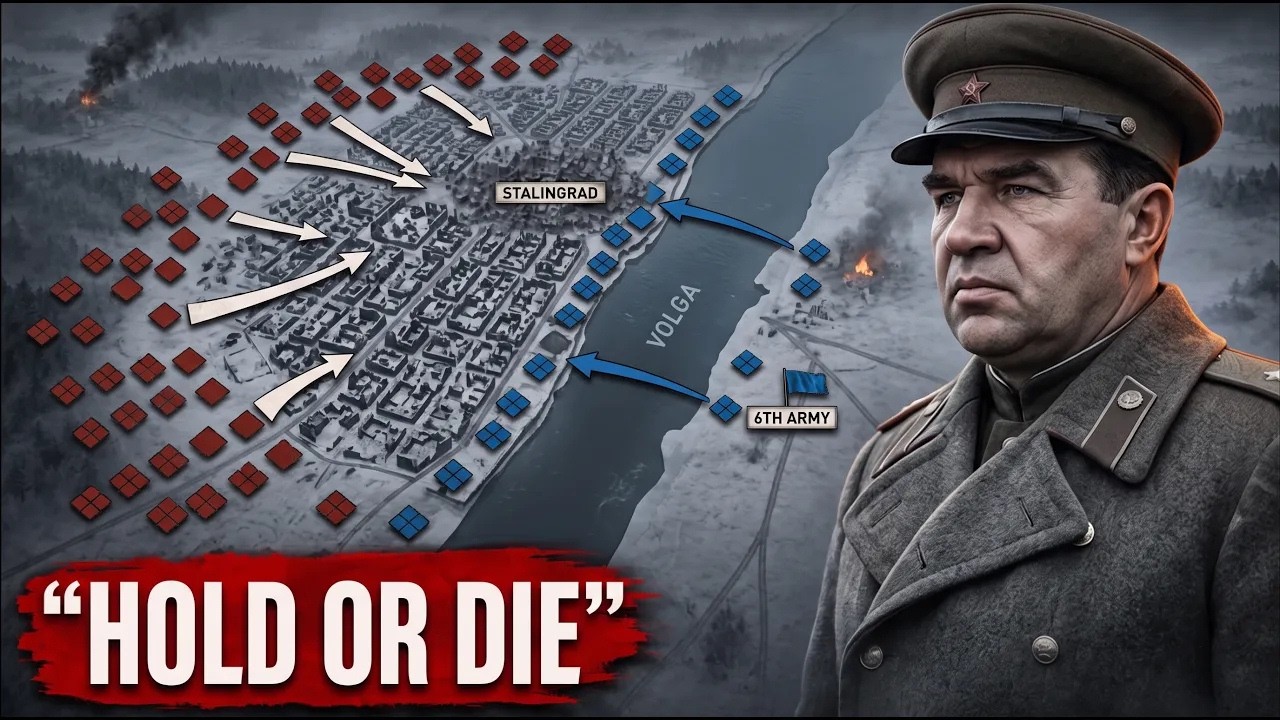
Friedrich Paulus and his Sixth Army, some of the most experienced troops in the German order of battle, had all but promised that Stalingrad would fall in a matter of days. The prize was worth the effort. The Volga was one of the great arteries of the Soviet Union, the river down which oil and grain moved up from the south. Take the city and you cut that artery and threatened the oil fields of the Caucasus beyond it.
And there was the name. A city called Stalingrad could not be allowed to stand. For both sides, the fight became about far more than a stretch of riverbank. It became a test of will that neither leader could afford to lose.
It did not fall in days. It swallowed the Sixth Army whole. And the man most responsible for that reversal was not one of the famous Soviet marshals. He was a broad-shouldered, gold-toothed general who only months earlier had been serving as a military attaché on the other side of the world.
A soldier with a mixed record and no great reputation. His name was Vasili Ivanovich Chuikov. He never had the fame of Zhukov. His methods were so brutal and unorthodox that some of his own superiors doubted them.
And yet the German officers who faced him came to regard the defense of the city as the most terrible fighting of their lives. Chuikov was born in 1900, one of a huge peasant family in a village south of Moscow. He joined the Red Army as a teenager during the Russian Civil War, and by the age of nineteen he commanded a rifle regiment in the hard fighting against the White forces of Admiral Kolchak in the east. He was sent to the Frunze Military Academy, learned Chinese, and spent years as a Soviet military adviser in China.
His combat command in the Winter War against Finland had gone badly, an embarrassment that saw him quietly sent abroad again. When he was recalled to the Soviet Union in the spring of 1942, he was a capable but unremarkable figure. On September 12, 1942, Chuikov was called to the headquarters of the Stalingrad front. The commander of the 62nd Army, the formation holding the city itself, had been judged too pessimistic about the chances of holding on.
Chuikov was given the job. When his superiors asked him how he understood his task, his answer was plain. He would hold the city or he would die there. He meant it quite literally.
He crossed the Volga into a place that was already burning, and he did not leave until the battle was won. The army he inherited was in a desperate state, badly mauled and pressed back toward the river by German attacks coming from two directions. Above it, the Luftwaffe owned the sky. German dive bombers could loiter over the city and smash any strong point they could see, and German artillery could pound Soviet positions from a distance with near impunity.
Chuikov had studied the Germans carefully during earlier fighting on the Don. He had noticed that their attacks followed an almost mechanical rhythm. First came the aircraft, then the artillery, then the tanks, then last of all the infantry moving up to occupy ground. It was a system that depended entirely on being able to strike from a safe distance.
So Chuikov set out to take that distance away. He ordered his men to keep the front lines as physically close to the German positions as they could possibly get. Not hundreds of yards apart, but fifty meters, thirty meters, sometimes the width of a single street or the two halves of the same shattered building. His soldiers called it hugging the enemy.
The logic was simple and merciless. If a Soviet trench sat only a stone’s throw from a German one, the Luftwaffe could not bomb it without dropping those bombs on their own men. The heavy artillery lost its value for the same reason. The German advantages in air power and guns, the very things that had carried them a thousand miles east, were switched off at the point where it mattered most.
Chuikov kept his own heavy artillery on the far bank of the Volga and on the islands in the river where forward observers could call fire down onto German troops as they massed for an attack. But inside the city the fighting was dragged down to the closest possible range, where it became a contest of grenades, submachine guns, knives, and sharpened entrenching spades. He built his defense around a web of fortified strong points, ordinary buildings turned into small fortresses, sighted so that they funneled German attacks into narrow lanes covered by hidden anti-tank guns and dug-in tanks. Nowhere was the principle tested harder than on the great mound that rose over the center of the city, an ancient burial hill marked on maps as Height 102.
Whoever held that summit could see for miles and direct fire across the whole battlefield. Both sides fed men into it without pause. It changed hands again and again. On some days, by later accounts, the Germans launched as many as a dozen separate assaults up its scarred slopes.
When the fighting was finally over, the earth on that hill was so churned and laced with shell fragments that every square meter of soil held hundreds of splinters of hot metal. Not a blade of grass grew there for years. Chuikov’s forward troops clung to those slopes exactly as he had ordered, close enough that the German guns could never fully be brought to bear. The single greatest blow fell in the middle of October, when Paulus threw the weight of his army, panzer divisions and fresh infantry together, straight at the tractor factory in the north of the city.
Chuikov later called it the most savage day of the entire battle. The line bent almost to breaking, and the Germans reached the river in places, yet the 62nd Army did not shatter. For the first time in the east, the German war machine was forced to fight on terms chosen by its enemy. By late September, Chuikov had seen enough of city fighting to understand that the old way of attacking was getting his men slaughtered.
Sending a whole company or battalion charging across open ground toward a fortified building was suicide. So on September 26, he issued an order that broke sharply with Soviet doctrine. He forbade his commanders from launching attacks with large formations. Instead, the fighting would be handed to something small, fast, and vicious.
The result was the birth of the storm group. A storm group was tiny, often built from a single platoon of twenty to fifty men, divided into parts that each had a clear job. At the front went the assault squads, small handfuls of six or eight soldiers armed with submachine guns, a heavy load of grenades, knives, and spades. Their task was to slip in close under cover, then rush a building in a sudden violent burst before the defenders could react.
Behind them came the reinforcement groups, moving up the moment the assault squad signaled that it was inside. These men brought the heavy tools: machine guns, anti-tank rifles, mortars, crowbars, picks, and sacks of explosives, along with sappers and snipers. A third group waited in reserve, ready to feed the fight or block any enemy attempt to work around the flank. Rather than fight along the streets, which the Germans covered with machine guns, the storm groups blew holes through interior walls and moved from room to room and house to house without ever stepping into the open.
They fought through cellars and sewers. They rolled grenades down stairwells and cleared rooms with flamethrowers. Chuikov summed up the idea in one line: the storm group tactic was based on speed, on shock, and on the daring of every single soldier acting on his own judgment. The Germans, whose doctrine was built for sweeping movement across open country, found themselves trapped in a nightmare for which they had no answer.
They coined a bitter word for it: Rattenkrieg, the war of the rats. It was a war fought in the dark, in the rubble, in the drains beneath the streets, where a factory floor could change hands five times in a day, and where the distance between the two front lines was sometimes a single wall. In the south of the city, a huge concrete grain elevator was held by a mixed handful of soldiers and naval infantrymen, perhaps fifty or sixty men in all. For days they beat back attack after attack, supported by tanks, ignored demands to surrender, and fought until their water and ammunition were gone before the survivors slipped away.
When the Germans finally took the ruin, they were stunned to find only around forty dead inside. They had believed they were fighting many times that number. One position became the most famous of all. On a square near the river, a solid four-story apartment building was seized by a small assault group under a junior sergeant named Yakov Pavlov.
His men fortified it, ringed it with mines and wire, cut firing slits in the walls, and connected it to the Soviet lines by a trench dug across the open ground. They held it against everything the Germans threw at them for nearly two months. Chuikov later remarked that the Germans lost more men trying to take Pavlov’s house than they had lost taking the whole city of Paris. While the 62nd Army held on in the streets, the Soviet high command was quietly assembling enormous forces on the open flanks far to the north and south of the city, flanks held not by Germans but by weaker Romanian and Allied troops.
The great reserves were saved for that blow rather than fed into the ruins. Chuikov received just enough. Fresh divisions fed across the river at the worst moments to keep his grip on the bank while Paulus poured his strength into the fight for the last few hundred yards. His army fixed the enemy in place while the trap was prepared behind it.
On November 19, 1942, the Soviet counteroffensive broke out of the snow against those weak flanks. Within days, the two pincers swung around behind Stalingrad and met near the town of Kalach to the west. The Sixth Army, some 290,000 men, was suddenly sealed inside a ring with winter closing in and no way out. On February 2, 1943, the last of the trapped Germans surrendered.
Of more than ninety thousand who went into captivity, only a few thousand ever saw home again. For its stand, the 62nd Army was given a new and honored name. It became the Eighth Guards Army, and Chuikov led it for the rest of the war. The struggle for the city had lasted some five months and ranks among the costliest battles in human history, with combined losses on both sides climbing into the millions.
It broke the spell of German invincibility in the east, and from that winter onward the long retreat toward Berlin had begun. A German general named Hans Doerr, writing after the war, described what Stalingrad had done to his army. The mile, the ordinary measure of distance in war, had been replaced by the yard. For every house, every workshop, every water tower, every cellar, and every pile of ruins, a bitter battle was fought that had no equal even in the First World War.
Another German corps commander wrote that the enemy was invisible, that ambushes came out of basements and ruined walls and hidden bunkers, and that they were bleeding his troops white. The Soviet marshal Konstantin Rokossovsky said simply that only a man like Chuikov could have stood his ground and held that strip of land. Chuikov carried the Eighth Guards Army out of the wreckage of Stalingrad and drove it west across two years of hard fighting through Belarus and Poland until it reached the gates of the German capital. In the final days of the war, it was Chuikov who received the surrender of the German general commanding the defense of Berlin.
He rose in time to the highest rank the Soviet Union could give, Marshal of the Soviet Union. He died in 1982, an old man still carrying shrapnel in his body from wars decades gone. He refused burial among the other marshals beside the Kremlin wall. His final wish was to be laid to rest on Mamayev Kurgan, the shell-scarred hill in the heart of Stalingrad, so that he could lie among the soldiers he had commanded in the worst days of his life.
It was there on that hill above the river that they buried him.






