The stench reached Julia before the sound did. Her husband lay in the bed above, his throat rotting from the inside, wrapped in thick towels that could not hide the decay. The former general, the man who had commanded a million soldiers and saved the Union, could no longer speak. He communicated in pencil scratches on slips of paper, grinding his teeth against the pain to write the words that would buy her survival.
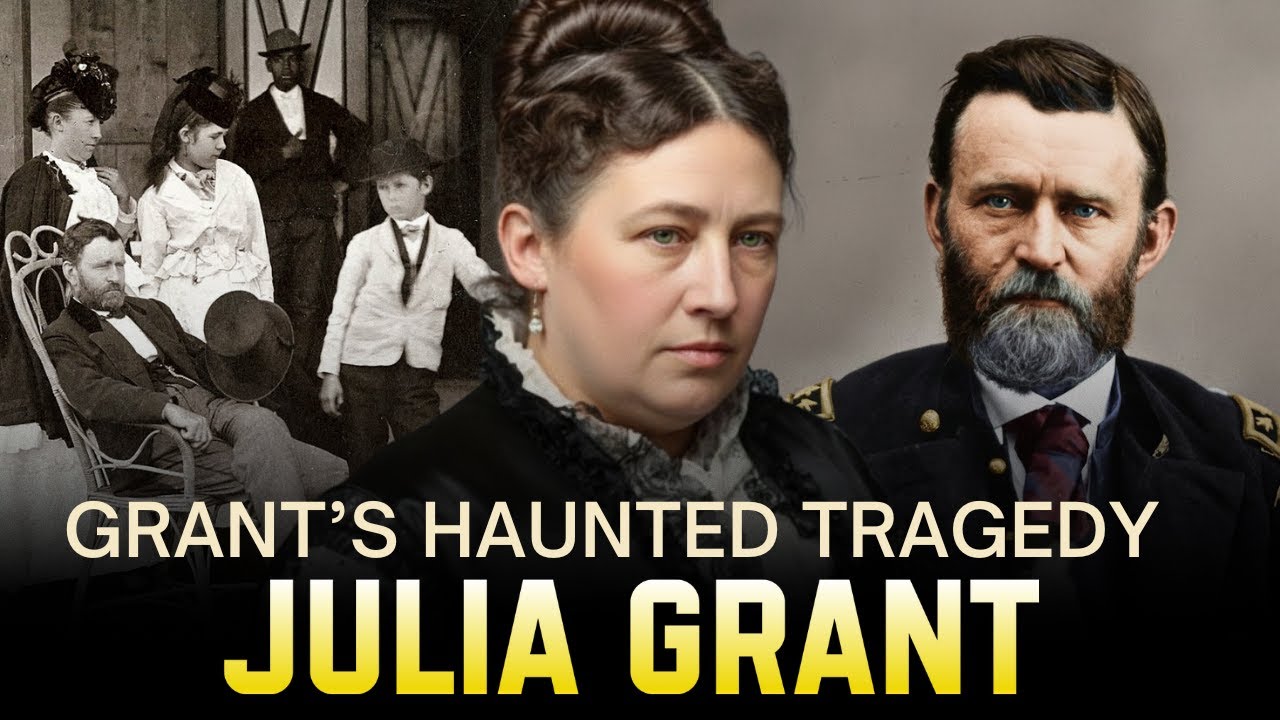
She sat there and counted every page, knowing each one was bought with his blood and his last breaths, and knowing it was the only thing standing between her and starvation when he died. She had never been a picture-perfect first lady. She was the woman with the crossed eyes, a defect her husband had forbidden her from fixing because he simply liked that off-center look. She had dragged her skirts through battlefield mud, sleeping in tents with lice just to be near him.
She had risen to the White House only to crash down to rock bottom, broke, homeless, and stripped of every last penny. This was the story of Julia Grant, and it began on the humid banks of the Mississippi River, in a world of contradictions where freedom and bondage lived side by side. Julia entered the world on January 26th, 1826, in St. Louis, Missouri.
St. Louis was the gateway to the West, a booming, chaotic frontier town turning into a city of commerce. It was a place where the genteel traditions of the old South collided with the rough-and-tumble grit of the frontier. The air was thick with the humidity of the Mississippi and the smell of coal smoke, tobacco, and livestock.
Julia was the fifth of eight children born to Colonel Frederick Dent and Ellen Renshaw Dent. Her father was a figure carved from the granite of the old order. A wealthy merchant and planter, Colonel Dent was a man of loud opinions, fierce temper, and rigid social hierarchy. He viewed himself as a Maryland aristocrat transplanted to the wilderness of Missouri.
The Dents lived at White Haven, a sprawling plantation about twelve miles from St. Louis. It was not the plantation of white pillars and manicured lawns that fiction would later imagine. White Haven was more rustic, a working farm of roughly 850 acres.
It was a place of beauty, with honeysuckle vines climbing the porches and dense woods surrounding the fields. But it was a beauty maintained by human bondage. This is the difficult, jagged truth that sits at the center of Julia’s early life. Her long summer of sunshine, flowers, and smiles, as she later poetically described her childhood, was maintained by the labor of roughly thirty enslaved African-Americans.
The slaves of White Haven—men and women like old Bob, Jule, and Dan—were the invisible machinery of Julia’s happiness. They cooked the meals she ate. They chopped the wood that warmed her room. They saddled the horses she rode.
Julia grew up in a bubble of privilege where she did not cook, did not clean, and was never taught the basic domestic skills that most American women relied upon. She was raised to be served. This environment created a complex psychological duality in Julia. On one hand, she was a pampered Southern belle, conditioned to believe in the hierarchy of her father’s world.
On the other hand, growing up on the edge of the frontier instilled in her a ruggedness uncharacteristic for her gender and class. The tension of the era was palpable at White Haven. Missouri was a border state, a cauldron where pro-slavery and abolitionist sentiment simmered dangerously close to boiling over. While her father thundered about states’ rights and the inferiority of the Yankee mentality, the world outside their gates was changing.
This friction between the Southern aristocracy she was born into and the changing American landscape would eventually tear her family apart and place her directly in the crosshairs of the Civil War. But in the 1830s and 1840s, war was a distant thunder. For young Julia, the immediate battle was not political but personal: the struggle to define herself in a house dominated by her father’s ego and a society’s expectations. If society expected Julia to be a wallflower because of her eyes, she disappointed them.
She was, by all accounts, a tomboy with a streak of rebellion that terrified her tutors and delighted her brothers. Her father, despite his rigid views, had a soft spot for his wild daughter. While her sisters might have been content with needlepoint and the harpsichord, Julia preferred the outdoors. She climbed the oak trees that dotted the plantation.
She fished in the muddy creeks with a cane pole. She gathered walnuts in the woods. Most significantly, she was a fearless horsewoman. In an era when women were expected to ride sidesaddle at a gentle trot, Julia rode with terrifying speed and confidence.
She possessed a physical courage that belied her small stature. This love of horses would become the first bridge between her soul and the soul of Ulysses S. Grant. Her education was extensive for a woman of her time and place.
She attended Mrs. Morros’s boarding school in St. Louis for seven years. It was a finishing school designed to polish rough frontier girls into gems of society.
There Julia studied French literature, mythology, history, and botany. She was an avid reader, devouring novels and poetry. This intellectual curiosity is often overlooked by historians who focus only on her domestic role. Julia was sharp, witty, and opinionated.
However, the shadow of her physical appearance always loomed. The strabismus was not just a cosmetic issue; it was a medical reality. At one point in her youth, a prominent surgeon offered to perform a procedure to correct the wandering eye. The surgery in the early nineteenth century would have been brutal, performed without anesthesia, likely involving the cutting of eye muscles while the patient was fully conscious.
Julia refused. Whether this refusal stemmed from a fear of the pain or a stubborn, defiant pride is a matter of speculation. But there is something revealing in her decision. She demanded to be accepted as she was.
She refused to be cut and stitched to fit the world’s standard of perfection. She was waiting for someone who would look at her and see not a defect but a whole woman. As she entered her late teens, the pressure to marry began to mount. White Haven was a social hub, frequently visited by young officers from the nearby Jefferson Barracks.
The Dent family hospitality was legendary, and the porch was often filled with suitors courting the Dent sisters. Julia enjoyed the attention, the dances, and the flirtations, but she remained unattached. She was waiting. And if her own memoirs are to be believed, she was forewarned.
In a moment that borders on the mystical, Julia claimed to have had a vivid, almost hallucinatory dream. In it, she saw a man she did not know returning to her house, not in a uniform but in civilian clothes. In the dream logic, she understood this man was coming to claim her. It was a premonition of intimacy, a psychic preparing of the ground for the arrival of a destiny she could not yet name.
It was the spring of 1844. The air at White Haven was heavy with the scent of blooming locust trees. Julia’s brother, Frederick Dent, had returned from West Point Military Academy. He brought with him a roommate, a young lieutenant assigned to the Jefferson Barracks.
Frederick introduced him simply as Grant. Ulysses S. Grant was not a striking figure. He was short, standing only about five feet eight inches.
He was slight of build, weighing perhaps 135 pounds soaking wet. He slouched. He was pathologically shy, often fumbling for words in social situations. He possessed none of the swagger of the dashing dragoons or the loud confidence of the Southern planters who frequented the Dent home.
To Colonel Dent, this young Lieutenant Grant was entirely unimpressive: a man with a meager salary, no family fortune, and a personality that seemed to lack fire. But Julia saw something else. When they were introduced, the connection was immediate and electric. Grant, usually tongue-tied around women, found he could talk to Julia.
She was vibrant where he was still. She was expressive where he was stoic. They were perfect complements, the unstoppable force and the immovable object. Grant was a man who felt things deeply but lacked the mechanism to express them to the world.
In Julia, he found his translator. She understood his quiet intensity. She saw that his shyness was not weakness but a reservoir of deep, contemplative thought. And perhaps most importantly, he was the unparalleled horseman she had been waiting for.
They spent that spring riding together. These rides through the Missouri countryside were their courtship. Away from the prying eyes of her parents and the judgment of society, they fell in love. Grant did not see a cross-eyed girl.
He saw a woman of intelligence, vitality, and a spirit that matched his own hidden depths. But the clock was ticking. The geopolitical landscape of the United States was shifting. Tensions with Mexico were rising over the annexation of Texas.
The idyllic bubble of White Haven was about to burst. In May 1844, Grant’s regiment was ordered to move to Louisiana, a prelude to war. The realization hit Grant with the force of a cannonball. He was leaving, and he had not told Julia how he loved her.
He requested a leave of absence to make one last visit to White Haven. He rode to the plantation, his heart pounding harder than it ever would in battle. On the way, he crossed a swollen creek, the water soaking his uniform. A bad omen for a suitor, but Grant pressed on.
He arrived to find Julia preparing to attend a wedding. He was desperate. He could not let her leave without speaking. He offered to drive her carriage.
On that carriage ride, amidst the mud and the anxiety of impending separation, the shy lieutenant found his voice. He did not offer flowery poetry. He offered her a choice. He told her he was likely going to war.
He told her he had nothing to offer but his heart and his uncertain future. He handed her his West Point class ring. It was a large, clunky signet ring, far too big for her finger. Julia accepted it.
But secrecy was paramount. They both knew that Colonel Dent would be apoplectic. To the colonel, Grant was a nobody, a transient soldier who could not support his daughter in the style to which she was accustomed. Furthermore, the political divide was already surfacing.
Grant’s father, Jesse Root Grant, was a tanner in Ohio and a staunch, vocal abolitionist. The idea of the Dent family uniting with the Grant family was political poison. So they kept it a secret: a secret pact made on a carriage ride, sealed with an oversized ring and a promise to wait. If the courtship was brief, the separation was an eternity.
For four long years, from 1844 to 1848, Julia and Ulysses were separated by thousands of miles of dusty terrain, hostile borders, and the violence of the Mexican-American War. This period was the crucible that forged their relationship. It transformed a youthful infatuation into a bond of iron. They survived on ink and paper.
Letters took weeks, sometimes months, to arrive. They were their only lifeline. For Julia, this was a time of intense internal struggle. She was surrounded by other suitors at White Haven, men her father approved of, wealthy men, suitable men.
The pressure to abandon her secret engagement to the poor soldier fighting in Mexico was immense. Her father mocked Grant’s prospects. “That man will never amount to anything” was the refrain at the dinner table. Yet Julia’s loyalty was absolute.
She read Grant’s letters describing the heat of the Mexican plains, the monotony of camp life, and the horror of battle. Grant, who would later be known for his stoicism, poured his heart out to her. He wrote of his loneliness, his fears, and his unwavering love. In these letters, we see the foundation of their future dynamic.
Grant relied on Julia as his emotional anchor. He needed her belief in him to survive the isolation. And Julia in turn developed a fierce protectiveness over him. She began to view him not just as a lover but as a man misunderstood by the world, a man she alone could appreciate.
While Grant was distinguishing himself in battle, showing flashes of the tactical genius that would one day save the Union, Julia was fighting her own war of attrition at White Haven, defending a man her family considered a failure before he had even begun. Finally, in 1848, the war ended. The United States was victorious, and the victorious lieutenant returned to Missouri. He was thin, tanned by the Mexican sun, and weary, but he was alive, and Julia was still waiting.
The confrontation with Colonel Dent was inevitable. When Grant formally asked for Julia’s hand, the colonel refused to give his blessing. He did not forbid the marriage outright, perhaps realizing that Julia’s stubbornness matched his own, but he offered no dowry, no support, and no enthusiasm. He essentially washed his hands of the union, convinced his daughter was making a ruinous mistake.
On the other side, Grant’s parents were equally horrified. They refused to attend the wedding. They could not countenance their son marrying into a family that owned slaves. It was a moral affront to their abolitionist principles.
Thus, when Julia Dent and Ulysses S. Grant were married on August 22nd, 1848, at the Dent townhouse in St. Louis, they stood alone in the middle of a family storm. The wedding was a small affair compared to the grandeur of St.
Louis society. As they said their vows, few in the room believed this union would prosper. They saw a plain woman and a quiet soldier with no fortune. They saw a mismatch of politics and backgrounds.
They had no idea. They could not foresee that this couple would endure poverty severe enough to force Grant to sell firewood on street corners. Little did they know that this quiet man was destined to command millions of soldiers, or that this woman would one day renovate the White House and shake hands with Queen Victoria. The years between 1848 and 1861 were not a path to glory.
They were a slow, agonizing slide into destitution and humiliation. For Julia, the wild daughter of White Haven who had never known want, this was the period where the girl died and the woman was born. It began with the reality of army life. The romantic letters from Mexico were replaced by the cold, drab reality of military outposts.
Julia followed Ulysses to Detroit and then to Sackets Harbor, New York. Gone were the servants to brush her hair. Gone were the warm Missouri evenings. In their place were drafty officers’ quarters, harsh northern winters, and the tedious hierarchy of garrison life.
But Julia adapted. She learned to manage a household on a lieutenant’s meager pay. She bore her first child, Frederick Dent Grant, in 1850. She was happy simply to be with him.
But the army had one final cruelty in store. In 1852, Grant’s regiment was ordered to the Pacific coast, first to Panama, then to Oregon and California. The journey was deemed too dangerous and arduous for Julia, who was pregnant with their second child, Ulysses Jr. The separation was devastating.
Grant begged her to stay behind at White Haven for her own safety. Julia, weeping, agreed. It was the worst decision of their lives. Left alone on the bleak, fog-drenched coast of Fort Humboldt, California, thousands of miles from the woman who was his emotional ballast, Grant unraveled.
He had no war to fight, no wife to hold, and no purpose to drive him. The silence of the frontier amplified his inner demons. He slipped into a profound depression. It was here that the rumors began, rumors that would dog him for history.
Did he drink? Yes. Was he a drunkard? The historical record is nuanced.
Grant had a notoriously low tolerance for alcohol. One or two glasses could slur his speech. He drank not for pleasure but to numb the crushing loneliness of missing Julia. In 1854, faced with a disciplinary threat regarding his drinking, Captain Ulysses S.
Grant resigned his commission. He came home a failure. He was thirty-two years old with no civilian skills, no money, and a wife and two children to support. The reunion at White Haven was bittersweet.
Julia was overjoyed to have him back, but the reality of their situation was terrifying. Her father, Colonel Dent, was merciless. He sneered at his son-in-law, the West Point failure. Julia’s response was immediate and fierce.
When her father mocked Ulysses, she stood between them. She forbade anyone in her presence to speak ill of her husband. She saw his pain, the deep quiet shame of a man who feels he has failed his family, and she applied the balm of her unwavering confidence. “You will succeed, Ulys,” she told him.
“We will succeed. ”
They moved to a plot of land given to Julia by her father. It was a rugged, unforgiving patch of earth. Grant, the former officer, set about building a house with his own hands.
He named it Hardscrabble. The name was a dark joke, but it was an accurate description of their lives. This period is crucial to understanding Julia. She was no longer the belle in the silk dress.
She was a farmer’s wife. She learned to churn butter. She learned to mend clothes until the patches had patches. She watched her husband, the man she had dreamed of, load a cart with firewood and drive it into St.
Louis to sell on street corners. There is a famous, heartbreaking anecdote of Grant encountering former army friends on the streets, men now rising in rank and status. They would see Grant in his faded, soil-stained old army greatcoat selling wood for a few dollars. Some looked away in pity; others crossed the street to avoid the embarrassment.
Through it all, Julia never wavered. She bore two more children, Ellen and Jesse. During these lean years, she created a home inside the log cabin of Hardscrabble that was filled with love, if not luxury. She made a choice.
She would not be a victim of her circumstances. She maintained her dignity and, by extension, she maintained his. By 1860, they had hit rock bottom. The farm had failed.
A stint in real estate had failed. Grant was forced to move the family to Galena, Illinois, to work as a clerk in his father’s leather goods store. He was working for his younger brothers, a humiliation for a man approaching forty. He was a shabby, silent man, shuffling through the dusty streets of Galena.
To the townspeople, he was a nobody. To Julia, he was still the man from her dream. And then the telegrams began to arrive from the East. The South had seceded.
Fort Sumter had been fired upon. The country was at war, and the useless clerk was about to become the most important man in the world. The transformation was instantaneous. As soon as the call for volunteers went out, the slouch disappeared from Grant’s posture.
The clarity of purpose returned to his eyes. He was a soldier again. Grant helped organize a volunteer company in Galena, but he struggled to get a command. The bureaucracy in Washington ignored his letters.
It was Julia who urged him to keep trying, to travel to the state capital to demand a place. When he finally received his commission as a colonel and then a brigadier general, the dynamic of their marriage shifted from survival to partnership in war. Unlike the wives of other generals who stayed safely in the North, wrapping bandages and attending prayer circles, Julia Grant went to war. This is one of the most remarkable and often omitted chapters of her life.
Julia became a fixture in the Union camps. Whenever the army paused between campaigns, Grant would send for her. She packed up the children and traveled down the Mississippi into the heat, the mud, and the danger of the occupied South. Why?
Because she knew the secret. She knew that without her, the darkness might return to Ulysses. She knew he needed her physical presence to maintain his equilibrium. President Lincoln, with his shrewd understanding of human nature, recognized this.
When critics complained about the expense or the logistics of Mrs. Grant traveling to the front, Lincoln reportedly waved them off. He understood that Julia was the guarantee of Grant’s sobriety. As long as she was there, the general was stable.
Julia lived in tents. She lived in commandeered plantation houses with shattered windows. She lived in the rough cabins of City Point, Virginia, within earshot of the cannon fire. She walked through hospitals, seeing the grisly reality of nineteenth-century warfare: the amputations, the dysentery, the dying boys calling for their mothers.
She was not just a morale booster for her husband. She became a mother figure to the staff. Rawlins, Grant’s chief of staff, adored her because she was the only one who could manage the general’s moods. When Grant was stubborn, Julia could cajole him.
When he was despondent, she could make him laugh. However, her presence in the war zone highlighted the great unresolved contradiction of her life: her relationship with slavery. Julia was a Southerner. She had grown up with slaves.
Even as her husband fought a war that morphed into a crusade for emancipation, Julia traveled with an enslaved woman named Jule. Jule was Julia’s nurse and maid, a woman who had been with her since childhood. For the first half of the war, a bizarre dynamic played out. The wife of the Union commander was being dressed and served by a slave.
This cognitive dissonance shattered in 1862. As the Union Army moved deeper into the South, the proximity to freedom became too tempting. Jule, seizing the chaos of the war and the proximity to Union lines, ran away. Julia was shocked.
In her memoirs, she expresses a naive confusion, writing about how she could not understand why Jule would leave when she was treated so well. It was a moment that revealed the limits of Julia’s worldview. She could be the resilient wife of the liberator, but she was still the daughter of Colonel Dent. She never truly reconciled her Southern upbringing with the cause her husband led.
Yet she remained fiercely loyal to him, if not to the ideology. By 1864, Grant was the general-in-chief of all Union armies. The Grants were no longer nobodies. They were the second most famous couple in America, eclipsed only by the Lincolns.
But fame brought danger. The war was brutal, grinding toward its bloody conclusion in Virginia. Julia was at City Point during the siege of Petersburg, living in a cabin while Grant orchestrated the strangulation of Lee’s army. On April 9th, 1865, Lee surrendered at Appomattox Court House.
The war was over. The Union was saved. Grant returned to Washington a hero. The city was in a frenzy of celebration.
On April 14th, 1865, a special invitation arrived for the Grants. President and Mrs. Lincoln invited the general and his wife to join them for a celebratory evening at Ford’s Theatre to see the play Our American Cousin. It was the hottest ticket in town.
To appear in the presidential box with the savior of the Union on the week of victory was the ultimate honor. Julia declined. Her refusal is one of the most pivotal what-ifs in American history. The reason was not political.
It was personal. It was petty. It was a social feud. Julia Grant could not stand Mary Todd Lincoln.
The first lady was known for her erratic behavior, her jealousy, and her sharp tongue. During a previous review of the troops, Mrs. Lincoln had publicly berated Julia, accusing her of trying to steal the spotlight and implying that Julia coveted the presidency. Julia, with her Dent pride, was humiliated and furious.
When the invitation for the theatre arrived, Julia told Ulysses she would not go. She absolutely refused to sit in a box and be subjected to Mary Lincoln’s moods. She insisted instead that they take the train to New Jersey to visit their children. Grant, the man who could command a million soldiers, could not command his wife in this.
He agreed. He sent his regrets to the president. That evening, as the Grants were on a train chugging north toward Philadelphia, John Wilkes Booth crept into the presidential box. He carried a Derringer pistol and a knife.
His plan was to kill both the president and the general. Because of a social snub, because of Julia’s pride and her distaste for the first lady, Ulysses S. Grant was not in the chair next to Lincoln when the trigger was pulled. When the news reached them in Philadelphia, Grant was devastated.
He wept openly. He felt he should have been there, that perhaps as a soldier, he could have stopped Booth. But Julia knew the truth. Her stubbornness had saved his life.
When Ulysses S. Grant took the oath of office on March 4th, 1869, the United States was a nation still bandaging its wounds. The Reconstruction era was fraught with racial violence, political corruption, and the bitter residue of the Civil War. But for Julia Dent Grant, the inauguration was nothing short of a coronation.
She was forty-three years old. The hardships of Hardscrabble, the loneliness of the Western outposts, and the terrors of the war camps were behind her. She had survived the wilderness. Now she intended to conquer civilization.
Julia entered the White House with an energy that Washington had not seen since the days of Dolley Madison. She found the executive mansion in a state of melancholy disrepair. The Andrew Johnson years had been grim, marked by impeachment trials and political paralysis. The furniture was moth-eaten.
The carpets were threadbare, and the atmosphere was heavy with the ghosts of the recent past. Julia threw open the curtains. She embarked on a renovation project that was as much a political statement as an aesthetic one. She wanted the White House to reflect the power and the permanence of the reunited nation.
She was not a subtle decorator. She favored the Gilded Age aesthetic before the term even existed. She installed massive crystal chandeliers that blazed with gaslight, illuminating the gloom. She ordered heavy velvet drapes in crimson and gold.
She brought in Grecian columns and commissioned plush Victorian furniture. It was a style that some critics called gaudy, but the public loved it. It was optimistic. It was grand.
It signaled that America was rising from the ashes. Julia called her eight years in the White House the happiest period of her life. While Ulysses often found the presidency a burden, a thankless office filled with office seekers and political sharks, Julia reveled in it. She loved the receiving lines.
She loved the state dinners. She instituted a level of hospitality that was staggering. A typical state dinner under Julia’s command might feature twenty-five courses accompanied by six different wines. She hired an Italian steward, Melah, to oversee the kitchen, bringing a level of culinary sophistication to the White House that rivaled the courts of Europe.
But her most revolutionary act as hostess was her inclusivity. Julia was a paradoxical figure, a Southern woman with a complex view of race and class. But as first lady, she was aggressively democratic. She insisted that her public receptions be open to everyone.
On reception days, the line would snake out the door and down Pennsylvania Avenue. Wealthy senators stood in line behind muddy-booted mechanics. Society matrons waited alongside war widows. And significantly, African-Americans were welcomed.
For the first time, the White House was truly the people’s house. Julia stood for hours shaking hands until her gloves were stained black from the contact, greeting each person with a warmth that her husband often struggled to muster. Despite her triumph, the old insecurity remained. Julia was now the most photographed woman in America.
Her image was on cartes de visite, in newspapers, and in magazines. And with visibility came scrutiny. The whispers about her strabismus, her crossed eyes, returned. In the cruel caricature culture of political cartoons, her eyes were often exaggerated.
She was acutely aware of it. In almost every posed photograph from this era, Julia is captured in profile. It was a carefully calculated angle designed to hide her flaw from history. Early in the presidency, a renowned surgeon approached her.
He told her that surgical techniques had advanced. He promised her that a simple operation could fix the muscle, aligning her gaze perfectly. He offered to give her the beauty she had been denied. Julia was tempted.
She made an appointment. She packed a bag. But before she left, she told Ulysses. The president’s reaction is one of the most tender moments recorded in the annals of the White House.
He was a man of few words, a man who had seen six hundred thousand men die, a man often described as made of granite. He looked at his wife, the woman who had waited for him, who had lived in the mud with him, who had believed in him when he was selling firewood, and he shook his head. “Did I not see you and fall in love with you with these same eyes? ” he asked her.
“I like them just as they are, and now let them remain. They are mine. ” Julia unpacked her bag. She never spoke of surgery again.
It is a mistake to view Julia Grant merely as a hostess. She was a political operator of the highest order. The Grant administration was plagued by scandal. Grant, a man of simple honesty, was often too trusting of those around him.
He appointed friends and family to positions of power, and many of them betrayed that trust, engaging in bribery, kickbacks, and fraud. When the press attacked Grant, Julia attacked back. She was a lioness. She read the newspapers voraciously, often marking up articles with angry notes.
She banned critical journalists from the White House. She pressured Ulysses to fire cabinet members she deemed disloyal and to protect those she favored. Her loyalty was blind, which was both her strength and her weakness. She often refused to believe the evidence of corruption against their friends.
If Ulysses liked a man, that man was a saint in Julia’s eyes. This blind spot contributed to the administration’s difficulties, as she often insulated the president from necessary, albeit painful, truths. Yet she also influenced policy. She was a staunch defender of her husband’s efforts to destroy the Ku Klux Klan.
She supported his peace policy with Native Americans. She even met with suffragists, though she never publicly committed to the cause of women’s voting rights, preferring to exercise her power through her husband rather than the ballot box. By 1876, the country was weary of Reconstruction and weary of scandal. Grant declined to run for a third term.
Leaving the White House in 1877 was a moment of genuine grief for Julia. She wept as they packed their trunks. She felt she was losing her home, her stage, and her purpose. She did not know that the greatest adventure of her life was just beginning.
Most ex-presidents retired to their farms to write memoirs and fade away. Ulysses S. Grant decided to see the world. What was intended as a brief vacation turned into a two-and-a-half-year circumnavigation of the globe.
It was a spectacle without precedent. The Grants became the first global American celebrities. They left Philadelphia in May 1877 on the steamer Indiana. For Julia, this was the fairy tale she had read about in her French books at boarding school, finally coming to life.
In England, the reception was thunderous. The industrial working classes of Britain saw Grant not as a conquering general but as a man of the people, the tanner’s son who had defeated the slave-power aristocracy. Tens of thousands of people lined the docks and the streets to cheer them. The pinnacle of the European leg was dinner at Windsor Castle with Queen Victoria.
The meeting between the Queen of England and the Queen of America was fraught with tension. Victoria was a stickler for protocol and viewed the Grants as somewhat rustic. She was annoyed that the Grants brought their son Jesse to the dinner. Julia, however, was unintimidated.
When she was informed that she and the queen would enter the dining room, but the queen would sit in the center while Julia would sit to the side, Julia bristled. She was the wife of a head of state. She held her head high. Despite the awkwardness, the dinner proceeded.
It was a moment of immense symbolism: the plain girl from St. Louis dining with the monarch of the British Empire. From Europe they traveled to Egypt, sailing up the Nile. They visited the Holy Land, where Julia, deeply religious, was moved to tears in Jerusalem.
They traveled to Russia, meeting the Tsar. They went to India, riding elephants and marveling at the Taj Mahal. But it was in Asia that the Grants were received with almost godlike reverence. In China, they met with Li Hongzhang, the powerful viceroy, who treated Grant as an equal, a fellow warrior and statesman.
In Japan, the reception was spectacular. The Emperor Meiji, who rarely interacted with foreigners, shook Grant’s hand, a breach of imperial protocol that signaled immense respect. They stayed in the emperor’s summer palace. The Japanese people lined the streets with lanterns chanting banzai.
For two years, Julia Grant lived in a dream. She was showered with gifts: silks, pearls, lacquer. She was toasted by kings and emperors. The plain face and the crossed eyes did not matter here.
She was the embodiment of American womanhood, the partner of the great general. She wrote home in ecstatic letters. She had transcended her origins. She had seen the world, and the world had bowed to her.
The Grants returned to the United States in late 1879. They docked in San Francisco to a reception that rivaled the Roman triumphs. The entire city turned out. Bells rang, cannons fired.
They traveled across the country, a victory lap that seemed to never end. There was talk of a third term for Grant in 1880. The Grant movement was strong, fueled by his renewed popularity from the world tour. However, the political machinery had moved on.
At the Republican convention in 1880, Grant led for thirty-five ballots but could not secure the majority. The nomination went to James A. Garfield. Julia was disappointed, but she was also tired.
They were getting older. Ulysses was approaching sixty. They decided to settle down. They chose New York City.
They bought a brownstone at 3 East 66th Street. They were, they believed, wealthy. Their son, Buck, had gone into business with a young, charismatic Wall Street wizard named Ferdinand Ward. Ward was known as the Young Napoleon of Finance.
He promised returns on investments that were astronomical: ten percent, fifteen, sometimes twenty percent a month. Ulysses, trusting his son and this charming young man, invested his entire fortune, roughly one hundred thousand dollars. Julia invested her own money. They encouraged their friends and family to invest.
For a few years, it was paradise. The checks came in regularly. They lived affluently, enjoying the theatre, the dinners, and the adoration of New York society. In the spring of 1884, they believed they were worth millions, securing a massive inheritance for their grandchildren.
But it was a mirage. Ferdinand Ward was running a massive Ponzi scheme. In May 1884, the bubble burst. Grant, having just humiliated himself to borrow money to save the firm, arrived at Wall Street to find everything gone.
The family fortune, the loan he had begged for, the grandchildren’s trust funds—vanished. He walked out of the office a pauper, checking his pockets to find he did not even have enough cash for a carriage ride home. Julia was defiant, ready to sell her personal treasures to save his honor. But the stress broke Ulysses.
And in the silence of their ruin, a physical enemy struck. A stinging pain in his throat while eating a peach was diagnosed as epithelial cancer. In 1884, this was a death sentence. Grant realized with terrifying clarity that he was dying and leaving Julia destitute.
Desperate to provide for her, he embarked on a final battle: writing his memoirs. Mark Twain stepped in to publish them, but Grant had to finish the book to get the payout. For months, Julia watched her husband waste away. She became his gatekeeper, fluffing his pillows and holding his hand through coughing fits, refusing to believe he would succumb.
But Grant wrote with the speed of a man racing the reaper. By June 1885, he could no longer speak, communicating only via pencil slips. “I’m sorry to leave you,” he scrawled on one. On July 16th, he finished the manuscript.
On July 23rd, surrounded by his family and with Julia holding his hand, the general died. He had won his last battle. When the funeral train carried Ulysses S. Grant to his temporary tomb in Riverside Park in August 1885, Julia did not ride with the body.
She could not bear the finality of seeing the earth swallow him. She remained behind, a figure draped in heavy crepe, suddenly alone in a world that had been defined by his presence for forty years. She was fifty-nine years old. The frantic energy of the death watch—the cocaine swabs, the scribbling pencils, the sleepless nights—was replaced by a deafening silence.
But Julia was not destitute. Thanks to Grant’s final heroic effort, the royalties from the Personal Memoirs began to flow in. The first check of two hundred thousand dollars settled her debts. Subsequent payments made her a wealthy woman.
She moved from the brownstone where he died to a comfortable home in Washington, DC, returning to the city where she had reigned as queen. In her widowhood, Julia assumed a unique role in American society. She was the Mrs. Grant.
She was treated as a living national monument. Veterans of the Grand Army of the Republic would weep when they saw her. Politicians sought her endorsement. Presidents McKinley and Roosevelt paid their respects.
Yet she was not content to be merely a relic. She had a mission. She felt that the public image of her husband as a butcher general or a scandalous politician was incomplete. She wanted the world to know the tender, shy, loving man who had refused to let her fix her eyes because he loved them.
So, in a move that was decades ahead of her time, Julia sat down to write. In the late nineteenth century, women, even first ladies, did not write memoirs. They wrote letters. They wrote diaries.
But they did not write commercial autobiographies intended for the public market. That was the province of men. Julia did not care. She began dictating her life story to her eldest son, Frederick.
She possessed a remarkable memory, recalling the scent of the flowers at White Haven, the texture of the dresses she wore at balls, and the specific conversations she had with Lincoln and Sherman. Her manuscript was titled The Personal Memoirs of Julia Dent Grant. It was lively, opinionated, and deeply personal. She wrote about her childhood in the slaveholding South with a nostalgia that is uncomfortable for modern readers but honest to her experience.
She wrote about the privations of the Civil War camps. She wrote about the Gilded Age splendor of the White House. Most importantly, she wrote a love story. She stripped away the general’s uniform to reveal the husband.
When she finished, she shopped the manuscript to publishers. They were interested until they read it. The publishers wanted political gossip. They wanted inside baseball on the Civil War strategy.
They wanted her to settle scores with Grant’s political enemies. Julia gave them none of that. She gave them a domestic history. She wrote about raising children in a war zone, about the color of the wallpaper in the White House, and about her emotional landscape.
The publishers rejected it. They told her it was too personal, too trivial, and lacked historical weight. One publisher famously told her that the public was not interested in a woman’s view of the presidency. Julia was stung.
She refused to rewrite it to suit their tastes. She refused to turn her love story into a political tract. With a characteristic lift of her chin, she locked the manuscript away in a vault. It would sit there gathering dust for nearly seventy-five years.
It was not published until 1975, when historians finally realized that Julia’s trivial details were actually invaluable insights into the social history of the nineteenth century. Today, it is considered one of the most important primary sources on the lives of first ladies. Denied a literary voice, Julia found another way to make a statement. In the final decade of her life, she forged a friendship that shocked the nation.
In 1893, Julia Grant found herself at the same resort in upstate New York as Varina Davis. Varina was the widow of Jefferson Davis, the president of the Confederacy. For four years, their husbands had directed armies to slaughter one another. Grant had been the butcher of the South.
Davis had been the traitor to the North. By all rights, these two women should have been bitter enemies. They were the living symbols of the opposing sides of the Civil War. But when they met, something extraordinary happened.
They did not talk about states’ rights or slavery. They talked about the crushing burden of being married to history. They talked about the pain of widowhood. They talked about their children.
They became friends. The press went wild. Photographs of Julia Grant and Varina Davis sitting together on a porch or riding in a carriage through Central Park were splashed across newspapers. It was a visual shock to the American system.
For a nation that was still deeply scarred by the war, seeing the Union general’s wife holding hands with the Confederate president’s wife was a powerful signal that the war was truly over. It was a gesture of healing that no politician could have orchestrated. Julia’s willingness to embrace Varina was consistent with her character. She was a woman of intense loyalty, but she was not a woman of hate.
She saw the human being across the divide. As the nineteenth century turned into the twentieth, Julia’s health began to fail. Her heart and kidneys were weakening. But she had one final duty to perform: oversight of her husband’s tomb.
After Grant’s death, a massive fundraising campaign had been launched to build a monument befitting the savior of the Union. The result was Grant’s Tomb in New York City, a colossal granite mausoleum modeled after the tomb of Napoleon and the Mausoleum of Mausolus. It remains the largest mausoleum in North America. But during the design phase, there was a debate.
Military tradition dictated that a great general should be buried alone, or perhaps with his lieutenants. Julia intervened. She reminded the committee of a promise Ulysses had made to her. During his final illness, he had told her, “Julia, I do not want to be in a place where you cannot be with me.
” He had feared a military cemetery like West Point might exclude her. Julia insisted she would not be separated from him in death. The committee acquiesced. Inside the massive rotunda, they placed not one sarcophagus but two.
They were made of red granite, identical in size, placed side by side. Julia lived just long enough to see the monument completed and dedicated in 1897. She sat on the dais, a tiny frail figure in black, watching a million people parade past to honor her husband. She knew her place beside him was waiting.
Julia Boggs Dent Grant died on December 14th, 1902, in Washington, DC. She was seventy-six years old. Her funeral was a state occasion, but her journey ended in New York. She was carried into the great granite tomb.
The heavy bronze doors were opened, and she was laid to rest in the sarcophagus next to Ulysses. Above the entrance to the tomb are the words: “Let us have peace. ” It was Grant’s campaign slogan, but it was also the summary of their marriage. After the storms of war, poverty, and cancer, they had finally found peace together.
History has not always been kind to Julia Grant. For decades, biographers dismissed her. They focused on her physical appearance, mocking her strabismus and her weight. They criticized her love of luxury, painting her as a shallow spendthrift who nearly bankrupted her husband.
They belittled her intellect, calling her simple or naive. But these judgments miss the essential truth of her life. Julia Grant was the fuel that powered the engine of Ulysses S. Grant.
She was the one who saw the genius in the failure. She was the one who kept the bottle away from his lips during the darkest nights of the war. She was the one who forced him to believe in himself when the world called him useless. Without Julia, Grant likely quits the army in 1854 and never returns.
Without Julia, he likely succumbs to depression in 1862. Without Julia, he almost certainly dies of despair in 1884 before writing the memoirs. She was a woman of contradictions: a slaveholder who married the great emancipator, a pampered belle who thrived in the mud of the battlefield, a plain woman who captivated a nation. In the final analysis, her crossed eyes were not a flaw.
They were a filter. They allowed her to see the world differently. Where others saw a shuffling clerk, she saw a hero. Where others saw a lost cause, she saw a victory.
She was, in every sense that matters, the general’s general. And as long as the granite of Grant’s Tomb stands on the banks of the Hudson, she remains there. Not behind him, not below him, but right beside him.






