The humming came from beneath the floorboards of the western bedroom, three long notes that rose and fell and then stopped. Corrila Vance lay in the narrow bed with her breath held, listening. She could not have said whether the notes were high or low, sharp or flat. She could only say that they had come from somewhere under the planks, and that there was nothing under those planks but the joists, and beneath the joists the crawl space, and beneath the crawl space the mountain itself.
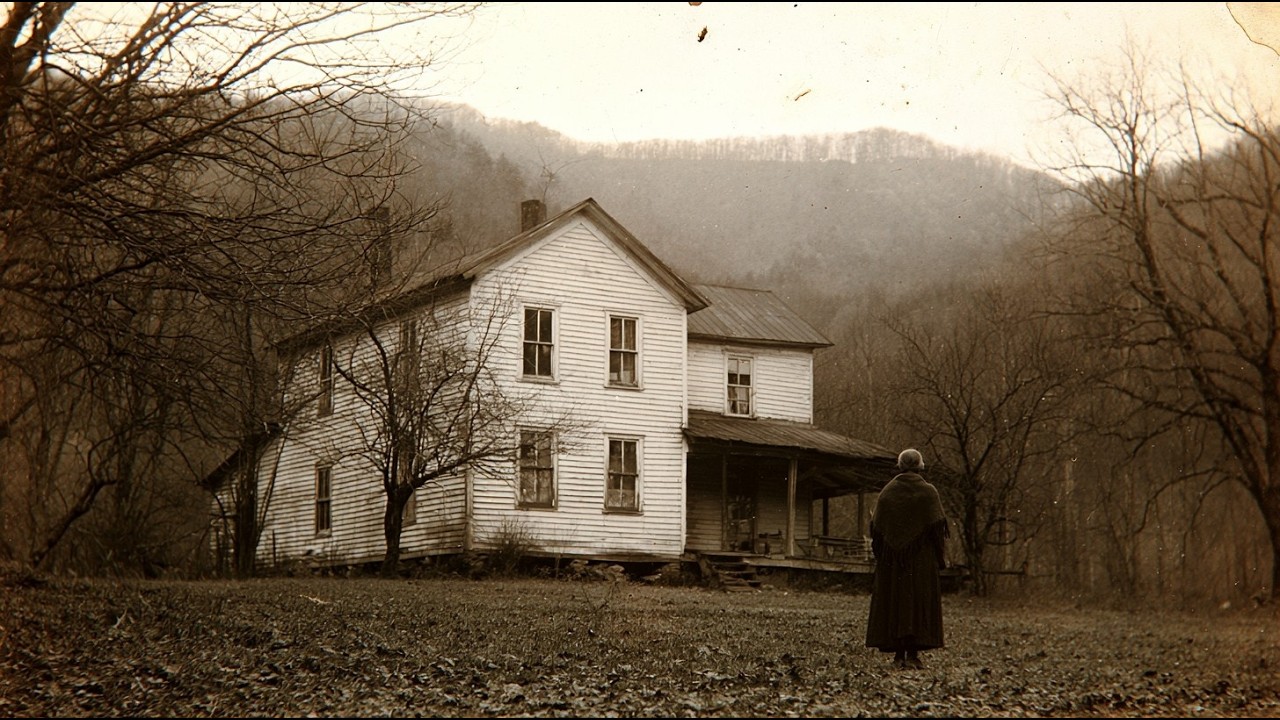
The western bedroom was on the second floor. The humming should not have been possible. She waited. The sound did not return that night.
Neither did sleep. In the morning she said nothing about it, because by then she had already learned the first rule of the Vance farm: you did not speak of those things. You did not speak of the floors that stayed clean in a house abandoned for thirty-eight years. You did not speak of the birds that were absent from the trees, though October had painted the hollow in red and gold.
You did not speak of the door at the end of the upstairs hall, the one with the fresh coat of white paint that could not have been more than a year old, though no one had lived in the house since 1893. Corrila noticed the paint on the second morning and did not mention it either. The farm lay at the end of a road that had stopped being a road about a mile before it arrived. The county had graveled it once at the turn of the century and never returned.
It climbed through the fold of mountains the family called Embrey Hollow, a name no one outside the family had reason to know, and by the time anyone outside the family did know it, the reason was gone. Nothing came up that road unannounced, and nothing came back down it without having justified its existence. Corrila was thirty-four that October of 1931, a widow of three years. Her husband Merrick had caught the influenza in the winter of 1928 and had been one of the last in the county to die of it.
She kept the ledgers at Halstead’s store in Merefield, at the mouth of the valley, went to mass on Sundays because that was what people did, and slept poorly as a matter of principle. She was a small woman, barely five foot three, pale, with hair the color of dark honey pinned tight to her head. People said, when they had to say something about her, that her hands were steady. That was the compliment she received.
She could reconcile a farm account without her pen wavering a hair’s breadth. She could sew a straight hem in a moving wagon. Corrila Vance had steady hands. There was nothing more anyone could think to say.
Her aunt Rosamund came to the store that October afternoon and stood at the counter until Corrila finished Mr. Halstead’s ledger. Rosamund was fifty-eight then, a midwife by trade and a woman whose spine had been bent straight by weather. She had that way some mountain women had of speaking in a low voice that forced you to lean in and listen.
It was how she ensured you were hearing her. She said, “Corrila, dear, come with us to the old place for a few weeks. Alistair and I are closing it up before the snow. The company would do you good.
”
Corrila wanted to say no. The decision was in her hands, the same hands that had gone briefly unsteady. But she looked at her aunt’s face and saw the tiredness behind the polite tone. She thought of her room above the store, of the way the walls had felt like they were closing in since August.
She thought of Merrick. She thought of how long autumn was when you spent it alone with a memory. She said she would come. Rosamund reached across the counter and touched her wrist.
“Just a few weeks. Alistair has to sort what’s worth keeping. Then the place goes to the county. It’s time to let it go, dear.
”
Corrila asked why they were letting it go. The question was fair, and as she asked it she understood her aunt would not give a convincing answer. Rosamund said, “Some places just run out of livability. That’s all.
Some places just run out. ”
They set out on Tuesday. Alistair Vance was sixty-one that year, a heavy, broad-shouldered man with hands the color of tobacco leaves and a mouth that had grown quieter every year since his brother’s funeral. He drove the old Ford, kept running by patchwork and prayers since the war.
Corrila loved her uncle without knowing exactly why, the way you love an uncle who has never lied to you, even when a lie was all you needed. He glanced at her once in the rearview when they left the pavement and began the climb. He said, “If things go bad up there, dear, we turn around. That’s the rule.
” She asked what he meant by bad. He did not answer. Rosamund watched the trees from the passenger window and did not answer either. That was the first thing Corrila noticed about the trip: the kind of questions that received no answer.
The drive took two hours from Merefield, and for the last forty minutes they were not on a road at all but on tracks, then on something like the memory of tracks. The Ford coughed twice on the final grade, and Corrila thought they might have to walk the rest. It steadied and pushed on. The trees parted and Embrey Hollow appeared like a held breath finally released.
The farm sat in a bowl of land maybe two hundred yards across. The house stood in the middle of it, two stories of white paint faded to gray, with a wide porch that sagged slightly on the east side. Behind the house was a barn, and behind the barn was the mountain, rising black and featureless. There were no birds.
That was the second thing Corrila noticed. The trees wore October red and gold, but no birds sat in them. The quiet was not the quiet of a place without birds. It was the quiet of a place they had left on purpose.
Alistair stopped the Ford before the porch and left the engine running for a minute. Rosamund reached over and touched his wrist the same way she had touched Corrila’s the day before. He nodded and killed the engine. The silence seeped in through the doors as if it had been waiting outside.
They climbed the porch. Alistair had the keys, three of them on an iron ring older than any of them. He put one in the front door lock and turned it. The door did not stick.
Old houses stuck. This one opened as if it had been fitted last week. Inside, the smell was cold and papery with something sweet underneath that Corrila could not place. The front room held only a horsehair sofa under a sheet and a rocking chair by the window.
The pine floors had been waxed once, long ago, and never again, and they were clean. Not clean the way a deserted house is clean because no one walks on it. Clean the way a floor is when dust does not settle on it. Corrila could not have explained it to herself yet.
She only knew that no matter how hard she looked, she could not find a single speck of dust on the boards. Light fell through the windows and lay on the floor and found nothing to cling to. Rosamund set her bag by the sofa. “We’ll take the two bedrooms upstairs.
Corrila, take the west one. The morning sun comes late to it, but the wall doesn’t touch the kitchen chimney, so it stays cooler. You’ll sleep better. ”
Corrila thanked her.
Rosamund stood in the hall doorway with her back to her and said, “Dear, one thing. The north room upstairs, the one at the end of the hall. That door doesn’t get opened. Your uncle will explain it if you want, but that door stays closed.
Do you understand? ” Corrila said she understood. Rosamund turned then, and her face was the face of a woman who had said her piece and was waiting to see if she had been heard. She said, “Promise me.
” Corrila promised. Rosamund nodded once and went out to the porch to help Alistair with the bags. Corrila stood alone in the front room of a house that collected no dust and listened. The house made no sound at all.
It was so empty that in its own way it was full of that emptiness. She thought of her rooms in Merefield, which had never felt empty like this. She thought, I have made a mistake coming here. Then she thought, No.
Aunt Rosamund needs me. I am here for Aunt Rosamund. That night Alistair lit a fire in the kitchen stove and Rosamund heated a stew she had brought in a glass jar. The three of them ate at a table too large for three people, in a room that was, again, cleaner than a room in an abandoned house had any right to be.
Alistair had brought a bottle of rye. He poured himself a short glass and drank it slowly and did not offer any. Rosamund said grace, which she did not usually do at home. Corrila said amen and ate.
After dinner Alistair took his lantern and went out to the barn, and Corrila heard him check the barn door latch twice. He came back in and sat by the fire and did not speak until Rosamund said it was time for bed. They all went. Corrila’s bed in the west room was a straw mattress on an iron frame, freshly made.
Rosamund had brought sheets in her bag. Corrila lay down, pulled the wool blanket to her chin, and listened. The house stayed still for a long time. She heard Alistair snoring from the other end of the hall and Rosamund turning over.
Once she heard the east porch settle under its own weight, the sag she had noticed on arrival. She thought she might sleep. She almost did. Then she heard it, not in the walls but under the floor.
It was not a scratch, not a scuffle, not like any animal. It was a faint sound, three long notes, a humming. So faint you could convince yourself you were not hearing it, until you had listened to it for two more nights. She held her breath.
The three notes came again. Then they stopped, and did not return that night. But she did not sleep either. On the second morning, Alistair went to the barn after breakfast and Rosamund set Corrila to work in the parlor.
“Sort what’s worth keeping,” she said. “Anything with a name on it goes in the marked box. Anything with a date goes in the other. Everything else we burn or take to the county.
”
Corrila asked what year the house was built. Rosamund did not look up from the linen chest she was going through. “1874. Built by Cassian Vance, your grandfather’s elder brother.
He was a timber man, not a farmer, and he built the house wrong for the ground it stood on. Martellus finished it for him. Martellus and Zerelda, my grandmother, moved in in 1881. They lived here until the fall of 1893.
”
Corrila asked what happened in ’93. Rosamund closed the linen chest. She knelt before it for a long moment. Then she said, “Martellus died at the kitchen table of a heart condition.
Zerelda left the mountain the following spring. The house has been shut since. ”
Corrila asked whether Cassian was still alive then. Rosamund did not answer.
She got to her feet and said, “I’m going to walk to the springhouse. If you find anything you don’t know what to do with, put it on the sofa and I’ll look at it later. ” She left, and Corrila was alone in the parlor of a house built in 1874 by a man her aunt had not wanted to name twice in one morning. She opened the cedar chest under the parlor window.
The latch was stuck; she worked it with her thumb until it gave. Inside were flattened, yellowed newspaper pages, and under them a bundle of letters tied with string. She lifted the bundle into her lap. The string was so dry it broke at her touch.
The letters were from Zerelda Vance to her sister, in Argenshire, Kentucky, dated from ’81 through the fall of ’93. Corrila did not read them in order. She picked up the first, about a broken pickle jar in the pantry. The next, about weather.
She picked up five more, about things a widow did not usually write to her sister. Then she reached a letter dated September 3, 1893, and stopped. Zerelda had written: “Sister, Cassian has returned to the north room and will not come out. Martellus was taking him his food until yesterday, when Cassian said through the door, ‘Brother, do not open this door for me again.
’ Martellus cried in the barn that night. I have never heard my husband cry. Cassian is dying, sister. He has had the pneumonia since July and it will finish him within a week.
He knows it and says it is fine. He says he heard the singing again last month on the hill above the spring, and he brought it home in his coat, and it is now in the room with him. He says if he stays in the room with it, it will stay with him. He says, ‘Do not open the door.
’ Martellus has promised him. He has laid the oak bar across the door from the outside. I am afraid, sister, and not of Cassian. Cassian is a good man.
I am afraid of what is behind the door with him. ”
Corrila lowered the letter to her lap. Her hands, for the second time in a week, were trembling. She read the rest of the bundle.
There was one more letter, dated September 14. Zerelda wrote that Cassian had died on the eleventh, that Martellus had not opened the door, that they had laid a Bible outside it and Martellus had said a prayer for his brother through the wood. She wrote, “I do not think Martellus will live long. He has stopped eating.
He sits at the kitchen table in the evenings and I can see him listening. I ask him what he hears and he says, ‘Nothing, dear. Go to sleep. ’ I go to sleep and stay awake, and I hear nothing, but I know he hears.
I will go to my sister’s house if he goes before winter. I cannot stay in this house. I cannot stay in this house. ”
There were no more letters.
Martellus died on October 22, 1893, at the kitchen table, of a heart condition. Zerelda left in March. Corrila put the letters back in the chest in the order she had found them. She closed the lid.
She sat on the horsehair sofa and looked at the parlor ceiling. Above the ceiling was the upstairs hall. At the end of the upstairs hall was a door with fresh white paint. She thought of the oak bar.
She thought of whether it was still there on the outside of the door under the paint. She thought of who had painted the door. Alistair had painted the door. She knew it that evening.
He came in from the barn with paint flecks on his shirtsleeves, and she looked at them and understood. She did not ask. She was learning the rules of this house. She spent the rest of that day sorting the linen cupboard and the pie safe and did not go upstairs.
Alistair went out to the barn again and came back at dusk with a wooden box he set inside the front door and did not open. Rosamund returned from the springhouse with red eyes and would not say why. They ate again at the big table. Alistair poured himself three fingers of rye instead of two.
Rosamund said grace and Corrila said amen, and no one spoke for the rest of the meal. That was the second night. She heard it again. The humming, three long notes.
It came right after she got into bed, before she had even blown out the lamp. She sat up. She listened. It came from under the floorboards of the west room again, but tonight it was not directly beneath her.
It came from farther off, toward the parlor, toward the chest. It had moved. That was what Corrila noticed. The humming was in the house, and it was moving.
It was in one place, and then while she listened, it was in another. It came closer. It reached the spot directly beneath her bed. Then it stopped.
Corrila put her hand flat on the floorboards beside the bed. They were not warm. They were not cold. They were ordinary floor temperature.
She kept her hand there for a full minute. The humming did not return. She lay back down and did not sleep. On the third morning she went to Alistair in the barn and asked him, “Uncle, what is in the north room upstairs?
” He was planing a piece of oak. He set the plane down and did not look at her. He said, “Dear, why don’t you take a walk in the woods before the cold gets in this evening. The maple leaves are turning early.
” She said, “Uncle, I read Zerelda’s letters. ” He was silent a long time. Then he said, “Well. Well, dear.
Come sit down. ” She sat on a pile of straw. He sat on the workbench across from her, put his hands on his knees, and said, “My father’s father was Martellus Vance. My father was born in Argenshire because my grandmother did not want to come back to this valley after ’93.
My father grew up not knowing his father. He grew up on the stories. And the stories he grew up on, dear, he passed to me, and now I’ll pass one of them to you. Just one.
And then we will not speak of this again. ”
He told her about Cassian, and the singing on the hill, and the room, and the bar Martellus had laid across the door. He told her about the promise. Martellus had promised Cassian, and Martellus’s son had promised his father, and Alistair’s father had promised his, and Alistair had promised his father, and now Alistair, sitting in the barn in the fall of 1931 with his niece before him on a pile of straw, would make a promise to her too.
He would promise her that the door stayed closed, that the bar had never been moved, that the paint on the door was fresh because he had repainted it every four years for twenty years, as his father had done before him. Because paint was a way of watching. If the paint cracked, the bar had moved. If the bar had moved, an attempt had been made to open the door.
In twenty years, the paint had never cracked. Corrila asked, “Then why are you closing the house? ” He did not answer. He picked up the plane and set it down again.
He said, “My father said, ‘One day, dear, the county will want this valley. There is copper in the high mountain and they will come for it. When they come, I want that room to be quiet. I want us to have finished our business first.
’ That is why we are closing the house. So that nothing in it will ask anything of anyone by the time someone comes up here. ”
She asked what he would do with the room. “We’ll leave it as it is.
Door barred, paint fresh. The county may do as it likes after we’re gone. That’s not mine to decide. ” She asked what if the county opened it.
He looked at her for a long moment and said, “Dear, they will. And whatever is inside will become their business. That was the bargain Martellus made. Cassian held it for as long as one man’s life could.
Martellus held it after. My grandmother let it be because she promised Martellus. My father held it. I have held it.
And when the county comes, dear, they will open the door and it will be their business, not ours. That is how things end. They end when it is no longer our door. ” She asked, “Is Cassian still inside?
” Alistair said, “Dear, that is a question I will not answer. And if you love me, you will not ask it again. ” She did love him. She did not ask again.
Everard came at noon the next day. He was Alistair’s nephew on the other side of the family, Corrila’s cousin by custom if not by blood, forty years old, a carpenter from Wayland. He had been summoned because Alistair had written three weeks earlier that the front porch would need to come off before they could sell the house to the county, and Everard was the only Vance who knew that kind of work. He was a big man, six foot two, broad-chested, with a black beard and quiet eyes.
In Corrila’s memory he was the kindest of the Vances. He had made her a small pine box for her wedding shoes the year she married Merrick. It was still on her dresser in Merefield with three pairs of shoes inside. He came in his own truck, a decade newer than Alistair’s car, with a toolbox, a bag of clothes, and a bag of canned food.
He stood in the yard and looked at the house for a full minute before he climbed the porch. He did not say why. He looked at the east side of the porch, at the sag, and shook his head and said, “This is more work than Uncle wrote me. ” He stayed in the small room off the kitchen, the one that had been a pantry.
He said he wanted to be near the coffee. He worked on the east porch posts until the light failed. That afternoon Everard stayed in the barn. Rosamund cooked.
Corrila read the papers she was supposed to be sorting and did not sort them. Everard came in at dark, washed his hands, sat down to supper, and said, “Evening, folks. ” It was the loudest thing anyone had said in the house since they arrived. It made Rosamund smile.
She had not smiled in three days. After supper, Corrila asked what had been done upstairs. Everard told her. She asked what was in the north room, and Everard told her nothing.
He looked at her for a long time, then said, “All right. All right, Uncle. Goodnight. ” And went to bed.
On the third night, the humming did not come. Corrila lay awake for two hours waiting for it, and it did not come. She nearly wept with relief. Then she heard footsteps in the upstairs hall, slow and steady, going from the top of the stairs to the end of the hall, where they stopped.
She sat up in bed. She could not tell whose footsteps they were. Not Alistair’s; he walked heavy and dragged his right foot from an old break. Not Rosamund’s; she had been asleep for an hour, and Corrila could hear her breathing through the wall.
Perhaps Everard’s. But Everard was downstairs in the pantry. The footsteps returned down the hall the way they had come. They descended the stairs.
Then they stopped. Corrila lay with her hand on her chest and counted her heartbeats to a hundred. Then she got up, put on her robe, went to the top of the stairs, and looked down. The stairs were empty.
The front room was empty. The lamp Alistair kept on the shelf was burning low, exactly as he always left it. Nothing had moved. Nothing had been disturbed.
She went back to bed and did not sleep. In the morning Everard was already awake when she came down, drinking coffee in the kitchen. He looked like he had not slept. She said good morning, cousin.
He said, “Morning, dear. ” She poured herself a cup from his pot and stood at the window. The ground had frosted overnight. The grass was silver.
No birds in the frost. Everard said from behind her, “Dear. ” She turned. He was looking into his coffee cup.
He said, “Did you hear something last night? Upstairs. ” She said, “Footsteps. ” He said, “That’s what I thought.
” He said nothing else. He finished his coffee, stood, went out to the porch, and started work. Corrila went to the parlor and sat on the horsehair sofa and looked at the ceiling. Above the ceiling was the upstairs hall.
At the end of the upstairs hall was the door. The door was still closed. The paint was still fresh. But the humming had stopped, and something was walking.
On the fifth day, Everard opened the door. He did it at midday, when Alistair was in the barn and Rosamund was at the springhouse. Corrila heard it from the parlor. She heard the heavy sound of something being lifted and laid down on the floorboards.
Then she heard a hinge that had not moved in thirty-eight years turn. It was not a loud sound. It was faint, and rusted, and patient. It was the sound of a door being opened by a man who had made up his mind.
She got up from the sofa. She did not know what to do. She walked to the bottom of the stairs and called, “Everard. ” He did not answer.
She climbed the stairs. She walked down the upstairs hall. The oak bar lay on the floor to the left of the doorway. It was long and dark and old, and it had been set down carefully, not thrown.
The door was open. Everard stood in the doorway with his back to her, perfectly still. She said, “Everard? ” He said, “Dear, come here a moment.
” She did not want to go. She went anyway, because he was her cousin, and because there is something about being asked to look that makes you go whether you want to or not. She stood behind him and looked over his shoulder into the room. The room was empty.
That was the first thing. It was a small room, maybe eight by ten, with a single window on the north wall boarded over from the outside. A narrow bed stood against the west wall with a folded wool blanket and no mattress. A small chair sat beside the bed.
A cast-iron washstand on a low table. A candle in a tin holder on the windowsill. There was no body. There was no dust.
There was nothing in the room that should not have been in a room where a man died alone in September of 1893. The second thing was the walls. The walls of the north room were written on. Not painted, not carved.
Written, in what looked from where Corrila stood to be pencil. Line after line, wall after wall, in small, careful, forward-slanting script. She could not read most of it from the doorway. What she could read said, over and over, in different sizes across the plaster, the same phrase.
“Do not answer. Do not answer. Do not answer. ” She counted eleven on the one wall she could see.
She stopped counting because Everard was walking into the room, and she wanted to reach out and stop him. She could not move her hand. He crossed to the chair beside the bed. He sat down.
He looked around the room like a man remembering something. Then, quietly, faintly, from somewhere under the floorboards of that north room, from somewhere in the pine, or the joists, or the mountain itself, came the humming. Three long notes. And Everard closed his eyes and smiled, sitting in the chair beside the bed in the room of Cassian Vance.
Corrila backed away from the doorway. She walked backward down the hall. She went down the stairs on legs she no longer felt belonged to her. She went out the front door, past the porch Everard had been working on, and ran across the yard to the barn.
She opened the door and said, “Uncle. ” Alistair looked up from the workbench, saw her face, and was on his feet before she could finish. He said, “What? ” She said, “Everard opened the door.
” Alistair’s face went pale. He did not run. He walked. Corrila followed him across the yard, up the porch, into the house, up the stairs.
Rosamund had come back from the springhouse and stood in the front room with a bucket in her hand, with the look of a woman who already knew. She set the bucket down and climbed the stairs behind them. The door at the end of the hall was open. Everard was still in his chair.
He was still smiling, eyes closed. Alistair stood in the doorway and said, “Everard? ” Everard did not answer. Alistair said, “Everard, son, come out of there.
” Everard opened his eyes. He looked at Alistair the way you look at something very small from a great distance. He said, “Uncle. It’s a very quiet room.
I don’t know why we kept it closed. ” Alistair said, “Get up from that chair. ” Everard did. He rose slowly.
He walked past Alistair in the doorway, past Rosamund, past Corrila. He went down the stairs. He went into the pantry. He closed the door behind him.
They heard him lie down on the cot. They did not hear anything else. Alistair looked into the room. Rosamund began to cry quietly, without moving her hands.
Corrila looked at the walls and read what was written there and understood it, and did not want to. Alistair stepped into the room. He picked up the oak bar from the hall floor. He carried it into the room.
He came out. He closed the door. He said, “We can’t bar the door from the outside if we don’t know what’s in there. ” He set the bar back down on the hall floor.
He said, “Rosamund, take Corrila downstairs. Both of you. I want everyone off this landing. ” Rosamund did as he asked.
Corrila followed her down. In the kitchen, Rosamund sat at the big table and put her face in her hands. She said, without raising her head, “Dear, we have to leave. We have to leave tonight.
Go pack your bag. ” Corrila asked, “What about Everard? ” Rosamund said, “We’ll come back for Everard with people. We’ll come back with the preacher and the sheriff and I don’t know who else.
But we cannot stay here tonight, dear. Please, go pack your bag. ”
Corrila went upstairs and packed. She did not look at the north room door as she passed it.
She came back down. Rosamund had a bag by the front door. Alistair was still upstairs, doing something she did not know. Rosamund said, “Dear, go outside and start the car.
Just start it. Don’t drive it. Just get it running so it warms up. ” Corrila went out and started the Ford.
The engine caught on the third turn of the crank. She sat in the driver’s seat with the engine running, looking at the house, waiting. Alistair came out. Rosamund came out behind him.
They had two bags and a small box. Alistair said, “Slide over, dear. I’ll drive. ” She slid over.
Alistair got in. Rosamund sat in the passenger seat. Corrila sat in the back. Alistair put the car in gear.
He drove across the yard toward the road out. There was no road out. This is not a metaphor. He was not exaggerating.
The road out was gone. Where the wheel ruts had ended when they arrived, where the trees had parted, there was now a slope of dark earth and gravel and pine needles running from the top of the hill down across where the road had been, covering it, and continuing into the bowl twenty yards past the yard fence. It had happened without any sound. It had happened.
Corrila understood that it had happened while they were in the north room, or perhaps while they were driving across the yard, or perhaps while they slept the night before. There was no way to know. The road was gone. Alistair stopped the car.
He got out. He walked to the edge of the slope. He looked up toward the top of the hill. He came back, got in, and said, “Dear, we’ll have to walk out in the morning.
It’ll be dark within the hour. We can’t do this by lantern light. Rosamund, we’ll take the car back to the house and be ready to walk at first light. ” Rosamund said, “All right.
” They drove back to the house. It took ninety seconds. On the way out they had felt they might make it. On the way back they felt like they were coming home.
Everard was in the kitchen when they came in. He was making coffee. He looked at them and said, “Evening, folks. ” He smiled.
It was the smile he had been born with. It was the smile Corrila had grown up watching across summer dinner tables. It was warm and slow and never reached his eyes. He said, “I’ve been thinking.
We ought to stay a while. There’s more work than Uncle wrote me. ” No one argued. No one said, “No, cousin, we have to leave.
” No one said, “We tried to leave and the road is gone. ” No one said anything. They ate the supper Rosamund made from what was left in the pantry. Everard poured coffee for himself and for all of them.
The coffee tasted ordinary. Corrila drank hers. Alistair drank his. Rosamund poured hers into the sink when Everard was not looking and refilled her cup from the pot on the stove.
Have you ever sat at a table with someone you have known your whole life and felt that the person across from you was wearing that person’s body? Not that they had changed, but that they had been replaced by something else. Corrila did not know what to do. She sat at the table and ate and smiled when a smile was expected.
She watched her cousin drink his coffee, and for the first time in a long time, since the winter Merrick died, she felt she was in the presence of something that wanted her attention. She did not know what to do with the feeling. Her hands were steady. She held her cup.
That night Rosamund came into her room after Corrila had blown out the lamp. She did not knock. She opened the door and stood on the threshold and said, in her low midwife’s voice, “Dear, are you awake? ” Corrila said she was.
Rosamund came in and sat on the edge of the bed. She said, “I have to tell you the part your uncle didn’t. Are you listening? ” Corrila said she was.
Rosamund said, “It wasn’t Cassian who heard the singing first. That’s the story your uncle tells because his father told it to him that way. And your uncle believes it because he wants to. My grandmother told me the truth on her deathbed in Argenshire in the spring of 1919.
I have kept the secret for twelve years, and I would keep it forever if I could, but I can’t, dear. I’ll tell you now. ”
Rosamund said, “Martellus heard the singing first. It came to him on the hill above the springhouse in the summer of ’89, and he followed it home.
He could not sleep for a full year. Cassian saw what the singing was doing to him. Cassian went up the hill and stood in the same place Martellus had stood. He stayed there three days and three nights.
Then he came down and told Martellus, ‘Brother, it will take one of us. It will take one of us because it was asked by something under the mountain that had no business being here in the first place. If it takes you, it will take the farm and Zerelda and everyone who comes after us. If it takes me, it takes me alone, because I have no wife and no name that goes on after me.
I am the one, brother. It will be me. ’ That is what Cassian told Martellus in the summer of ’92. In the summer of ’93, Cassian fell ill with the damp lung.
When it was upon him, he went up the hill one last time and brought it home in his coat the way you would carry a small animal. He took it into the north room and shut the door and asked Martellus to lay the oak bar across it. Martellus did. Cassian died inside within eleven days.
And the room was quiet for thirty-eight years. ”
Rosamund said, “Dear, my grandmother told me that what Cassian gave the singing was not his life. Cassian was going to die anyway, of the damp lung, and both of them knew it. What Cassian gave it, my grandmother said, was his consent.
He said it aloud in that room more than once. ‘Take me and leave this family alone. ’ And it did. It took him.
And there was peace. ”
Rosamund said, “But consent does not last, dear. Consent has to be renewed. My grandmother said, ‘One day a Vance will open that door, and that thing will look at him.
And it will ask again. And if that person says yes without knowing what he is agreeing to, it will take him, and there will be peace for a time. And if that person says no, or says nothing at all, it will not return to the room. It will come out.
It will come out and it will not stop. ’”
Corrila asked, “So what did Everard say? ” Rosamund said, “Dear, I don’t know. But he came out of the room.
He did not say yes. ” Corrila asked, “What did he say? ” Rosamund said, “I don’t think he said anything. I don’t think he knew he was asked a question.
I don’t think he knows he is still being asked. I think it is asking through him. I think that was what we saw at the table tonight. ”
Corrila asked, “Then what do we do?
” Rosamund said, “One of us has to go into the room. One of us has to answer for the family. ” Corrila asked why. Rosamund said, “Dear, because the road is gone.
And it will stay gone until the answer comes. My grandmother told me that too. She said, ‘A Vance must answer for the whole family, or none of us will leave. ’”
Corrila lay in the dark for a long time.
She could hear Everard downstairs in the kitchen, still awake, moving from room to room in a slow, patient circuit. She could hear Rosamund’s breathing beside her, uneven, the breathing of a woman waiting to be told she would not be the one chosen. Corrila said, “Aunt? ” Rosamund said, “Dear?
” Corrila said, “Is it me? ” Rosamund said, “Dear, no. It doesn’t have to be you. I have thought about it every day since my grandmother told me.
I have thought my whole life it would be my turn someday. I am fifty-eight years old. I have birthed forty-one children into this world. I have buried a brother-in-law and a sister and a niece.
I have lived a long life, dear. And I always thought the turn would come to me and not to you. I didn’t bring you here for this. I brought you here to be company.
I didn’t know it would happen so fast. ”
Corrila said, “Aunt, listen to me. ” Rosamund was silent. Corrila said, “I have been alone in a room with a hunger for something for three years, every night, since Merrick died.
I have been alone in a room with a hunger for something that will not come back, and I have not let it beat me. I have fought it with these two hands. I have kept my books. I have gone to mass on Sundays.
I have not let it beat me. I know how to sit with something that wants me. I know it better than you, Aunt. Do you understand what I am saying?
” Rosamund said, “Dear. ” Corrila said, “I have practice at this. You don’t. Let me do it.
” Rosamund cried then, without moving, the same way she had cried at the door of the north room. Corrila held her hand until it was over. Then Rosamund said, “Dear. All right.
All right, dear. But tell me what you will say to it. Tell me now. ” Corrila said, “I don’t know yet.
I’ll know when I’m in the room. ” Rosamund said, “Dear, there has to be a way that doesn’t destroy you. ” Corrila said, “If there is, Aunt, I’ll find it. Cassian was cleverer than us.
He left instructions. I’ll trust he left instructions. ” She said, “Will you sit with me until it’s over? ” Rosamund said, “Yes.
”
Corrila entered the north room in the dark of the last morning, before first light. Alistair was on the porch with a rifle across his lap. Not because the rifle would help, but because a man in Alistair’s position needs something to hold. Rosamund stood in the hall with the lantern.
The door was open. The writing filled the walls. The room was cold in a way the rest of the house was not. Everard was in the pantry.
He had not come out since supper. He was breathing but he was not asleep. That was all any of them knew. Corrila sat in the chair beside the bed.
She put her hands on her knees, palms down, the way her father had taught her to sit when she was a small child waiting her turn at the doctor. She looked at the walls. She had thought there was only one phrase on them. There was not.
Between the lines reading “Do not answer,” in a script that grew smaller and more precise as it approached the end, in Cassian’s hand, there was a second text. A single paragraph, spiral-written on the plaster of the north wall, beginning large and growing smaller toward the center. Corrila took the lamp from Rosamund at the door, held it up, and began to read. Cassian had written: “Brother, if you are reading this, you are opening the door I asked you not to open, and I have failed.
If you are not my brother, you are one of us, and I am sorry. Here is what I know. It wants a voice, not a life. It took my life because I was going to lose it anyway and I struck a bargain with what I could not keep.
It has been listening for another voice for a long time. It will ask you for yours. Do not say yes. Do not say no.
Sit in this chair and whisper back the three notes, the same three notes it gives you, and do not promise it your life. Promise it your listening. Tell it, ‘I will hear you when you speak. ’ Tell it, ‘I am the one who is listening now.
’ And then, dear, if you are one of us, leave this room. Do not close the door behind you. Leave it open. Leave the bar on the floor.
It will stay quiet as long as you are alive and listening. That is what it wants. It is so alone under this mountain and it wants someone to know it exists. It will not hurt you if you do not lie to it.
Do not lie to it. Do not promise more than you can give. Do not promise less. Sit with it in your kitchen at night for the rest of your life.
Sit with it in the corner of your church. Sit with it in your dreams. You will not sleep well again. I am sorry.
I am so sorry, dear. But you will live, and the family will live. And someday when you die, you will find another one of us. I hope by then we are wiser than to open this door.
I hope this door is under a mountain of stone and no one remembers where it is. I love you, whoever you are. Cassian. ”
Corrila read it twice.
She set the lamp on the small table beside the washstand. She said aloud to the room, “All right. ” The humming came. It came from directly beneath the chair.
Three long notes. She did not know the key and did not need to. She hummed it back, in her own small steady voice, the voice she used to say amen at supper. Then she said, “I hear you.
I am the one who is listening now. ” The humming stopped. The room was not colder. The room was not warmer.
The room felt, for the first time since she had entered it, like a room, and not like something pretending to be one. Corrila stood. She walked to the door. She did not close it behind her.
She stepped over the oak bar, which lay across the threshold on the floor, and did not touch it. She walked down the hall past Rosamund, who was crying, who was crying because she had seen, without being told, that it had worked and that it had a price. Corrila went down the stairs. She went out the front door, past Alistair, who stood when he saw her face and did not know what to say.
She walked into the yard. In the east, above the ridgeline, the first light was showing. Everard came out of the pantry an hour later. He was himself again.
He remembered nothing after opening the door. He wept when he understood what had happened. Rosamund sat with him at the big table and held his hand and did not answer his questions, because his questions had no ready answers. The road out was there again.
It had returned the way it had gone. Alistair walked to it and stood in the wheel ruts and did not understand how, and in the end did not need to. They loaded the Ford. They drove out of Embrey Hollow at mid-morning under a sky that had turned the color of old iron.
They stopped at the sheriff’s office in Merefield before going home. Alistair told the sheriff, whose name was Otis Pruitt, that Everard had wandered off in the night, that an old rockslide had blocked the road for a full day, that they had had a rough few days but everyone was fine. The sheriff, who was a good sheriff and had known Alistair since they were boys, wrote it in his ledger. He wrote mishap.
He wrote weather. He did not ask, because Alistair Vance was not a man you asked questions of. He wrote what he wrote. He signed his name at the bottom of the page.
He shook Alistair’s hand and told him to go home and get some rest. That was the record. That was the end. Mishap.
Weather. If you go to the courthouse in Merefield today, you will find that page. It is a very quiet page. It does not say one true thing.
Corrila returned to her rooms above the store. She kept her ledgers. She went to church on Sundays. She never remarried.
From that October on, every night after dark, she sat in her kitchen with a single candle burning and her hands folded on the table, and she sat that way for an hour for the rest of her life. The landlady who lived below her said she sometimes heard Corrila humming quietly, three notes, always the same three notes. The landlady never asked. She was a mountain woman too, and knew when a woman was doing what she had to do.
Corrila Vance died in the spring of 1959 at the age of sixty-two, of natural causes, in her bed in her rooms above the store. The landlady found her in the morning. Her hands were folded on top of the blanket. She was smiling, which surprised the landlady, because Corrila was not a woman who smiled much.
Whatever she was hearing at the end, she was finally glad to stop listening to it. The Vance house in Embrey Hollow stood empty for twenty-two more years. In the spring of 1953, the county came for the copper in the hills, exactly as Alistair had said they would. They bulldozed the house to make way for a service road.
The man who drove the bulldozer, a fellow named Jesse Halverson from neighboring Cranbrook County, told everyone who would listen afterward that the north room was the strangest thing he ever had to knock down. He said it did not want to fall. He said it took him three passes with the blade to break the north wall, and that when the wall finally came down, he heard something. He said he heard a humming.
He said he heard it for a full minute after the wall fell, coming from somewhere beneath his blade, somewhere under the mountain, and then he heard it stop. He said he never knew whether it stopped because the thing had settled, or because the thing had moved on to somewhere else. Jesse Halverson finished the service road. He quit the bulldozer work the next year and became a mail carrier.
He never went back to Embrey Hollow. And that is the story of the Vance family and the empty mountain house, and of what Corrila Vance carried home with her in the fall of 1931.






