The two identical faces appeared in the doorway of the forge, and Isaiah, who had been a blacksmith at Blackwood Plantation for twenty-six years, set down his hammer. It was February 3rd, 1856, and the girl who stepped forward carried a basket of bread from the kitchen, a delivery ordinary enough that no one would question it. Her sister stood silent guard at the entrance. The first girl looked at him with eyes that seemed far older than her thirteen years and asked him quietly if he could make keys.
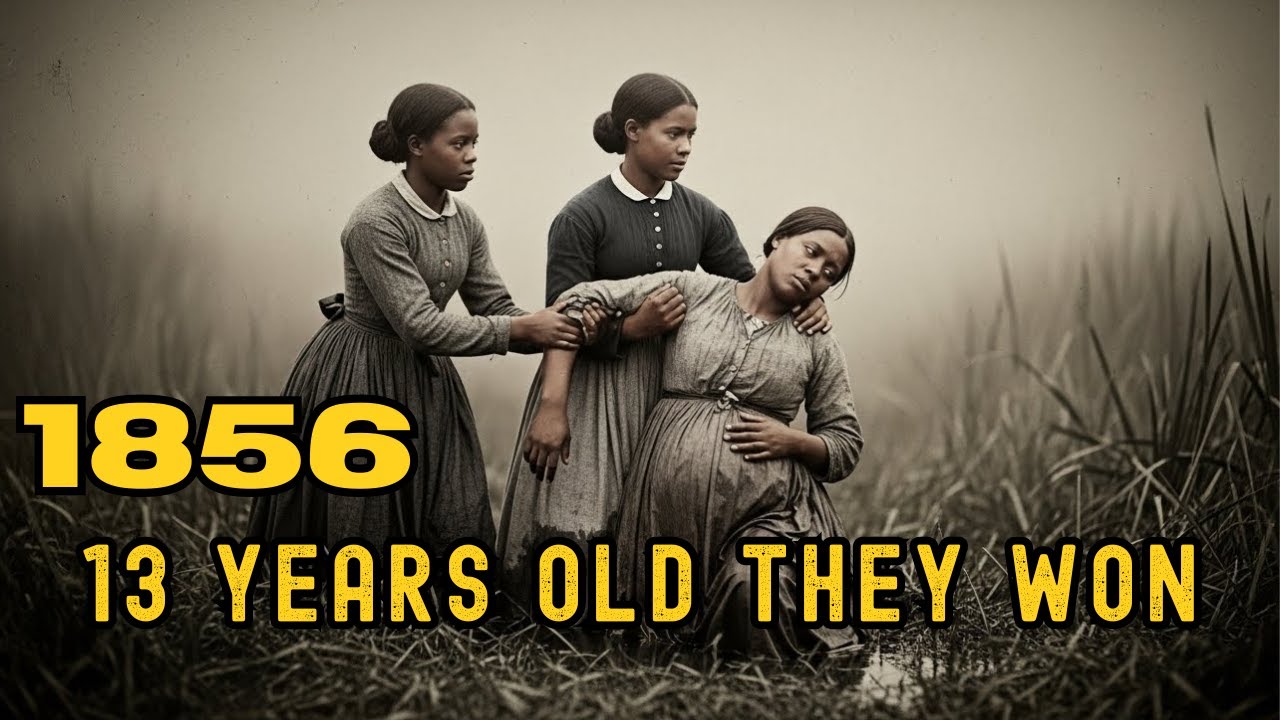
When he asked keys to what, she answered: every lock in the place. If she brought him impressions in clay, she said, could he make keys that worked? It had been decades since Isaiah had allowed himself to believe in anything resembling hope, but something in that small, identical face made him lay down his tools and listen to the plan that two enslaved twin girls were unfolding before him in the evening silence of the forge. They had come to Blackwood Plantation in December 1855, purchased from an estate liquidation in Charleston, South Carolina.
The bill of sale listed them as twin females, approximately thirteen years old, both healthy, trained in domestic service and fieldwork, sold as a pair. No surnames were recorded. No parents were mentioned. Their history before Charleston was undocumented, and they arrived at Blackwood on December 17th, riding in a wagon with eleven other newly purchased people, their identical faces revealing nothing as they surveyed their new prison.
Blackwood sprawled across a thousand acres of prime coastal Georgia land, eight miles south of Savannah, and it specialized in rice cultivation, which meant something specific and terrible. The work happened in standing water, breeding grounds for mosquitoes carrying malaria and yellow fever. The heat was suffocating. The labor was backbreaking.
Life expectancy for those forced to work the rice fields averaged seven years after arrival. Josiah Blackwood, who owned this empire of misery, was forty-six years old in January 1856, a third-generation plantation owner who had inherited the property in 1843 and expanded operations by forty percent through methods that did not bear close examination. He was known throughout Chatham County as a shrewd businessman, a committed Methodist, and a man who kept immaculate records of every transaction, every birth, every death, every dollar earned. His wife Caroline, thirty-eight and educated at a finishing school in Charleston, ran the main house like a military commander.
Nothing happened without her knowledge. Nothing was wasted. Nothing was forgiven. The head overseer who processed the new arrivals was Thomas Harlon Ridge, fifty-one years old, built like a bull, with hands scarred from three decades of plantation work.
He had been at Blackwood for eighteen years and understood the economics of human suffering with the precision of an accountant. He assigned Emma and Grace to work under Caroline Blackwood’s supervision in the main house: kitchen duties, laundry, cleaning, serving. Their small size and identical appearance made them useful for household work. Caroline found them efficient and unsettling in equal measure.
They don’t speak to each other, she mentioned to Josiah one evening in late December, but they move like they share one mind. Josiah dismissed her concerns. Silent efficiency was preferable to rebellion. What no one understood was that the twins had done this before, not at this scale, not with this level of complexity, but they had survived situations that required observation, pattern recognition, and strategic thinking.
Within three weeks, they had memorized the rotations of the six armed patrollers who monitored the property at night. They identified the gaps, the moments when certain areas went unwatched, the windows of opportunity that lasted only minutes. They studied the physical layout of the plantation with the focus of military engineers, learning every building, every path, every vulnerable point in the security systems that kept 347 people imprisoned. Then came the morning of January 14th, 1856.
The twins were carrying water to the rice fields, a duty that gave them access to areas beyond the main house, when they witnessed the entire event from thirty yards away. A woman named Ruth, barely twenty years old, six months pregnant, had been working since dawn, struggling with fever. When she collapsed in the fields, the overseer responsible for rice field operations, a man named Silas Morehouse, was on her within seconds. He was thirty-four years old and known for violence that went beyond maintaining discipline, violence that seemed to feed something broken in his psychology.
He kicked Ruth twice, hard enough that everyone within fifty yards heard the impact. When she did not rise, he used his leather strap, five blows across her back and shoulders while she lay in the mud and water. Then he walked away, leaving her unconscious, face down in four inches of standing water. Other workers pulled Ruth from the water before she drowned, but the damage was done.
She lost the baby that night, and she developed an infection that would kill her within two weeks. Emma and Grace watched all of this without expression, their identical faces showing nothing while their identical minds processed what they had witnessed and reached the same conclusion simultaneously. This had to stop. Not just for Ruth, for everyone.
And if stopping it required doing the impossible, then they would do the impossible. That night, lying in their shared sleeping space in the servants’ quarters attached to the main house, Emma whispered to her sister for the first time since arriving at Blackwood. We can’t kill our way out of this one. Grace understood immediately.
At their previous location, whatever it had been, violence against individual oppressors had been viable. But Blackwood was too large, too well-guarded, too systematized. Killing one overseer would just result in a replacement. They needed something different, something bigger, something that had never been successfully accomplished in coastal Georgia.
We need to get everyone out, Grace whispered back. Emma nodded in the darkness. All of them. At once.
Over the next three weeks, they studied Blackwood with obsessive focus, mapping every building, every fence line, every road and path within five miles of the plantation. They identified the locations of neighboring plantations and their patrol patterns. They noted the schedules of supply wagons and the rhythms of life that governed the broader geography of Chatham County. They learned that Blackwood coordinated with three neighboring plantations on security matters, that escaped individuals were typically tracked using dogs kept in kennels two miles north of the main house, and that the county slave patrol operated from a central office in Savannah.
All of this information went into their mental catalog, sorted and analyzed and cross-referenced until patterns emerged. But they also needed to understand the people they were planning to save. 347 souls lived at Blackwood, and not all of them would be capable of what the twins were contemplating. Some were too young, some too old, some too broken by years of systematic dehumanization.
They began identifying key individuals: people who still had fight in them, people who could keep secrets and follow instructions. Isaiah the blacksmith was their first recruit, followed by a woman named Sarah who worked in the laundry and knew every piece of gossip on the plantation; a field supervisor named Jacob who still had the respect of the workers; two brothers, Daniel and Marcus, who worked the stables and understood horses; a woman named Abigail who cooked in the kitchen and had access to supplies; and an old man named Thomas, who had been a sailor before being enslaved and knew the waterways of coastal Georgia like he knew his own hands. These seven became the core of what Emma called the network. Each of them would recruit others, carefully selected individuals who could be brought into the plan incrementally.
No one would know the full scope except Emma and Grace. Information would be compartmentalized, distributed on a need-to-know basis, protecting the operation if anyone was caught and interrogated. They were building something unprecedented: not a rebellion, which would be crushed, not a simple escape, which would be tracked down, but an organization, a shadow structure that existed invisibly within Blackwood’s normal operations, preparing for a single coordinated action that would evacuate 347 people in one night. March brought new challenges.
Josiah Blackwood hired an additional overseer, a man named William Krenshaw from Alabama with a reputation for breaking resistance. Thirty-eight years old, experienced and suspicious by nature, he began conducting random inspections, changing patrol patterns, disrupting the predictable routines the twins had been relying on. They adapted, slowing their recruitment and shifting from gathering information to gathering resources: small amounts of food that wouldn’t be missed, scraps of cloth that could be sewn into bags, pieces of rope and metal that Isaiah could work into useful tools. Everything was hidden in locations the twins had identified throughout the plantation: a hollow space beneath the kitchen floor, a gap in the wall of the servants’ quarters, the crawl space under the main house, an abandoned well on the eastern property boundary.
April brought tragedy that hardened everyone’s resolve. Ruth finally died from the infection that had been killing her since January. She was buried in the small plot behind the plantation chapel, one more nameless marker in soil soaked with suffering. Silas Morehouse didn’t attend the burial.
He was in the fields maintaining production quotas. Emma and Grace stood at that burial surrounded by people who had known Ruth, and the twins made a silent promise to her memory. This would work. It had to work, because if it didn’t, Ruth’s death would be just one more in an endless series and nothing would change.
By May 1856, the network had grown to 43 people. They knew to gather certain supplies, to memorize certain routes, to watch certain signals, to trust the twin girls who moved through Blackwood like ghosts, seeing everything, saying nothing, planning everything. The twins had also solved their biggest problem: where to go. Thomas the sailor had provided the answer.
Eight miles north of Savannah, the Savannah River formed the boundary between Georgia and South Carolina, and Thomas knew of a network, barely organized but real, of people who helped runaways cross into South Carolina and continue north. The Underground Railroad wasn’t a single entity; it was a loose collection of individuals who believed that slavery was evil and were willing to risk everything to help people escape it. The plan that emerged over June and July was breathtakingly complex. Phase one: neutralize the guards and dogs without killing anyone.
Emma insisted on this point. Deaths would trigger a massive manhunt, but incapacitated guards would slow response time enough to create the window they needed. Phase two: open every lock simultaneously. Isaiah had been working on keys for four months using clay impressions the twins provided, creating master keys for the quarters, the storage buildings, and the stables.
Phase three: move 347 people eight miles to the Savannah River using routes that avoided main roads and patrol areas, with the group divided into smaller units that would travel separately and converge at the river. Phase four: cross the river using boats the network would acquire in advance and hide at specific locations, with Thomas coordinating the navigation. Phase five: disperse. Once across the river, the group would split up, following different routes north, making tracking impossible.
By August 1856, everything was ready. The supplies were hidden. The keys were made. The routes were memorized.
The boats were acquired and concealed. 68 people now formed the core group, each responsible for guiding specific others during the escape. Emma and Grace set the date: September 23rd, 1856. A night when the moon would be dark, providing maximum concealment.
A night when Josiah Blackwood would be in Savannah attending a business meeting. A night when patrol schedules created a three-hour window of reduced coverage on the eastern property boundary. The final three weeks moved with agonizing slowness. Every morning they woke wondering if this would be the day someone talked.
Every evening they counted down the hours, recalculating risks, reviewing contingencies. On September 10th, they had their first serious crisis. William Krenshaw discovered that supplies were missing from one of the storage buildings: flour, salt, pork, dried beans, the kind of provisions someone might take if they were planning to travel. He launched an investigation immediately, questioning workers, conducting searches, examining storage areas methodically and thoroughly.
Most of the hidden supplies were in locations he hadn’t discovered yet, but if he expanded the search systematically, he would eventually find something. On September 12th, Emma made a decision that demonstrated the kind of cold calculation that separated the twins from everyone else involved in the network. She deliberately arranged for Krenshaw to discover a small cache of stolen food in the quarters of a man named Peter, a field worker who wasn’t part of the network and had no knowledge of the escape plan. The discovery was convincing because Emma made it look like Peter had been careless, and she made sure the search happened by mentioning to Krenshaw that she had seen Peter acting suspiciously near the storage building.
Peter was whipped for the theft: twenty lashes administered by Silas Morehouse while William Krenshaw watched. Emma and Grace witnessed the punishment from their positions serving water to the overseers and showed no emotion while watching an innocent man suffer for something he didn’t do. That night, Grace confronted her sister. Peter didn’t deserve that.
No, Emma agreed quietly. He didn’t. But 347 people deserve freedom. And if protecting this operation required sacrificing Peter’s back, then that’s the price we pay.
Grace stared at her identical twin, seeing something in Emma’s eyes that troubled her deeply: a willingness to make calculations that weighed suffering against outcomes, that valued the collective over the individual, that accepted cruelty as necessary if it served a larger purpose. We’re becoming like them, Grace whispered. No, Emma said firmly. We’re becoming what we need to be to beat them.
There’s a difference. The investigation concluded with Peter’s punishment, and security returned to normal levels. Then, on September 15th, came the second crisis, potentially more dangerous than the first. Josiah Blackwood announced that his business trip to Savannah was being postponed until October.
He would be at the plantation on September 23rd, meaning the main house would be fully staffed and alert during the escape window. The twins held an emergency meeting with the core network members on September 16th, gathering in the forge after midnight, 68 people crowding into a space designed for one, speaking in whispers while Isaiah stood watch at the door. Jacob argued for postponement. Emma interrupted.
The boats were in position. The supply caches were ready. Thomas’s contacts expected them on the 23rd. Changing the date now would require reconfiguring everything, which created new opportunities for discovery.
Grace spoke for the first time in the meeting. We adjust. Instead of relying on Blackwood’s absence to reduce detection speed, they would actively delay it. On the night of September 23rd, after everyone else had departed, Emma and Grace would remain behind temporarily and create a diversion in the main house that would occupy Josiah, Caroline, and the household staff for critical hours while 347 people moved through the darkness toward the Savannah River.
The network members looked at these two thirteen-year-old girls who spoke with the authority of generals and made decisions with the coldness of executioners. Trust us, Grace said quietly. We’ve brought you this far. Trust us to finish it.
Over the next seven days, they finalized their preparations with obsessive attention to detail. They reviewed every element of the plan with the core network members. They verified that all supplies were positioned correctly. They confirmed with Thomas that the boats were ready.
They prepared their diversion, sharing the specifics with no one except each other. On the evening of September 22nd, lying in their shared sleeping space, Grace asked the question that had been troubling her since the incident with Peter. Do you think we’re good people? Emma considered this carefully.
I think good and evil are words people use when they don’t want to think about complexity. We do what’s necessary. We protect people who can’t protect themselves. Does that make us good?
I don’t know. Does it matter? It matters to me, Grace said. Then believe this, Emma replied.
Tomorrow night, 347 people will have a chance at freedom they wouldn’t have otherwise. Some will make it, some won’t. But all of them will know that two girls who barely reached their fourteenth year cared enough to try the impossible. September 23rd, 1856 dawned with cloudless skies and unseasonable heat.
Josiah Blackwood was in particularly good spirits that morning. Cotton prices were rising, rice production was exceeding projections, and his plantation’s profitability was at an all-time high. At four in the afternoon, Caroline gave the twins an assignment that initially seemed like a complication but turned into an unexpected advantage: the main house’s dining room needed to be prepared for a special dinner that evening. Josiah’s brother Marcus was arriving unexpectedly from Charleston, and Caroline wanted to demonstrate appropriate hospitality.
This meant Emma and Grace would be working in the main house during the critical evening hours, with legitimate reasons to move through the building, accessing areas they needed to access, positioning materials they needed to position. At 6:30, as sunset painted Chatham County in shades of orange and red, the final preparations began throughout Blackwood Plantation. Isaiah was distributing the keys he’d spent months creating. Sarah was ensuring everyone knew their designated travel groups and routes.
Jacob was organizing the field workers, making sure the elderly and children were paired with strong adults. Daniel and Marcus were preparing the horses and wagons. Thomas was conducting his final check of the supply caches along the escape route. Abigail was distributing the last provisions from the kitchen.
At 7:15, Marcus Blackwood arrived, a forty-two-year-old owner of a cotton plantation outside Charleston, bringing news of commodity prices and political developments. The dinner conversation would likely last hours. At 8:40, full darkness had settled over the plantation, and the moon, as predicted, was barely a sliver. At 8:45, Isaiah unlocked the first door.
At 8:50, Jacob began moving the first group toward the eastern property boundary, thirty people moving in silence through the darkness. At 9:00, the second group departed, then the third, then the fourth. 347 people began flowing out of Blackwood Plantation in coordinated streams. Daniel and Marcus moved the wagons at 9:15, the wheels wrapped in cloth to muffle sound.
At 9:45, the last group departed. Every quarter stood empty. Every work building sat abandoned. 347 people had evacuated in exactly one hour.
At 10:00, Emma and Grace began their diversion. A candle knocked over in the kitchen landed near some drying towels that the twins had positioned carefully earlier in the evening, soaked in cooking oil. The fire started small, just smoke at first, but smoke in a wooden building carries, and within three minutes someone noticed the smell. By the time Caroline called for investigation, the kitchen was fully involved, flames climbing walls, consuming the dry wood with terrifying speed.
Chaos erupted immediately. Josiah and Marcus ran from the dining room. Caroline began shouting orders. The household staff scrambled to respond, grabbing buckets, organizing a water brigade.
Emma and Grace, covered in soot and appearing panicked, ran toward the house screaming that the fire had started from the kitchen stove, that they tried to put it out but it had spread too fast, that they were sorry, so sorry they’d failed in their duties. No one questioned them. No one suspected. They were victims of the fire, not perpetrators.
The kitchen burned completely, and the flames spread to an adjacent storage building before the water brigade managed to contain them. It took until midnight to fully extinguish the blaze. During those critical hours between 10:00 p. m.
and midnight, while Josiah and Caroline and Marcus and the entire household staff fought to save the main house, 347 people traveled eight miles through darkness and reached the Savannah River. Thomas was waiting with the boats exactly as planned: twelve small boats acquired over months through careful transactions, hidden in inlet vegetation. The crossing began at 11:30. Thomas coordinated with the precision born of decades on water, organizing groups by size and weight, ensuring boats weren’t overloaded.
By 1:00 a. m. , the first groups were reaching the South Carolina shore, where contacts that Thomas had identified were waiting to guide the escapees to safe houses. By 2:00 a.
m. , more than half of the 347 had crossed. The impossible was happening. Back at Blackwood, the fire was finally under control.
Josiah stood in the smoke-filled yard surveying the destruction, calculating the financial impact. It wasn’t until 3:00 a. m. that someone finally thought to check the quarters.
The messenger could barely get the words out. Sir, they’re gone. All of them. Every quarter is empty.
Every building. There’s no one here. 347 people gone. The words didn’t make sense initially.
Then understanding hit with the force of physical impact. The fire wasn’t an accident. It was a diversion. Get Ridge!
Josiah shouted. Get every overseer. Get the patrol. Get the dogs.
Get everyone now. By 3:30, organized pursuit began, but it was already too late. The dogs found trails leading to the river, but the water crossing had destroyed the scent. The escapees had vanished as completely as if they’d never existed.
And Emma and Grace stayed at Blackwood, playing their roles perfectly, two frightened girls who’d accidentally started a fire and were devastated by the consequences. They cried when questioned. They trembled when Josiah shouted. They convinced everyone who saw them that they were victims of circumstances beyond their control.
No one suspected. How could they? Thirteen-year-old girls couldn’t plan and execute the largest mass escape in Georgia history. The morning of September 24th brought chaos that bordered on panic throughout Chatham County.
The discovery of the escape triggered the most intensive investigation ever conducted in coastal Georgia. Sheriff Robert Talbert, a fifty-six-year-old career law enforcement officer, brought in experienced trackers from three counties and coordinated with South Carolina authorities. The twins were questioned on September 25th in the main house parlor with Caroline Blackwood present. Did you see anything unusual in the days before the escape?
Talbert asked. The twins sat with perfect posture, their identical faces showing appropriate fear and confusion. No, sir, Emma said quietly. Everyone just did their regular work.
The fire, Talbert continued. Tell me exactly how it started. Grace explained, her voice trembling, that they had been cleaning the kitchen after dinner service, that there were so many candles because of the special meal, that a candle had fallen near some towels, that the fire had spread so fast. Talbert looked at these two small girls and saw exactly what they wanted him to see: victims, frightened servants who’d made a tragic mistake.
Children didn’t do such things. The investigation continued for weeks, expanding to cover neighboring counties and extending into South Carolina. Rewards were posted, but no one came forward with useful information. By mid-October, the uncomfortable truth was becoming clear: the escaped individuals had successfully scattered and vanished.
The economic impact on Josiah Blackwood was catastrophic. 347 people represented an investment of approximately $200,000 in 1856 currency, and losing that entire workforce in a single night threatened bankruptcy. Blackwood was forced to sell significant portions of his land to cover debts. By December 1856, Josiah employed only 43 people.
But the financial impact was secondary to the psychological impact. The escape demonstrated something that plantation owners throughout the South found deeply threatening: the enslaved population could organize. Throughout November and December of 1856, plantation security across Georgia underwent dramatic changes. Guards were increased.
Patrols were reorganized. New restrictions were implemented on movement and gathering. Emma and Grace watched these developments with mixed feelings. Their operation had freed 347 people, but it had also triggered responses that made life harder for thousands of others still trapped in the system.
What they didn’t know yet was whether their network members had successfully reached safety. The plan had called for no communication for at least six months. In January 1857, they received their first indirect confirmation. A traveling merchant visiting Blackwood mentioned an interesting rumor he’d heard in Charleston: a whole community of former slaves had established itself somewhere in Pennsylvania, maybe 300 people, all claiming to have come from Georgia plantations.
Authorities up there won’t return them. Emma, serving tea during this conversation, showed no reaction, but her heart was racing. That night, Grace whispered to her sister. Do you think it was them?
Some of them, Emma said. Not all. 300, not 347. Some didn’t make it.
Some went different directions. But yes, I think a significant number reached Pennsylvania. We did it, Grace said, her voice containing wonder and relief. We actually did it.
February 1857 brought new arrivals to Blackwood as Josiah purchased 23 people to rebuild his workforce. The twins began rebuilding their network with even greater care than before, recruiting five core members from the new arrivals. But in April 1857, everything changed. Sheriff Talbert received a letter from authorities in Pennsylvania containing testimony from individuals who had escaped from Blackwood on September 23rd, 1856.
The testimony detailed the escapees’ organization, named core network members, described the planning process, and mentioned briefly but definitively that two young twin girls who worked in the main house had been present at planning meetings and appeared to have detailed knowledge of the operation. On April 15th, Talbert returned to Blackwood and requested another interview with Emma and Grace, this time without Caroline present. His questions were pointed, designed to test consistency with previous statements. Tell me again about the planning meetings, Talbert said carefully.
Did you ever see groups gathering in unusual locations? The twins understood the trap. Emma made a decision that demonstrated the strategic thinking that characterized every action since arriving at Blackwood. She would give Talbert partial truth, enough to satisfy his suspicions without revealing the full scope of their involvement.
There were some nights when we saw people gathering at the forge, she said slowly. We didn’t understand what they were doing. We were scared to ask. Because we were afraid, Grace added, her voice trembling in a performance of fear that was partially genuine.
We’re just children. Talbert studied them carefully. Their explanation was plausible. But something about the twins’ perfect composure troubled him.
I think, Talbert said carefully, that you know more than you’re telling me. I think you were involved in the escape. Perhaps not as leaders, but as accomplices. No, sir, Emma said firmly.
We’re just servants. We do what we’re told. We’re children. Talbert wanted to believe they were involved, but instincts weren’t evidence, and without evidence, he couldn’t act on suspicions that seemed increasingly ridiculous when stated plainly.
He left without making any arrests, but he also left with certainty that Emma and Grace knew more than they admitted. The twins understood their situation had changed fundamentally. They were now under suspicion. That night, Emma and Grace had the most serious conversation of their lives.
We can’t stay, Grace said. Talbert suspects us. If anything else happens, we’ll be blamed. The twins developed a new idea over the following weeks.
Instead of planning another mass escape, they would create infrastructure: document the routes they’d established, record the names and locations of helpful contacts, compile information about security patterns and safe passages. But documenting this information created massive risk. Their solution came through Abigail, the cook who had escaped to Pennsylvania. Before leaving, Abigail had taught several younger women her cooking techniques, passing down recipes and methods.
Emma and Grace realized they could do the same thing, not with cooking, but with escape planning. They would teach their knowledge to trusted individuals, person by person, ensuring the information existed in multiple minds rather than single documents. They would create human libraries, people who memorized routes and contacts and methods. The knowledge would become oral tradition, impossible to destroy by burning papers.
May and June of 1857 were spent in careful education. The twins identified twelve individuals among the new arrivals and remaining workers who showed the intelligence and commitment necessary to preserve and transmit complex information. They taught these twelve everything they knew about planning escapes, coordinating movement, identifying security vulnerabilities, and connecting with helpful contacts. Each of the twelve was instructed to teach at least two others, creating exponential spread of knowledge throughout networks that extended beyond Blackwood to plantations across Chatham County and eventually throughout Georgia.
By July 1857, the twins understood their work at Blackwood was complete. It was time to leave, not just Blackwood, but Georgia entirely. They planned their departure for August 23rd, exactly one year after the mass escape. On August 22nd, the day before their planned departure, they performed their duties with the same silent efficiency they’d maintained for twenty months.
That night, lying in their sleeping quarters for the last time, they reviewed their achievements. 347 freed directly, Emma whispered. At least 60 more educated in escape methods. Not bad, Grace said softly, for two thirteen-year-old girls that no one took seriously.
Fourteen now, Emma corrected. We turned fourteen in January, though I suppose no one thought to celebrate. We’ll celebrate in Philadelphia, Grace said. When we’re free, when we’ve built new lives, when we can finally stop pretending to be helpless children.
August 23rd, 1857 began like any other day at Blackwood Plantation. The twins rose before dawn, prepared breakfast, served Josiah and Caroline with the silent efficiency that had made them nearly invisible over twenty months of careful performance. At four in the afternoon, Sheriff Talbert arrived at Blackwood unannounced. Caroline received him in the parlor, and Emma served tea while Grace stood by.
Talbert revealed that he had received additional correspondence from Pennsylvania with increasingly detailed testimony. Two individuals are mentioned repeatedly, he said. A blacksmith named Isaiah. And he paused, letting the silence build deliberately.
Two young girls who apparently had detailed knowledge of security patterns, patrol schedules, and main house operations. You’re not suggesting, Caroline said slowly, that Emma and Grace were involved. They’re children. The idea is absurd.
Is it? Talbert asked, turning to look directly at the twins. Tell me something, he said quietly. If you were planning a mass escape, if you needed to gather intelligence about security and schedules, who would you use as your agents?
Strong men who’d be noticed moving around, or small girls who everyone ignores because they’re just servants? Emma met his gaze directly, abandoning the downcast eyes that signaled submission. Sheriff Talbert, you’re suggesting that two enslaved children outsmarted every overseer, every guard, every security measure in Chatham County. Does that seem likely to you?
The directness of her response surprised Talbert. Then we’re much cleverer than anyone’s given us credit for, Grace said, speaking for the first time. Though if we were really that clever, why would we still be here? Wouldn’t we have escaped with everyone else?
This question was the twins’ strongest defense. Their continued presence at Blackwood after the mass escape was the single fact that most contradicted Talbert’s theory. I’ll be watching you, Talbert said finally. Both of you.
If anything unusual happens, if anyone else disappears, I’ll know where to look first. We’re just servants, sir, Emma said, returning to the submissive tone and downcast eyes. We do what we’re told and nothing more. Talbert left that afternoon, convinced the twins were guilty but unable to prove it, having played his hand too early.
The twins understood the encounter had changed everything. Talbert was watching them now. Leaving as planned would seem like confirmation of guilt. That evening, Emma approached Caroline Blackwood with a request that seemed to come from genuine distress.
Ma’am, she said quietly, my sister and I were frightened. Sheriff Talbert thinks we were involved in the escape. We’re scared he’s going to arrest us just to close his investigation. Caroline assured them that Talbert couldn’t arrest them without evidence.
But what if he makes up evidence? Grace asked, joining her sister. What if he needs someone to blame and we’re convenient? We’re just property.
No one would question if he took us. The concern was valid. Enslaved people had no legal protections against false accusations. Please, Emma said, her voice carrying what sounded like desperate pleading.
Could we be sold to someone far from here, somewhere Sheriff Talbert’s investigation doesn’t reach? We’ll work hard. We promise. Caroline Blackwood was not a sentimental woman, but she recognized practical reality.
The twins were valuable property, and their value would be compromised if they were arrested. Selling them to a buyer in another state would remove them from Talbert’s reach while recovering their purchase price. The Blackwoods arranged to sell Emma and Grace to a cotton merchant from Alabama traveling through Savannah, a man named Edward Thornhill, for $1,200, slightly below market value but acceptable given the circumstances. The sale was documented, legally transferred, and completed on August 26th, 1857.
Emma and Grace were placed in Thornhill’s wagon for transport to Alabama, and they departed Blackwood Plantation with Sheriff Talbert watching from a distance, frustrated but unable to prevent a legitimate property transfer. What Talbert didn’t know was that Edward Thornhill was not actually a cotton merchant from Alabama. He was a Quaker abolitionist from Philadelphia who occasionally traveled south under false identity, purchasing enslaved people and transporting them to freedom. His network had been contacted by the twins months earlier through channels established during the mass escape planning.
The sale was elaborate theater designed to remove Emma and Grace from Georgia legally, with documentation that would prevent pursuit or recovery attempts. The journey north took three weeks. Thornhill transported the twins along with seven others he’d purchased from various locations, maintaining his merchant cover until they crossed into Pennsylvania on September 16th, 1857. Philadelphia in 1857 was a city of contradictions, offering opportunities for free black residents that didn’t exist in the South while maintaining deep racial prejudices and segregation.
Thornhill’s network connected the twins with a Quaker family who provided housing in exchange for domestic work while the girls attended school. For the first time in their documented lives, Emma and Grace had access to formal education. They learned to read and write with a hunger that startled their teachers. By 1858, both twins were reading at levels far beyond their peers.
By 1859, they were teaching other students. But education and stability didn’t eliminate the drive that had formed them. They found purpose in the expanding abolitionist movement. By 1860, the twins were running safe houses, coordinating travel routes, and training others in the methods they’d developed, transformed from escape children into skilled operatives.
They also maintained contact with people from their Blackwood network. Isaiah had settled in Pittsburgh, working as a blacksmith. Sarah was in Boston. Jacob had stayed in Philadelphia.
The stories they shared confirmed what the twins had hoped: of the 347 who escaped on September 23rd, 1856, at least 290 had successfully reached free states and established new lives. Some had died during the journey north. Others had been recaptured. But the majority had made it.
This success rate was unprecedented. The Blackwood operation had succeeded for over eighty percent of those involved. When the Civil War began in April 1861, the twins saw opportunities that extended beyond individual escapes. They began working with military authorities, providing intelligence about plantation operations, security systems, and resistance networks.
They also worked with contraband camps, the settlements that formed around Union armies where escaped slaves gathered seeking protection. By 1863, when the Emancipation Proclamation transformed the war’s purpose, Emma and Grace had become recognized figures in abolitionist circles, known as the twins who’d organized the Blackwood escape, though very few people knew the full scope of what they’d accomplished. In 1865, when the war ended and the Thirteenth Amendment abolished slavery throughout the United States, Emma and Grace stood in Philadelphia’s streets watching celebrations. What do we do now?
Grace asked her sister. We become who we were supposed to be before circumstances made us into something else, Emma said quietly. This transition proved more difficult than either twin anticipated. They were twenty-two years old in 1865, but their experiences had aged them beyond their years.
They stayed in Philadelphia, working in education. Emma became a teacher at a school for formerly enslaved children. Grace worked with literacy programs, teaching adults to read and write. The twins never married.
They lived together in a modest house in Philadelphia’s seventh ward, maintaining the connection that had existed since birth. They also never told their complete story. When asked about their past, they provided basic facts, but the full details of the Blackwood escape remained private. In 1872, seven years after emancipation, Emma and Grace received a letter from Chatham County, Georgia.
It was from Marcus Blackwood, Josiah’s brother. The letter was brief. Miss Emma and Miss Grace, I am writing to inform you that my brother Josiah passed away last month. In his final years, he became obsessed with the escape of 1856.
He believed you were responsible, though he never could prove it. Sheriff Talbert believed the same until his death in 1868. I want you to know that I understand what you did. I don’t condone it, but I understand it.
You took 347 people who were legally property and transformed them into free human beings through nothing but intelligence, planning, and courage. My brother never recovered financially or psychologically. Blackwood Plantation was sold in 1863. The system you fought against no longer exists.
I suppose I’m writing to tell you that you won. Whatever your goals were that September night in 1856, you achieved them. The impossible thing happened because two children refused to accept that it was impossible. Emma and Grace read this letter together in their Philadelphia home.
Do you think we were right? Grace asked. Everything we did, the way we did it. I think we did what was necessary, Emma said.
People were suffering. We had the capacity to reduce that suffering. We used that capacity at significant cost to ourselves. But I would make the same choices again.
Wouldn’t you? Grace considered this question seriously before answering. Yes, I would. Though I wish we could have been different people, normal people who didn’t have to become what we became.
We were never going to be normal, Emma said gently. Whatever happened to us before Charleston, before Blackwood, it formed us into something specific. We can regret the necessity, but we shouldn’t regret using what we became to help others. Emma died in 1891 at age 48 from complications following pneumonia.
Grace followed her sister three months later, as if unable to exist separately from the twin who’d been her constant companion through extraordinary circumstances. They were buried together in Eden Cemetery in Philadelphia, one of the first cemeteries in America specifically established for African Americans. Their shared headstone carried a simple inscription: Emma and Grace, 1843 to 1891. They made the impossible possible.
Most people who attended their funeral knew them as teachers and literacy advocates, not as the architects of one of history’s most successful mass escapes. But in archives throughout the northeastern United States, in courthouse records from Chatham County, and in personal letters and testimonies preserved by historical societies, the story existed. Estimates suggest that methods and routes developed during the Blackwood planning were used in at least 200 additional successful escapes between 1856 and 1865. Information the twins taught to their network members spread throughout Georgia’s enslaved population, creating a decentralized resistance infrastructure that proved impossible for authorities to destroy because it existed in human memory rather than physical documents.
In 2019, researchers at the University of Georgia discovered additional documentation related to the Blackwood escape: personal letters from Emma and Grace written in the 1880s to former network members. One letter written by Emma to Isaiah in 1884 contained a passage that captured the twins’ perspective on their actions. You asked if I have regrets about what we did those many years ago. I regret the necessity.
I regret that circumstances forced children to become strategists and operators. But I don’t regret the outcomes. 347 people reached freedom because two girls refused to accept that impossible meant unachievable. We were weapons, Isaiah.
Forged by experiences we never discuss, sharpened by necessity, aimed at targets that deserve destruction. Weapons can’t be judged as good or evil. They can only be judged by the purposes they serve and the skill with which they’re wielded. We served liberation.
We were wielded with precision. That’s enough for me. That letter is now displayed at the National Museum of African American History and Culture in Washington, DC. The Blackwood Escape remains one of the most studied events in the history of American slavery resistance, examined as a case study in strategic planning, as an example of organized resistance, as evidence of what young people can accomplish when necessity demands it.
But the story also raises uncomfortable questions that resist easy answers: how much violence is justified in resisting oppression, what moral compromises are acceptable when fighting evil systems, whether people who do terrible things for good reasons can be considered heroes. Emma and Grace never provided definitive answers to these questions. They lived their lives, accomplished their objectives, and left history to judge their actions. What can be stated definitively is this: two fourteen-year-old girls, enslaved and powerless by every legal and social standard of their time, planned and executed an operation that freed 347 people, created knowledge systems that enabled hundreds of additional escapes, and demonstrated that impossible was just another word for things that required more courage and intelligence than most people possessed.
They did this through strategic thinking, operational precision, moral flexibility, and an absolute refusal to accept that their age, gender, or legal status limited what they could accomplish. On September 23rd, 1856, the impossible happened in Chatham County, Georgia, and it happened because two identical faces looked at a system built on violence and oppression and decided that every impossible thing was possible if you planned carefully enough and refused to accept defeat.






