In the mid-1930s, a woman in a Manhattan apartment flipped a switch, and her kitchen came alive. The electric refrigerator kept her milk cold. The radio played jazz from a nightclub downtown. An electric iron heated in seconds.
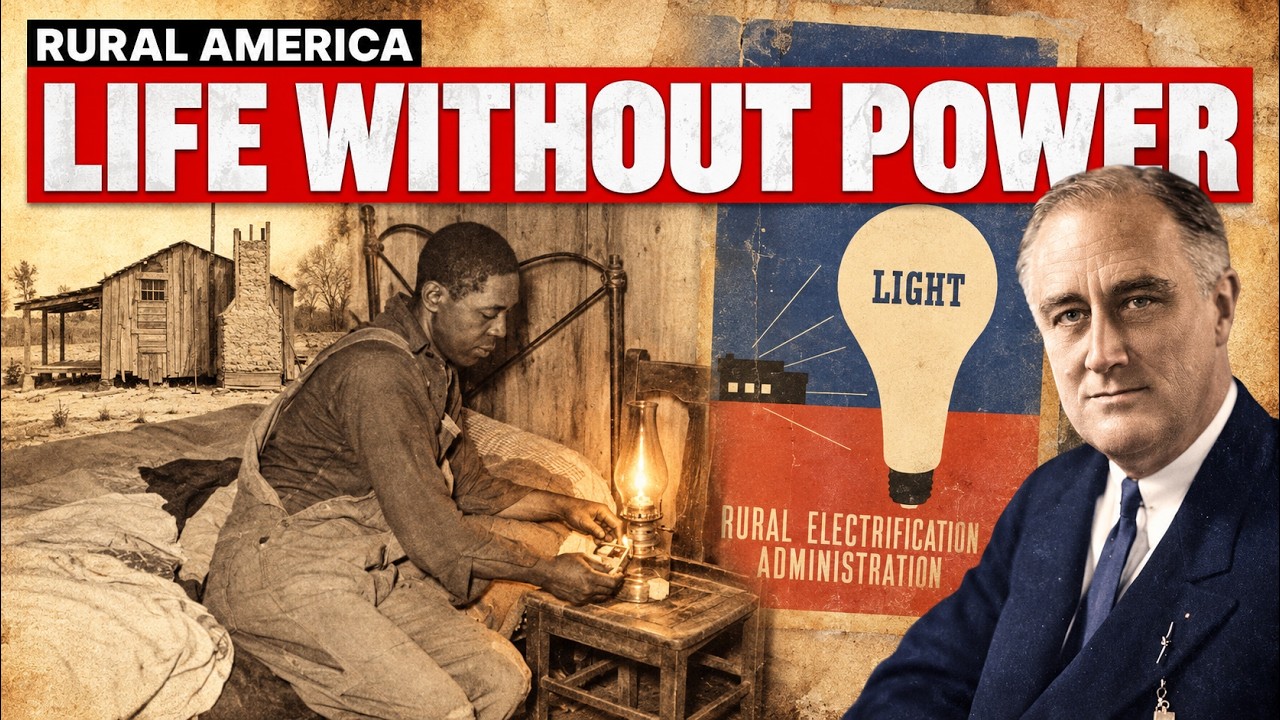
Outside, the city burned with streetlights and neon. Three hundred miles away, a farmer’s wife in rural Pennsylvania hauled buckets of water up a muddy slope from a hand-pumped well. She had been scrubbing laundry on a washboard since before dawn with lye soap that cracked her hands. Her kitchen was a hundred degrees because the wood stove had burned for six hours.
At night, the family ate by the dim, smoky light of a kerosene lamp. In 1935, nearly ninety percent of American farms had no electricity. Cities pulsed with modern power while the countryside lived as it had in 1850. The United States was the world’s largest producer of electricity, yet Germany, France, Denmark, New Zealand, and even the island of Tasmania all had higher rates of rural electrification.
The technology existed. The money existed. The demand existed. The obstacle was a corporate monopoly with a single name at its center: Samuel Insull.
Insull was born in London in 1859 and came to America in 1881 to serve as private secretary to Thomas Edison. By 1892 he ran Chicago Edison. He understood the economics of electricity better than almost anyone. Building power plants and laying wires cost enormous sums, but once those costs were paid, producing additional electricity was cheap.
Profit came from scale: more customers, more consumption, spread across a huge system. By 1907 his company, now Commonwealth Edison, supplied all of Chicago. In 1912 he invented a financial structure that would reshape American capitalism and eventually destroy it. He created Middle West Utilities, a holding company that owned shares of other companies that owned shares of other companies that owned the actual utilities.
A pyramid of corporations, each layer leveraged on the stock prices of the layer below. With relatively little real capital at the top, Insull controlled vast networks of power companies at the bottom. At its peak, his empire included more than eighty-five companies serving customers in thirty-two states, valued at roughly four billion dollars, well over seventy billion in today’s money. By the early 1930s, just three giant holding companies controlled more than eighty percent of America’s power companies.
They were obsessed with scale, but only urban scale. Running a power line into the countryside cost about the same as running one down a city block, yet a city block served fifty customers and a country road served two. The industry calculated the return on investment and made a deliberate decision. They would not serve rural America.
In the few rural areas that did have power, rates were commonly twice what city residents paid, and service was unreliable. When farmers organized for better rates, they were refused. When towns tried to build municipal systems, the utilities fought them in court and poured money into defeating public power referendums. They controlled regulators, lobbied legislatures, and in documented cases bribed officials.
In 1930, fewer than one percent of Mississippi farms had electricity. In the Tennessee Valley, only three percent. In the Texas Hill Country, 2. 3 percent.
Then the system broke. The stock market crashed in October 1929. Insull’s pyramid had been built on borrowed money collateralized by inflated stock prices. When the market collapsed, the collateral vanished.
In June 1932, Insull Utility Investments failed, and holding company after holding company followed. More than a million investors lost their savings. Insull fled to Europe, was extradited, tried three times for fraud and embezzlement, and acquitted on all counts because the jury could not prove he had broken a specific law. He died alone in a Paris subway station in 1938 with less than a thousand dollars to his name after once being worth billions.
His collapse gave Franklin Roosevelt and the New Dealers the ammunition they needed. Progressive critics like Senator George Norris and Pennsylvania Governor Gifford Pinchot had argued for years that private power was corrupt and exploitative. Now they had proof. Roosevelt took office in March 1933.
On May 18, less than three months later, he signed the Tennessee Valley Authority Act. The TVA was a public corporation with sweeping powers over a seven-state river basin: flood control, navigation, farming assistance, and the generation and distribution of cheap electric power. In 1933, per capita income in the valley was only forty-four percent of the national average. In Union County, Tennessee, there were no electrical utilities at all.
The private power companies fought the TVA ferociously, filing lawsuits and running newspaper campaigns calling it socialism and communism. The Supreme Court upheld the TVA in 1939. By 1941, it was the largest producer of electric power in the United States, and during World War II it would power the Manhattan Project’s uranium enrichment at Oak Ridge. The TVA covered seven states.
There were forty-one others, and farmers there still lived in the dark. Roosevelt turned to Morris Cooke, a progressive engineer from Pennsylvania who had tried to bring electricity to rural areas in the 1920s and seen the private utilities refuse. On May 11, 1935, Roosevelt signed Executive Order 7037, creating the Rural Electrification Administration with Cooke as its first administrator. The following year, Congress passed the Rural Electrification Act.
Cooke’s first strategy was to work with the private companies. He offered them low-interest federal loans, twenty-five-year terms, subsidized rates. They refused. They demanded higher rates, proposed building a token amount of new line, and refused to commit to rates farmers could afford.
They would take government money only if they could keep charging rural customers double the city rate. So the REA pivoted. Instead of lending to the utilities, it would lend directly to farmers organized into rural electric cooperatives: not-for-profit organizations owned by their members, existing only to provide service at the lowest possible cost. No shareholders, no Wall Street holding companies, no siphoning of profits.
The response was overwhelming. Applications poured in from every corner of the country. In Meeker County, Minnesota, farmers organized the first REA-financed co-op in the state on September 13, 1935. In Indiana, the Woody family received their electric meter on May 22, 1936.
In Clark County, Wisconsin, when the local private utility refused REA rates, farmers organized their own cooperative. The REA also solved a technical problem the private industry had never bothered with. The standard urban system used 2,300 volts, which could only travel about four miles before the voltage drop became unacceptable. REA engineers developed a 6,900-volt system that could carry power up to forty miles, making rural electrification economically feasible for the first time.
They lent money not just for lines but for home wiring and appliances, and they organized traveling demonstrations called the REA Circus that toured twenty states starting in 1938, showing farmers how milking machines and electric washing machines worked. In 1935, roughly eleven percent of American farms had electricity. By 1940, about thirty percent. By 1945, nearly half.
By 1953, more than ninety percent. One place and one man would come to define the transformation. The Texas Hill Country was rugged, rocky, and so sparsely populated that even the REA’s loans required a minimum density of three customers per mile of line, a threshold the Hill Country could not meet. Lyndon Baines Johnson was born there in 1908 in a farmhouse with no electricity and no running water.
He had watched his mother haul water and wash clothes by hand. He had done his schoolwork by kerosene lamp. In 1937, at twenty-nine, he was elected to Congress from the district that included the Hill Country, making rural electrification his central campaign promise. His strategy was direct.
He went to President Roosevelt in the summer of 1938 and pressed for a special exception to the density rule. Roosevelt was impressed by the young congressman’s intensity and agreed. He personally called the REA administrator and told him to make an exception. On May 19, 1938, Johnson and area rancher E.
Babe Smith signed the incorporation documents for Pedernales Electric Cooperative. In September, the REA granted a loan of about $1. 3 million to build roughly 1,800 miles of line serving nearly 3,000 Hill Country families. Johnson spent that summer going from farm to farm, convincing skeptical farmers to pay the few dollars for membership.
Many did not believe the lights would ever come on. The first farm in the system to receive electricity was E. Babe Smith’s. When the switch was flipped, farm wives wept.
Children ran around flipping lights on and off. One Hill Country resident later recalled that when the power came on, his mother sat down at the kitchen table and cried for an hour. Years later, as president of the United States, having passed the Civil Rights Act and launched the Great Society, Lyndon Johnson said that of all the things he had ever done, nothing gave him as much satisfaction as bringing power to the Hill Country of Texas. The Pedernales Electric Cooperative still operates today as the largest electric cooperative in the United States, serving more than a million members.
The social transformation was immense. The endless physical labor of hauling water, washing clothes, heating irons, and cooking on wood stoves collapsed. Infant mortality fell, largely because of improved sanitation, refrigerated food, and clean water pumped indoors. Child literacy rose because homework could be done by electric light.
Rural isolation broke down as families connected to the national conversation through radio. Farm productivity surged. Dairy farmers with electric milking machines handled larger herds. Electric motors ran water pumps, cream separators, and feed grinders.
Egg production increased because artificial light kept chickens laying through winter. Rural communities that got electricity attracted small manufacturing and food processing. Towns that had been shrinking began to grow again. There is an irony at the end of the story.
Once the cooperatives had proven there was a profitable market for rural electricity, the private power companies suddenly rediscovered their interest in the countryside. During the 1940s and 1950s, they tried to buy out the co-ops or compete with them. The co-ops, firmly established and protected by Congress, fought them off. Today, more than nine hundred electric cooperatives still serve rural America, providing power to around forty-two million people across fifty-six percent of the nation’s landmass.
In 1935, eleven percent of American farms had electricity. By 1953, over ninety percent did. That did not happen because of the invisible hand of the market.
It happened because farmers organized, because a government decided to act, and because the idea that electricity was a right and not a luxury proved strong enough to overcome one of the most entrenched corporate interests in the country.






