On the last morning of 1941, a 38-year-old naval intelligence officer stood on the narrow deck of a submarine and prepared to accept the end of his career. Edwin Thomas Layton had spent the past year doing one thing: predicting what the Japanese Navy would do before it did it. On the morning of December 7, he had not known. Now, 2,403 Americans were dead, eighteen ships were sunk or crippled, and the Pacific Fleet—the wall between the West Coast and the Japanese Navy—had vanished in less than two hours.
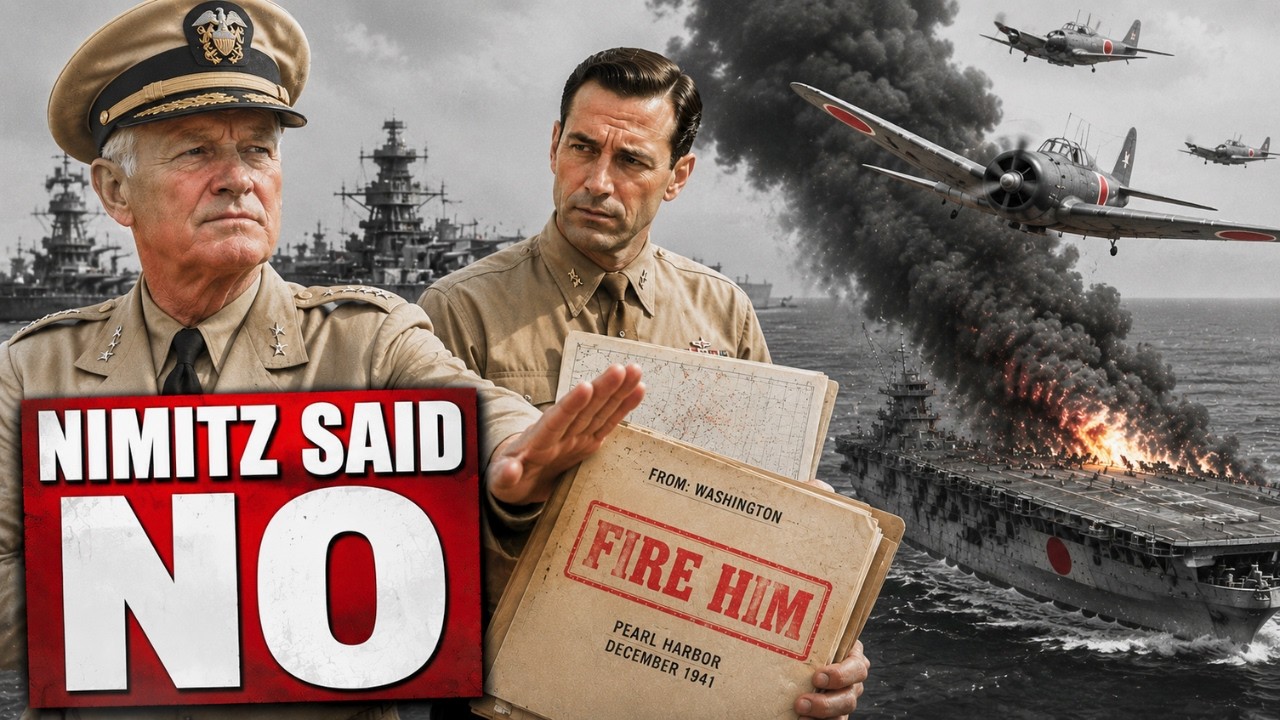
Layton had already submitted his transfer request. He wanted command of a destroyer, anything far from this harbor. He assumed that when the new fleet commander arrived, his own dismissal would follow. The man who arrived at Pearl Harbor on Christmas morning was a tall, quiet Texan named Chester Nimitz.
Washington had already decided that Layton had to go. Nimitz read the same file Washington had read. Then he did the opposite of what Washington wanted. He kept Layton.
Six months later, the four Japanese carriers that had led the attack on Pearl Harbor were burning at the bottom of the Pacific. The Japanese Empire never recovered from what one man did in a basement office with a second chance he was never supposed to get. To understand what Nimitz saw in Layton, it is necessary to go back twelve years. In 1929, the U.
S. Navy ran a program almost no one had heard of. Each year, it selected two young officers—not the fastest promoted, not the most decorated, but two with distinctly analytical minds—and quietly sent them to Tokyo. Not to spy, and not to gather documents, but to live inside the language.
To attend plays, read newspapers, attend naval functions, and listen. Not for secrets, but for the essence of how the other side thought. How they spoke about the sea, how they spoke about Americans, what they were proud of, what they feared, and what they would never admit. That year, one of those officers was Edwin Layton, a 26-year-old Naval Academy graduate with five years of service already behind him.
On the slow crossing of the Pacific, he met the other officer chosen that year, a man named Joseph Rochefort. They were opposites. Layton was sharp, social, quick-witted, comfortable anywhere. Rochefort was deep in a way most people could not follow.
He forgot to eat and forgot to sleep. He was in love with codes and ciphers long before the Navy pointed him toward Japan. But somewhere between San Francisco and Yokohama, they became friends. Over the next three years in Tokyo, they built something neither of them had a name for yet.
Layton went to Kabuki plays in a language he was learning word by word, attended Imperial Navy functions, and watched how the officers argued—not what they argued about, but how. The way a man argues tells you more about his mind than the position he takes. Layton returned home in 1932 carrying something no report could contain. He knew how the Japanese naval officer thought.
Not from a book, but from across a table. In 1937, he returned to Tokyo as assistant naval attaché at the American embassy. The Japan he came back to was not the one he had left. By then, the army had already won the internal argument.
Japanese forces were already in China. The admirals and generals who attended official functions carried themselves with the confidence of men who had already made their decision. One voice of restraint belonged to a man Layton would study more carefully than anyone else: Isoroku Yamamoto. At an official duck-hunting party in the fall of 1938, Layton observed him closely.
Yamamoto had studied at Harvard and served as Japan’s naval attaché in Washington. He had walked through American factories and seen with his own eyes the industrial capacity of the country his generals now wanted to fight. In rooms where he trusted the audience, he said that war with the United States was not a war Japan could win. Not because he was afraid, but because he had done the arithmetic.
By 1939, when Layton left Tokyo for the last time, he knew what Yamamoto feared—and what Yamamoto would do anyway once Japan made its decision. Layton had been the Pacific Fleet’s combat intelligence officer since December 1940. Every morning at 8:15, without exception, he briefed Admiral Husband Kimmel. A few miles away, in a windowless basement below the Fourteenth Naval District headquarters, Joseph Rochefort commanded Station HYPO.
His men called it the Dungeon. The two old friends from the Tokyo years worked side by side. Rochefort pulled meaning out of intercepted Japanese transmissions. Layton turned it into strategy.
It was a near-perfect arrangement, with one condition neither of them controlled: it only worked when the enemy was transmitting. By late November 1941, Layton stood before Kimmel and told him war was coming. Not a possibility—within days, at most weeks. He had been warning so strongly for so long that some of his colleagues called him an alarmist.
He was not wrong. He was catastrophically right. But he could not tell them where. His analysis pointed east and south: the Philippines, Malaya, the Dutch East Indies.
He did not say Pearl Harbor. Nothing in the data he was reading pointed there, because the data he needed did not exist. Six Japanese carriers, more than 400 aircraft, the most powerful naval striking force ever assembled in the Pacific, had left Japan and were moving east across the northern Pacific under radio silence unlike anything Layton had ever encountered. No transmissions, no codes, nothing.
Physical keys had been removed from the ships’ transmitters and locked away. To every signals intelligence system the United States possessed, that striking force did not exist. On December 2, Kimmel asked Layton directly where the Japanese carriers were. For the first time in a year of daily briefings, Layton looked at his commander and said, “I don’t know.
”
What neither of them knew was that another group of Americans, thousands of miles away in Washington, knew a great deal. The highest-level Japanese diplomatic code, codenamed Purple, had already been broken. Messages between Tokyo and the Japanese consulate in Honolulu—including a grid system showing the precise locations of American ships in Pearl Harbor in a format that served only one purpose—were being read in Washington. None of it reached Kimmel.
None of it reached Layton. The men at Pearl Harbor, the ones who would take the blame for what was about to happen, were left in the dark by their own government. On the morning of Sunday, December 7, 1941, Layton was at home when the first explosion came from the direction of the harbor. Then another.
Then the sound became continuous. He drove to fleet headquarters through streets where men in white uniforms were running toward the waterfront. The air above the harbor was already dark with smoke. He entered the operations room.
The same map he had updated every morning for a year was still there. The markers for the Japanese carrier force, placed according to the last intercepts he had, were all wrong. No one shouted at him. There was no need.
He sat down and began building an intelligence picture of what had just happened: the size of the striking force, the attack routes, what they had hit—and most importantly, what they had deliberately left untouched. The fuel depot, untouched. Four and a half million barrels of oil, enough to run the Pacific Fleet for eighteen months. The submarine base, untouched.
The repair shops and dry docks, untouched. The three American carriers at sea, untouched. He noted all of it. That evening, he submitted his request for transfer to destroyer command.
He was still waiting on December 31, when the submarine USS Grouper hosted a change-of-command ceremony unlike any the Navy had imagined. The new commander of the Pacific Fleet climbed onto that narrow deck. Chester Nimitz looked at the men before him—the men who had watched the fleet sink—and prepared to say something no one in Washington had authorized. When they gathered in the briefing room afterward, he looked at them for a long moment and said: “I know most of you here.
We have taken a very heavy blow, but I have no doubt of the final outcome. ” Then: “December 7th will not be held against you. You are needed, and you must stay. ”
One officer in that room would remember for the rest of his life what he felt in the seconds that followed.
In a few minutes of that quiet talk, he later wrote, Admiral Nimitz convinced everyone of his ability to lead them through this ordeal. In the days that followed, Nimitz called Layton in alone. He did not speak of December 7. He did not offer forgiveness, analysis, or blame.
He looked at his new intelligence officer across a desk in a headquarters that still smelled of oil smoke, and gave him a job description no admiral had ever given any officer in the history of the U. S. Navy. “I want you to be my staff’s Admiral Nagumo.
” Layton did not move. Nimitz continued in the same quiet voice. He wanted every thought, every instinct, as Layton believed Nagumo might have them. He wanted Layton to see the war, their operations, their objectives, from the Japanese point of view.
Not to report on Nagumo, but to become him in his own mind—to think what he would think, decide what he would decide, and tell Nimitz before he did it. That was the job. Not to analyze the enemy, but to become the enemy. It could only go to one man in the Pacific Fleet: the man who had watched Yamamoto argue at an official dinner in Tokyo and noticed every hesitation.
The man who had made a catastrophic error on December 7 and would carry that weight for the rest of his life. Nimitz kept Layton not because he thought Layton was innocent of error. He kept him because no one else in that Navy had paid the price Layton had already paid—and men who have paid that price do not repeat the same mistake twice. From that day, Layton was the only officer on Nimitz’s staff with permanent permission to enter his office at any hour, night or day, without announcing himself.
The next five months were months of bleeding. In February 1942, Singapore fell. Sixty thousand British and Commonwealth troops surrendered, the largest single surrender in British military history. Burma collapsed, the Dutch East Indies fell.
In the Philippines, MacArthur was ordered to leave his men at Bataan and flee to Australia. Nimitz fought a defensive battle with three carriers and a shortage of everything else. In March 1942, two Japanese seaplanes appeared over Oahu and dropped bombs near Pearl Harbor. The damage was almost nothing, but the incident itself meant everything.
Nimitz asked Layton how they had gotten there; no Japanese carriers had been close enough to launch them. Layton did not turn to intercepted reports. He turned to memory. Years before the war, he had read an obscure article describing a technique the Japanese Navy had experimented with: refueling long-range seaplanes from submarines at remote coral atolls far out in the Pacific.
Only one place was close enough and remote enough to serve as a launch point for a strike on Pearl Harbor: French Frigate Shoals, 490 miles northwest of Honolulu, an empty stretch of coral and sand where no one lived, no one watched, and no one would think to look for a submarine. He told Nimitz. Nimitz sent ships. When the Japanese submarine and seaplane team arrived at French Frigate Shoals a few weeks later, they found American ships already there.
They turned back. Nagumo’s fleet would sail into its next great battle without knowing where the American carriers were. In a war where the side that sees first wins, that blindness would cost Japan everything. By May 1942, Rochefort’s team had broken enough of the JN-25 code to see the shape of what was coming: a major Japanese attack in the central Pacific, with multiple carriers and amphibious force.
The target appeared again and again under a two-letter code: AF. Rochefort believed with all his strength that AF was Midway. The signals intelligence unit in Washington, OP-20-G, did not. They believed the next major Japanese strike would target Hawaii itself, or the West Coast, or the Aleutians—anywhere but Midway.
If Washington was right and Nimitz sent his carriers to Midway, the approaches to the West Coast would be exposed. If Rochefort was right and Nimitz did not send them, the ambush that could change the entire war would never happen. Rochefort’s team set a trap. They arranged for an unencrypted, plain-language message to be sent from the small garrison on Midway, stating that the island’s fresh water distillation plant had broken down and that Midway was short of drinking water.
Within 48 hours, a Japanese interception station picked up the message and relayed it, encrypted, to Tokyo. AF was short of fresh water. The intercepted return message came back into American hands. Rochefort’s men translated it in the basement.
Layton carried it upstairs. AF was Midway. Nimitz had his confirmation. He began moving his carriers to a position northeast of the island, exactly where Layton and Rochefort had told him Nagumo’s fleet would appear.
Three days before the battle, Nimitz called Layton into his office. Admiral Raymond Spruance was already there. Spruance had just been assigned to command the American carrier force—not because he had asked for it, and not because he had fought a carrier battle before. He had never commanded a carrier force in his life.
He was a surface warfare officer, precise, analytical, quiet. He told Nimitz he could not plan a carrier engagement based on estimates. He needed to know where the enemy would be. Nimitz turned to Layton.
Layton looked at the charts, at everything he and Rochefort had built over the past six weeks: the intercepts, the course lines, the refueling patterns, the timing of Japanese messages, the way Nagumo had approached Pearl Harbor from the north, using the weather. He raised his head and spoke. The Japanese carriers would attack Midway on the morning of June 4. They would approach from the northwest on a bearing of 325 degrees.
They would be sighted about 175 miles from Midway at approximately 6:00 a. m. local time. The room went silent.
Nimitz asked Spruance to plan the battle accordingly. June 4, 1942. In Pearl Harbor’s operations room, Layton was at his station, 3,000 miles from the ocean. The first contact report came in at 5:34 a.
m. A PBY patrol plane broke radio silence somewhere northwest of Midway: many planes heading toward this bearing. Minutes later: two carriers. Layton looked at his charts—the bearing, the distance, the time.
Within 5 degrees, 5 miles, and 5 minutes of what he had said in that office three days earlier. He said nothing. Reports continued through the morning. American dive bombers had found the Japanese fleet.
Three carriers were hit within minutes of each other: Akagi, Kaga, Soryu. Every one of those names was on a list begun on December 7. Each had been at Pearl Harbor that morning. Each had launched aircraft against ships whose masts were still bent over the water outside the window.
Now they were burning in the same ocean. The fourth carrier, Hiryu, fought back. Her aircraft found Yorktown and hit her twice that evening. But by the next morning, American bombers had found Hiryu too, and she went down by dusk.
Yorktown would not survive. She was hit again the next day by a Japanese submarine and sank on June 7 in more than 16,000 feet of water. But the four Japanese carriers that had led the attack on Pearl Harbor were destroyed. Every one of them.
Nimitz called Layton in. He did not say “well done. ” He did not say “you were right. ” He looked across the desk in the same room where Layton had said “I don’t know” six months earlier, and said one thing: “Well, Layton, you were only wrong by 5 degrees, 5 miles, and 5 minutes.
” Then he returned to his papers. Layton left the office. He stood in the corridor for a moment. The distance between that morning and the morning of December 7 was not luck.
It was not talent alone. It was what Nimitz had understood on December 31, when everyone in Washington thought the intelligence officer who missed Pearl Harbor was finished. Six months earlier, no one had believed him. Now the Pacific remained American because they had finally believed him.
The war did not stop for Midway. It never does. In mid-April 1943, a single decrypted message arrived at Pearl Harbor that posed the hardest question of Layton’s career. It contained the complete travel schedule of Admiral Isoroku Yamamoto: dates, times, locations, aircraft type, number of escort fighters, an inspection tour of Japanese positions in the Solomons, detailed with the kind of operational precision that appears only in the most secret internal communications.
Nimitz read it. Then he sent for Layton. The question was not whether American fighters could intercept Yamamoto’s aircraft. P-38 Lightnings based at Guadalcanal could reach the interception point with extra fuel tanks.
The question was whether they should. No one in the Pacific Fleet could answer it except Layton, because he was the only one who had ever sat across from Isoroku Yamamoto and watched how he thought. Layton gave his assessment carefully. Yamamoto was the most brilliant strategic mind in the Japanese Navy.
He was not a peace advocate. He had planned the attack on Pearl Harbor and the battle of Midway, and executed both with cold precision. But he was, in Layton’s estimation, strategically indispensable. There was no officer in the Japanese Navy who could fill the vacuum he would leave.
Removing him would not make Japan softer. It would remove their most skilled planner and leave a vacuum that would be filled by less cautious, less imaginative men. Layton’s recommendation was to proceed. Nimitz sent the mission for approval.
On April 18, 1943, eighteen P-38 Lightnings took off from a dirt runway on Guadalcanal with long-range fuel tanks. Two turned back with mechanical failures. Sixteen reached the interception point, flying low over the water to stay below Japanese radar. They found Yamamoto’s aircraft over the jungles of Bougainville exactly on schedule.
The man who had designed the attack on Pearl Harbor died in the crash of a burning Japanese bomber on an island his forces occupied, shot down by the country he had always quietly and correctly said Japan could not defeat. The war continued for two more years. Layton was at Pearl Harbor throughout. The Marianas, the Philippine Sea, Leyte Gulf, Iwo Jima, Okinawa—every major Pacific operation was shaped in part by the intelligence picture that passed through his office at 8:15 each morning.
For his work at Midway, the Navy awarded Edwin Layton the Distinguished Service Medal. He kept it in his desk drawer. He did not talk about it, because the man in the basement—the man who had first said AF was Midway, the man who had trained the analysts, the man whose insight had grown out of a fresh-water trap—did not receive the medal Nimitz had recommended for him. Joseph Rochefort had been pulled from Pearl Harbor before the end of 1942 and sent to the mainland to command a floating dry dock in San Francisco.
His Distinguished Service Medal, recommended twice by Nimitz, was denied in Washington. He never received it in his lifetime. Layton knew. They all knew.
The men who had been wrong about Midway had won the internal fight after the battle, and the friend Layton had crossed the Pacific with in 1929 had been quietly removed from the war. Layton continued working. On September 2, 1945, he stood in Tokyo Bay as the Japanese officers walked to the table on the deck of the battleship Missouri and signed the surrender. He retired from the Navy in 1959 with the rank of rear admiral—35 years of service, two wars—and moved to a small house in Carmel, California, overlooking the same ocean every ship he had ever tracked had sailed.
During the 1970s, as the documents of Pearl Harbor and Midway were slowly declassified and the true shape of what had happened in Washington emerged in the records, Layton began to write. Not to defend himself. He had made his peace with the memory of December 7 long before. He wrote for Admiral Kimmel, the man who had been relieved of command and who had died in 1968 still trying to clear his name.
Layton argued that officers in Washington had controlled access to the highest levels of Japanese diplomatic decryption and had failed to pass the most important warnings down the chain of command to the field commanders who needed them. He wrote for Rochefort, who was living out his quiet retirement in Southern California and would die in 1976 without ever receiving the medal Nimitz had recommended for him. Layton wrote for years. On April 12, 1984, Edwin Thomas Layton died in Mount Carmel, California, at the age of 81.
The manuscript was not complete. His wife Miriam and his co-authors completed the work. The book was published in 1985, a year after his death. It ran more than 500 pages.
The title consisted of four words. Not “I was right. ” Not “I was wronged. ” Not “This is what I deserved.
” He called it And I Was There. That is what is printed on the cover. That is what the man in Carmel wanted entered into the record. He had been there on the first morning he walked into a briefing as the fleet’s intelligence officer.
He had been there on the morning of December 7, 1941, when the map showed everything wrong and the harbor was burning. He had been there in the days after December 31, when Nimitz kept him and ordered him to think like the enemy. He had been there in the operations room on the morning of June 4, 1942, when the predictions he had built with Rochefort came true to within five degrees, five miles, and five minutes. He had been there when they asked him whether to kill the man he had watched argue in a Tokyo garden.
He had been there on the deck of the Missouri when the war ended. He was there, not on the bridge of a carrier, not behind a gun, not on the beach, but in the room where decisions were made, in the briefings where information became strategy—the quiet space between what the enemy intended to do and what American command understood. In the Pacific war, that space often meant the difference between a fleet that survived and a fleet that did not.






