The impact threw Bumpy Johnson forward against the steering wheel. Metal crushed against metal. Glass shattered. The rear of his black Cadillac crumpled inward like paper, and for a moment the night air on 125th Street smelled of burnt rubber and gasoline.
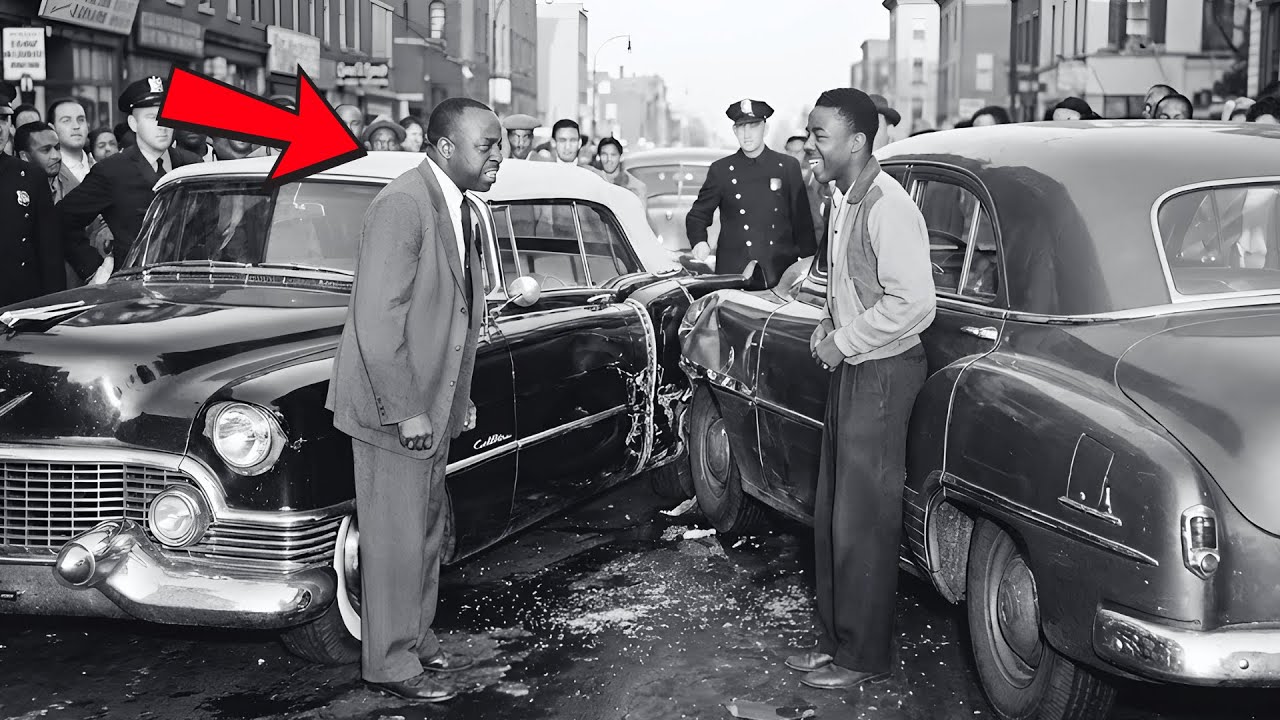
He steadied himself, checked his ribs—sore but intact—and turned to the man beside him. “You good? ”
Illinois Gordon rubbed his neck. “Yeah, I’m good.
”
Bumpy opened the door and stepped out onto the asphalt. Behind his Cadillac sat a red Corvette, brand new and expensive, its front end crumpled, steam rising from the hood. The driver’s door swung open, and a young man stumbled out. Maybe twenty-three, maybe twenty-four.
White shirt unbuttoned at the collar. Dark slacks. Leather shoes. He took two steps, wobbled, caught himself against the car door.
Drunk. Obviously drunk. The young man looked at the wreckage, looked at Bumpy, and started laughing. Not nervous laughter, not embarrassed laughter—genuine amusement, like this was the funniest thing he’d seen all week.
Bumpy approached, slow and calm, hands visible at his sides. “You all right, son? ”
The kid wiped tears from his eyes, still laughing. “Oh, man.
Oh, man. My dad’s going to be pissed. ” He kicked the Corvette’s tire. “But whatever, he’ll pay for it.
He always does. ”
Bumpy stopped three feet away and studied the young man’s face. Glassy eyes, pupils dilated beyond what alcohol alone could cause. Slurred speech.
The smell coming off him wasn’t just liquor—something chemical, something pharmaceutical mixed with bourbon. “You’re drunk,” Bumpy said. “You shouldn’t be driving. ”
The kid’s face changed.
The laughter died. His expression turned cold, arrogant, entitled. “You know who my father is? No, Anthony Straw.
” The kid said it like he was announcing royalty. “You know what that means? ”
Bumpy said nothing. “It means my dad will bury you if you make a big deal out of this.
” The kid stepped closer, swaying slightly. “So here’s what’s going to happen. I’m leaving. You’re fixing your own car, and we’re going to forget this happened.
”
He turned, walked back to the Corvette, dropped into the driver’s seat, and turned the key. The engine coughed, sputtered, died. He tried again. Same result.
The impact had damaged something critical. Coolant leaked onto the street, forming a dark puddle. The kid got out and kicked the door hard enough to dent it. “This is your fault.
You were in my way. ”
Illinois had gotten out of the Cadillac now, standing beside Bumpy. His hand moved toward his jacket. Bumpy shook his head once.
Illinois stopped. “You need to take responsibility for this,” Bumpy said. The kid laughed again. “Responsibility for what?
A fender bender? Please. ” He waved his hand dismissively. “My dad will handle it.
He handles everything. ”
Then he walked away. Just walked away. Left his car sitting in the middle of the street, left Bumpy standing there with a destroyed Cadillac.
Didn’t apologize. Didn’t exchange information. Didn’t even look back. Just entitlement, just arrogance, just the absolute certainty that his father’s name protected him from consequences.
Bumpy watched him disappear around the corner onto 126th Street, stumbling slightly, still laughing. Illinois came up beside him. “Say the word, boss. I’ll handle it.
”
“No. ”
“His daddy’s Anthony Straw. He’s Genovese’s captain, connected. But we can still—”
“No,” Bumpy said again, quieter this time.
“Not yet. ”
But Bumpy was looking at the Corvette now. Really looking. And he saw things that Illinois didn’t.
Old scratches along the passenger side, poorly repainted. A dent in the front quarter panel that didn’t match tonight’s crash. Scuff marks on the hood that looked like impact patterns. This wasn’t the first accident.
Not even close. Bumpy walked around the Corvette, examining it with the careful attention of someone reading evidence. The driver’s side mirror was cracked—recently replaced, but already damaged again. The front bumper had scrape marks underneath the fresh damage.
The wheel wells showed impact signatures from multiple incidents. This car had been in collisions before, multiple collisions, and someone had been covering them up. Illinois watched him circle the vehicle. “What are you thinking?
”
Bumpy crouched down and looked at the front bumper more closely. There, caught in a seam between metal panels, was something dark, something organic. He touched it with his finger and brought it close. Blood.
Old blood. Dried brown, but unmistakably blood. “I’m thinking,” Bumpy said slowly, “that boy has been getting away with things for too long. ” He stood up and looked down the street where Michael Straw had vanished.
“I’m thinking someone needs to teach him what consequences look like. ”
Illinois lit another cigarette. “Want me to make some calls? Find out about this kid?
”
“Yes. But quietly. I want to know everything. How many accidents.
How many times his father has paid people off. How many times this has happened before. ” Bumpy looked at the blood on his finger and wiped it on his handkerchief. “And then we make sure it never happens again.
”
They drove the damaged Cadillac back to Bumpy’s place, the trunk rattling with every bump. Illinois kept asking what the plan was. Bumpy kept saying nothing, because he didn’t have a plan yet. He had a feeling.
A feeling that this wasn’t random. A feeling that Michael Straw’s arrogance came from somewhere deep—from years of being protected, from a father who loved his son enough to destroy him. That night, Bumpy couldn’t sleep. He sat in his study, lights off, looking out the window at Harlem’s dark streets.
The sight of that kid walking away. Laughing. The old damage on the Corvette. The blood in the bumper seam.
The chemical smell mixed with alcohol. The dead look in Michael’s eyes when he’d threatened Bumpy, like consequences were a foreign language he’d never learned to speak. At two in the morning, Bumpy’s mind went somewhere else. Somewhere old.
Somewhere painful. 1945. Sixteen years ago. His mother walking home from the market on a Tuesday afternoon.
A car running a red light, speeding through the intersection at 145th Street. The impact threw her fifteen feet, broke her hip, fractured her skull, shattered her left arm. The driver never stopped, never came forward, never faced any consequences. His mother survived, but she was never the same.
Walked with a cane for the rest of her life. Had headaches that lasted for days. Lost the ability to work, to be independent, to live without pain. Bumpy had been twenty-eight years old then, already deep in the life, already connected, already feared.
He’d used every resource he had to find the driver. Spent months investigating, followed every lead, and came up empty—because the driver had money, had connections, had a father who made the problem disappear. Just like Michael Straw. Just like tonight.
Bumpy looked at his reflection in the dark window. “Not this time,” he said to himself. “This time, someone pays. ”
At three in the morning, he picked up the phone and dialed a number from memory.
Five rings, then a groggy voice. “Yeah? ”
“Raymond, it’s Bumpy. ”
Silence.
Then: “Boss, it’s three in the morning. ”
“I know. I need information about a car. Red Corvette, license plate—” Bumpy closed his eyes, pulled the number from memory.
He’d memorized it while circling the vehicle. “New York plates. Charlie Delta 7492. Owner is Michael Straw, son of Anthony Straw.
”
Raymond worked at a body shop in the Bronx and had connections to every repair place in the city. If a car got fixed, Raymond could find out about it. “What do you need to know? ”
“Everything.
How many times it’s been in for repairs. What kind of damage. When. How much it cost.
Who paid. I want every detail. ”
Raymond was quiet for a moment. “This about tonight?
”
“This is about making sure tonight never happens again. ”
“Give me until morning. ”
“You have three hours. ”
Bumpy hung up and made another call—to Clara Washington, a nurse at Harlem Hospital.
She’d worked in the emergency room for twelve years and had access to patient records, admission logs, incident reports. She owed Bumpy a favor from when he’d helped her sister avoid eviction two years back. “Clara, I need you to look for something in your records. ”
“Bumpy, do you know what time it is?
”
“I do. This is important. I need you to search for hit-and-run victims over the past two years. Specifically, anyone brought in with injuries consistent with being struck by a vehicle.
Focus on dates, locations, and vehicle descriptions if available. ”
Clara was silent. Then: “How far back? ”
“Two years, maybe three to be safe.
”
“That could be dozens of cases. ”
“I’m looking for patterns. Unsolved cases. Victims who didn’t have resources to follow up.
People who couldn’t afford lawyers or private investigators. ”
Clara understood immediately. “People like us. ”
“Exactly.
”
“What are you looking for, Bumpy? ”
“Justice that someone else should have delivered a long time ago. ”
He hung up, sat back in his chair, and closed his eyes. The pieces were moving now.
The investigation had begun. And Bumpy Johnson knew something that Michael Straw and Anthony Straw didn’t know yet: when Bumpy decided to solve a problem, he didn’t just solve it. He made sure it never happened again. At six in the morning, Raymond called back.
“Boss, you sitting down? ”
“Talk. ”
“That Corvette. It’s been in the shop five times in the past two years.
And I mean five separate incidents, not maintenance. Collision repair. ”
Bumpy leaned forward. “Tell me about them.
”
“First time: April 1959. Front end damage. Headlight smashed. Bumper destroyed.
Hood dented. Work order says rush job, paid cash, no insurance claim. Cost was $3,200. ”
“Go on.
”
“Second time: October 1959. Passenger side damage. Mirror torn off. Door dented.
Window shattered. Same deal. Rush job, cash payment, no insurance. $2,800.
”
“Third: March 1960. Front end again. More severe this time. Radiator damaged.
Engine mounts shifted from impact. Windshield cracked. They had to replace the entire front clip. $5,400.
Still cash. Still no insurance claim. ”
Bumpy did the math in his head. Over eleven thousand dollars in repairs, all cash, all hidden from insurance companies, which meant hidden from police reports.
“Fourth and fifth: September 1960 and February 1961. Both front end collisions, both serious enough to require frame straightening. Both paid in cash by the same man every time. ”
“Who?
”
“Guy named Vincent Straw. Anthony’s brother. He’s the one who brings the car in, pays cash, tells us to work fast and keep quiet. ”
Bumpy closed his eyes.
Five accidents in two years. All covered up. All hidden. All erased from official records.
“Raymond, the damage you described—front end collisions. That’s severe. What would cause that? ”
Raymond was quiet for a moment.
“Boss, I’ve been fixing cars for twenty years. That kind of damage comes from hitting something solid. Something that doesn’t move much when you hit it. ”
“Like what?
”
“Like a person. ”
The words hung in the air. “And the last two times,” Raymond continued, his voice lower now, “when Vincent brought the car in, there was something else. Something I didn’t mention in the work orders because Vincent paid me extra to forget about it.
”
“What? ”
“Blood on the hood, on the bumper, inside the wheel well. Not a lot, but enough. Fresh blood—the kind that’s still wet when the car arrives.
”
Bumpy felt something cold settle in his chest. “When did Vincent bring the car in? ”
“The last two times, around four in the morning. Said his nephew had hit a deer.
But boss, we both know there aren’t any deer in Manhattan. ”
“No,” Bumpy said quietly. “There aren’t. ”
“What do you want me to do?
”
“Get me copies of every work order, every receipt, every piece of paper associated with that Corvette. And Raymond, don’t tell anyone about this conversation. ”
“You got it, boss. ”
Bumpy hung up and sat in the silence of his study as dawn light began filtering through the windows.
Five accidents. Two with blood on the car. Two at four in the morning. All covered up by Anthony Straw’s brother.
All hidden from police, from insurance companies, from anyone who might ask questions. Michael Straw hadn’t just hit Bumpy’s car last night. He’d been hitting people for two years and getting away with it. The phone rang again.
Clara. “Bumpy, I found something. Actually, I found five somethings. ”
“Tell me.
”
“Five hit-and-run cases over the past two years. All unsolved. All victims brought to emergency rooms with severe injuries from vehicle strikes. All cases where police investigated but never found the driver.
”
“Dates. ”
Clara read them off: April 14th, 1959. October 23rd, 1959. March 15th, 1960.
September 8th, 1960. February 19th, 1961. Bumpy pulled out Raymond’s notes and compared dates. The hit-and-runs occurred within three days of when the Corvette came in for repairs.
Every single one. “Clara, I need everything you have on those five cases. Names, addresses, injuries, hospital bills, everything. ”
“Bumpy, this is going to take time.
”
“I’ll wait. ”
Sunday morning, Clara called him at home. “I have it all. You want me to bring it over?
”
“Please. ”
She arrived at noon with a folder three inches thick. Bumpy spread the documents across his dining room table. Five victims.
Five lives destroyed. Five families left with medical bills they couldn’t pay and no one to hold accountable. Case one: James Cooper, forty-one, a construction worker hit crossing Amsterdam Avenue on April 14th, 1959. Broken ribs, punctured lung, severe lacerations.
Six days in the hospital. Medical bills totaling $9,000. Lost his job because he couldn’t work for three months. Had to sell his car to pay part of the hospital bill.
Still owed $4,200. Case two: Linda Washington, twenty-eight, a school teacher hit while walking to her car on October 23rd, 1959. Fractured pelvis, internal bleeding, traumatic head injury. Emergency surgery.
Twelve days hospitalized. Bills totaling $12,000. Her teaching salary was barely enough to cover rent. The hospital put a lien on her wages.
She was still paying fifty dollars a month—and would be for the next eight years. Case three: Rita Morales, thirty-four, mother of three, hit on March 15th, 1960—the date that matched the worst damage to the Corvette. Broken femur, shattered kneecap, severe tissue damage. Three surgeries to save her leg.
Six weeks unable to walk. Twelve weeks unable to work. Hospital bills totaling $18,000. Her family lost their apartment and moved in with relatives in a one-bedroom place in the Bronx.
Rita walked with a permanent limp now, still had chronic pain, still couldn’t work full-time. Bumpy read Rita’s file twice. Looked at the photos from the emergency room—her leg bent at an angle that shouldn’t exist, her face twisted in agony, her children crying in the waiting room because they thought their mother was going to die. His hands started shaking.
He moved to case four. Tommy Martinez, sixteen years old, hit on September 8th, 1960, crossing 138th Street on his way home from basketball practice. Spinal cord injury. Fractured vertebrae.
Nerve damage. The impact had been so severe that Tommy would never walk again—confined to a wheelchair for life. Medical bills totaling $7,000 for initial treatment, but ongoing care would cost thousands more every year. His parents worked three jobs between them just to afford the wheelchair, the modifications to their apartment, the physical therapy that insurance wouldn’t cover.
Sixteen years old. His whole life ahead of him. And now nothing but a wheelchair, and pain, and limitations. Bumpy closed the file, stood up, walked to the window.
He needed a moment, needed to breathe. But there was still one more case. Kevin Patterson, fifty-two, a janitor, hit on February 19th, 1961, just five months ago. Broken arm, severe concussion, facial fractures.
Four days hospitalized. Bills totaling $4,000. Kevin’s insurance covered $2,000. He’d been making payments on the rest, but it was crushing him.
His wife had to take a second job. Their teenage daughter had to drop out of high school to work and help with bills. Five victims. Five families.
Fifty thousand dollars in medical bills—not counting lost wages, ongoing treatment, permanent disabilities. And the driver had never been caught, never faced any consequences, because his father had money and connections and made problems disappear. Illinois arrived that afternoon. Bumpy showed him the files.
Illinois read through them, his jaw getting tighter with each page. When he finished, he looked at Bumpy. “This kid needs to disappear permanently. ”
“No.
”
“Boss. He put a sixteen-year-old in a wheelchair. He destroyed five families. He’s been doing this for two years, and his daddy keeps covering it up.
We make him disappear. Problem solved. ”
Bumpy shook his head. “That’s not justice.
That’s just revenge. ”
“What’s the difference? ”
“Justice teaches. Revenge just satisfies.
I want Michael Straw to learn. I want Anthony Straw to understand what he’s done by protecting his son. I want both of them to face what they’ve created. ”
Illinois sat back.
“So what’s the play? ”
“We don’t kill what Michael trusts most. We kill it. ”
“I don’t follow.
”
Bumpy picked up Rita Morales’s file and held it up. “Michael Straw thinks his father’s money and power will always protect him. That’s what he trusts. That’s what makes him untouchable.
We’re going to prove that some things can’t be bought. Some consequences can’t be erased. We’re going to take away the protection and force him to face what he’s done. ”
“How?
”
Bumpy stood up, walked to his desk, and pulled out a ledger. “I’m going to pay every single one of those medical bills. All $50,000. I’m going to make those families whole.
And then I’m going to present Anthony Straw with a bill for exactly $50,000, along with proof that his son has been leaving broken bodies across Harlem for two years. ”
Illinois whistled low. “That’s a lot of money, boss. ”
“It’s not about the money.
It’s about making sure Anthony Straw understands that his son is a monster—and he created him. And if Anthony refuses to pay, then every piece of evidence goes to the police, the newspapers, the FBI, everyone. And Michael Straw spends the next twenty years in prison while his father watches, knowing he could have stopped this years ago. ”
Illinois nodded slowly.
“When do we start? ”
“Tomorrow morning. I want you to gather eight of our best people. We have a lot of work to do.
”
Monday, July 10th, seven in the morning. Bumpy’s office. Eight men and women sat around the table—people Bumpy trusted with his life, people who understood that this wasn’t business, this was personal, this was about something bigger than territory or profit or power. Bumpy laid out the plan.
Seven steps, each one precise, each one necessary. “Step one,” he said, placing Rita Morales’s file on the table. “We pay the medical bills. All of them.
$50,000 total. We approach each victim, explain what we’re doing, and pay their debts directly to the hospitals. We get receipts for everything. ”
Marcus, one of his financial people, asked, “Why tell them who’s paying?
Why not just make the debts disappear? ”
“Because they deserve to know someone cares. They deserve to know this wasn’t random. They deserve to know someone is holding the person responsible accountable.
”
“Step two: we document everything. Photos, receipts, medical records, police reports. We build a file that proves beyond any doubt what happened to these five people and when it happened. ”
“Step three: we hire a private investigator.
Someone good, someone discreet. For the next week, that investigator follows Michael Straw everywhere, takes photos of him drinking, driving drunk, being reckless. We prove he hasn’t stopped. We prove he’s still dangerous.
”
Sarah, who ran one of Bumpy’s legitimate businesses, raised her hand. “What if he doesn’t drive drunk this week? ”
Bumpy smiled grimly. “He will.
Men like Michael Straw don’t change unless someone forces them to. He’ll drive drunk because he always has, and he’s never faced consequences. ”
“Step four: we acquire the police reports from all five hit-and-runs. I know a detective who owes me a favor.
Those reports were buried, but they still exist. We find them, copy them, add them to our evidence. ”
“Step five: we get written statements from each victim. Their testimony about what happened, how it affected their lives, what they lost.
Signed and dated. ”
“Step six: we compile everything into one package. Five folders, one for each victim. Medical records, photos, police reports, witness statements, hospital bills, payment receipts.
Everything Anthony Straw needs to understand what his son has done. ”
“Step seven. ” Bumpy paused and looked at each person around the table. “We deliver the package to Anthony Straw with a simple message: pay $50,000 or watch your son go to prison.
”
Illinois spoke up. “And if he comes after us instead? ”
“He won’t. Because we make it clear that if anything happens to any of us, copies of everything go to the authorities immediately.
We’re not trying to destroy Anthony Straw. We’re trying to save his son by forcing accountability. ”
The room was quiet. Then Marcus said, “When do we start?
”
“Right now,” Bumpy replied. “We have one week to build this case. Let’s move. ”
Over the next three days, Bumpy personally visited each victim.
He brought Illinois with him, but he did the talking. First stop: James Cooper’s apartment in the Bronx. Bumpy knocked. James answered, saw two well-dressed Black men at his door, and his expression went cautious.
“Mr. Cooper, my name is Bumpy Johnson. I’m here about what happened to you on April 14th, 1959. ”
James’s face changed.
“The hit-and-run. Did they find who did it? ”
“Yes. And I’m here to make it right.
”
They sat in James’s small living room. Bumpy explained everything—the investigation, the evidence, the pattern of accidents, Michael Straw’s name, Anthony Straw’s cover-up. James listened, his hands clenched. When Bumpy finished, James said, “Why are you telling me this?
”
“Because you deserve to know. And because I’m going to pay your hospital bills. All of them. The $9,000 you still owe.
”
James stared. “Why would you do that? ”
“Because someone should have done it two years ago. And because I’m going to make sure the person responsible pays me back.
”
Bumpy handed James a check made out to Harlem Hospital for $9,000. “Take this to the billing department. Clear your debt. Get a receipt.
I’ll need a copy. ”
James took the check with shaking hands. “I don’t understand. ”
“You don’t need to.
Just know that justice is coming. Slowly, but it’s coming. ”
The same conversation happened with Linda Washington, with Rita Morales, with Tommy Martinez’s parents, with Kevin Patterson. Each time: shock, disbelief, tears, gratitude, and then questions.
Rita Morales asked the question that mattered most. “Why didn’t the police do this? Why didn’t anyone help us before? ”
Bumpy answered honestly.
“Because the man who hit you has a powerful father. A father who made your case disappear. But some things can’t stay disappeared forever. ”
By Wednesday evening, all five medical bills were paid.
Bumpy had receipts for $50,000 in payments. The victims had given written statements. The files were growing. Thursday morning, the private investigator Bumpy hired—a man named Frank who specialized in surveillance—delivered his first report.
Photos of Michael Straw leaving a nightclub at two in the morning, stumbling to his new car: a black Thunderbird that Daddy had bought to replace the wrecked Corvette. Photos of Michael driving erratically down Park Avenue. Photos of him nearly hitting a pedestrian at a crosswalk. “He’s going to hurt someone else,” Frank said.
“Not if we stop him first,” Bumpy replied. Friday. The detective came through with copies of the original police reports. All five hit-and-runs, filed and then buried.
Investigation closed due to lack of evidence. But the reports showed witness descriptions of vehicles. Three mentioned a red sports car. One mentioned a Corvette specifically.
Saturday afternoon, Bumpy compiled everything into the package. Five folders, each labeled with a victim’s name. Inside each folder: hospital admission records, emergency room photos, surgical reports, bills, payment receipts, police reports, witness statements, surveillance photos of Michael Straw, and repair shop records showing the Corvette came in for front-end damage within three days of each incident. The final folder contained a cover letter typed on plain paper.
No signature necessary—Anthony Straw would know exactly who sent it. “Mr. Straw: your son has been driving drunk for two years. He has struck five people, injured them severely, and fled the scene each time.
One victim is now paralyzed for life. He was sixteen years old. You covered up these incidents. You used your money and influence to make them disappear.
You protected your son from consequences. In doing so, you created a monster who believes he is untouchable. I have paid the medical bills your son should have paid two years ago. $50,000 given directly to the victims your son destroyed.
You owe me $50,000. Not for me. For them. For Rita Morales, who walks with a limp and lost her home.
For Tommy Martinez, who will never walk again. For the other three people whose lives your son shattered. You have seven days to deliver payment. If you do not, every document in these folders goes to the police, to the district attorney, to the newspapers, to the FBI.
Your son will face every charge he should have faced years ago. And you will face the consequences of enabling him. This is not revenge. This is accountability.
The lesson you should have taught your son before he hurt anyone. The choice is yours. ”
Sunday morning, Bumpy had the package delivered to Anthony Straw’s home in Staten Island. A courier service, untraceable.
Signature required. Anthony Straw himself signed for it at three in the afternoon. Bumpy sat in his office waiting, knowing that at that exact moment, Anthony Straw was opening the package, reading the files, seeing the photos, understanding perhaps for the first time what his son had done. Illinois sat across from him.
“You think he’ll pay? ”
“He’ll pay. Because the alternative is losing his son forever. ”
“And if he comes after you?
”
Bumpy opened his desk drawer and pulled out an envelope. “This contains copies of everything. If I don’t call my attorney every day at noon, he opens this envelope and delivers it to the authorities. Anthony knows how this works.
He’s smart enough to understand the only way forward is to pay. ”
Illinois nodded. “So we wait. ”
“We wait.
”
But what Bumpy didn’t know yet—what he couldn’t have anticipated—was that at that exact moment, someone in Anthony Straw’s household was making a phone call. Someone who had seen the package arrive. Someone who had watched Anthony’s face go pale as he read the contents. Someone who understood that Bumpy Johnson had just declared war.
And when Anthony Straw learned that Bumpy had already started paying the victims, that Bumpy had already set everything in motion, that the first payment had already been made and witnesses had already been contacted—his response would be something Bumpy hadn’t planned for. Something that would turn this careful, calculated plan into something far more dangerous. The next day, Anthony called. “Mr.
Johnson. This is Anthony Straw. I think we should meet. ”
“We should.
”
“My office downtown. Four o’clock. ”
“No. You come to my place.
You’re the one asking, not demanding. ”
Silence. “Freddy’s bar, 132nd and Lennox. Seven tonight.
Come alone. ”
“I don’t go anywhere alone. ”
“You do. If you want to talk to me, bring bodyguards and I’ll know you’re not serious.
”
Anthony hung up without answering. Illinois shook his head. “He won’t come alone. ”
“We’ll see.
”
At 7:15, a black Lincoln pulled up outside Freddy’s. The driver stayed in the car. Anthony Straw got out alone. He walked in, spotted Bumpy, and sat down across from him.
“You came alone,” Bumpy observed. “You said to. Let’s talk. How much money do you need to forget about my son?
”
“I don’t want your money. ”
“Everyone wants money. Name your price. ”
“I already did.
$50,000. What I spent paying your son’s victims. ”
“You paid their bills. Why?
”
“Because someone needed to. Because your son destroyed five lives and you covered it up. ”
Anthony’s jaw tightened. “You don’t know anything about my son.
”
“I know he’s been driving drunk for two years. I know he hit five people and fled every time. I know you created a monster and called it love. ”
“Watch your mouth.
”
“Or what? I’ve already made arrangements. Anything happens to me, everything goes to the police, the FBI, the newspapers. Your son spends twenty years in prison.
”
Anthony pulled out a checkbook, wrote quickly, and threw the check on the table. “$100,000. Take it and walk away. ”
Bumpy picked up the check, tore it in half, tore it again, and let the pieces fall like confetti.
“You still don’t understand. I don’t want your money to go away. I want your money to make things right. I want you to understand your son isn’t a kid who made mistakes.
He’s a danger. And you enabled it. ”
Anthony stood, face red. “You’re making a mistake.
”
“No. You made the mistake two years ago when you covered up the first accident. You taught your son actions don’t have consequences. That money fixes everything.
I protected my son. ”
“You destroyed him. You turned him into someone who thinks human life doesn’t matter. Someone who can paralyze a sixteen-year-old and sleep fine.
”
Anthony leaned on the table, inches from Bumpy’s face. “I will handle this my way. ”
“No. My way.
Because I have all the evidence. I have everything to bury your son, and you can’t stop me. ”
“We’ll see. ”
Anthony walked out.
The Lincoln pulled away, tires screeching. Illinois came over. “That went well. ”
“He’s scared.
”
“Good. ”
Over the next days, Bumpy completed the package. Five folders thick with documentation: hospital records, police reports, witness statements, repair receipts. Forty-seven pieces of evidence.
Over two hundred pages. But he added a sixth folder. Surveillance photos from the past week. Michael stumbling from nightclubs, getting into his Thunderbird drunk, driving erratically, nearly hitting pedestrians.
Proof he hadn’t stopped. Thursday night, Bumpy wrote a letter by hand. “Anthony: your son is not a kid who made mistakes. He is a man who has been hurting people for years without consequences.
You did this. Every time you paid to make problems disappear, you taught him human life has no value. Every time you protected him from accountability, you taught him power means never caring about damage caused. You thought you were being a good father, but you were destroying him, turning him into a monster who believes he is above everything.
I paid the debts he should have paid. $50,000 to five people whose lives he shattered. You owe me that money. Not because I want it, but because paying it is the first step toward understanding.
You have seven days. If you don’t pay, every piece of evidence goes to the district attorney, the police commissioner, the FBI, and every newspaper in New York. Your son will face five counts of hit-and-run, leaving accident scenes, driving while intoxicated, reckless endangerment. He will go to prison.
And you will know you could have stopped this years ago. This is not revenge. This is accountability. The lesson you should have taught.
The love you should have shown. Pay the debt. Make your son face what he’s done. Or lose him forever.
The choice is yours. ”
He sealed it with the six folders, then made a complete copy of everything, put it in a separate package with a note for the district attorney’s office to be opened if Bumpy didn’t call by midnight July 18th, and had it delivered to his attorney. Insurance. Friday afternoon, the main package was delivered to Anthony’s house.
Anthony signed for it at three o’clock. The call came at eight that night. “Yes. ”
Anthony’s voice shook.
“The sixth folder. The surveillance photos. Those are from this week. ”
“Yes.
”
Silence. “He hasn’t stopped. ”
“No. Because you never taught him to.
”
“I’m calling Michael home now. ”
Anthony hung up. Later, Bumpy learned what happened from a maid in the Straw household. Anthony threw the folders at Michael.
Papers scattered everywhere. “Tell me this isn’t real. ”
Michael picked up pages, face going pale. “Dad, I can explain.
”
“Explain what? That you hit five people, left them bleeding? You never told me. ”
“I told you about the accidents.
You said those were fender benders. ”
“Because that’s what you told me! Not that you hit people! ”
Michael sat down, arrogance cracking.
“I thought if I didn’t tell you details, it would go away. Nobody came after me. ”
“Because I made you safe. I paid people off.
But Bumpy Johnson dug it back up. Paid $50,000 to make this a problem I can’t ignore. ”
“So what, we don’t pay him? ”
Anthony hit him—an open-handed slap across the face.
The first time ever. Michael touched his face, shocked. “He can send this to the police, the newspapers, the FBI. You’ll go to prison for twenty years.
I cannot protect you. Not with this evidence. ”
Michael started crying. Real tears.
“I’m scared. Dad, I don’t know how to stop. ”
Anthony sat beside him, head in his hands. “I did this.
I thought protecting you was love. But I just taught you that you could hurt people without caring. ”
“What do we do? ”
“We pay him.
And you apologize to every person you hurt. Face to face. ”
“I can’t. ”
“You will.
Or I’m done protecting you. You go to prison and I don’t stop it. ”
Michael saw something new in his father’s eyes. Finality.
“Okay. I’ll do it. ”
Anthony called Bumpy. “Mr.
Johnson. I’ll pay the $50,000. I’ll write the check tonight. ”
“Good.
”
“But I need a favor. My son needs to learn what I failed to teach him. Will you help? Will you teach him what I couldn’t?
”
Bumpy was quiet. “I’m not a teacher, Anthony. ”
“You are. You taught me more in one week than I learned in forty-eight years.
My son needs that. ”
“What are you asking? ”
“Make him see what he did. Make him face the victims.
”
“I don’t want money for that. But yes. On one condition: he does it alone. You don’t go with him.
”
Silence. “Agreed. ”
Monday morning, St. Augustine’s Church on 142nd Street.
Nine in the morning. The church was empty except for Bumpy and Illinois. At nine, Anthony walked in alone, carrying an envelope. He sat beside Bumpy and handed it to him.
Inside was a check for $50,000—and another for $25,000. “The first is what I owe. The second is a fee for teaching my son. ”
Bumpy took the $50,000 and handed back the $25,000.
“I don’t take money to teach lessons. But I’ll make sure your son understands. ”
Anthony looked at the returned check. “Why give me a chance to make it right?
”
“Because destroying your son doesn’t help the people he hurt. Making him better does. ”
“How? ”
“He visits each victim personally.
Alone. Looks them in the eye. Hears what his actions cost. Sees Rita’s limp.
Sits across from Tommy and understands paralysis is forever. Faces truth with no protection. And if he refuses, the package goes to the authorities. He goes to prison.
”
Anthony nodded. “When does he start? ”
“Tomorrow. I’ll send Rita Morales’s address.
He goes alone. Apologizes. Listens. No excuses.
”
“He’ll do it. ”
Anthony stood and looked at the altar. “I spent twenty-three years thinking I was a good father. Turns out I was just a coward, too scared to let my son feel pain.
”
“You can still teach him. Starting now. ”
Anthony walked to the door and paused. “Mr.
Johnson, thank you for saving my son when I couldn’t. ”
Then he was gone. Illinois waited. “You really think this kid will change?
Tomorrow, when he knocks on Rita’s door and has to look her in the eye, something’s going to break inside him? ”
“Maybe arrogance. Maybe denial. Maybe the armor his father built.
”
“And if nothing breaks? ”
“Then he goes to prison. ”
But what Bumpy didn’t know was that when Michael Straw knocked on that first door, when Rita Morales opened it and saw the young man who destroyed her life standing there, what happened next would change everything. Tuesday morning, July 12th.
Michael Straw stood outside Rita Morales’s apartment building, hands shaking. Twenty minutes passed before he could move. Finally, he climbed the stairs to the second floor, apartment 2C. He knocked.
Rita opened the door. Her face went hard. She knew who he was. “Mrs.
Morales, my name is Michael Straw. I’m the one who hit you. I’m here to apologize. ”
Rita didn’t invite him in.
Just stood there, arms crossed. Michael’s voice broke. “I was drunk. I hit you and drove away.
I left you there. I never looked back. My father made it disappear, and I let him. ”
He dropped to his knees in the hallway.
“I’m sorry. I destroyed your life and I never faced it. ”
Tears ran down his face. Real tears.
Just grief and shame. Rita looked down at him. “Stand up. ”
Michael stood, wiping his eyes.
“You’re young,” Rita said quietly. “You made terrible choices. You hurt me badly. But I won’t give you my hatred.
That would just make you win again. ”
“I don’t deserve your forgiveness. ”
“No. You don’t.
But you deserve a chance to be better. Don’t let this guilt kill you. Let it teach you. Let it change you.
Live better. That’s the only apology that matters. ”
Michael nodded. Couldn’t speak.
Rita closed the door. The visits continued. James Cooper just stared, then closed the door without a word. Linda Washington asked one question.
“Did you even think about me when you drove away? ”
Michael shook his head. “No. I only thought about myself.
”
She closed the door. Tommy Martinez broke him completely. Sixteen years old in a wheelchair. Michael saw him and started sobbing.
“I did this to you. I took your legs. I’m so sorry. ”
Tommy watched him cry with no expression.
Then he wheeled closer. “You took my legs. But I won’t let you take my soul. I won’t let hatred for you poison my life.
”
“How can you not hate me? ”
“Because hating you doesn’t give me my legs back. It just makes me carry you in my heart forever. And I won’t do that.
”
Tommy paused. “You can’t do anything for me. But you can do something for the next person. Don’t hurt anyone else.
Learn. Change. Be someone different. ”
Michael left understanding that consequences weren’t just punishment.
They were transformation. Seven years later, in January 1968, Bumpy Johnson died of a heart attack. The funeral filled St. Augustine’s Church with hundreds of mourners.
In the back sat Michael Straw—now thirty, sober for seven years, married, working as a counselor for troubled youth. He wore a white flower on his lapel. After the service, he approached Bumpy’s widow. “Mrs.
Johnson, I wanted to thank your husband. He made me face what I’d done. I was terrible, and he made me better. I owe him everything.
”
She smiled through tears. “He believed people could change if forced to see the truth. ”
Anthony Straw appeared behind Michael, much older now, gray-haired. “Bumpy Johnson taught me the most expensive lesson.
That loving you meant teaching you to face consequences, not protecting you from them. I failed you for twenty-three years. He fixed you in one week. ”
“Dad, I thought protecting you was love.
But it was cowardice. I almost destroyed you. Bumpy saved us both. ”
Michael became known in Harlem as the counselor who never gave up on kids.
He told his story honestly to teenagers struggling with addiction and entitlement. “I thought I was untouchable,” he’d tell them. “But I was just a coward. Bumpy Johnson saved my life by making me see the truth.
”
When Rita Morales died in 1986 at seventy-two, Michael paid for her funeral. He spoke at the service. “She could have destroyed me with hatred. Instead, she gave me permission to be better.
That was a gift I didn’t deserve, but tried to honor every day. ”
On Bumpy Johnson’s gravestone at Woodlawn Cemetery, Illinois Gordon added an inscription: “He didn’t punish the wicked. He taught them to be good. ”
That’s the legacy.
Not the $50,000. Not revenge. The lesson. The transformation.
This wasn’t about revenge. It was about how one man used power not to destroy, but to redeem. How he forced a broken young man to see his own humanity by confronting the humanity of others. $50,000 can’t buy a conscience.
But it can buy an opportunity—an opportunity to face truth, to change, to learn what it means to be human. Michael Straw learned that lesson on his knees before five families. He carried it every day. Every teenager he helped, every life he saved, proved that Bumpy’s justice worked.
Not because it punished, but because it taught. And sometimes the hardest lessons are the ones that save.