In late 1901 the Emperor of Russia summoned his uncle to Tsarskoye Selo. Nicholas II, a man who prized family above all but hated confrontation, was white with rage. His uncle, Grand Duke Paul Alexandrovich, stood before him and heard the verdict: he would never be permitted to marry Olga Karnovich. The tsar invoked his ancestors’ tyranny.
You are a Romanov, he said. You have a duty to your rank, to your children, to Russia. This is unthinkable. To which Paul could only reply that he loved her, that she carried his child.
It changed nothing. The tsar allowed that Paul might support her financially, but the affair must end at once. If Paul married her, he would lose his military rank, his income, and his right to live in Russia. He would be dead to the family.
The ultimatum was designed to crush the romance, and Nicholas gambled that a man raised in the corridors of the court, who had known nothing but imperial luxury, would never forfeit everything for a woman. The emperor was wrong. The woman at the center of the scandal was born in 1865 as Olga Valerianovna Karnovich, on the edge of the golden circle that ruled the Russian Empire. Her father was a respectable court chamberlain, her background noble but unremarkable.
She was not a grand duchess, not royalty, simply a well-bred girl expected to follow a script written for her centuries earlier: marry a suitable officer, produce heirs, host tea parties, and never cause a stir. But Olga had never been made for the chorus. From childhood she possessed a hunger that frightened her mother and intrigued the men who crossed her path. She lacked the porcelain-doll beauty of her age; her features were sharper, her gaze more intense.
She had intelligence that could cut like a blade and charm that could disarm a battalion. Petersburg in the late nineteenth century was a stage for cruelty disguised as civilization, frozen in a rigid hierarchy ruled by the Romanovs, who seemed less a family than a pantheon of living gods. In a society that preferred its women silent and decorative, Olga was alive, and she was sharp. At first she did what was expected.
She married General Erich von Pistolkors, a man of impeccable lineage and no imagination whatsoever, an adjutant to Grand Duke Vladimir, the tsar’s uncle. It placed Olga on the fringes of the imperial court. On paper the marriage was a success. She bore him three children, ran his household with efficiency, smiled at the right moments, and curtsied to the right people.
But inside the suffocating reception rooms of the Pistolkors palace, Olga was slowly asphyxiating. She felt like a leopard pacing a cage, watching dreary days turn into years, waiting for a break. The break came in the early 1890s, not with a bang but with a polite introduction at a winter dinner party. The man standing before her was tall and thin, with the saddest eyes she had ever seen.
He was Grand Duke Paul Alexandrovich, the youngest son of the Tsar-Liberator Alexander II, favorite uncle of the young Nicholas II. Paul was the tragic figure of the Romanov family. A few years earlier his beloved wife, Princess Alexandra of Greece, had died in childbirth, leaving him shattered and alone, raising two small children, Maria and Dmitri. He drifted through the glittering court like a sleepwalker, kind, gentle, and utterly lost.
When Olga looked at Paul, she did not see a grand duke bedecked with honors. She saw a man starving for affection. When Paul looked at Olga, he saw the vitality he had lost. The attraction was immediate and dangerous.
This was no passing court affair, the kind that was tolerated so long as it stayed discreet. It was something real. Olga gave Paul warmth, laughter, a place where he need not be a symbol of imperial dignity but could simply be a man. For Olga, Paul was the lifeline she had prayed for.
It went beyond ambition, though ambition was there. It was the recognition of a kindred soul, two lonely people trapped in a crowded room. The relationship began in shadow: long glances across crowded ballrooms, innocent letters carrying more than they wrote, chance meetings in the parks of Tsarskoye Selo. But in the hothouse atmosphere of Petersburg, privacy was a myth.
Servants talked, coachmen talked, and soon the whole city was whispering. Society ladies clutched their necklaces, enjoying the scandal but horrified by the breach of protocol. A grand duke could take a mistress, that was almost expected, but he was supposed to choose a ballerina or an actress, someone expendable. He was not supposed to fall in love with the wife of a fellow officer, a woman of his own social circle.
That was messy. That was vulgar. What made it far more dangerous was the reaction of the Romanov family itself. For them, family honor was a sacred idol demanding constant sacrifice.
The matriarch, the Dowager Empress Maria Feodorovna, was a woman of steel and ice who ruled the court. She saw Paul not as a mature man approaching forty but as her husband’s younger, foolish brother who needed protection from predatory women. In the court’s eyes, Olga was the villain, the scheming social climber seducing a grieving widower. They ignored the fact that Paul was as much the pursuer as the pursued.
They ignored that for the first time in years, the grand duke was actually smiling. All they saw was a threat to the existing order. The tension festered for years, a pot about to boil. Olga’s husband, General Pistolkors, chose studied blindness.
Challenging a grand duke to a duel would have been treason; divorcing his wife would have been a public insult. So he looked away, accepting the role of the cuckolded husband with fortitude, perhaps hoping the affair would burn itself out. It did not. It burned brighter.
Driven by love and perhaps a touch of arrogance, Olga began to take risks. She stopped walking three steps behind Paul. She hosted dinner parties where he was the guest of honor. She dressed in a manner that bordered on defiance.
The turning point came at a ball in the Winter Palace, a scene that belongs in a film but was hideously real. The Mirror Hall blazed with ten thousand candles; the air was heavy with the scent of lilies and the rustle of silk. The orchestra played a waltz. The Dowager Empress received her guests, surrounded by her ladies-in-waiting, a majestic formation of diamonds and displeasure.
Then Olga entered. She wore a diamond necklace, not an ordinary one but a magnificent piece given to her by Grand Duke Paul. The court had a long memory. Whispers began at once, spreading through the hall like a cold wind.
Those gems had belonged to Paul’s mother, the late Empress Maria Alexandrovna. They were crown jewels, sacred relics of the dynasty. And here was Olga Karnovich, wife of an ordinary general, wearing them around her throat as if she were a queen. It was a declaration of war, a public statement that she possessed both the grand duke’s heart and his inheritance.
The Dowager Empress froze, her cold blue eyes fixed on the diamonds around Olga’s neck. The music did not stop, but the room seemed to hold its breath. By wearing those diamonds, Olga had crossed the invisible line between a private affair and a public insult to the crown. The message was clear: you will pay for this.
The consequences were swift and cruel. Social invitations stopped arriving. People who had toasted champagne with her a week earlier now ignored her as if she were made of glass. General Pistolkors finally agreed to the divorce, cornered by the publicity of the scandal and the pressure of his superiors.
Under the rigid morality of Russia in 1901, a divorced woman was damaged goods; a divorced woman who had caused a royal scandal was an outcast. Then, in late 1901, the real crisis arrived: Olga was pregnant. It was the catastrophe the Romanovs had dreaded, an illegitimate child born of a grand duke and a divorced commoner. After the tsar’s ultimatum, Paul refused to obey.
In the late summer of 1902, Olga left Petersburg for Italy, in the final months of her pregnancy, an outcast. She went to Livorno, a quiet coastal town where the judgments of Russia felt distant. She waited. Then, defying the tsar, his family, and the weight of all Russian history, Grand Duke Paul joined her.
On October 10, 1902, in a small, modest Greek Orthodox church in Livorno, they were married. There were no crowds, no banners, no diamond crowns. The witnesses were complete strangers. The priest was hurried.
By Russian law it was a morganatic marriage, which meant Olga would never become a grand duchess and any children would have no right to the throne. But as they stood before the altar, Paul holding Olga’s hand, none of that mattered. They had committed treason at the heart of the empire. They had chosen happiness over duty.
When the telegram reached Petersburg, the explosion was enormous. Nicholas II felt a searing sense of personal betrayal by his favorite uncle. He wrote to his mother, pressing the pen so hard it nearly tore the paper: I fear a whole colony of the Russian Imperial family will be established in Paris with their entirely illegitimate wives. This sets a scandalous precedent.
The punishment was immediate and total. The tsar issued a decree stripping Grand Duke Paul of his rank in the Horse Guards. His vast estates were placed under judicial sequestration, freezing his assets. He was exiled from Russia indefinitely.
He was forbidden to see his two children from his first marriage, Grand Duchess Maria and Grand Duke Dmitri, who now became wards of the tsar. Paul lost his homeland, his career, his fortune, and his children. Olga gained the man she loved, but the price was staggering. She was now the wife of an exile, blamed for destroying one of the highest personages in the land.
They settled in Paris, the great sanctuary for the wreckage of European royal families, and built a life that was a glittering, defiant mirror image of the one they lost. If Russia did not want them, they would make Paris their court. They rented a magnificent mansion in Boulogne-sur-Seine, an aristocratic suburb quiet enough to be respectable and close enough to the Champs-Elysées to matter. Olga, with her exquisite taste and her need to prove herself, filled it with treasures: imported furniture, textiles, paintings.
They hired a staff that moved with silent, spectral efficiency. They created a world where the champagne was always chilled, the flowers always fresh, and the uncomfortable fact of their exile stopped at the front gate. This was the Belle Époque, the beautiful age before the world killed itself, and Olga became one of its queens. But a queen needed a title.
In the hierarchy of Europe, the name Madame Romanov was a mockery, a commoner’s name attached to a royal house. Since the tsar refused to grant her a noble title, Paul turned to his German relatives. The Prince Regent of Bavaria, a man who understood the chaotic complications of royal emotional lives, took pity on them. In 1904 he granted Olga the title Countess von Hohenfelsen.
It was Bavarian, not Russian, but it was a title. It had a crown, a coat of arms, and it allowed the butler to throw open the doors and announce the arrival of the Countess von Hohenfelsen with perfect dignity. It was a piece of paper under which she concealed the shame of her origins, and Olga wore it like armor. Their life in Paris was a whirlwind of parties, opera, and dinner parties.
They were the most talked-about couple among the émigré set, welcomed by the French aristocracy, who were less bound by the frozen protocols of the Russian court. Paul, once a grieving, lonely widower, flourished. He relaxed, he was happy, he was a father who actually saw his children. They had more children, after Vladimir, born in the chaos of their flight: Irina in 1903 and Natalia in 1905.
It was here, in the nurseries of Boulogne-sur-Seine, that the roots of Olga’s real tragedy took hold. If you were writing a script for a woman destined for grief, you would invent a son like Vladimir Paley. He was the golden boy, beautiful with dark eyes full of life like his mother and his father’s gentle manner. But he was more than a handsome aristocrat.
He was a prodigy. He spoke French, English, and German before he could properly tie his shoes. He played the piano with haunting sensitivity. He wrote poetry, not clumsy schoolboy rhymes but verses of astonishing maturity and melancholy.
He was a soul who seemed too fragile for the cruel century into which he was born. Olga worshipped him. He was the living proof of her love for Paul, the tangible validation of their scandalous union. Every time she looked at Vladimir, she saw the best of herself and the best of the Romanovs combined.
She poured her ambition into him. He would not be a mere count. He would be a great man. She did not know she was raising a martyr.
But even amid Paris’s luxury, there was a shadow in the corner. Paul’s two children from his first marriage remained in Russia, raised by their uncle Grand Duke Sergei and his wife Ella, a famously pious and cold couple. Paul was a father forbidden from fathering. He missed them with a physical ache.
Olga saw this pain in his eyes when he thought she was not watching, saw him staring at photographs of Dmitri and Maria, wondering if they still remembered him, wondering if they hated him for choosing that woman over them. It was a guilt that never slept. Olga tried to compensate by being the perfect mother to their three children, filling the house with laughter, but she knew half of Paul’s heart was hostage in Petersburg. In 1912, a crack appeared in the ice.
The tsar allowed Paul to visit Russia for the tercentenary celebrations of the Romanov dynasty. It was a test. Paul went alone, behaved perfectly, stood beside the tsar, looked every inch a grand duke, said all the right words. He returned to Paris with a glimmer of hope.
Nicky is changing, he told Olga. He looks tired. He needs us. Then came 1914, the year the world broke.
In that year, months before the cannons of August tore apart the silence of Europe, the miracle finally began to take shape. The tsar allowed Grand Duke Paul to return to Russia, restored his military rank and his property. A year later, he went further and formally recognized Olga. No longer merely the Bavarian Countess von Hohenfelsen, she was granted the title Her Serene Highness Princess Paley.
It was a name with a significant pedigree, an old Ukrainian Cossack name connected to Paul’s ancestors, legitimate and noble. It was a seal of approval. It was a homecoming. The family began to pack.
The excitement in the mansion in Boulogne-sur-Seine was electric. Vladimir, now seventeen, was ecstatic. He was going to Russia, the legendary homeland he knew only through his parents’ stories and the icons on the walls. He would join the Corps of Pages, the empire’s most prestigious military academy.
He would become a Russian prince. For Olga, this was the great vindication. She had defied the Romanov dynasty and forced them to retreat. She was returning to Petersburg not as an outcast mistress but as a princess, the wife of the tsar’s uncle.
They left Paris in May 1914. The train journey east was a triumphal procession. When they crossed the border into Russia, Paul wept. He knelt and kissed the ground.
Olga stood beside him, her hand on his shoulder, looking at the endless horizon of birch trees, flooded with a sense of deep peace. They were home. They moved into a new palace in Tsarskoye Selo, a magnificent classical building modeled on the Petit Trianon at Versailles, built especially for them, filled with the treasures they had brought from Paris. They planted a rose garden.
They planned balls. They reconnected with old friends who suddenly found it convenient to forget the scandal of 1902. Even the Dowager Empress, the woman who had once fixed Olga with icy stares, gave her a nod of recognition in public. It was not friendship, but it was a truce.
History, however, has a cruel sense of humor. Olga spent twelve years fighting to return to Russia, and she succeeded precisely at the moment when staying in Russia became a death sentence. In August 1914, news of Sarajevo turned into a thunderclap. War.
Germany declared war on Russia. The patriotic hysteria that swept through Petersburg, now renamed Petrograd to sound less German, was intoxicating. Crowds knelt before the Winter Palace singing God Save the Tsar. For the Paley family, war initially seemed another chance to prove their loyalty.
Grand Duke Paul, despite fragile health, begged for a military command. He was appointed to command the Guards Corps at the front, donning his old uniform and riding off to war, determined to erase the stain of exile through blood and service. Vladimir did what all the golden boys of Europe did that summer: he rushed to volunteer. He joined the Hussars, the most glamorous and reckless cavalry regiment in the army.
Olga watched him in his new uniform, tall, handsome, heartbreakingly young. He kissed her hand and promised to return before the snow fell. Don’t worry, Mama, he said. I’ll bring you the Kaiser’s helmet.
The war that was supposed to last six months stretched into a year, then two. Glory evaporated in the mud of Galicia and the forests of Poland. Telegrams arrived not with news of victories but with casualty lists. The brilliant uniforms turned gray with filth.
In the palaces, the atmosphere soured. The patriotism of 1914 curdled into the paranoia of 1916. The Empress Alexandra, desperate to save her hemophiliac son, fell under Rasputin’s influence. The court split into factions, poisoned with suspicion.
Olga, with her sharp instincts honed by years of living on the edge, smelled rot before anyone else. She saw how soldiers looked at officers now, not with respect but with a muffled hatred. She heard mutterings about bread shortages in the city. She read Vladimir’s letters from the front, which had lost their boyish enthusiasm and filled with a dark, weary wisdom.
He wrote of death, of senseless waste, of the terrifying silence of battlefields under moonlight. The poet was seeing hell, and it was changing him. Paul, however, refused to see it. He was a Romanov, and he believed in the sacred bond between tsar and people.
This will pass, he would say, coughing into his handkerchief, his health deteriorating under the strain of command. The people love the tsar. This is just a difficult period. Olga wanted to scream, to shake him, to pack their bags and flee back to the safety of Paris.
But they could not flee. They were trapped by their own success, princess and grand duke, obliged to set an example. So Olga threw herself into hospital work, turning part of the palace into a clinic for wounded officers, bandaging shattered limbs, sitting beside the beds of dying boys who cried for their mothers. Then came the domestic tragedy: the incident of the poem.
Vladimir, home on leave, was disgusted by the government’s incompetence. He was young, brilliant, and angry. He wrote a poem, not about flowers but a withering satirical attack on the ministers, the corruption, the paralysis of the regime. It was clever, it was funny, and it was dangerous.
Olga, in a moment of maternal blindness, saw only her son’s genius. She showed it to friends: Look what Volodya wrote. Isn’t it brilliant? The poem spread, copied and whispered in salons, eventually reaching the wrong ears.
The Empress Alexandra heard about it and was furious. For her, it was not satire but betrayal, a stab in the back from the family itself. The chill between the Alexander Palace and the Paley Palace turned to absolute frost. Olga realized, too late, that words in Russia could kill as surely as bullets.
She had let her pride in her son endanger him. In February 1917, bread riots turned into revolution. The garrison mutinied. The tsar abdicated.
The imperial flag came down from the Winter Palace; the double-headed eagles were torn from the gates. At the Paley Palace in Tsarskoye Selo, Olga looked out the window to see, not the respectful guards of old, but a truck loaded with soldiers wearing red armbands, rifles pointed at her front door. They were not there to salute. They were there to inventory the property of the people.
The first months under the Provisional Government were a fragile, false calm. Grand Duke Paul and Olga were placed under house arrest, but it was a genteel arrest. They could still walk in the rose garden, though soldiers watched from the other side of the fence, spitting sunflower seeds. They still ate from Sèvres porcelain, though the meals grew simpler, thin soup and black bread, as supply lines to the city broke down.
Olga tried to maintain the illusion of normalcy, dressing for dinner, insisting Paul wear a tie, playing Chopin on the piano, the notes fading into the empty, echoing halls. It was a performance, a desperate attempt to convince herself civilization still existed. Vladimir saw the truth. The young poet, stripped of his uniform and forced into civilian clothes that looked like a costume, paced the reception rooms like a caged tiger.
They were no longer guests in their own home. They were prisoners. Then came October. The Bolsheviks seized power in Petrograd.
The change at Tsarskoye Selo was immediate and brutal. The polite guards of the Provisional Government were replaced by Red Guards, men with dirty boots, neglected beards, and hard eyes full of hate. They did not knock on doors; they kicked them in. One morning in early 1918, a commissar arrived at the Paley Palace.
A short man in a leather jacket, he walked into the great hall, leaving mud from his boots on the polished parquet floor. He looked at the Renaissance tapestries, the marble statues, the collections of jade and crystal that Olga and Paul had lovingly assembled. He saw not art but blood-money, stolen proletarian sweat. With the indifference of a clerk stamping a form, he announced that the Paley Palace now belonged to the Soviet state.
Nationalization. But here was the paradox, the cruel, surreal absurdity that only a revolution could invent: Olga and Paul were not evicted. They were told they could stay, as caretakers of the museum. They were allowed to live in a few small rooms on the ground floor, formerly the rooms of their children’s governesses.
The rest of the house, their bedrooms, the ballroom, the library, was sealed off. Twice a week the doors were opened to the public. Groups of workers, soldiers, and peasants were led through the palace on organized tours, told to marvel at the luxury, to stare at the gold and silk as proof of how parasites lived while the people starved. Olga sat in her cramped room below, listening to the tramp of boots over her head, hearing the guides distorting the details of her life into propaganda.
Here is the chair where the bloodsucker sat, they said. Here is the table where they ate the poor people’s bread. Sometimes the curious pressed their faces to the glass of the French doors to peek into the garden, hoping for a glimpse of the former owners. It was a human zoo, and Olga, with her fierce pride, had to endure it in silence.
She had to watch them touch her possessions, break her things, mock her memories. Worse than the humiliation was the hunger. The winter of 1918 was brutal. Food distribution collapsed; money became worthless, barter the only currency.
Princess Paley, who once wore the Romanov diamonds, found herself sneaking to the local market, a shawl over her head to hide her face, trading trinkets for potatoes, a silver fork for a sack of flour. She learned the terrible arithmetic of survival: a Fabergé egg was worth nothing if you could not eat it, but a bag of oats was a fortune. Inside the palace, the cold was a tangible enemy. There was no fuel for the stoves.
The temperature in the great halls dropped below freezing. Olga, Paul, and the children huddled in their small rooms around a single stove, burning furniture to stay warm. They burned chairs, books, the wooden frames of paintings. It was a slow, systematic dismantling of their world, piece by piece, just to keep the blood flowing in their veins.
Grand Duke Paul was withering. His stomach ulcers caused him unbearable agony. He lost weight rapidly, his tall frame reduced to a skeleton. He spent his days in a chair, wrapped in blankets, coughing, his eyes fixed on the window.
He was a man of the nineteenth century, a creature of honor and protocol, and he simply could not absorb the brutality of the twentieth. He was dying of a broken heart as much as a broken body. Olga became the pillar of the family. She argued with commissars for firewood.
She hid the last jewels in the linings of her corsets and in medicine bottles. In March 1918, a decree was published: all male members of the Romanov family must register with the Cheka, the secret police. It was a trap. Everyone knew it was a trap, but refusal meant instant death.
Vladimir was twenty-one. He was a Paley, not a Romanov by name, technically the son of a morganatic marriage. He had a legal loophole. Some accounts suggest Vladimir was quietly encouraged to disown his father and his Romanov blood in exchange for a chance to survive.
Whether such an offer was formally made or not, it is clear he never denied his father. He accepted exile and eventually death as the son of Grand Duke Paul Alexandrovich. He signed his own death warrant by refusing to lie. Olga was there.
She heard him. Part of her must have wanted to scream, to grab his hand, to force him to sign and live. But another part of her, the part that had walked into the Mirror Hall wearing the Empress’s diamonds, understood. She had raised a prince, and he was behaving like one.
The order for his exile came days later. He was to be sent to the Urals, to a remote town called Vyatka, with several other young princes, Grand Duke Sergei Mikhailovich and the three sons of Grand Duke Constantine. On the day of departure, Cheka agents arrived at the palace. Vladimir packed a small bag: his Bible, a few volumes of poetry, a photograph of his mother.
Olga stood in the hallway, the same hallway where she had once received ambassadors and kings. She was trembling so violently she could barely stand. Her son, her golden boy, the poet who wrote about lilacs, was being led into the darkness of the Russian interior. They embraced, a desperate, life-or-death attempt to merge their souls before separation.
Mama, don’t cry, he whispered. Everything will be fine. Fine. Just exile.
People returned from exile. He was lying to protect her, and she was lying to protect him. Both of them knew, with the terrible instinct of the hunted, that this was the end. She watched him walk out the door, surrounded by soldiers with fixed bayonets.
He did not look back. Perhaps he knew that if he did, he would break. The heavy oak door closed with a thud. The sound echoed through the empty palace like a gunshot.
Olga collapsed onto the floor. She did not scream, did not cry, just sat there in the cold, dusty hallway, staring at the closed door, feeling a piece of her heart being torn from her chest and carried away toward the Urals. With Vladimir gone, the house felt like a tomb. Paul was devastated, stopping eating, sitting in his chair staring at the wall, murmuring Vladimir’s name.
Olga forced him to drink soup, forced him to stay alive. We must be here when he returns, she said firmly. We must be here. Summer came, oppressive and hot.
News from the Urals was intermittent, heavily censored letters covered in black ink stamps. Vladimir wrote about the boredom, the kindness of some locals, the plays they put on to pass the time. He never complained. He sent poems, sad and beautiful verses about faith and surrender.
Olga read them until the paper was worn thin from touching. Then in July 1918, the letters stopped. On August 30, 1918, the black car came for Grand Duke Paul. It was late evening, shadows long in the garden.
Cheka agents entered without knocking, found Paul in his bedroom in his dressing gown, too weak to stand. Citizen Romanov, they said, you are under arrest. Olga threw herself between the men and her husband. She was fifty-three, exhausted and hungry, but she fought like a lioness.
He is dying! she screamed. Can’t you see that? He is an old man.
He can’t hurt you. Leave him alone. The leader of the squad looked at her with cold, dead eyes. Get out of the way, citizen, he said, or we take you too.
Take me then! she sobbed. Take me with him. No, Olga, Paul said, his voice weak but carrying the authority of the old world.
He placed his hand on her arm. The girls. You must stay for the girls. Irina and Natalia were hiding upstairs in their rooms, terrified.
If Olga were taken, they would be orphans in hell. She fell back, sobbing, covering her mouth with her hands. The soldiers realized Paul could not walk. They brought a stretcher, flinging the Grand Duke onto it like a sack of laundry, and carried him down the stairs, his head lolling to the side.
Olga ran after them, out into the courtyard in her house slippers, clinging to the side of the truck as they loaded him inside. Where are you taking him? she begged. Please, tell me where.
Shpalernaya, the soldier said, kicking her hand away. The engine growled. The truck lurched forward, and she stood in the road watching the red taillights disappear into the dusk. She was alone.
That night, Olga sat in the kitchen by the dying embers of the stove. She did not light a candle, just sat in the dark. The fear faded, replaced by a cold, hard clarity. The worst had happened.
She was no longer a princess trying to maintain her status. She was a woman trying to hold on to her mind. She swore an oath in the darkness: she would not let them die alone. She would find them, feed them, annoy every commissar, bribe every guard, knock on every door until she got them back.
She did not know that Vladimir was already dead, his body at the bottom of a mine shaft in Alapayevsk. She did not know Paul had only five months to live. She only knew she was still breathing, and as long as she was breathing, she would fight. Petrograd in late 1918 was a corpse picked clean by vultures.
The great streets where Olga had once ridden in carriages were now rivers of mud, patrolled by starving dogs and people who looked like ghosts. In this horrific landscape, Princess Olga Paley became a familiar tragic figure, a small, determined woman in a threadbare coat, walking miles through the snow to Shpalernaya Prison. Her life shrank to the size of a wicker basket. Every morning she scoured the markets, bartering the remnants of her former life, a silver spoon, a lace handkerchief, a pair of cufflinks, for the basic fuel of survival: a bottle of milk, a piece of black bread, a few boiled potatoes.
Then she walked. At the prison gates, she joined the silent army of women, wives and mothers of the former people, countesses standing beside shopkeepers, united by the terror of the list pinned to the wall. Olga would wait for hours in the freezing wind, clutching her basket, only to hand it to a sullen guard. She never saw Paul; visits were forbidden.
She knew he was still alive only if the guard accepted the basket. If they refused it, well, every woman in the line knew what that meant. Inside the prison, Grand Duke Paul was dying slowly. The most elegant man in Europe was now a skeleton on a bed in a damp, overcrowded cell, his stomach ulcer burning in his guts.
But when the basket arrived, with its clean linen, its small pot of milk, and Olga’s letter hidden in the lining of a sock, he would weep. He wrote replies, scrawled notes with trembling hands on scraps of paper, telling her not to worry, that he was praying, assuring her of his love. He never told her about the rats, or the screams of torture from the basement, or the blood he coughed into his handkerchief. He tried, to the end, to remain the nobleman she had married.
Meanwhile, over the Urals hung a more sinister silence. Since July, no letters from Vladimir. The silence was a tangible weight, a void Olga filled with frantic hope. She convinced herself the mail trains had stopped, that he had escaped and was hiding in the forests waiting for the White Army to rescue him.
She invented a thousand scenarios, all ending with him appearing at the door. The truth, which reached her only later in horrific fragments that shattered her soul, was that Vladimir was already gone. The murder of Vladimir Paley and his cousins at Alapayevsk was one of the most singular atrocities of the revolution. It lacked the bureaucratic efficiency of the firing squads.
It was something from the Middle Ages, a nightmare conjured from the darkest corners of the human mind. On the night of July 18, 1918, just one day after the tsar and his family were butchered in a cellar in Yekaterinburg, the Bolshevik guards at Alapayevsk moved to dispose of their royal prisoners. They woke them at midnight, told them they were being moved to a safer location, and loaded them onto carts. They were taken to the forest, to an abandoned iron mine known as Nizhnaya Seliminskaya, a black throat in the earth about sixty feet deep, smelling of damp and rust.
When the carts stopped and the prisoners realized what was happening, Sergei Mikhailovich is said to have resisted and was shot on the spot. For the others, there was no swift, organized execution. The remaining prisoners were beaten with rifle butts and thrown alive, one by one, into the mine shaft. Vladimir, twenty-one, a poet who loved beauty, was thrown into total darkness.
The fall was horrific, but the pit was not deep enough to guarantee the death of all of them. The men who guarded the site later recounted how, after the bodies disappeared into the blackness, voices could still be heard from below. The executioners began throwing heavy timber and rocks into the shaft to finish the job. When the sounds did not stop, they rolled grenades in after them.
The explosion shook the earth, smoke and dust billowing from the hole. Only then did the guards cover the shaft with timber and earth and leave, convinced no one could have survived. Months later, when the White Army captured the area and opened the mine, what they found gave rise to one of the most horrifying stories of the revolution. The remains indicated that at least some of the victims had not died immediately from the fall or the grenades.
The bones and the positions of the corpses led investigators to conclude that some may have remained trapped in the darkness, slowly succumbing to wounds, thirst, and exhaustion. One account describes the discovery of Prince Ioann Konstantinovich with his head wrapped in what was said to be the veil of Grand Duchess Ella, as if she had tried to bandage his wounds in the dark. Local peasants later claimed they heard, for some time after the execution, faint singing coming from the direction of the shaft, snatches of Orthodox hymns carried through the night air. Whether every detail can be proven or not, the image is unforgettable: a group of broken princes and a nun buried alive in an abandoned mine, answering hatred with prayer.
Olga did not know this yet. She was still walking to Shpalernaya, carrying her basket, fighting a battle that was already half lost. In her memoirs, she later wrote of the terrible, suffocating bouts of depression that seized her in those months, a feeling of doom that had no name. She was mourning him before she knew he was dead.
In Petrograd, the winter of 1918 turned into the year of hunger. The city was dying; people ate glue and leather. Paul was moved to the Peter and Paul Fortress, where the Cheka gathered their high-profile prisoners. Realizing that if they did not treat him he would die naturally, and they wanted the pleasure of killing him themselves, they finally allowed Olga short visits.
The meetings were scenes of devastation. Paul was unrecognizable, a withered old man with a gray beard and sunken eyes. But when he saw Olga, his face lit up. Their hands intertwined.
They did not speak of politics or the tsar. They spoke of the children, of the garden in Boulogne-sur-Seine. They took refuge in the past because the present was unbearable. You must survive, he told her, pressing her hand with his thin, cold fingers.
You must live for the girls. You must tell the world what they did to us. I won’t leave you, she promised. I will get you out of here.
I am writing to Gorky. It was a beautiful, necessary lie. There was no escape. The final chapter was not triggered in Russia but in Germany.
In January 1919, communist revolutionaries Rosa Luxemburg and Karl Liebknecht were killed in Berlin. The Bolshevik leadership in Moscow flew into a rage. They needed a bloody sacrifice to avenge their fallen comrades. They decided to liquidate the four remaining grand dukes held in the Peter and Paul Fortress: Paul Alexandrovich, Dmitri Konstantinovich, Nikolai Mikhailovich, and Georgi Mikhailovich.
It was revenge by equivalence: four Russian princes for two German communists. The date was set for January 29, 1919. It was a bitter, freezing night, wind howling off the Neva, whipping snow into blinding eddies. At three in the morning, the guards came for them.
The other three grand dukes walked, but Paul could not. He tried to stand and face death on his feet like a soldier, but his legs gave way. The soldiers, impatient and cold, brought a stretcher and carried him to the fortress courtyard. Imagine the indignity: a man who commanded armies, a grandson of Tsar Nicholas I, carried to his execution like an invalid taken to a clinic.
He wore his old coat over his hospital clothes, shivering not from fear but from the bitter cold and the fever gnawing at his body. They brought them to a ditch near the mint, beneath the shadows of the fortress walls, the same fortress where all the Romanov emperors lay in marble tombs. Paul would die in the shadow of his ancestors, but he would not join them in the cathedral. He would be buried in clay.
They tipped him off the stretcher onto the snow. He lay there looking up at the pitch-black sky. His cousin Grand Duke Dmitri Konstantinovich, a deeply religious man, knelt and began to pray for the souls of his executioners. Forgive them, for they know not what they do.
Paul could not kneel. He lay on his back. Perhaps he thought of Olga. Perhaps he wanted only for the pain in his stomach to stop.
The firing squad was a ragged group of soldiers and workers blowing on their hands to keep warm. They lined up. The order was given. Fire!
The shots rang out across the night, startling the birds that nested in the fortress walls, sending them scattering and shrieking into the dark. Grand Duke Paul Alexandrovich twitched once and was still. The snow around him turned black in the moonlight. The bodies were thrown into a mass grave.
There was no burial service, no headstone. Earth was shoveled over them, and the soldiers went inside to drink vodka and warm their hands. The next morning, unaware that the world had ended, Princess Olga Paley walked to the prison gates. The wind was harsh, cutting through her thin coat.
She had managed to find a small piece of tobacco, Paul’s favorite luxury, and hid it in the basket with a clean shirt. She stood in the line, stamping her feet to keep feeling in her toes, rehearsing what she would say to the guard, that little pleasantry she used to coax information. When she reached the front, she held out the basket. For the prisoner, Paul Alexandrovich, she said in a hoarse voice.
The guard behind the desk did not look up. He was smoking a cigarette and reading the newspaper. He took a deep breath, exhaled slowly, then looked at the basket. Take it away, he said coldly.
Olga froze. What? Take it away, he repeated. He looked at her then, not with cruelty but with a dull indifference that was infinitely worse.
He doesn’t need it anymore. He was shot last night. The words didn’t make sense, just sounds, meaningless. Shot?
Last night? No, she whispered. This is a mistake. I saw him two days ago.
He is sick. He is in the hospital. He’s underground, citizen, the guard said. Move along.
Next. She stood there. The basket slipped from her fingers, the clean shirt, the tobacco, the small jar of milk all spilling onto the dirty snow. The woman behind her pushed past gently to take her place.
Olga did not scream or faint. She simply ceased to exist in that moment. The woman who was Olga Paley, beloved, wife, and fighter, died at the prison gate. What remained was only a ghost.
She turned and walked away, through the city that had killed her husband and her son. She did not know where she was going; she just walked. The tears did not come until much later. At that moment there was only vast, white silence.
She could not go home. Home had ceased to exist. For weeks she lived in a daze, a numbness that was her mind’s only defense against total collapse, moving through the frozen streets like driftwood caught in a current, staying with friends brave enough to shelter the widow of a grand duke, sleeping in her coat on floors, clutching the few jewels she had sewn into the lining of her clothes. Through the fog of her grief, one primal instinct pulsed with the rhythm of her heartbeat: the girls.
Save the girls. Irina and Natalia were barely teenagers, hiding in the shadows of a terrifying new world. If Olga stayed, they would all die. In 1920, an escape plan was laid.
Not a royal departure with luggage and servants, but a terrifying covert operation. The only way out was north, across the frozen surface of Lake Ladoga toward Finland. They walked across the ice separating Soviet Russia from the thin strip of safety on the other side. The vast, terrifying emptiness of the gulf, the wind howling like demons, the absolute darkness broken only by the flicker of searchlights from the Red Army fortress in Kronstadt.
Every time a beam of light swept near, they threw themselves flat on the sharp ice, hearts pounding, praying the white sheets would hide them. They walked for hours. Olga’s boots disintegrated; her lungs burned from the frozen air. Each step took her further from the life she had fought so hard to build.
Irina and Natalia stumbled, weeping with exhaustion. Olga, summoning a strength she did not know she possessed, the strength of a mother cornered by fate, pulled them up. Walk, she whispered into the wind. Walk, or we die.
When they finally saw the lights of Finland flickering on the horizon, they did not cheer. They were utterly broken, stumbling ashore half-frozen, refugees with only the clothes on their backs. The journey from Finland to France was a blur of trains and charity. When they finally reached Paris, the city of their golden exile, it seemed a cruel joke.
Paris in 1920 was not Paris in 1905. Olga was no longer the glittering Countess von Hohenfelsen, no longer a social star. She was just another White Russian, part of the great flood of aristocrats who now drove taxis, waited tables, or sewed clothes to survive. She settled in a small house in Boulogne-sur-Seine, not far from the magnificent mansion they had once owned.
She lived modestly, a ghost haunting the scenes of her former glory. But Olga Paley was not the sort to give up and fade away. Her grief hardened into a diamond-hard anger. She had a mission now: to tell the world what had happened.
She wrote her memoirs, Memories of Russia. It is not a polite book, without the restraint of British royal biographies. It is a primal scream, raw, angry, soaked in tears. She detailed the humiliations of house arrest, the theft of her home, the abduction of her son, the murder of her husband.
She called the Bolsheviks not political revolutionaries but common criminals and murderers. When the book was published, it unsettled Europeans, who wanted to normalize relations with the new Soviet Union and did not want to hear an old woman weeping for her dead prince. Olga did not care. Then came the final, crushing indignity: the auction.
In the mid-1920s, the Soviet government, desperate for hard currency, began selling the treasures looted from the Petersburg palaces. Olga heard rumors that items from the Paley Palace were appearing in London. She traveled there and entered the auction house, head held high, dressed in mourning black. There, displayed on velvet tables, she saw her life up for sale.
The textiles she and Paul had bought in Italy. The furniture from her own rooms. Paul’s cigarette case. The Bible she had given Vladimir at his first communion.
She did something unprecedented: she filed a lawsuit. The case, Princess Olga Paley v. Weiss, became a major legal sensation. She stood in a British court and pointed a trembling finger at the auctioneer.
These are stolen goods! she cried. They were taken from my home by force. You cannot sell them.
They are mine. She argued with passion, with logic, with the moral weight of a grieving victim. But the British legal system was a cold machine. Britain had recognized the Soviet Union as the legitimate government of Russia.
Under international law, the Soviet government had the legal right to nationalize property within its borders. The seizure of the Paley Palace was technically legal. The judge ruled against her: the plaintiff has no right of claim. It was the final betrayal.
The West, the civilized world to which she belonged, sided with the murderers because it was politically convenient. She watched her family’s treasures hammered down to the highest bidder. She left the courtroom not just defeated but erased. The law had declared her memories were no longer her own.
She returned to Paris a broken woman, the struggle having drained what remained of her strength. Her daughters tried to build their lives from the ruins. Natalia, with her striking beauty and sad, dark eyes like her brother Vladimir, became a model, working for Lucien Lelong. She became a film star, a Hollywood icon, a friend of Cocteau and Dalí, the face of the Romanov tragedy for a new generation, glamorous, mysterious, and tragic.
Olga watched Natalia’s fame with exhausted detachment, seeing the pain behind the makeup. In the late 1920s, the shadow that had been stalking Olga finally caught her. She became ill, a cancerous disease. But those who knew her said it was simply the body complying with the mind’s wish to depart.
She spent her last days in her room, surrounded by the few photographs she had managed to save: Paul in his military uniform, tall and proud, Vladimir in his cadet uniform, looking like a young god. She talked to them. She apologized to them. I tried, she would whisper.
I tried to save you. By then the rumors about the mine shaft at Alapayevsk had been confirmed; White Army investigators had published their findings. She knew about the grenades. She knew about the singing.
The horror of it was a poison she drank every day. But there was a strange, terrible comfort too: Vladimir had died a hero. He had not broken. He had not disowned his father.
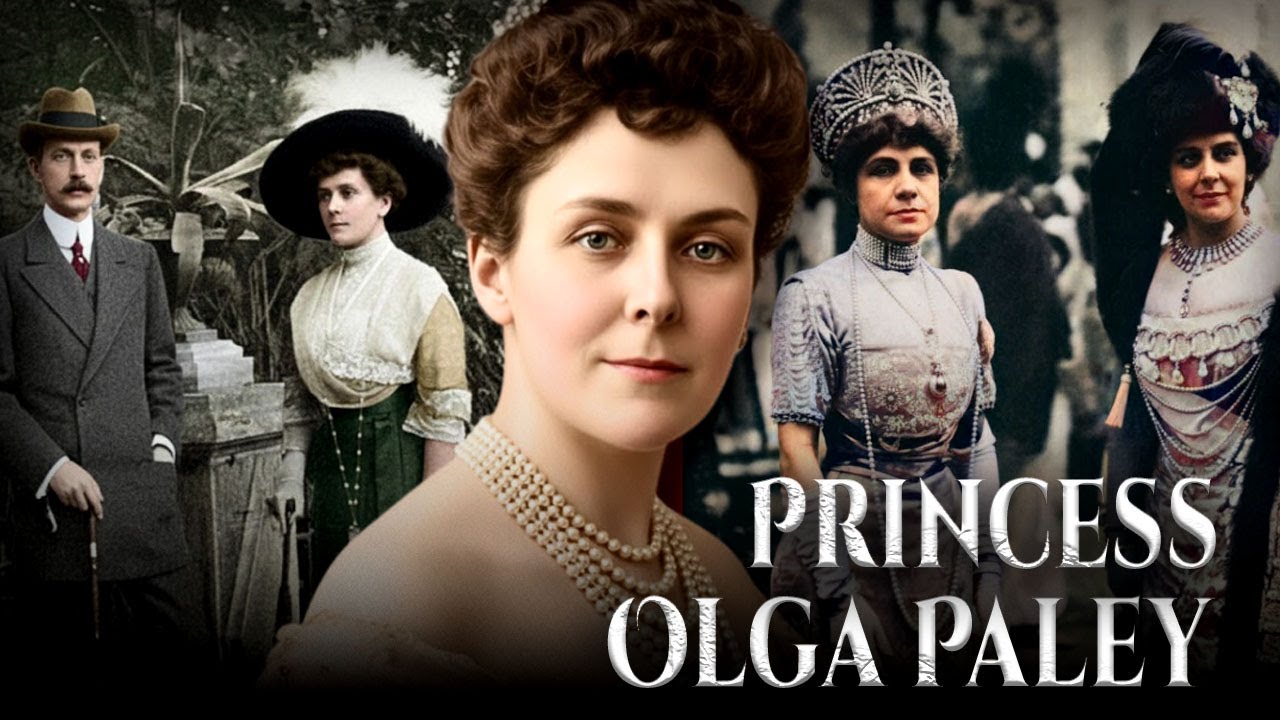
In a world that had lost its moral compass, her son had kept his. Princess Olga Paley died on November 2, 1929, at the age of sixty-four. She did not die in a palace. She died in exile, a woman without a homeland, a princess without a throne.
She was buried in a modest grave near Paris at the cemetery of Colombes, far from the palaces where her story began. Years later, when the Soviet Union fell and the archives were opened, the full scope of the tragedy she witnessed was revealed to the world. Olga had not needed archives. She had lived the tragedy herself.
What does Olga Paley’s life mean? It is easy to dismiss her as a social climber, a woman who wanted the crown and paid the price. But that is a reductive simplification. Olga Paley was the human heart of the Romanov catastrophe.
The Romanovs, for all their grandeur, often seemed like statues, distant, unknowable, frozen in their official portraits. Olga was real. She was impulsive, passionate. She struggled, screamed, loved, made mistakes.
She pulled Grand Duke Paul out of his depression and gave him the happiest years of his life. She raised a son who showed, in the face of death, more dignity than the government that murdered him. Her story is a testament to the terrible fragility of civilization. She saw how quickly the veneer of culture can peel away, how a palace can become a prison in the space of a single afternoon, how a neighbor can become an executioner, how the world will watch you drown if there is profit in it.
But more than that, she is the witness who stood outside the execution pit and refused to look away, the voice that reminds us the victims of history were not just names in a textbook. They were fathers who needed medicine, sons who wrote poetry, and beloved husbands. Today, if you go to auction houses in London or New York, you might see a piece of porcelain or a silver frame from Princess Paley’s collection. People compete to buy them, admire the craftsmanship, place them in glass cabinets.
If you hold one of those objects, close your eyes and listen, you might hear the faint echo of a woman’s voice whispering across the ice of the Gulf of Finland, whispering through the smoke of revolution, whispering the only truth that ultimately matters.